
BRUSSELS (Norway News) — The United States is moving to make its foreign investment screening process more transparent and easier to navigate, a senior U.S. Treasury official said this week, in a message with direct relevance for Norwegian investors and companies looking to expand in the American market.
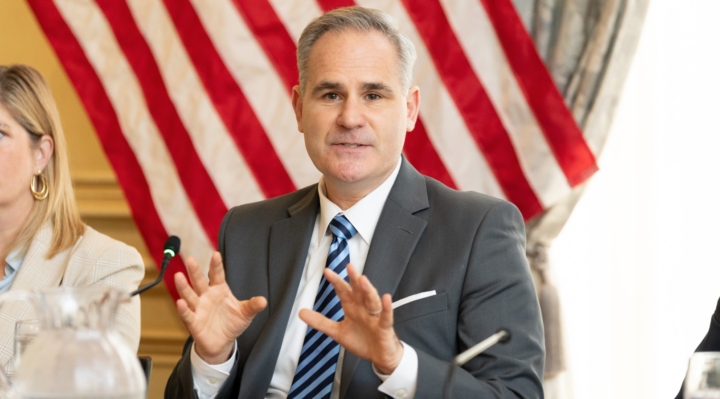
Chris Pilkerton, Assistant Secretary for Investment Security at the U.S. Treasury Department, spoke at a virtual press briefing from the State Department’s Brussels Media Hub after several days of meetings with European Union officials, member-state representatives, lawyers and industry groups.
Pilkerton leads the Committee on Foreign Investment in the United States, or CFIUS, the interagency committee that reviews certain foreign investments for national security risks. CFIUS is chaired by Treasury Secretary Scott Bessent and includes eight other federal agencies.
“The President has made it very clear that America is open for business,” Pilkerton said. “One of the things we’re doing at CFIUS is seeking to demystify certain components of the black box that CFIUS has been defined as in the past.”
Pilkerton announced several changes aimed at making the CFIUS process more predictable for foreign investors:
· A new pre-filing consultation page. Parties, lawyers or investors can submit anonymized information about a potential transaction through the CFIUS website and be assigned a case officer. This allows early discussions about risks and possible mitigation while a deal is still being negotiated.
· A “Known Investor Program.” The pilot program is aimed at frequent filers and involves deeper background checks with the intelligence and law enforcement communities. Pilkerton said it is expected to go live in early 2027.
· Greater public guidance. The CFIUS website now lists specific types of risks and mitigation measures that have been used previously, part of what Pilkerton described as a transparency effort.
“It’s good to have those conversations early on, because then it can be part of the actual transaction documents,” he said. “When folks actually come back to us with a filing, we’ve seen and are familiar with that case.”
He also noted that CFIUS maintains a compliance and enforcement division, a non-notified transaction team that looks for deals that should have been reviewed but were not, and an Investment Security Technology Initiative focused on pre-commercial technologies.
Pilkerton’s Brussels meetings included talks with U.S. Ambassador to NATO Matt Whitaker, the European Commission, EU member states, the academic and practitioner network CELIS, a group of European lawyers, and the business association BusinessEurope.
He said the United States is sharing best practices and technical assistance with allies as they develop or strengthen their own foreign direct investment screening programs.
“When you think about different countries having a robust foreign direct investment screening program, it’s important for the United States’ national security,” Pilkerton said.
Asked about trends in foreign direct investment, including from China, Pilkerton said the focus is on cutting-edge technologies such as artificial intelligence, quantum computing, semiconductors and data centers. He said European partners are seeing similar trends and that the goal is to ensure investment enters countries in a safe and secure way.
Pilkerton also discussed the U.S. outbound investment program, which for about two years has focused on artificial intelligence, quantum and semiconductors and on U.S. investment into China. The program includes both prohibitions and notification requirements.
At the end of 2025, Congress passed the COINS legislation, which expands the technology areas to include hypersonics and supercomputing and broadens some geographic scope. Draft rules are expected in the coming weeks, with a notice-and-comment process and a hoped-for launch in the spring.
For Norway, the direction of U.S. investment screening is closely watched. The Norwegian sovereign wealth fund, Norges Bank Investment Management, is one of the largest investors in U.S. markets, and Norwegian companies in sectors such as energy, technology, maritime industries and defense may encounter CFIUS when pursuing acquisitions or investments in the United States.
Pilkerton emphasized that national security remains the “north star” of CFIUS, but he also said customer service is a priority.
“We want folks to come visit us, to explain to us, to the extent they’re comfortable, their potential investment plans so we can learn more about the company by the time that they’re going to file,” he said.
He pointed to Finland as a success story. Bluefors, a Finnish quantum refrigeration company, has invested in Syracuse, New York, where it is part of a growing technology ecosystem. Pilkerton said local officials and the Syracuse Quantum Institute highlighted workforce training, including programs for people with a high school diploma to become technicians. The next day, Micron was scheduled to break ground nearby.
“Success builds upon success,” Pilkerton said, adding that he had recently met Finland’s ambassador along with several Finnish quantum companies looking to invest further in the United States.
“Commitment has never wavered”
Pilkerton closed by thanking European allies and partners for their engagement.
“The weather changes very frequently here in Brussels, but what I did see is the commitment of our European allies and partners has never wavered, and neither will ours as we move forward to protect national security, but also ensure that America is open for business,” he said. “We have that safe, secure, and open investment environment.”
