NORWAY NEWS – latest news, breaking stories and comment – NORWAY NEWS
  • Home
  • About us
  • News
  • Other News
    • Africa and Norway
    • Asia and Norway
    • Asylum
    • Breaking News
    • China and Norway
    • Corruption in Norway
    • Crimes
    • Defence
    • Diplomatic relations
    • Economics
    • Environment
    • Farming
    • Featured
    • Health
    • Killing
    • Media Freedom
    • Middle East and Norway
    • NATO and Norway
    • Nobel Peace Prize
    • Norwegian Aid
    • Norwegian American
    • Oil & Gas
    • Peace Talks
    • Politics
    • Racism in Norway
    • Religion
    • Royal House
    • Russia and Norway
    • Science
    • Sex scandal
    • Sports
    • Spy War
    • Srilanka and Norway
    • Svalbard
    • Taiwan and Norway
    • Terrorist
    • Travel
    • Video clips
  • Disclaimer
  • Contact us
NORWAY NEWS – latest news, breaking stories and comment – NORWAY NEWS
  • Home
  • About us
  • News
  • Other News
    • Africa and Norway
    • Asia and Norway
    • Asylum
    • Breaking News
    • China and Norway
    • Corruption in Norway
    • Crimes
    • Defence
    • Diplomatic relations
    • Economics
    • Environment
    • Farming
    • Featured
    • Health
    • Killing
    • Media Freedom
    • Middle East and Norway
    • NATO and Norway
    • Nobel Peace Prize
    • Norwegian Aid
    • Norwegian American
    • Oil & Gas
    • Peace Talks
    • Politics
    • Racism in Norway
    • Religion
    • Royal House
    • Russia and Norway
    • Science
    • Sex scandal
    • Sports
    • Spy War
    • Srilanka and Norway
    • Svalbard
    • Taiwan and Norway
    • Terrorist
    • Travel
    • Video clips
  • Disclaimer
  • Contact us
Saturday, October 3, 2026
NORWAY NEWS – latest news, breaking stories and comment – NORWAY NEWS
  • Home
  • About us
  • News
  • Other News
    • Africa and Norway
    • Asia and Norway
    • Asylum
    • Breaking News
    • China and Norway
    • Corruption in Norway
    • Crimes
    • Defence
    • Diplomatic relations
    • Economics
    • Environment
    • Farming
    • Featured
    • Health
    • Killing
    • Media Freedom
    • Middle East and Norway
    • NATO and Norway
    • Nobel Peace Prize
    • Norwegian Aid
    • Norwegian American
    • Oil & Gas
    • Peace Talks
    • Politics
    • Racism in Norway
    • Religion
    • Royal House
    • Russia and Norway
    • Science
    • Sex scandal
    • Sports
    • Spy War
    • Srilanka and Norway
    • Svalbard
    • Taiwan and Norway
    • Terrorist
    • Travel
    • Video clips
  • Disclaimer
  • Contact us
Copyright 2025- All Right Reserved Norway News
NATO and Norway

Belgium joins Allied effort to deliver air-to-air refueling capacity

by Nadarajah Sethurupan February 15, 2018
written by Nadarajah Sethurupan

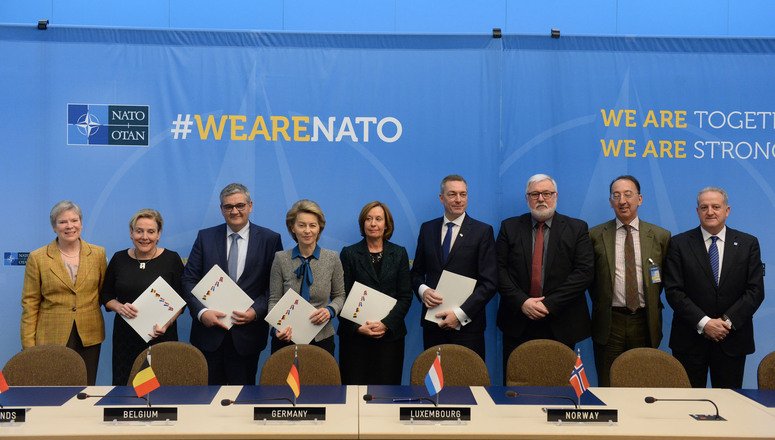
On Wednesday (14 February 2018), Belgium joined a multinational effort to acquire a European multinational fleet of Airbus multirole tanker–transport (MRTT) aircraft. At a signing ceremony at NATO Headquarters in Brussels, Defence Ministers from Belgium, Germany, Luxembourg, the Netherlands and Norway celebrated Belgium’s official accession to this effort.
The initiative has been supported by NATO and the European Union. It is an example of effective cooperation between the two organizations when delivering critical capabilities for its members.

Deputy Secretary General Rose Gottemoeller said: “Increasing our ability to keep our planes flying – for longer periods and farther distances – has a direct bearing on our ability to defend our citizens and our territories.”

The project was launched in July 2016 through an order of two Airbus A330 MRTT aircraft by the Netherlands and Luxembourg, and has expanded steadily. With Belgium joining, the multinational fleet will now grow to eight aircraft, which are scheduled for delivery between 2020 and 2024. The aircraft can be configured for air-to-air refuelling, the transport of passengers and cargo, as well as medical evacuation missions. The multinational fleet will be operated from a Main Operating Base in Eindhoven (Netherlands) and a Forward Operating Base in Cologne (Germany).

This multinational fleet arrangement will substantially increase European capacity in air-to-air refueling and reduce the over-reliance on the United States in this area. It remains open to other participants.

(N.Sethurupan, NATO)

February 15, 2018 0 comments
0 FacebookTwitterPinterestEmail
Norwegian Aid

Norway to increase support to Iraq to USD 44 million

by Nadarajah Sethurupan February 14, 2018
written by Nadarajah Sethurupan

‘Iraqi cities have been freed from the terrorist group ISIL’s control. We are now increasing our aid to the liberated areas, so that even more internally displaced people can return home safely,’ said Minister of Foreign Affairs Ine Eriksen Søreide, who is participating today in the Kuwait International Conference for the Reconstruction of Iraq.

 The conference is being organised by Iraq and Kuwait in cooperation with the World Bank. Minister of Foreign Affairs Eriksen Søreide will announce that Norway will increase its aid to Iraq for 2018 to NOK 350 million (approx. USD 44 million). Of this amount, NOK 240 million will go to measures to promote stabilisation and reduce fragility. This is an increase of 20 % from last year. NOK 110 million will be used, amongst other efforts, to provide education, improve access to water and sanitation, and put in place protection measures for internally displaced people, vulnerable local communities and Syrian refugees in Iraq.

‘We are now entering a challenging transition phase. Some 4.5 million Iraqis are currently living in areas liberated from ISIL’s rule of terror. Norway’s aim is to support Iraq’s efforts to ensure that the vulnerable civilian population has a better future, and to prevent the terrorist group ISIL from gaining a new foothold in the country. Some of the funds from Norway will be used to rebuild homes that have been destroyed, to clear mines and explosives, and to help civilians affected by sexual and gender-based violence,’ said Ms Eriksen Søreide.

Ms Eriksen Søreide also emphasised that it is crucial that Iraq carries out political and economic reforms that can help to prevent inequality and instability, and that can promote genuine political reconciliation in Iraq.

Over 2.6 million people are still internally displaced because of ISIL’s reign of terror and also because of the fight against the terrorist group. Homes and infrastructure have been destroyed, and there are still a large number of landmines and explosives in the affected areas. This is further exacerbating the situation for those who have already returned and those who are still internally displaced.

According to the UN, around 8.7 million Iraqis are in need of humanitarian assistance. Norway will continue to provide substantial amounts of humanitarian aid.

‘Important progress has been made in the fight against the terrorist group ISIL. However, Iraq will continue to need significant support in the time ahead. Many internally displaced people do not yet feel it is safe to return home. Our aim is to enable the safe and voluntary return of these people by supporting stabilisation efforts,’ said Ms Eriksen Søreide.

The Government has drawn up a framework for Norway’s engagement in conflict prevention, stabilisation and resilience building. Norway has a broad political, humanitarian and military engagement relating to the conflicts in Syria and Iraq. As a member of the global coalition against ISIL, Norway is providing both military and civilian support for stabilisation efforts in Iraq.

(Ministry of Foreign Affairs – Norway )
February 14, 2018 0 comments
0 FacebookTwitterPinterestEmail
Environment

WHO’s Alessandro Demaio Appointed CEO of EAT

by Nadarajah Sethurupan February 13, 2018
written by Nadarajah Sethurupan

OSLO, February 7th 2018 – EAT is pleased to announce the appointment of Alessandro Demaio, MD, MPH, PhD, as its new chief executive officer. Currently a Medical Officer at the World Health Organization, Demaio will assume his role in April 2018.

 “Sandro encapsulates the essence of EAT: a visionary thinker who is led by science, a relationship-builder who dares to be disruptive,” said Gunhild A. Stordalen, President and Founder of EAT. “He brings a wealth of experience to the role, from his years at the WHO, to teaching public health and co-founding NCDFREE, a global social movement against noncommunicable diseases. Sandro has been an advisor to EAT since its inception. I am confident that with his scientific knowledge, his deep understanding of our organization and his passion for our mission, he is well equipped to lead EAT on its journey to becoming the leading platform for global food systems transformation. We are delighted to have him onboard.”

 A medical doctor by training, Demaio is an expert on issues of noncommunicable diseases, public health, nutrition and health policy. He joined the Department of Nutrition for Health and Development at the World Health Organization’s global headquarters in 2015, as Medical Officer for Noncommunicable Conditions and Nutrition. Since 2017, he is also co-host of the ABC television show Ask the Doctor – an innovative and exploratory factual medical series broadcasting weekly across Australia.

 “Food is our missing silver bullet for both planetary and human health,” said Demaio. “It is at the heart of almost every culture; our common language in an increasingly fragmented world. I am thrilled to join this dynamic and fast-growing organization, with such a critical mission—providing healthy and sustainable food for all. The mission of EAT has never been more important, nor urgent.“

 Demaio trained and worked as a medical doctor at The Alfred Hospital in Australia. While practicing as a doctor he completed a Masters in Public Health, including fieldwork to prevent diabetes in Cambodia. He completed his PhD with the University of Copenhagen, focusing on noncommunicable diseases. Demaio held a Postdoctoral Fellowship at Harvard Medical School from 2013 to 2015, and was Assistant Professor and Course Director in global health at the Copenhagen School of Global Health, in Denmark. To date, he has authored over 23 scientific publications and more than 85 articles.

 His appointment follows an extensive five-month global search.

Demaio will take over from EAT’s Interim CEO Clare Matterson, who will return to EAT’s Board of Trustees. Matterson served as Vice Chair of EAT’s Board of Directors from 2014 to 2017, representing the Wellcome Trust, one of EAT’s three co-founders. Matterson starts her new position as Director of Engagement for the Natural Museum of History in London in March 2018, initially dividing her time with her commitment to EAT.

(N.Sethu)

February 13, 2018 0 comments
0 FacebookTwitterPinterestEmail
Science

High performance crew transfer vessel is based on proven military design

by Nadarajah Sethurupan February 12, 2018
written by Nadarajah Sethurupan

In the last 18 months, a number of new designs have been launched in the market for high-speed crew transfer – the latest is based on an evolved version of a hullform used on the Royal Norwegian Navy’s fast missile craft

Umoe Mandal in Norway has developed a further version of its Wavecraft Voyager family, the Voyager 38 X, a high-performance crew transfer vessels for the offshore oil and gas sector.

Based on technology originally developed and used by Umoe Mandal for military applications, the Wavecraft Voyager 38 X was designed to reduce transit time, enhance passenger comfort, safety and efficiency and reduce costs compared with existing designs.

The Royal Norwegian Navy’s Skjold-class missile craft make use of the same air-cushion catamaran/surface-effect ship technology. The same hullform was also used on the Royal Norwegian Navy’s Oksøy-class minehunters and minesweepers. As with the commercial versions of the design, the reduced wetted surface of the hullform significantly reduces wave resistance compared to a conventional hull configuration.

The Voyager 38X makes use of enhanced air-cushion catamaran/surface-effect ship technology combined with a sophisticated motion control system that compensates for vertical wave motion, offering comfortable transit and safe access to other vessels and installations offshore. The vessel can be fitted with a gangway and a SeaSpyder personnel transfer system.

The vessel is designed to transport 150 passengers and a crew of six at speeds of up to 55 knots, with excellent seakeeping, even in high sea states, good fuel efficiency and reduced emissions.

The Voyager 38 X can be delivered in accordance with the requirements of all major classification societies and complies with US Coast Guard and ABS A1 HSC Crew boat, Circle E + AMS + DPS-2 classification. Applying the latest in high-speed diesel engine and SCR technology, the Voyager 38 X meets stringent environmental standards and complies with EPA Tier 4 requirements.

In December 2017, the company announced that, as part of the MAROFF-2 programme for research, innovation and sustainability in the marine and offshore industries, Umoe Mandal had been granted funding for further development of the Wavecraft design concept for the offshore oil and gas sector.

Umoe Mandal said it would focus on optimising the concept, focusing on the most important hull parameters in order to reduce the weight of the hull and hence reduce fuel consumption and emissions. Other focus areas will include enhanced propulsion solutions and fire safety. The company said it planned to use a number of different techniques, including simulation, model testing, computational fluid dynamics and finite element modelling.

The overall objective of the project is to further develop the surface-effect ship and air-cushion catamaran technology used in the Wavecraft in order to develop a more competitive vessel with regard to construction and operating costs.

Umoe Mandal partnered with the Research Council of Norway on an earlier MAROFF project developing the Wavecraft concept for use as a high-speed crew transfer vessel for the renewable energy industry. The MAROFF programme aims to support and provide funding for Norwegian companies and research institutions.

Earlier in 2017, Umoe Mandal developed other versions of the Wavecraft, including the Voyager 32 and Voyager 38W2W (in which W2W stands for walk-to-work) for the offshore oil and gas sector.

The company has also incorporated class 2 dynamic positioning into its designs. This optional feature is intended to meet customer and regulatory requirements whilst improving the safety of crew transfer to/from rigs and other offshore installations. As the company also noted, DP2 will also provide Wavecraft vessels with greater operational freedom in congested environments, such as in offshore windfarms or where other vessels and installations may be present.

(N.Sethu, osjonline)

February 12, 2018 0 comments
0 FacebookTwitterPinterestEmail
Asia and Norway

Norwegian national still in prison

by Nadarajah Sethurupan February 12, 2018
written by Nadarajah Sethurupan

Seven of the 10 foreigners arrested on pornography charges after a pool party in the Cambodian tourist town of Siem Reap have been deported, a court official said on Monday.

Police accused the group of “singing and dancing pornographically” after their arrest two weeks ago at a party in a private villa in Siem Reap, the launchpad for visitors heading to Cambodia’s famed Angkor Wat temples.

A Siem Reap court charged them with producing pornographic pictures and materials and a prosecutor said party organisers circulated obscene images online to promote the bash.

The group of Five Britons, two Canadians, a Norwegian, a New Zealander and a Dutch national faced up to a year in prison but their lawyer sought and received bail for seven of them on grounds that they had not organised the party.

Court spokesman Yin Srang said on Monday that the court “deported them from the country” as part of the bail decision, although the charges against them have not been formally dropped.

“They have left Cambodia. We gave them back their passports,” he said.

Their lawyer Ouch Sopheaktra confirmed that the seven had left the country and said he had no plan to ask for bail for the remaining three, a British, Dutch and Norwegian national.

All 10 defendants denied the allegations, saying only that they were wearing “sexy” clothing but were not nude and had not produced pornography.

Authorities have yet to announce a date for the trial.

Cambodia is a largely Buddhist country and the temples of Angkor Wat are considered sacred, leading to arrests of foreigners for taking racy photos at the ruins and a ban on wearing skimpy clothing there in 2016.

But the gateway town of Siem Reap where the party took place has a lively nightlife and many bars and restaurants.

(theguardian)

February 12, 2018 0 comments
0 FacebookTwitterPinterestEmail
Politics

Steep rise in visa charge for international students

by Nadarajah Sethurupan February 11, 2018
written by Nadarajah Sethurupan

A sharp increase in the visa application charge for international students, plus a significant increase in the minimum amount that international students must deposit in the country before beginning their studies in Norway, have drawn criticism from student groups and political opponents.

The changes were introduced in January. Since the start of 2018, handling charges for visa applications for international students to Norway have been raised from NOK3,200 (US$414) to NOK5,300 (US$685), a jump of 65%, the web-based newsletter, Khrono of Oslo Metropolitan University, reported.

This is far higher than similar charges in neighbouring countries Sweden (US$126), Denmark (US$350) and Finland (US$371).

The Norwegian government – which is now a three-party coalition comprising the Progress Party (an anti-immigration party), the Conservative Party and the Liberal Party – in January also increased the minimum sum that international students will have to prove they have deposited for studying in Norway from NOK103,900 (US$13,400) to NOK111,657 (US$14,400) per year.

But the leader of the International Students’ Union of Norway (ISU), Eric Kimathi, said the rise in visa charges is “unjust”, was made without warning, and is “hitting international students hard”. “Most international students are funding their studies themselves and can work only 20 hours per week,” he said.

In a statement, ISU said these increases would “continue to marginalise international students, adding further concerns about their future in the country, while at the same time impeding prospective students from applying in future years”.

Daylight robbery

An opposition member of the parliamentary higher education committee, Nina Sandberg, a Labour MP, said the visa increase was “daylight robbery”. She accused the government of talking up internationalisation while in practice “weakening student mobility and hence the quality of higher education”.

Sandberg alleged that the increased fee for visa applications was a way of “introducing tuition fees through the back door”. She said fewer students from abroad were getting the chance to study in Norway and now the chances had been weakened further for those with fewer resources.

Jone Trovåg, international officer for the National Union of Students in Norway (NSO), suggested to University World Newsthat the government was trying to find another way to “claw back money from international students” after previously pushing for but failing to secure the introduction of tuition fees.

Sandberg told University World News that the number of students from outside the European Economic Area, and particularly the number from developing countries, has decreased significantly since the quota scheme for students from developing countries was closed in 2015.

“[The inflow of] African students and students from poor countries has almost dried up,” she said.

That programme had accepted 1,100 students a year, 800 of them from Africa, Asia and Latin America, but it was closed to switch resources, with 60% going into institutions with partnerships with institutions in the South and 40% into two-way institutional collaborations and research collaborations with BRICS countries – Brazil, Russia, India, China and South Africa – and Japan.

Mari Sundli Tveit, professor and rector of the Norwegian University of Life Sciences and chair of the Norwegian Association of Higher Education Institutions, said that given that an international student community is of great value to Norwegian higher education, and internationalisation and student mobility are important components of quality of education, “it is important to avoid obstacles to international student mobility, and the increase in the handling charge for visa applications can constitute a severe hindrance to attracting international students”.

(universityworldnews)

February 11, 2018 0 comments
0 FacebookTwitterPinterestEmail
Racism in Norway

Protests mount against Norwegian Child Welfare Service

by Nadarajah Sethurupan February 10, 2018
written by Nadarajah Sethurupan

Researchers are working to understand why Norway’s child protective services sometimes resort to the dramatic step of taking a child from its mother right after birth.


Several thousand activists have been demonstrating against the Norwegian Child Welfare Service (Barnevernet), both in Norway and worldwide.

The European Court of Human Rights (ECHR) now has a number of Norwegian child welfare cases on the docket waiting to be heard.

And in 2016, Czech President Miloš Zeman went so far as to compare Barnevernet with Nazi Germany.

Norway’s child welfare system and its fundamental values are under fierce attack.

Important to know more

Marit Skivenes, a professor at the University of Bergen (UiB), says that may not be so surprising. The Barnevernet interventions have been huge. Going in and removing a child has big consequences.

She believes it’s important to know more about what lies behind these dramatic actions.

Ida Juhasz recently embarked upon a doctorate to review all Norwegian care order decisions from 2012 through 2016. She is one of the UiB researchers delving into actual care order protection cases to see how the child welfare authorities justified them.

The data focuses on interim care order decisions for newborns who were still in hospital and hadn’t yet moved home with their parents.

A quarter of parents agreed

Juhasz initially examined 58 cases from 2015 and 2016. She recently shared her preliminary results with a seminar audience in Oslo, under the auspices of the Research Council of Norway.

A care order decision was taken in 91 per cent of these cases. The County Social Welfare Board acts as a tribunal and makes the determination in such cases.

The average age of the children was 3.5 months old when care orders were granted.

In 27 per cent of the cases, parents agreed to placing the child in foster care.

Mental health given as main reason

Juhasz started by looking at the mothers’ backgrounds and found several reasons for children’s removal.

The cases are often complex, she says, but one issue surfaced more prominently than the others.

“In 71 per cent of the cases, concern about the mother’s mental health was the main reason for granting a care order where one or more diagnoses were established,” she says.

Drug abuse turned out to be less of a reason for children being in care than Juhasz imagined. In 73 percent of the cases, the mother’s drug issue was not the main problem.

In half of the cases, children were born healthy and had no visible signs of being exposed to substance abuse in utero.

Juhasz will also look into fathers’ backgrounds later in her research.

Cognitive limitations

In 40 per cent of the cases, the mother’s cognitive limitations posed the greatest concern for child welfare workers.

“Reports state that the mother’s skill level is well below normal functioning,” says Juhasz. The limitations may involve extensive learning difficulties or mild to moderate developmental disabilities.

Often history with child welfare service runs deep

The researcher has also considered parents’ previous history with Barnevernet.

In 55 per cent of the cases, parents had previously lost care of a child. The mother also had her own child welfare background in 47 per cent of the cases, having received either support services or placement in a child welfare institution.

Strasbourg emphasizing children’s rights

The European Court of Human Rights has taken up nine Norwegian child welfare cases. Just before Christmas the ECHR delivered its first judgment.

Skivenes recently received a European scholarship to investigate the quality of the assessment done when Barnevernet removes children from their parents.

She has studied the judgment and sees a new pattern emerging in the Strasbourg court cases.

“Human rights have generally only addressed adults. Now more emphasis is being placed on children’s rights and the UN Convention on the Rights of the Child,” she says.

The recent ECHR judgment is an example of this shift, she believes.

Vulnerable mother

A mother had her newborn taken from her in 2008. The boy is now nine years old and has lived with his adoptive family since he was three weeks old.

Skivenes says that the birthmother contacted Barnevernet when she was six months pregnant. When the boy was born, mother and child moved into a parent-child institution.

“The mother was vulnerable and needed care. She took little notice of her baby or of his need for food and care. After three weeks she wanted to move from the family centre with her child. Child welfare authorities believed this would put the baby at risk and placed him in a foster home.

Roots severed or safety secured?

The birthmother sent a complaint to the EHRC in 2013 after she had appealed the adoption to the District Court.

Norway prevailed in the EHRC suit.

But the verdict was not without dissent, says Skivenes.

“A minority of the judges argued that the adoption was a violation of human rights. They believed that the adoption would sever the child’s biological roots and that this was not in the child’s best interest,” she says.

According to Skivenes, this argument is based on the adults’ perspective. The rights and interests of the child aren’t mentioned.

This view is in stark contrast to how the majority of the judges argued in the case.

The foster parents are the child’s actual and psychological parents, these judges argue. They believe that the boy has an independent interest in not changing his family situation. He is vulnerable and needs security and predictability. An adoption would strengthen his ties to his foster parents and give him increased security.

“We’re seeing that the court is considering the child’s perspective more in these cases. It’s a good development,” believes Skivenes.

————————————-

Read the Norwegian version of this article at forskning.no.

February 10, 2018 0 comments
0 FacebookTwitterPinterestEmail
Norwegian Aid

Norway pledges NOK two billion to the Global Partnership for Education

by Nadarajah Sethurupan February 10, 2018
written by Nadarajah Sethurupan

‘Norway is one of the largest donors to the Global Partnership for Education and we urge other donors to increase their support. Together we will continue our efforts to ensure that all children and young people have access to education, especially girls who are still being excluded,’ said Minister of International Development Nikolai Astrup.

The Minister of International Development will announce Norway’s contribution for the period 2018–2020 at the Financing Conference of the Global Partnership for Education (GPE) that takes place in Dakar, Senegal, today. Over the next three years, Norway will provide a total of NOK 2.07 billion, an increase of NOK 600 million compared to our contribution for the period 2015-2017. The Norwegian pledge will contribute to provide training for 1.7 million more teachers and to enable an additional 19 million children to complete primary education.

‘Education is of crucial importance for combating poverty and fostering social development. Some 264 million children and young people are out of school. In addition, there are many places where the quality of education is so poor that children do not even learn basic skills such as numeracy and literacy. This has major consequences in social, economic and security terms, both for the countries that are lagging behind and for the rest of the international community,’ said Mr Astrup.

The GPE is a partnership of donors, developing country partners, international organisations, civil society organisations, the private sector and philanthropic foundations. Its main objective is to support countries’ own plans for education, especially primary education.

Support provided during the previous funding period, when Norway was the third-largest donor, has produced good results. In 2015, the number of children enrolled in primary schools in the GPE’s developing country partners was 75 million higher than in 2002. Niger has used GPE funding to improve the quality of education by introducing mother tongue instruction, developing a new curriculum, improving the learning environment and recruiting trained teachers. As a result of these reforms, 78 % of children are now completing primary education, compared with only 51 % a few years ago.

‘Norway’s support for the GPE in the years ahead will focus on girls’ education, the inclusion of children with disabilities, teacher effectiveness and learning outcomes, and how work in the school sector at country level can be made more effective,’ said Mr Astrup.

Norway is at the forefront of international efforts to promote global education. More information is available here.

(Ministry of Foreign Affairs)
February 10, 2018 0 comments
0 FacebookTwitterPinterestEmail
Environment

New Map Reveals Which Countries are Most Likely to Survive Climate Change

by Nadarajah Sethurupan February 9, 2018
written by Nadarajah Sethurupan

Climate change is real, and it’s happening. But will you survive it?

Melting ice caps, record high temperatures and rising sea levels are just some of the telltale signs.

Climate change is one of the most pressing crises facing humanity. Caused by an immense and continual buildup of carbon dioxide and other greenhouse gases in our atmosphere as a result of human activity, climate change is already causing a series of alarming environmental events.

Once snowy landscapes are slowly melting away to leave an uninhabitable and baron wilderness, rising sea temperatures are killing thousands of miles of coral reef and marine life, while freak weather events are becoming more common and costing affected nations billions of pounds. For example, early estimates suggest that 2017’s hurricane Harvey caused between £48 billion and £134 billion worth of damage.

These serve as a worrying indication of the catastrophic effect that climate change could have on our planet in the future if nothing is done to tackle the phenomenon.

Whilst it’s clear that no single corner of the globe is safe from the changes that are happening to our climate, we wanted to find out which countries are the most (and least) at risk of the effects of climate change.

To answer this question, we looked at data from the University of Notre-Dame’s ND-Gain Index. This report analysed 181 countries on their vulnerability to climate change and how ready they are to adapt to a warming planet, based on factors such as healthcare, food supply and government stability.

We also scrutinized how much carbon dioxide all 181 countries emit every year to give an indication of each nation’s contribution towards climate change. This allowed us to compare a country’s likeliness to survive changes to the global climate against their responsibility for the phenomenon.

So which country is the most likely to survive climate change?

The answer is Norway, thanks to its low vulnerability score and high readiness score. The nation’s Nordic neighbours also fared well, with Finland (3rd), Sweden (4th), Denmark (6th) and Iceland (8th) landing 5 out of the 10 top spots for survivability. So we should all flee to the countries of northern Europe and the north Atlantic to live out our final days should our planet become uninhabitable.

Interestingly the UK and US did not make the top 10, ranking 12th and 15th respectively. Both these nations were named amongst the 10 countries most likely to survive climate change in our 2015 version of this map, but an overall worsening of their vulnerability and readiness scores led to this slip in rank.

Even more surprising is China’s position in the ranking – 59th. Despite arguably being the world’s biggest contributor towards climate change – emitting a massive 9,040 metric tons of CO₂ into the atmosphere every year – the country is somewhat sensitive to the effects of a warming planet. This is largely due to the nation’s growing population which is putting a strain on China’s natural resources and public services. Rather ironically, China’s vulnerability to climate change therefore means that they may eventually reap what they sow.

And who are the biggest losers?

At the other end of the scale, it comes as no surprise that the world’s poorest and least developed nations have the lowest chance of surviving climate change. Countries in sub-Saharan Africa fill the bottom 10 spaces for survivability, with Somalia being named the country least likely to survive climate change.

Chad, Eritrea, the Central African Republic and the Democratic Republic of Congo also fared badly, owing to their unstable governance, poor infrastructure, lack of healthcare and a scarcity of food and water.

These findings serve as a stark reminder of the need for wealthier, more established countries to support the world’s most vulnerable nations. This is particularly true given that many of the world’s richest economies contribute the most to climate change but are in fact the least likely to be affected by it, whilst impoverished countries who hold little responsibility for the phenomenon are left suffering the most. To put this into perspective, Eritrea emits just 0.01% of the total carbon dioxide that the US does each year – a mere 0.6 metric tons of CO₂ compared to 4,997 tons of the greenhouse gas.

Whilst it’s true that climate change will impact the entire global community in some way, this map clearly shows which countries are likely to be the most (and least) affected. The pressure is now mounting for global leaders to come up with an effective solution to stop climate change before it is too late and nations begin to succumb to the disastrous consequences of a warming world.

(N.Sethu)

February 9, 2018 0 comments
0 FacebookTwitterPinterestEmail
Crimes

Norway’s government backs cyber defence mobilisation

by Nadarajah Sethurupan February 8, 2018
written by Nadarajah Sethurupan

Norway has accelerated plans to scale up its national security infrastructure against threats emanating from the cyber domain.


Norway has accelerated plans to scale up its national security infrastructure against threats emanating from the cyber domain.

Recent intelligence reports more than suggest that Norway’s critical IT infrastructure will likely face a higher level of targeting in the shape of malicious cyber attacks launched by hostile foreign governments and cyber crime actors.

To counter this ever-present risk, conservative prime minister Erna Solberg has mobilised the country’s national security infrastructure, including the Norwegian Defence Force’s (NDF) specialist cyber defence unit (CDU), under an umbrella-style partnership that includes strategic input from private sector ICT suppliers.

The government’s heightened interest in waging war against cyber threats became clear in January 2018, when it contracted state telecom Telenor to advise departments on best practice in the implementation of effective cyber defence strategies. The emphasis is on using advanced technologies and security measures to protect critical ICT systems.

The evolving public-private sector alliance is taking place against a backdrop of rising cyber attacks against state-run infrastructure, including the public transport company NSB, military sites and hospitals.

The partnership, which will link to a new government policy initiative to reinforce ICT security on a national level, is timely. It comes in the wake of a serious cyber attack launched in January against Helse Sør-Øst, Norway’s largest regional healthcare provider.

The preliminary results of an investigation by the national security agency PST (Politiets Sikkerhetstjeneste) indicated the attack was the work of an international cyber crime group operating on behalf of an unidentified “foreign state”. The “attackers” penetrated the outer wall of the HSO’s security shield but failed to gain access to the targeted patient data system. This system contained over two million separate patient and medical files.

An identical outer wall system “breach” was recorded at Oslo University Hospital (Oslo Universitetssykehus), Norway’s biggest medical facility, which operates as part of the HSO organisation.

“Unfortunately, this type of cyber threat is becoming more prevalent. Patient security wasn’t affected, but all malicious hacking events like this are serious. This is why the government wants to do much more to prevent such attacks and better defend Norway’s critical IT systems against all hostile actors,” said Justice Minister Sylvi Listhaug.

The PST was alerted to the cyber attack against the HSO by Sykehuspartner, the healthcare organisation’s IT security partner. The PST described the attack as “quite advanced and professional”, adding that it is cooperating with all critical service providers in Norway to ensure that their ICT systems are capable of withstanding sustained attacks from cyber space.

“The suspicion we have is that someone, on behalf of a foreign state, is gathering information. If the client state can be revealed, this is a source of fundamental damage to our national interests and a threat against state infrastructure,” said Line Nyvoll Nygaard, a prosecuting attorney at the PST.

The Norwegian government’s partnering with Telenor represents both a logical and strategic component in its cyber defence capacity building mobilisation project. Around 80% of all domestic data traffic is carried on Telenor-owned networks.

In a connected state-funded programme, Telenor will deepen its cyber defence competence exchange collaboration with the NDF, delivering a range of tools and solutions to the CDU.

Significantly, the cooperation agreement reached between the NDF and Telenor covers the development of enhanced digital-based security tools to protect significant military events, such as joint NDF-NATO exercises, against the prying digital eyes and ears of “foreign agencies”.

Disruptive interference

Not only is the NDF concerned about cyber space surveillance of its activities, the organisation is increasingly on high alert against the potential for cyber-warfare-type “strikes”, and “disruptive interference” against the battlefield management command ICT-systems used to coordinate and direct large-scale military manoeuvres.

Closer cooperation in the cyber defence domain with Telenor will ensure important resources are available at the times they are required, said Major General Inge Kampenes, head of the NDF-CDU.

Telenor’s national role in Norway’s Total Defence System, which combines military and civil emergency preparedness, was elevated in 2017 as part of the government’s increased capital investment into high-priority cyber security projects.

“We will examine vulnerabilities and potential risks, and work together to develop expertise and exchange information about incident threats. We will analyse methods of attack and different malware in the cyber domain,” said Kampenes.

The collaboration between the NDF and Telenor is heavily weighted towards strengthening the military organisation’s crisis management expertise. Cooperation also aims to enhance the NDF’s ability to both protect and safeguard the operation of critical infrastructure as it relates to national security and emergency preparedness.

“Alongside the growth of increased digital dependency and vulnerability, it is natural we focus more on national emergency preparedness and our ability to react,” said Kampenes.

Cyber security tools

Telenor, in collaboration with the NDF-CDU, plans to roll out advanced cyber security tools ahead of NATO’s upcoming Trident Juncture 2018 exercises.

Hosted by Norway, the multi-branch Trident Juncture exercise will run during October and November of 2018. It will involve the deployment of up to 50,000 troops, and become NATO’s biggest military training operation since the fall of the Berlin Wall and the end of the Cold War era.

“We must be prepared for added security challenges. An exercise of this scale will attract a lot of international attention. We expect a greater load on our network,” said Berit Svendsen, head of Telenor Norge.

Propelled by the lure of mutual advantage, Norway’s leading business and industry chiefs are displaying a keen desire to join state-led cyber security projects. The primary driving force behind this mood of positive cooperation is powered by the universally accepted consensus, within the private sector, that the selective sharing of resources and professional expertise offers the best means to combat future threats from cyber space.

A survey conducted by BDO Norway, released in January, found cyber threats against ICT systems surpassed the risk of an economic downturn or financial crisis as the single biggest fear among 1,500 of the country’s top business and industry leaders.

Some 25% of senior Norwegian executives, in the BDO survey, conceded their companies were not adequately prepared or equipped to defend their computer systems and networks against professional and sustained malicious attacks from cyber space.

“Companies in Norway still have a long way to go in building organisations that can manage IT and cyber risks in the same way as other business risks,” said Chris Culina, head of BDO Norway’s operational IT security services department. “It’s a strange observation to make. It’s comparable to worrying about burning but failing to install smoke detectors.”

(computerweekly)

February 8, 2018 0 comments
0 FacebookTwitterPinterestEmail
Defence

Norway runs into fresh problem with NH90 helicopters

by Nadarajah Sethurupan February 8, 2018
written by Nadarajah Sethurupan

Norway has concluded that its on-order fleet of NH Industries NH90 naval helicopters will not deliver sufficient flight hours to perform the roles originally intended for the 11t-class rotorcraft and recommends that all are converted to the anti-submarine warfare mission.

To be operated by the Royal Norwegian Air Force, 14 NH90s were selected in 2001: six to undertake frigate-based ASW operations and eight for the search and rescue and fisheries and border protection role for the coastguard.

Oslo says that to meet the requirements for both the navy and coastguard, it needs 5,400 flight hours a year from the entire fleet. But an analysis performed by the armed forces suggests that availability is only 2,100h a year.

“The analysis shows that the NH90 will not be able to meet the need for both frigate and coastguard,” it says.

Instead, the report, compiled by Norway’s defence research institute, recommends that all 14 helicopters – seven have been delivered so far – are dedicated to the ASW effort.

“We are now in a situation where we have to reassess how we get the most out of this investment. My recommendation is to prioritise the NH90 for frigate,” says Adm Haakon Bruun-Hanssen, head of the Norwegian armed forces.

“This is because the helicopter is a weapon platform that is crucial to the frigates’ ability to detect and fight submarines.”

While the ASW mission cannot be performed by another platform, he notes, the coastguard’s requirements could be met by civilian operators or unmanned systems.

Norway’s defence ministry says it will consider the report’s recommendations before making a final decision.

The analysis did not consider the acquisition of alternative helicopters, or the termination of Oslo’s contract with the NHI consortium.

NHI recently delivered Norway’s first NH90 in the final operating configuration standard. It will hand over four more helicopters this year, with the remainder following in 2019.

(flightglobal, N.Sethu)

February 8, 2018 0 comments
0 FacebookTwitterPinterestEmail
Corruption in Norway

EU, Norway Sign VAT Fraud Prevention Deal

by Nadarajah Sethurupan February 7, 2018
written by Nadarajah Sethurupan

The EU and Norway have signed a new agreement on administrative cooperation on VAT compliance.

The agreement was signed on February 6. It will provide EU member states and Norway with a legal framework for administrative cooperation in the prevention of VAT fraud and for mutual assistance in the recovery of VAT claims.

Norway is the first country with which the EU has signed an agreement in this area. Norway is a member of the European Economic Area and has a similar VAT system to the EU.

(Tax-news)

February 7, 2018 0 comments
0 FacebookTwitterPinterestEmail
Srilanka and Norway

Sri Lanka National Day Celebration in Oslo 2018

by Nadarajah Sethurupan February 7, 2018
written by Nadarajah Sethurupan

The Embassy of Sri Lanka held a Flag Hoisting Ceremony to celebrate the Sri Lanka National Day on 4th February 2018 at the Chancery in Oslo. Ambassador Jayantha Palipane read the National Day Message of President Maithripala Sirisena. Religious observances were conducted by Ven. Unapane Pemananda Thero, Sri Nitheyananthasarma Naneetheiyer Kurukkal, Mr. M. Anees Rauf and Mr. Subaraj Anandaraja.

Sri Lanka Nationals and expatriates from all the ethnic communities participated at the Ceremony. The Ambassador hosted the participants to lunch after the conclusion of the Official Ceremony.

(N.Sethu, Srilanka.no)

February 7, 2018 0 comments
0 FacebookTwitterPinterestEmail
Defence

Norway lawmakers warn of ‘slippage’ from NATO

by Nadarajah Sethurupan February 7, 2018
written by Nadarajah Sethurupan

Norway’s newly formed Conservative-led government is under pressure from opposition leaders to raise defense spending to 2 percent of gross domestic product by 2024.

Opposition leaders fear the lack of an ambitious capital investment plan for Norway’s military organization will lead to spending on defense falling from 1.5 percent of GDP in 2018 to 1.5 percent by 2020.

Norway’s spend on defense is estimated to have corresponded to 1.59 percent of GDP in 2017. Latest indicators suggest that the 1.5 percent ratio might continue until 2024.

A fall in the defense spending-to-GDP ratio is certain to unnerve NATO and the United States, said Anniken Huitfeldt, a lawmaker and the Labor Party’s leader on the parliamentary Foreign Affairs and Defence Committee.

During talks with NATO and more recently the White House, Norway signaled its intent to increase spending and meet the 2 percent level sought by NATO, according to Huitfeldt. The Western alliance wants member nations to reach the 2 percent level by 2024.

“It would be very unfortunate if defense spending declined to 1.5 percent. It’s already surprising that we are looking at a slippage in our GDP spend on defense. We have been actively looking to draw closer to NATO’s 2 percent target. We now appear to be moving away from that,” Huitfeld said.

The Norwegian government must provide a “convincing explanation” for the decline in GDP spending, said Huitfeld.

Prime Minister Erna Solberg’s administration has manifested little desire to substantially increase spending on defense, amid fears that the present coalition government, formed in the wake of mid-January elections, lacks durability and may not serve its full four-year term.

The ruling Conservative administration includes the populist Progress Party and the center-right wing Liberals. Despite the three-party coalition, Solberg rules over a minority government dependent on the support of opposition parties in order to move legislation through parliament.

Defence minister Frank Bakke-Jensen has informed opposition leaders that the future level of spending on defense will be tied to economic developments, including the performance of the domestic economy and Norway’s export earnings.

Other contributing factors, according to Bakke-Jensen, include “decisions ratified by parliament and the fulfillment of current long-term plans, potential new resolutions in individual budgetary years, and other aspects in relation to the implementation of ratified plans.”

The predicted decline in the defense spending goal shadows a series of high-profile spending programs, including the purchase of F-35 fighters, which are intended to shore up Norway’s High North defenses against the backdrop of a military buildup by Russia in the region.

Opposition leaders are critical of “bad planning” and delays in providing the Norwegian Armed Forces with an advanced long-range air-defense system.

The military’s procurement of a long-range air-defense system is still at the planning stage. The eventual system is not expected to be delivered and operational until 2025.

By contrast, Russia has an existing long-range conventional precision weapons capability to hit potential military, state and industrial land and offshore targets across Norway. This threat could come from Russia’s own territory or be delivered from aircraft or naval ships.

The Norwegian Armed Forces must urgently acquire advanced long-range weapons to counter Russia’s capacity to launch precision strikes against Norway, said the military’s former defense chief, Gen. Sverre Diesen.

“We also need to have long-range weapons capable of responding with counter-strikes against Russian targets. We are just only now evaluating the degree of threat posed by Russia’s new weapons systems and the consequences this has for our Armed Forces and defense,” Diesen said.

(defensenews)

February 7, 2018 0 comments
0 FacebookTwitterPinterestEmail
NATO and Norway

NATO Secretary General visits Norway

by Nadarajah Sethurupan February 7, 2018
written by Nadarajah Sethurupan

NATO Secretary General Jens Stoltenberg meets with the Prime Minister of Norway, Erna Solberg

NATO Secretary General Jens Stoltenberg visited Oslo on Monday (5 February 2018) to have talks with Prime Minister Erna Solberg, Foreign Minister Ine Eriksen Søreide, and the Minister of Defence Frank Bakke-Jensen.

They discussed preparations for the Summit of Allied leaders in Brussels this July, the security situation in the High North, and Trident Juncture 2018, NATO’s biggest exercise this year which will take place in Norway.

The Secretary General also took part in the Norwegian Atlantic Committee Annual Leangkollen Security Conference, delivering a speech on “NATO in a Challenging Security Environment”.  This was followed by a question and answer session.

Mr. Stoltenberg also visited the parliament, and had an audience with His Majesty King Harald V of Norway.

(N.Sethurupan , NATO)

February 7, 2018 0 comments
0 FacebookTwitterPinterestEmail
Spy War

Russian Court Extends Detention Of Norwegian Spying Suspect

by Nadarajah Sethurupan February 6, 2018
written by Nadarajah Sethurupan

FOTO: THOMAS NILSEN, THE BARENTS OBSERVER to VG

A Russian court has extended the detention of a Norwegian man suspected of spying after he allegedly received classified documents from a Russian man who is also under arrest.

The Lefortovo District Court in Moscow on February 2 ordered that Frode Berg should remain in jail until May 5.

Berg, 62, was allegedly caught receiving classified material about the Russian Navy that he is accused of planning to hand over to Norwegian and U.S. intelligence agencies.

He has denied the charges.

“We still do not know if Berg fell into a trap, or if, without knowing it, actually became involved in a real intelligence operation,” Ilya Novikov, Berg’s lawyer in Moscow, was quoted by the Norwegian newspaper Aftenposten as saying.

Norwegian media have reported that Berg is a former border inspector and that the Norwegian Foreign Ministry has been working to provide him with assistance.

Some reports have suggested his arrest could be linked to what they said was his opposition to the construction of a fence along a small part of Norway’s short border with Russia.

Norway built the 200-meter fence in 2016 after thousands of asylum seekers, many of them from Syria, crossed from Russia into Norway at the border post.

The reports come eight days after a Moscow court convicted an Estonian businessman of espionage and sentenced him to 12 years in prison.

Russia has imprisoned several people from neighboring countries including Estonia, Lithuania, and Ukraine on espionage charges, with tension rising over Moscow’s seizure of Crimea in 2014 and involvement in a war against Kyiv’s forces in eastern Ukraine.

Kremlin critics say Russia uses spy claims as a tool in geopolitcal competition.

Russian courts usually hold espionage trials behind closed doors, citing what they say is the need to protect classified information and state secrets.

(With reporting by RFERL, Dagens Naeringsliv, AP, and TASS)
February 6, 2018 0 comments
0 FacebookTwitterPinterestEmail
Crimes

Norwegian woman loses her licence after driving with THIS frozen windscreen

by Nadarajah Sethurupan February 5, 2018
written by Nadarajah Sethurupan

A Norwegian woman has had her licence taken away from her after police stopped her while driving with an almost completely iced up front windscreen.

Police in the northern city of Tromso, which is inside the Arctic Circle, tweeted a picture of the woman’s opaque front window as a warning to other motorists.

‘In this case the patrol assessed the [offence] as so serious that it was cause for confiscation of her driving licence. It was a danger to traffic,’ operation leader Karl Erik Tomassen of Tromso Police District told Nordlys.

Police confirmed via a Twitter post that the woman’s licence had been confiscated and encouraged other drivers to ‘scrape windscreens sufficiently’.

The unnamed women, who is in her twenties, was the third driver in five days to be stopped for having an iced up windscreen

According Nordlys, Tromso police traffic coordinator Jan-Ove Fossli said several options are available to police when motorists fail to ensure their windows are cleared.

‘There is no blueprint for what the limit is. It is the patrol on the scene which makes the decision, since it is they who observe vehicles in traffic,’ he explained.

‘The patrol can instruct [drivers] to scrape their windows verbally or issue a fine of 2600 kroner (£237).

‘The final response could be a report and driving licence confiscation. We have seen examples where a hole has been scraped in the middle of the windscreen.’

(dailymail)

February 5, 2018 0 comments
0 FacebookTwitterPinterestEmail
Sex scandal

MeToo hits Norway’s woman-dominated politics

by Nadarajah Sethurupan February 4, 2018
written by Nadarajah Sethurupan

Norway’s political parties are scrambling to deal with a flurry of sexual harassment allegations in a country better known for a strong record of gender equality in the public and corporate spheres.

A series of high-profile cases, spurred by the global #MeToo movement, have led to apologies and resignations from top male politicians, throwing Norway’s political class into disarray just as a new women-led coalition takes power.

“It’s a very necessary clean up,” said Mathilde Tybring-Gjedde, a 25-year-old member of parliament for Norway’s Conservative Party. “We need to start by making all these stories known to the political parties … in order to shift to a wider cultural change.”

The first man to fall was Trond Giske, who until early January was the deputy leader of Norway’s main opposition Labor Party.

Giske, 51, had held several ministerial posts throughout his decades-long political career and was forced to step down after a wave of allegations of inappropriate behavior with young women dating back years. On Friday, he sent a letter to the party giving his version of events.

From the Conservative ranks, Kristian Tonning Riise, a newly elected MP aged 29, resigned as leader of the party’s youth wing over reports of inappropriate behavior with younger women, including sexual harassment complaints, often linked to alcohol.

The Conservatives are part of a three-party ruling coalition also involving the Progress Party and the Liberal Party — all of which are led by women.

MP Ulf Leirstein, 44, from the Progress Party, resigned as legal affairs spokesman for his group after reports that he had sent pornographic images to boys, one as young as 14, several years ago.

Most of the complaints were anonymous but the people accused were quick to publicly apologize and step down, while not necessarily admitting having done anything illegal. They all stayed on as MPs, partly because the constitution makes it almost impossible for lawmakers to give up their seat before their term expires.

Not as equal as we thought

The scandals have come as something of a shock to a country that prides itself on being a modern pioneer in gender equality.

Norway had its first woman prime minister in 1981 — Gro Harlem Brundtland — and today has women in the three most powerful Cabinet posts — prime minister, foreign minister and finance minister. More than 41 percent of MPs elected in 2017 were women and, outside politics, the Scandinavian country was the first to introduce a 40 percent quota for women on company boards.

But when the Norwegian #MeToo cases began appearing, “there was a realization that we are actually not equal,” said Berit Aalborg, political editor at Norwegian newspaper Vårt Land.

At the same time, Aalborg said, “the reason why #MeToo became so explosive in Norway is because women are so empowered and not afraid to speak out.”

The cases that have become public so far may just be the tip of the iceberg. Political parties are looking into dozens more reports of sexual misconduct and the Conservative and Progress Party in particular have come under fire for not taking earlier warnings seriously enough.

Norway’s political leadership is under pressure to reform internal reporting lines to ensure women feel safe about coming forward with such complaints.

“We needed to talk about this more than we thought,” said Labor MP Jette Christensen. “This has been very big in Norway.”

She didn’t want to comment on whether she experienced sexual harassment herself, but said it is important for women to make their complaints in writing within the party structure to ensure they are taken seriously.

What makes it challenging for a woman to come forward is the hierarchical nature of the political arena where power relationships dominate, said Tybring-Gjedde.

“There’s a difference between a guy slapping you on the butt while being out with friends, which is still not okay, and being in a formal position around people with power,” she said. “It’s more difficult to set those boundaries and make them evident to that person because that person has more influence over you.”

Some parties are looking at the relationship between drinking and politics, as several of the cases were linked with excessive alcohol intake. The Labor Party will no longer pay for alcohol at events and the Young Conservatives have introduced a total ban on drinking at party functions.

(politico)

February 4, 2018 0 comments
0 FacebookTwitterPinterestEmail
Environment

Researchers discover 6000-year-old artifacts from melting glaciers in Norway

by Nadarajah Sethurupan February 3, 2018
written by Nadarajah Sethurupan

In a new find, researchers have traced around 2000 ancient artifacts near the Norway glaciers. A group of archaeologists, while exploring Norway’s glaciers got hold of theses artefacts that can reveal many information about ancient Norway and the history of mountain populations.

The archaeologists are from Norway and the United Kingdom, and they have been surveying the edge so of glaciers in Norway’s highest mountains in Oppland since the year 2011 as part of the Glacier Archaeology Program and its Secrets of the ice projects. During their explorations, the archaeologists have discovered thousands of ancient artifacts like wooden skis, near complete bronze-age arrows, wooden shafts, Viking swords, clothing as well as the skulls of pack horses.

After analyzing those artefacts, the researchers found out that they date as far back as 4000 B.C. that means the artefacts are almost 6000 years old. Lars Pilø, co-director of the Glacier Archaeology Program said that in the glaciated mountain passes one can find basically anything. “Obviously because of the fantastic artefacts, there’s a lot of focus on the individual finds. But I think what is more important, perhaps, is the bigger picture,” he said.

The researchers were successful in getting ages of 153 artifacts out of those thousands of object. They found out that the unearthed artefacts were not spread out evenly over time. The archaeologists got surprised when they found out that the activities got intensified during the Late Antique Little Ice Age (c. 536 – 660 AD). At that time the earth was gradually cooling thus resulting in failure of harvest and falling of populations. The study indicated that during the Late Antique Little Ice Age the hunters and foragers dominated the mountain ranges and mountain hunting was a top priory work so as to supplement failing agricultural harvests in times of low temperatures.

The weapons and artefacts used by those hunters and foragers became frozen in glaciers over the years. But now, due to climate change, the glaciers are melting, and that has resulted in exposure of these 6000 years old artifacts. Although researchers are excited to study those artifacts, at the same time they are concerned that that exposure of these fragile artefacts to the elements might lead to their degradation. The ice of Norway’s mountains had perfectly preserved those artifacts. The latest study was published in the journal Royal Society Open Science.

(tecake)

February 3, 2018 0 comments
0 FacebookTwitterPinterestEmail
Royal House

King of Norway hopes UK will remain an ‘important friend’

by Nadarajah Sethurupan February 2, 2018
written by Nadarajah Sethurupan

King Harald V of Norway paid tribute to William and Kate at a royal palace dinner PA

Norway’s King has told the Duke and Duchess of Cambridge he hopes the UK and his nation can maintain their close ties when Britain leaves the European Union.

Speaking at an Oslo dinner staged in honour of William and Kate, King Harald also paid an affectionate tribute to the visiting British royals describing them as “family” and praising the way their carried out their duties and support the Queen.

William also celebrated the relationship between the UK and the Nordic nation in his address at the royal palace dinner saying: “Norway has been, and will continue to be, enormously important to Britain both as a friend and a partner.”

The Norwegian sovereign processed into the banquet arm in arm with the pregnant duchess, who wore an Alexander McQueen dress, and their close gesture was mirrored by his wife Queen Sonja and William who walked behind them.

Harald spoke first and described how the UK the number one study destination for Norwegians who return with a positive impression of their time away, strengthening bilateral ties between the two countries.

He said:”I hope we will be able to maintain our close and extensive co-operation when the United Kingdom withdraws from the European Union.

“Dear William, dear Kate, I admire the way you carry out your duties and the way you support he majesty Queen Elizabeth. The Queen and I know from our own experience how valuable it is to work together with the younger generation and how important it is to support one another on this rather unusual profession of ours.”

(N.Sethu, standard, PA)

February 2, 2018 0 comments
0 FacebookTwitterPinterestEmail
Royal House

Prince William and Kate are guests of honour at royal Norwegian dinner

by Nadarajah Sethurupan February 1, 2018
written by Nadarajah Sethurupan

Prince William and Kate were guests of honour at a dinner hosted by the Norwegian royal family on Thursday. The couple, who are on the second leg of their Scandinavian tour, attended the dinner at the palace, where both William and King Harald of Norway delivered speeches. Kate pulled out another chic outfit for the do, wearing a blush pink Alexander McQueen evening gown that skimmed over her growing baby bump. She accessorised with the Queen’s diamond earrings and matching diamond bracelet, which was given to the monarch as a wedding gift from Prince Philip.

Members of the Norwegian royal family were out in full force, including King Harald’s wife Queen Sonja, Crown Prince Haakon and Haakon’s wife Crown Princess Mette-Marit. The black-tie affair was attended by members of government, leaders in business and those from the Norwegian creative industries. William, 35, and Kate, 36, also had the chance to mingle with serving members and veterans from the Norwegian Armed Forces.

The Cambridges had lunch with Norway’s Crown Princess Mette Marit (left), Crown Prince Haakon (second left), King Harald (second right) and Queen Sonja (right) at Oslo’s Royal Palace (Image: REX/Shutterstock)

The Duke and Duchess are staying overnight at the royal palace at the invitation of King Harald and Queen Sonja. The Norwegian couple hosted a private luncheon for William and Kate earlier that day, which was also attended by Crown Prince Haakon and Crown Princess Mette-Marit.

Kate was wearing a Seraphine dress when she arrived in Oslo (Image: Daily Mirror)

After the lunch, William, Kate, Haakon and Mette-Marit visited a sculpture park within the palace grounds, named after Haakon and Mette-Marit’s 14-year-old daughter Princess Ingrid Alexandra. The royals also took part in a walkabout where they met members of the public.

The Cambridges are spending two days in Norway (Image: Daily Mirror)

Friday marks the final day of William and Kate’s whistle-stop tour. The Duke and Duchess, who have been apart from their children Prince George and Princess Charlotte, will visit a school where Norwegian TV show Skam was filmed, and will meet with stars and producers to hear more about the series. Later on Friday, they will observe a ski jumping session followed by a children’s ski school class.

The Duke and Duchess smile and wave on their way to Oslo’s Royal Palace (Image: AFP)

(N.Sethurupan, Dailymirror, people, )

February 1, 2018 0 comments
0 FacebookTwitterPinterestEmail
Royal House

Prince William and Kate forced to miss first engagement in Norway

by Nadarajah Sethurupan February 1, 2018
written by Nadarajah Sethurupan

PÅ PLASS: Hertuginne Kate og prins William ankommer Norge. Foto: Getty Images

Even if you’re royal, snow can still get in the way of travel plans! The Duke and Duchess of Cambridge were forced to change their schedule on Thursday due to the weather conditions in Stockholm. As a result, their first engagement at Uppsala Airbase in Oslo, Norway no longer went ahead. Kensington Palace announced the news on their Twitter account, tweeting: “Unfortunately the snowy weather in Stockholm today has meant that TRH’s travel plans have had to be changed. This morning’s engagement at Uppsala Airbase will not go ahead.” Later in the day, William and Kate are due to meet the Norwegian royal family when they arrive in Oslo later, at a private lunch hosted by the King and Queen of Norway at the royal palace. The palace is currently closed to members of the public, but during the summer tourists are able to book tickets for a guided tour of the state rooms.

Prince William and Kate began their royal tour of Sweden and Norway on Tuesday, which kick-started with a penalty shootout at a Bandy hockey event in Stockholm. William – who scored the winning goal – scoring two over Kate’s one – was very proud of his win, and later told the Prime Minister of Sweden Stefan Löfven and his wife Ulla during a meeting at the Residence of the British in Stockholm. The Duchess, who laughed and patted him affectionately on the arm, insisted: “I let him win.” For the black tie dinner, Kate and William were joined by Crown Princess Victoria and Prince Daniel of Sweden, as well as Hollywood royalty. Among the guests were Oscar-winning actress Alicia Vikander and film star Stellan Skarsgard.

PÅ PLASS: Hertuginne Kate og prins William ankommer Norge. Foto: Getty Images

Wednesday was another action-packed day, seeing the Duke and Duchess visit the Karolinska Institute in Sweden, and enjoy an afternoon spent with Crown Princess Victoria and Prince Daniel and their two young children at Haga Palace. Following a quick change of clothes, all four royals enjoyed an evening celebrating Swedish culture at the Fotografiska Gallery. During the evening, William gave a speech, in which he praised the Scandinavian’s outdoor lifestyle and way of thinking.

(hellomagazine)

February 1, 2018 0 comments
0 FacebookTwitterPinterestEmail
Spy War

Illegal foreign intelligence increasing threat to Norway

by Nadarajah Sethurupan January 30, 2018
written by Nadarajah Sethurupan

Religious extremism is considered to be the biggest terrorist threat, but illegal foreign intelligence activities by countries like Russia and China are also regarded as an increasing threat to Norway.

Norwegian Police Security Service (PST) today presented this year’s threat assessment for Norway. Religious extremism possess a lesser threat than before, but is still considered the biggest threat to Norway.

In addition, especially Russia’s intelligence activities has a great harm potential for Norway, according to PST. Other countries, like China, were also mentioned as potential players which can be involved in undesirable and harmful activities against Norwegian interests.

PST suggests that foreign intelligence tries to get information about Norwegian interests by recruiting sources and hacking or through network operations.

In particular, companies in the Norwegian defence and emergency sector, state administration, research and development and critical infrastructure companies are considered to be highly vulnerable, according to the assessment.

PST believes it is “possible” that religious extremists carry out terror attack in Norway in the coming year, but the terrorist level has nevertheless downgraded.

(Nadarajah Sethurupan)

Cyber-espionage: Norway’s intelligence chief accuses China of stealing military secrets

January 30, 2018 0 comments
0 FacebookTwitterPinterestEmail
Srilanka and Norway

Sri Lanka Participates at 2018 – Oslo Tourism Fair

by Nadarajah Sethurupan January 30, 2018
written by Nadarajah Sethurupan

Sri Lanka Embassy in Oslo and the Tourism Promotion Bureau organized and coordinated Sri Lanka’s participation at the premier Nordic Tourism Fair – ‘Reiselivsmessen 2018’held from 12th -14th January 2018.

NKAR Travels, Araliya Green Hills, Union Resort, Sunway Holiday from Sri Lanka participated and represented the Sri Lanka Travel Trade.

The attractive Sri Lanka pavilion drew a large number of visitors, all of whom were served with a cup of ‘Ceylon Tea’.

Tourist arrival from Norway have been appreciably increasing during the last few years. The participation at ‘Reiselvsmessen 2018’ is expected to give a further boost to Sri Lanka Tourism in Norway and the Nordic region.

(N.Sethurupan)

January 30, 2018 0 comments
0 FacebookTwitterPinterestEmail
Corruption in Norway

One of Norway’s most senior police officer suspended

by Nadarajah Sethurupan January 30, 2018
written by Nadarajah Sethurupan

One of the most senior police officer in Norway has been suspended, the NRK can reveal.

The policeman normally works for the Oslo police district. He has been suspended from his post after being arrested in early January.

The person is not attending the workplace Apart from that, we will not comment on the matter, says Director of Human resources in the Oslo Police District, Anne-Cecilie Kran, to NRK.

According to the NRK, the policeman is charged with threats and other matters, but the issues are supposedly not connected with his work as a police officer.

The case is being investigated by the East Police District as the man is employed by Oslo.

Police Attorney Kristine Kiær confirms that an employee in the Oslo police is charged with several offenses, but will not elaborate further

There are a number of investigative steps remaining , including questioning of witnesses.

Therefore, we do not want to elaborate at the present time, Kiær states.

The man was arrested in connection with search and seizure operation.

(N.Sethu)

January 30, 2018 0 comments
0 FacebookTwitterPinterestEmail
Newer Posts
Older Posts

Norwegian Nobel Prize 2025

101207 The Norwegian Nobel Committee has decided to award the Nobel Peace Prize for 2025 to Maria Corina Machado for her tireless work promoting democratic rights for the people of Venezuela and for her struggle to achieve a just and peaceful transition from dictatorship to democracy.

Special Interest

  • Africa and Norway
  • Asia and Norway
  • Asylum
  • China and Norway
  • Corruption in Norway
  • Crimes
  • Defence
  • Diplomatic relations
  • Economics
  • Environment
  • Farming
  • Killing
  • Media Freedom
  • Middle East and Norway
  • NATO and Norway
  • Nobel Peace Prize
  • Norwegian Aid
  • Norwegian American
  • Oil & Gas
  • Peace Talks
  • Politics
  • Racism in Norway
  • Religion
  • Russia and Norway
  • Royal House
  • Science
  • Sex scandal
  • Sports
  • Spy War
  • Srilanka and Norway
  • Svalbard
  • Terrorist
  • Taiwan and Norway
  • Video clips

Follow Us

Recent Posts

  • Syrian, Norwegian migration officials discuss cooperation in Oslo

    October 2, 2026
  • Norwegian premier says peace institute funding had no link to Epstein

    October 1, 2026
  • Norwegian ministers grilled in parliament over ties to Epstein

    October 1, 2026
  • Tesla rise across Europe, extending recovery

    October 1, 2026
  • Norway Provides $2.6 Million to UN Afghanistan Trust Fund

    September 29, 2026
  • Vietnam arrests three on terrorism charges, including Norwegian citizen

    September 29, 2026

Social Feed

Social Feed

Editors’ Picks

Norway opens market for Sri Lankan fish exports...

May 13, 2016

Sri Lanka – Nordic Business Council holds discussions...

May 15, 2016

Good governance to Sri Lanka

May 15, 2016

Shock and Joy in Sri Lanka – Erik...

May 15, 2016

Sri Lanka-Norway plenty of new opportunities for business–...

May 15, 2016

NORWAY NEWS is an online news site, written in English, dedicated to Norwegian affairs at home and abroad. Norway News.com is published online. It is a daily online newspaper in existence since May, 2003. The site is run by an Independent Journalist.

Facebook Twitter Youtube

Useful Links

    • Work With Us
    • Contact Us
    • Collaboration
    • Data Collection
    • Workplace
    • Adverstising
    • Privacy Policy
    • International Collab
    • Feedback
    • Terms of Use
    • About Our Ads
    • Help & Support
    • Entertainment
    • News Covering
    • Technology
    • Trending Now

Politics

Syrian, Norway to boost cooperation on mine clearance
Erna to step down as Conservative Party leader in 2026
Norwegian Labour Party on re-election win

Latest Articles

Syrian, Norwegian migration officials discuss cooperation in Oslo
Norwegian premier says peace institute funding had no link to Epstein
Norwegian ministers grilled in parliament over ties to Epstein
Tesla rise across Europe, extending recovery

Norway News 2025 . All Right Reserved. Designed and Developed by Norway News

  • Home
  • About us
  • Disclaimer
  • Contact us
NORWAY NEWS – latest news, breaking stories and comment – NORWAY NEWS
  • Home
  • About us
  • News
  • Other News
    • Africa and Norway
    • Asia and Norway
    • Asylum
    • Breaking News
    • China and Norway
    • Corruption in Norway
    • Crimes
    • Defence
    • Diplomatic relations
    • Economics
    • Environment
    • Farming
    • Featured
    • Health
    • Killing
    • Media Freedom
    • Middle East and Norway
    • NATO and Norway
    • Nobel Peace Prize
    • Norwegian Aid
    • Norwegian American
    • Oil & Gas
    • Peace Talks
    • Politics
    • Racism in Norway
    • Religion
    • Royal House
    • Russia and Norway
    • Science
    • Sex scandal
    • Sports
    • Spy War
    • Srilanka and Norway
    • Svalbard
    • Taiwan and Norway
    • Terrorist
    • Travel
    • Video clips
  • Disclaimer
  • Contact us
NORWAY NEWS – latest news, breaking stories and comment – NORWAY NEWS
  • Home
  • About us
  • News
  • Other News
    • Africa and Norway
    • Asia and Norway
    • Asylum
    • Breaking News
    • China and Norway
    • Corruption in Norway
    • Crimes
    • Defence
    • Diplomatic relations
    • Economics
    • Environment
    • Farming
    • Featured
    • Health
    • Killing
    • Media Freedom
    • Middle East and Norway
    • NATO and Norway
    • Nobel Peace Prize
    • Norwegian Aid
    • Norwegian American
    • Oil & Gas
    • Peace Talks
    • Politics
    • Racism in Norway
    • Religion
    • Royal House
    • Russia and Norway
    • Science
    • Sex scandal
    • Sports
    • Spy War
    • Srilanka and Norway
    • Svalbard
    • Taiwan and Norway
    • Terrorist
    • Travel
    • Video clips
  • Disclaimer
  • Contact us

Editor’s Picks

  • Norway’s Long Shadow Over Sri Lanka: UN Report Exposes Reform Failure as Oslo Faces Pressure to Act

    September 8, 2026
  • UN concern over Sri Lanka’s cases of enforced disappearances

    October 8, 2025
  • UN Human Rights Council Resolution on Sri Lanka’s Path to Reconciliation

    October 7, 2025
  • International should support Sri Lanka: Solheim

    October 4, 2024
  • Norwegian Meets Sri Lankan’s Challenges

    May 3, 2024
  • Norwegian Ambassador meets JVP in Sri Lanka

    May 2, 2024

Newsletter

@2025 - All Right Reserved. Designed and Developed by Norway News