
 The US has started gas supplies to the European market, which analysts believe cannot pose a threat to traditional suppliers like Russia and Norway. The first tanker with American LNG arrived in Europe in late April. According to an article in Die Welt, “The shipment of LNG from the US to Portugal could accelerate the drop of gas prices in Europe,” Sputnik reported.
However, the current situation is that Russia’s Gazprom continues to supply large amounts of gas to Europe, the report said. In the first quarter of 2016, the Russian company increased its supplies to Europe by 28%. But the question is still open regarding how much gas the US will be able to supply to Europe.
“Even if the US focuses all its export capacities on Europe, without supplies to other regions, exports in Europe will reach only 24 billion cubic meters. It would only cover 5% of Europe’s annual consumption that has reached 426 billion cubic meters,” it said.
Analysts are not sure whether the US will increase deliveries to Europe, but maintain that LNG exports to Asia would be more profitable for US companies.
In an interview with Bloomberg, Statoil senior vice president for marketing and trading, Tor Martin Anfinnsen, said LNG shipment by the US will not squeeze pipeline-transported gas from the European market.
The price of US-produced gas is expected to rise in 2016, which will increase export costs to Europe.
According to RBC Capital Markets, the price of gas at Henry Hub (the largest gas distribution point in the US) would rise by 32% in 2017.
“All European gas pipelines can compete with US deliveries. Even if there are long-term gas contracts between the US and European countries, they would pose no threat to traditional pipeline suppliers,” Anfinnsen said.
“Pipelines will be the main gas supply routes to Europe,” he added.


 An Islamist group in the Philippines has released a video featuring two Western hostages whom it has threatened to behead if a 600m pesos (£9m, $13m) ransom is not paid by June. Canadian Robert Hall and Norwegian Kjartan Sekkingstad appeared in the clip released by Abu Sayyaf, a group that executed Canadian John Ridsde in April 2016.
 The world’s largest sovereign wealth fund intends to take legal action against Volkswagen.
 Azerbaijan’s President Ilham Aliyev has congratulated His Majesty King Harald V of Norway on the occasion of his country’s national holiday.
 Foreign Ministry Director General Dore Gold thanked Norway on Sunday for stating that it will not transfer money to the Palestinian Authority that will be used to support convicted terrorists or their families.
 Foreign Ministry Director-General Dr. Dore Gold thanked Norwegian Ambassador Jon Hanssen-Bauer for his country taking Palestinian Authority (PA) Chairman Mahmoud Abbas to task over his use of foreign funds to pay jailed terrorists.
 A Ryanair flight from Norway to Manchester has been evacuated before take-off over a bomb scare which police say was due to a misunderstanding.
 First of all it’s important even as current events draw our attention to the East or to the South of NATO space, to remember that NATO is an Alliance in all directions. So here at the NATO headquarters we often remind ourselves that we are a 360 degree, that is a complete circle when we think about challenges to the Alliance. So the far north is part of that 360 degrees.Thanks to very solid allies like Norway we don’t have a serious security challenge today in the far north. NATO watches very carefully military developments in the Arctic and in particular the modernisation of some Russian capabilities in the Arctic. We watch it carefully because obviously we have Norway as an ally up there, but we have other Arctic allies, and obviously because the access to the North Atlantic space could be challenged from the far north.
 First of all, it’s important to recognize that this Ministerial falls almost exactly five months to the Warsaw Summit in July, and of course in NATO we use these Ministerial sessions as key milestones that tee up decisions for leaders at the Summit and shape the Summit outcomes. So we have three such Ministerials between now and Warsaw. The next two days, so Wednesday and Thursday of this week Secretary of Defense Carter will be here with his 27 Defense Minister colleagues. Then in May, Secretary Kerry will be here with his Foreign Minister friends. And back again in June will be the Defense Ministers. So February, May and June lead to the Summit in Warsaw in July.
 You’ll recall that last summer we announced that we were distributing training equipment across a number of Central and Eastern European allied countries to facilitate American troops coming in, training with our allies, and having the equipment already there prepositioned. So that prepositioning of rather small training sets is underway now. I think there are six or eight countries where we’re working with the host government first of all to secure an invitation. The United States doesn’t put combat equipment on another country’s territory without an invitation. But with that host nation invitation we also then have to negotiate things like the facility where the equipment will be stored securely and so forth. So that process is going on and it’s been going on now for about six or nine months.
 As for the NATO AWACS, there is an ongoing process where NATO is assessing whether it might provide support to the coalition against ISIL, but the forms of that support and the timing and how that might actually happen is still under discussion, and of course for those on the call, AWACS is an airborne essentially air traffic control aircraft from which air campaigns can be commanded and controlled. NATO has this capability. Nations also have this capability, so the United States, for example, has this capability. And there is a request asking NATO to assess whether it could lend some of its capabilities in support of the coalition. That’s the request that is still under consideration and no decision has been taken.
 US Deputy Secretary of Defense Bob Work met with Norway’s State Secretary for Defense Oystein Bo in Washington, DC to discuss bilateral security cooperation, a spokesperson for Work, Navy Lt. Cmdr. Courtney Hillson, said in a statement on Thursday, APA reports quoting Sputnik. “During their meeting, Work and Bo discussed US-Norwegian defense cooperation efforts and highlighted the Marine Corps Prepositioning equipment in Norway,” the statement noted.The two officials also addressed the upcoming NATO Summit in Warsaw in July and the security situation in Europe and the Middle East.


 Exercise Cold Response 16 is underway at Bodø Main Air Station, Norway, as Norwegian, U.S. and Belgian air forces continue to showcase NATO’s and the Partners for Peace’s ability to defend against any threat, in any environment-especially a frozen one. “Cold Response is designed to test our Airmen and other countries in cold-weather operations during major combat scenarios,” said Capt. William Flynt, 555th Fighter Squadron F-16 Fighting Falcon instructor pilot and exercise project officer.Operations seemed poised for a rocky start as many of Aviano’s Airmen and equipment weren’t present when the exercise kicked off; however, the Wyverns adapted quickly to the challenge.
 Norwegian police and military officials say one person has been killed when a tank collided with a car on a county road during a major military exercise in central Norway. The crash happened Monday in Nord Troendelag county, where the Cold Response exercise is taking place with 15,000 soldiers from NATO and partner countries.Lt. Col. Aleksander Jankov of the Norwegian Armed Forces says the tank involved in the accident was a Norwegian “armored recovery vehicle.”
 A new pilot helmet with three integrated technologies for improved situational awareness has been issued to a Norwegian F-35 pilot for the first time. The U.S. Air Force reports that the Generation III F-35 Helmet Mounted Display System from Rockwell Collins was given to the in-training F-35 pilot late last week at Luke Air Force Base in Arizona.The helmet incorporates improved night vision, optics and liquid-crystal displays.
 Kazakhstani parliamentarians – Vice Speaker of Majilis Abai Tasbulatov and member of the Senate’s Committee for international relations, defense and security Sergei Gromov – participated in the 61st annual session of the NATO Parliamentary Assembly from October 10 to October 12 in Stavanger, Norway, the Majilis’ press service reports.Over 300 parliamentarians from 28 NATO member countries, delegates from partner countries and observers discussed the problems of international security, paying utmost attention to the Middle East and Northern Africa crisis, relations with Russia, refugees, and terrorist attacks.
 The Chairman of the NATO Military Committee, General Petr Pavel concluded a four-day trip (11 to 14 October) to Norway where he attended the 61st Session of the NATO Parliamentary Assembly, visited the Joint Warfare Centre (JWC) and met His Royal Highness King Harald V of Norway.The Chairman of the NATO Military Committee, General Petr Pavel started off his country visit to Norway by addressing the members of the Defence and Security Committee of the NATO Parliamentary Assembly. He highlighted NATO’s progress on implementing the pledges made at the Wales Summit in 2014 and the challenges that still lie on the road to the Warsaw Summit in July 2015. “The Readiness Action Plan (RAP) is just the first step in adapting the Alliance for the challenges of the 21st century. The RAP will be implemented by Warsaw, and more importantly ready to deter any threat the Alliance may encounter”.
 NATO Defence Ministers will meet this Thursday. Our meeting comes at a decisive time for our security. We see the Middle East and North Africa in turmoil. Russia’s deployment of significant forces in Syria is of great concern.Russian combat aircraft have violated Turkish airspace. This is unacceptable. That’s why I yesterday convened a special meeting of the North Atlantic Council. NATO allies expressed strong solidarity with Turkey. They condemned the Russian violations of NATO’s air space. I call on Russia to avoid escalating tensions with the Alliance. Russia must de-conflict its military activities in Syria.


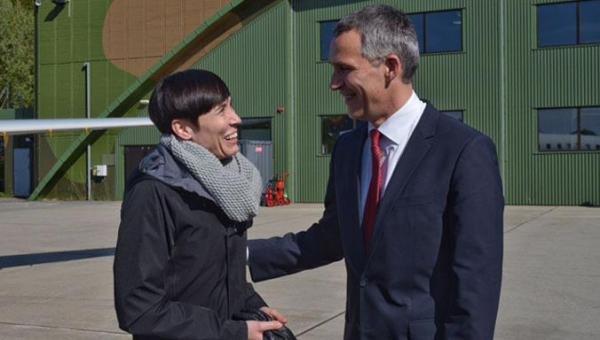
 NATO chief Jens Stoltenberg said Thursday Russia is not an immediate threat, but condemned Russia for its lack of cooperation with its neighbors. Stoltenberg, in his native Norway on his first official visit as NATO Secretary-General, told state broadcaster NRK in an interview Wednesday, “What we see is more unpredictability, more insecurity, more unrest… I believe we don’t see any immediate threat against any NATO country from the east.””Our goal is still cooperation with Russia,” he added. “That serves NATO and it serves Russia.”