
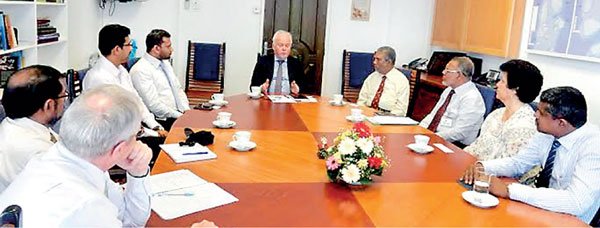

Sri Lanka – Nordic Business Council of the Ceylon Chamber paid a courtesy visit to Thorbjørn Gaustadsæther, the Norwegian envoy in Sri Lanka recently. The President and the Committee of the Sri Lanka – NORDIC Business Council were among the delegation who met with the Norwegian ambassador in Colombo.
During the discussion with His Excellency, Mr. Nazvi Hassan, President of the Council stressed the importance of improving bilateral commercial ties between Sri Lanka and Norway.
The members of the committee emphasized on the importance of organizing more ‘Match Making Events,’ which they believe helps immensely to improve trade and investment ties.
The committee also suggested to arrange a delegation to Scandinavian countries and requested Gaustadsæther’s assistance towards this. In response, he mentioned that Børge Brende, Minister of Foreign Affairs Norway, who visited the country recently is planning to bring a business delegation to Sri Lanka very soon.
The Sri Lanka – Nordic Business Council is also planning to lead a business delegation to Norway, later this year. Bobby Jordan Hansen, Vice President of the Council emphasized the importance of building tourism ties between the two countries.
She mentioned that tourism is a growing business in Sri Lanka and the businesses promoting good life style will attract the Scandinavian tourists to Sri Lanka. The committee mentioned to the envoy that the council has the capacity to help any company in Norway who wishes to engage in trade in Sri Lanka.

 Several people are missing after an avalanche smashed into 10 houses on Norway’s remote Arctic archipelago of Svalbard, authorities said. Eight people were taken to hospital after the avalanche tumbled down from Sukkertoppen mountain, which dominates Longyearbyen, the main settlement on Svalbard, at about 11am on Saturday.Dozens of houses at the foot of Sukkertoppen were evacuated as a precaution, said Tone Hertzberg, a spokeswoman for the governor of Svalbard.
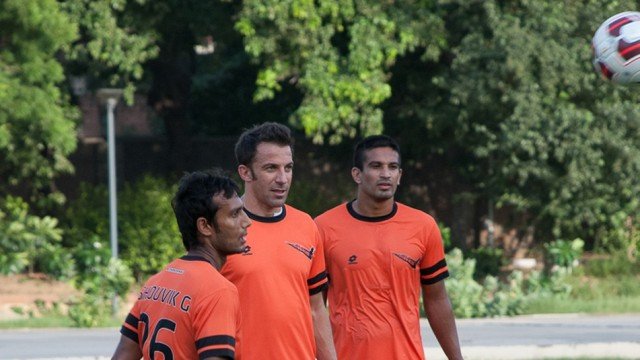
 Manandeep Singh, who played for the Delhi Dynamos in the Indian Super League (ISL) last season, is set to undergo trials with Norwegian side Strommen IF, and is looking forward to following in the footsteps of goalkeeper Gurpreet Singh Sandhu. Manandeep, 22, missed almost six months of football, including the I-League 2014-15, following a back strain. However, having recovered, the Haryana forward is looking forward to his three-week trials with the Norwegian side, who play in OBOS-Ligaen – the league below the premier division in Norway.”I had this offer to go to Norway in January [this year],” Manandeep told the Times of India.
 Norwegian air navigation service provider Avinor and Kongsberg Defense Systems entered into an NOK 400 million ($48 million) agreement for the provision of “remote tower” services at multiple airports from one location. The parties described the agreement as the most comprehensive yet for remote tower systems. Avinor had earlier decided to introduce remote tower services at up to 15 airports from one tower center in Bodø in northern Norway.In 2012, the ATC provider signed a contract with Sweden’s Saab to demonstrate remote tower service from that location. The latest agreement with Kongsberg may cover more airports, Avinor said.

 The Norwegian Directorate of Immigration ruled Wednesday that a popular Oslo mosque would not be allowed to house refugees because all offers of help needed to be “neutral,” a spokesman said. More than 700 refugees, mainly from Syria, were expected to arrive in Norway throughout the week and local authorities have begun setting up temporary housing ahead of their arrival.”Those behind an offer of reception may well have basic values, even if they are religious or political,” said Frode Forfang, the director of the Department of Immigration, as reported by the Local, adding “We could have used the Salvation Army — or the Church City Mission, for that matter. But the actual offer needs to be neutral.”
 Facebooks stopped the sharing function after the Norwegian mainstream newspaper Nettavisen posted an interview with Halvor Fosli, an author who is critical of Islam. Incomprehensible what would be inappropriate, says news editor Erik Stephansen.In the interview, writer Halvor Fosli talks about his new book “Strangers in their own country.”
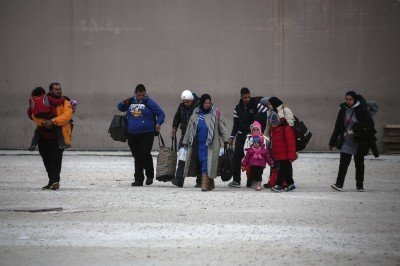
 According to national broadcaster NOS, around 2,000 people joined the protest in a town of 27,000. Two police officers were among those hurt late on Wednesday when demonstrators began throwing stones, bottles and firecrackers to protest against a planned center for 1,500 migrants in the small Dutch village of Geldermalsen.
 LAST week, the Tunisian National Dialogue Quartet — a motley civil society coalition of labour, industry, human rights activists and lawyers — received the Nobel peace prize in Oslo. The five-member Norwegian Nobel committee praised the quartet’s “decisive contribution to the building of a pluralistic democracy”, while African Union chairwoman Nkosazana Dlamini-Zuma had noted previously that “Tunisia has become a beacon of hope for peace in Africa”.The coalition helped their country avert civil war in 2013 by pushing political parties to accept a government of technocrats to organise democratic elections, negotiating a secular constitution that protected the rights of women, and coaxing the Islamist Ennahda party to surrender power. It was appropriate that Tunisia — the cradle of the “Afro-Arab Spring” — was awarded this prize, which four South Africans — Albert Luthuli, Desmond Tutu, Nelson Mandela and FW de Klerk — have won.
 The Norwegian Petroleum Directorate (NPD) has issued an update on its analysis of recoverable oil from Norway’s various offshore fields and discoveries. NPD’s goal in 2005 was to achieve growth in oil reserves of 5 BBbl over 10 years. The actual result is somewhat below that figure, although the target would have been achieved if Statoil’s development plan for Johan Sverdrup in the North Sea had been submitted before the end of 2014.“There has been substantial resource growth in many fields,” said Kirsti Veggeland, assistant director general for shelf analysis. “The most important reasons for this are more wells, extended field lifetimes and improved knowledge.”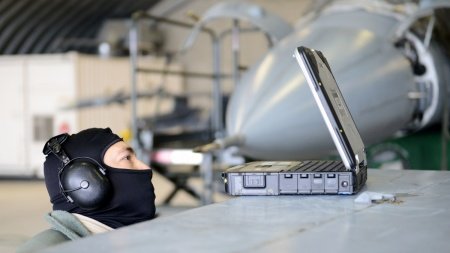
 Exercise Cold Response 16 is underway at Bodø Main Air Station, Norway, as Norwegian, U.S. and Belgian air forces continue to showcase NATO’s and the Partners for Peace’s ability to defend against any threat, in any environment-especially a frozen one. “Cold Response is designed to test our Airmen and other countries in cold-weather operations during major combat scenarios,” said Capt. William Flynt, 555th Fighter Squadron F-16 Fighting Falcon instructor pilot and exercise project officer.Operations seemed poised for a rocky start as many of Aviano’s Airmen and equipment weren’t present when the exercise kicked off; however, the Wyverns adapted quickly to the challenge.


 The government of Norway, in collaboration with leading outsourcing and technology services specialist VFS Global, has opened the first visa application centre (VAC) in Amman, Jordan. The Norway Visa Application Centre in Amman was officially inaugurated today by Ms Sissel Breie, ambassador of Norway to Jordan.Speaking on the occasion, the Ambassador said that the visa application centre will be the main channel in Jordan for submitting applications for visas to Norway, Denmark, Finland and Iceland, as well as residence permits to Norway and Denmark for persons residing in Jordan and Iraq.
 Silje Rønning Kampesæter, the Middle East correspondent for the Norwegian Aftenposten daily, had to leave Turkey after her application for a press card was rejected by the Prime Ministry’s Press Office. Aftenposten published an article on Tuesday reporting this is the first time since 1971 that one of the paper’s reporters is being forced to leave a country. The last occurrence took place in Soviet Russia.The Norwegian reporter arrived in Turkey on Sept. 24, 2015 and immediately began her application process. “Since it took quite some time, and I was eager to get it done by the early election [on Nov. 1], I was calling on a weekly basis to see where my documents were in the process,” she told Today’s Zaman in a phone interview.
 The Islamic State militant group (ISIS) claims to have killed two hostages, one from China and one from Norway, in the release of its official English-language propaganda magazine. In September, the group published “for sale” advertisements for Chinese national Fan Jinghui and a Norwegian national Ole Johan Grimsgaard-Ofstad in the magazine entitled Dabiq. Both were pictured in yellow jumpsuits, set against jet-black backgrounds.The group’s latest release of Dabiq on Wednesday includes photographs of two lifeless bodies with bloody faces, purporting to be those of Grimsgaard-Ofstad and Jinghui, with the word “Executed” stamped over the page.
 Researchers and research fellows at a number of Norwegian research communities are taking part in four Norwegian-Indian cooperative projects on fish and animal vaccines. At least as many people at Indian universities and research institutions are participating in the projects. Cooperating on fish and animal vaccines is part of the large-scale collaboration on vaccine research agreed upon in Delhi in December 2005 by Prime Minister Jens Stoltenberg and Indian Minister of Science and Technology Kapil Sibal.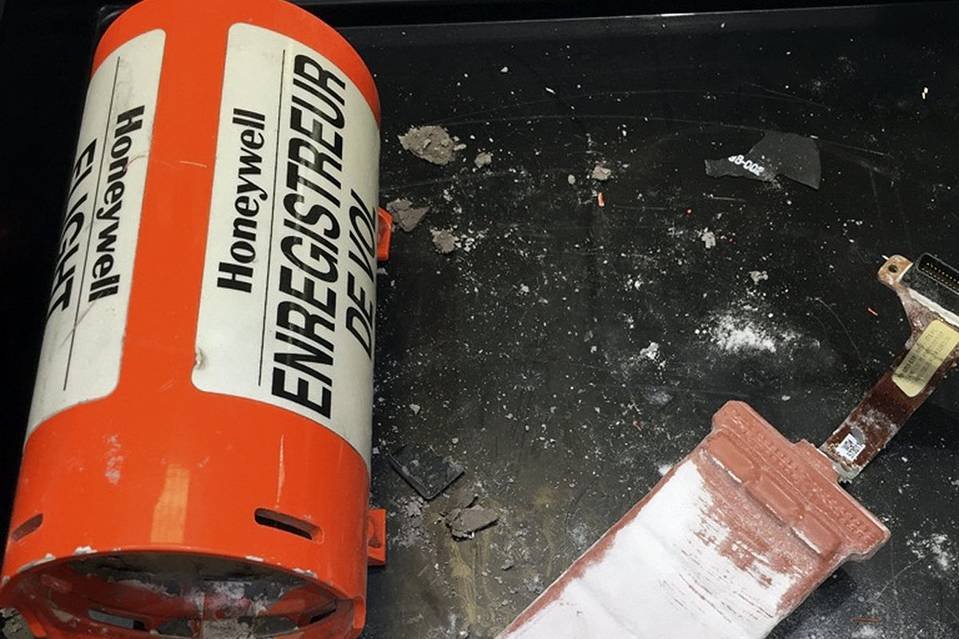
 The Director General of the Norwegian Air Investigations Branch (AIBN) said work has begun to put “together the puzzle” of what happened on board a fatal North Sea helicopter crash.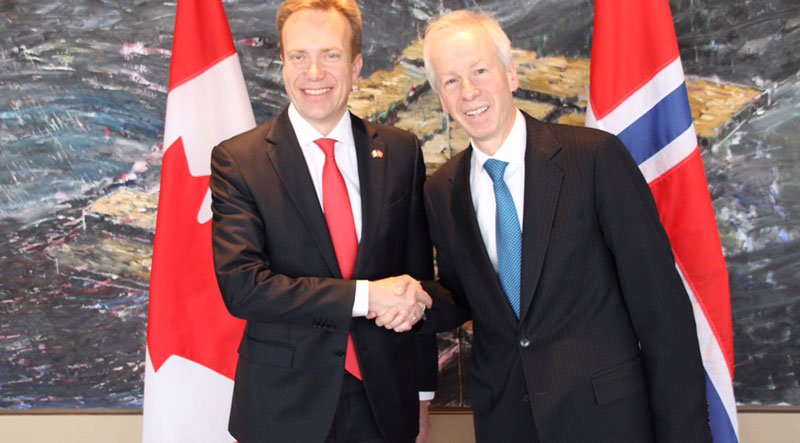
 ‘Transatlantic ties are more important than ever as we navigate today’s security policy landscape. Few countries have more in common than Norway and Canada – geographically, in terms of resources, and in what we believe to be important.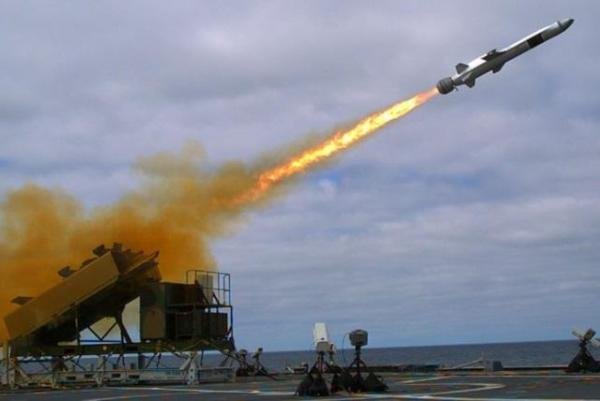
 The U.S. Navy is issuing a contract to Kongsberg Defense of Norway for missiles and equipment for additional testing of its Naval Strike Missile.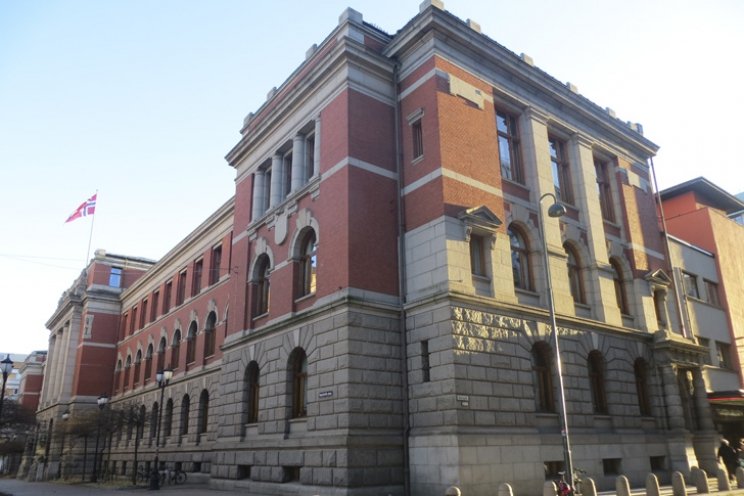
 JUST before Valentine’s Day, a 45-year-old Norwegian had something of a shock when a taxi in which he was travelling arrived at his home in Marbella, City in Spain to be greeted by officers of the Spain National Police who handed him a warrant issued by the Oslo district court and arrested him on behalf of the Norwegian authorities.
 The Air Accidents Investigation Branch (AAIB) said it has deployed a team to Norway after a North Sea helicopter crashed.
 China confirmed the reception of Norway’s application to join the Asian Infrastructure Investment Bank (AIIB) on Wednesday. “We have received the application. The AIIB is an open multilateral institute and welcomes countries in and out of Asia to apply for joining,” Foreign Ministry spokeswoman Hua Chunying said at a daily press briefing.Hua made the comments when asked to comment on Norway’s confirmation of its intention to join as a prospective founding member.