NORWAY NEWS – latest news, breaking stories and comment – NORWAY NEWS
  • Home
  • About us
  • News
  • Other News
    • Africa and Norway
    • Asia and Norway
    • Asylum
    • Breaking News
    • China and Norway
    • Corruption in Norway
    • Crimes
    • Defence
    • Diplomatic relations
    • Economics
    • Environment
    • Farming
    • Featured
    • Health
    • Killing
    • Media Freedom
    • Middle East and Norway
    • NATO and Norway
    • Nobel Peace Prize
    • Norwegian Aid
    • Norwegian American
    • Oil & Gas
    • Peace Talks
    • Politics
    • Racism in Norway
    • Religion
    • Royal House
    • Russia and Norway
    • Science
    • Sex scandal
    • Sports
    • Spy War
    • Srilanka and Norway
    • Svalbard
    • Taiwan and Norway
    • Terrorist
    • Travel
    • Video clips
  • Disclaimer
  • Contact us
NORWAY NEWS – latest news, breaking stories and comment – NORWAY NEWS
  • Home
  • About us
  • News
  • Other News
    • Africa and Norway
    • Asia and Norway
    • Asylum
    • Breaking News
    • China and Norway
    • Corruption in Norway
    • Crimes
    • Defence
    • Diplomatic relations
    • Economics
    • Environment
    • Farming
    • Featured
    • Health
    • Killing
    • Media Freedom
    • Middle East and Norway
    • NATO and Norway
    • Nobel Peace Prize
    • Norwegian Aid
    • Norwegian American
    • Oil & Gas
    • Peace Talks
    • Politics
    • Racism in Norway
    • Religion
    • Royal House
    • Russia and Norway
    • Science
    • Sex scandal
    • Sports
    • Spy War
    • Srilanka and Norway
    • Svalbard
    • Taiwan and Norway
    • Terrorist
    • Travel
    • Video clips
  • Disclaimer
  • Contact us
Sunday, October 4, 2026
NORWAY NEWS – latest news, breaking stories and comment – NORWAY NEWS
  • Home
  • About us
  • News
  • Other News
    • Africa and Norway
    • Asia and Norway
    • Asylum
    • Breaking News
    • China and Norway
    • Corruption in Norway
    • Crimes
    • Defence
    • Diplomatic relations
    • Economics
    • Environment
    • Farming
    • Featured
    • Health
    • Killing
    • Media Freedom
    • Middle East and Norway
    • NATO and Norway
    • Nobel Peace Prize
    • Norwegian Aid
    • Norwegian American
    • Oil & Gas
    • Peace Talks
    • Politics
    • Racism in Norway
    • Religion
    • Royal House
    • Russia and Norway
    • Science
    • Sex scandal
    • Sports
    • Spy War
    • Srilanka and Norway
    • Svalbard
    • Taiwan and Norway
    • Terrorist
    • Travel
    • Video clips
  • Disclaimer
  • Contact us
Copyright 2025- All Right Reserved Norway News
Asia and Norway

“WE ARE OPEN TO THE WORLD” – President of Kazakhstan

by Nadarajah Sethurupan June 12, 2019
written by Nadarajah Sethurupan

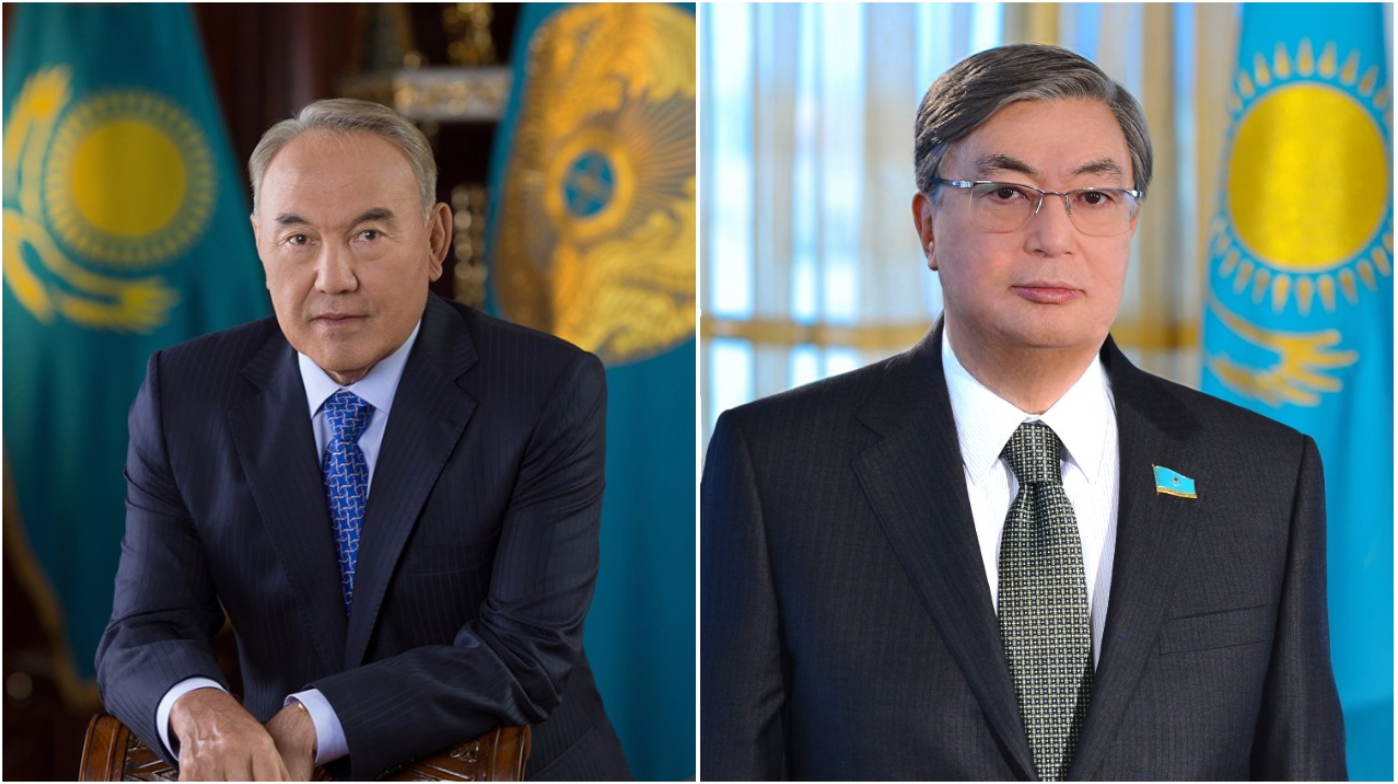
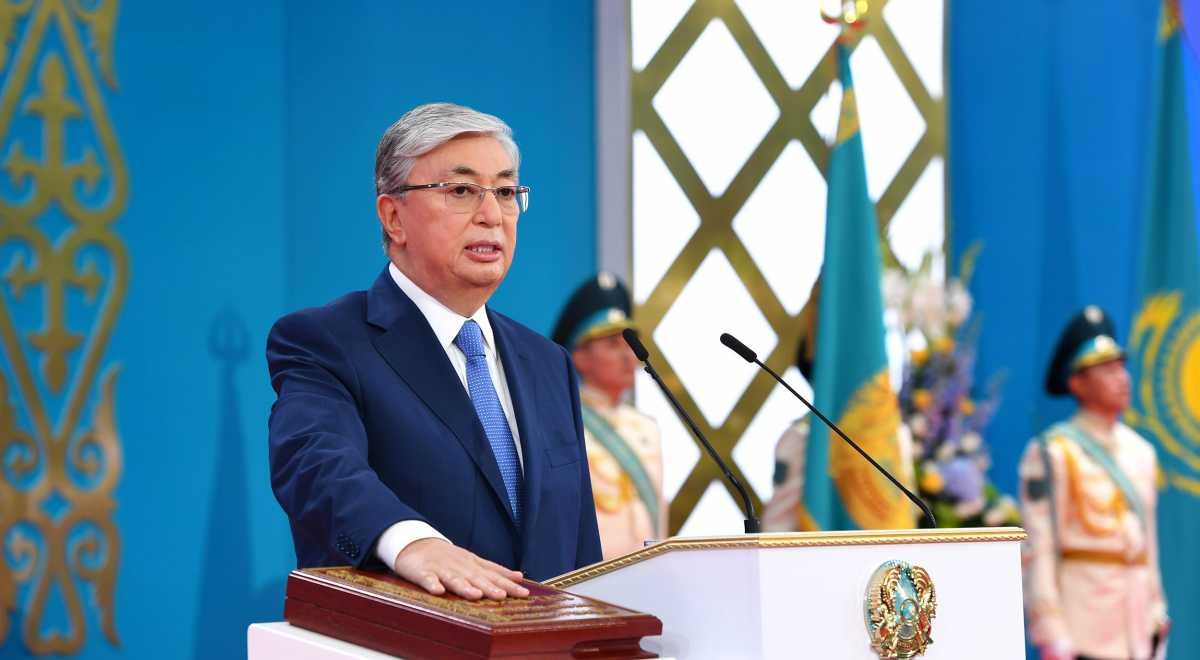
The inauguration ceremony of the newly elected President of Kazakhstan Kassym-Jomart Tokayev was held in the capital of Kazakhstan.

During a speech after the inauguration, Mr.Tokayev emphasized that he would continue the strategic course of the First President Nursultan Nazarbayev.

Kassym-Jomart Tokayev assumed office as the President of Kazakhstan – Photo MFA.Gov.KZ

He named 10 objectives that he will prioritize first and foremost. It is about raising the incomes of the population, fighting corruption, judicial reform, creating new working places. The state will address housing issues, ensure fair social policies, as well as support universal education and provide quality services to the population. The state will pass new laws raising the status of teachers and doctors, protecting their rights.

Mr.Tokayev also proposed a new course of regional development. “A strong region is a strong Kazakhstan. All objectives must be achieved at the local level. The population should participate in decision making in the regions,” he said.

The Government will continue the program “Rouhani Zhangyru” (“Spiritual Revival”). “The desire for freedom, unity and the creative power of the people, the youth is the future of the country. We must devote this program to the upbringing of the younger generation”.

The President announced the continuity of the country’s foreign policy. “Kazakhstan has established itself as an open, reliable country. We will firmly promote national interests on the world arena. Foreign policy activity will bring economic benefits”.

“We are open to the world, striving for the best achievements, advanced technologies. Creative change for the benefit of people – that is my understanding of progress. At the same time, the authorities are obliged to hear the requests of people, solve problems on the spot, and regularly report to the citizens”, – pointed out Mr.Tokayev.

The President said that the political reform process will continue in Kazakhstan. “The political superstructure should correspond to deep economic transformations, otherwise, reforms can be crippled. This is convincingly displayed by world experience. Only decent, educated people on the basis of meritocracy should be a part of public administration. There can be no other recruitment principle. In general, we must increase the responsibility of the authorities to the people. Special attention will be paid to the development of civil society,” he said.

Mr.Tokayev proposed a formula of national governance for Kazakhstan: a strong, plenipotentiary President — an influential, capable Parliament – a Government that is accountable to the people. “It is this political system that most fully meets the needs of our state in complex geopolitical realities, contributes to the fulfillment of the strategic objectives we face”.

TThe new President of Kazakhstan also spoke in favor of developing a dialogue between the government and society. “Such a dialogue should be based on the recognition of pluralism of opinions. Different opinions, but one nation. That is the main reference point. Therefore, I decided to create a National Council of Public Trust. The Council will include representatives of the entire society, including young generation. The first meeting of the National Council of Public Trust will be held in August of this month.

(MFA.Kz)

June 12, 2019 0 comments
0 FacebookTwitterPinterestEmail
Asia and Norway

“Both Korea” hopes to meet for “Peace for People”

by Nadarajah Sethurupan June 12, 2019
written by Nadarajah Sethurupan

Today marks exactly one year since North Korea’s leader and a sitting U.S. sitting president met for the first time in history for summit talks. The unprecedented event opened a new chapter in history, otherwise known as the Singapore summit.

It was a promising moment for the two sides to start building trust, reflected on the joint agreement they signed in Singapore. However, nuclear negotiations hit a snag during their second summit in Hanoi, and not much progress has been made since then.

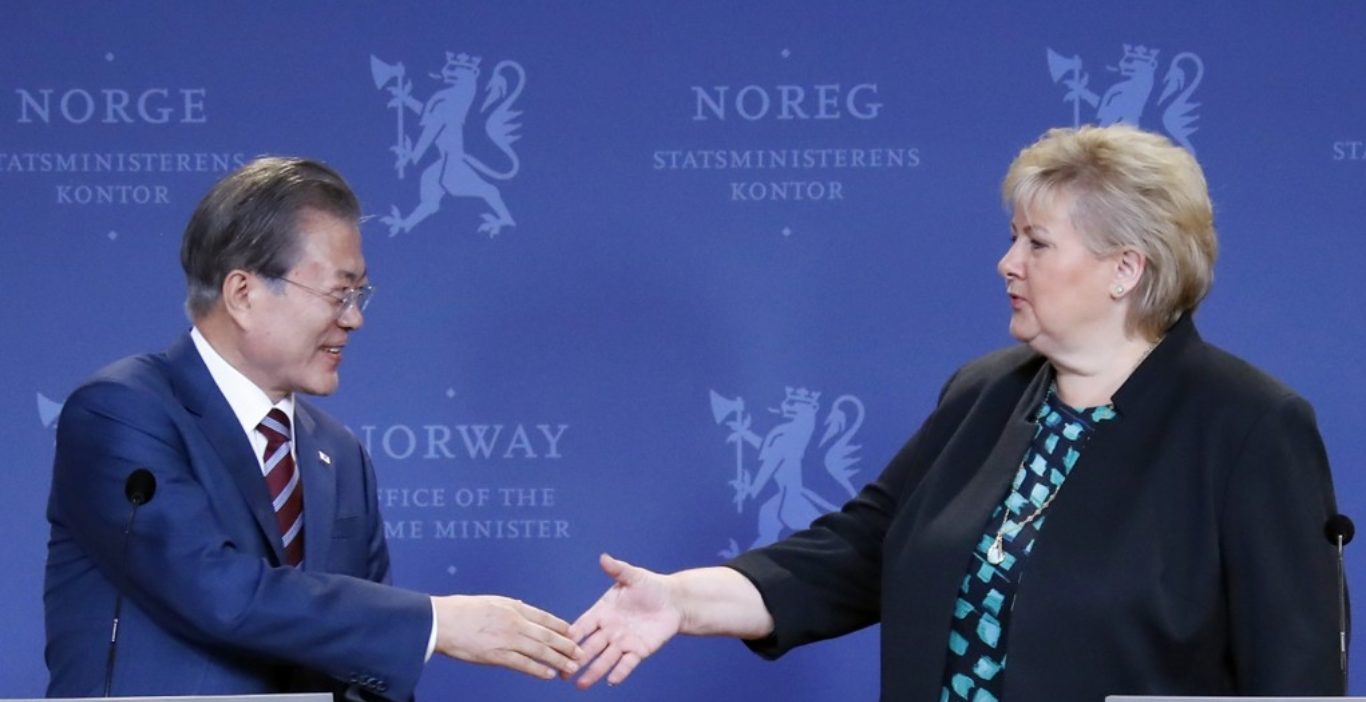
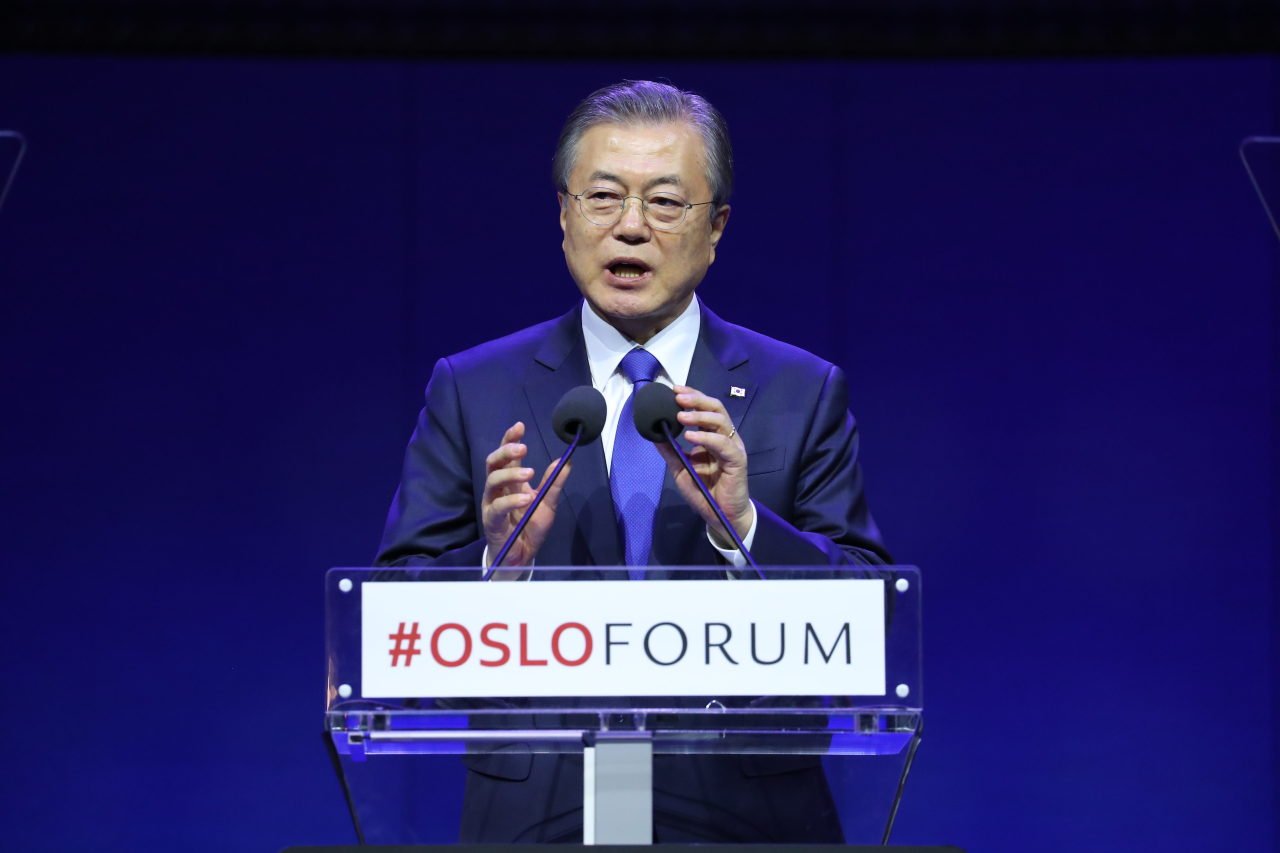
Against such backdrop, President Moon Jae-in has just delivered a speech in Oslo mentioning his peace process on the Korean Peninsula, during the second leg of his across three Nordic nations.

South Korean President Moon Jae-in unveiled his “peace for people” vision Wednesday, pledging to make non-stop efforts to resolve “structural violence” that Koreans have suffered due to division.

He was addressing the Oslo Forum in the Norwegian capital on the first anniversary of the historic Singapore summit between US President Donald Trump and North Korean leader Kim Jong-un.

He admitted that denuclearization talks appear to be in a stalemate but described it as part of a process to build mutual confidence.

The summit agreement is “moving forward,” Moon said.

He cited Norway’s experience in regional peace, speaking at the University of Oslo.

“Norway has never faltered on the journey for peace, as evidenced by the peace that exists today. Likewise, the Korean government will stride forward unwaveringly, to achieve peace without fail,” he said.

He referred to a “positive peace” concept formulated by a famous Norwegian sociologist, Johan Galtung.

“It is important to peacefully resolve the structural violence that the people of the two Koreas have suffered because of division,” he said. “I would like to name it as ‘peace for the people.'”

As a first step, the two Koreas must address the damage frequently reported in their border areas, especially in and around the Demilitarized Zone (DMZ), Moon said, adding that the “permanent legations” laid out in the 1972 German Basic Treaty can be an example.

The two sides “took advantage of these permanent legations to make swift and joint responses to fires, floods, landslides, infectious diseases, insect damage and water contamination occurring in border areas,” he noted.

What is most important is to deepen mutual understanding and trust, thus strengthening the will for dialogue, the president said.

His remarks were reminiscent of his landmark Berlin speech in 2017, in which he proposed a new peace initiative for the peninsula, leading to North Korea’s participation in the PyeongChang Winter Olympics and a brisk round of summit diplomacy on denuclearization and regional peace.

Oslo is the second leg of Moon’s eight-day tour of Northern Europe to last through this weekend. He made a state visit to Finland and plans to visit Sweden at the invitation of King Carl XVI Gustaf.

June 12, 2019 0 comments
0 FacebookTwitterPinterestEmail
Africa and Norway

Political stability and reforms bring progress in Somalia

by Nadarajah Sethurupan June 12, 2019
written by Nadarajah Sethurupan

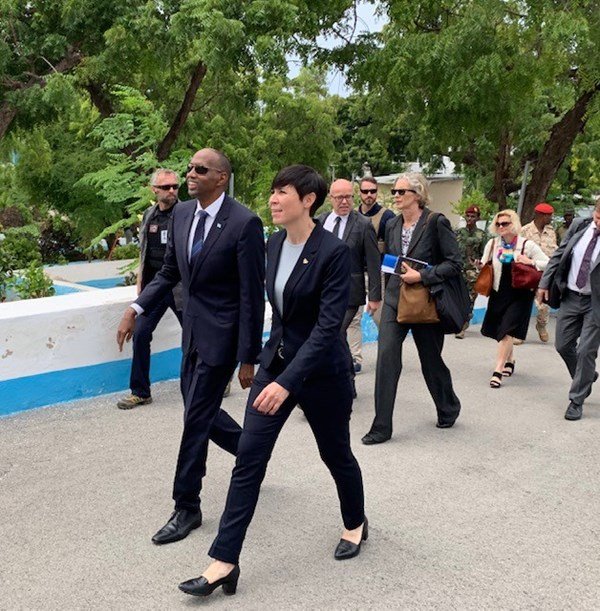
Minister of Foreign Affairs Ine Eriksen Søreide visited Mogadishu on 10 June for talks with Somalia’s President and Prime Minister. She also met key humanitarian and diplomatic actors.

‘The Somali Government is more politically stable than it has been for many decades, and it is now in the process of implementing vital reforms. Norway is an important partner for Somalia in this work,’ said Minister of Foreign Affairs Ine Eriksen Søreide.

Minister of Foreign Affairs Ine Eriksen Søreide visited Mogadishu 10 June 2019. Here with Somalia’s Prime Minister Hassan Ali Khaire. Credit: Svein Michelsen, MFA

Key reforms include the introduction of biometric registration of the Somali armed forces and digital payment of their salaries. This promotes predictability, prevents corruption and boosts loyalty. 

In cooperation with the African Union Mission in Somalia (AMISOM), a regional peacekeeping mission, and other allies, the Government has expanded its territorial control while also providing better protection for the local population.   

‘The progress is fragile and many challenges remain. In 2019 and 2020, it will be crucial to continue to implement the reforms to the security sector, the economy and the political system. But Somalia is already receiving broad international recognition for its reform efforts. To achieve lasting progress, it is important that regional actors and the international community support this work,’ Ms Eriksen Søreide said. 

One of the factors threatening progress is climate change, which is causing more frequent droughts. Droughts are a significant problem. They are affecting local food production, exacerbating existing conflicts and forcing even more people to flee their homes. Norway is now increasing its humanitarian efforts in Somalia in order to prevent a famine. 

Some 70 % of Somalia’s population is under the age of 30. 

‘Despite the major challenges, I am cautiously optimistic. A new generation of Somalis is creating a new story for their country. They are showing a willingness to pursue reconciliation and an ability and determination to build a new Somalia,’ Ms Eriksen Søreide said. 

(MFA)

June 12, 2019 0 comments
0 FacebookTwitterPinterestEmail
Middle East and Norway

US Disappointed with Syria , Turkey , Iranian oil and Assad’s ‘murderous regime’

by Nadarajah Sethurupan June 12, 2019
written by Nadarajah Sethurupan

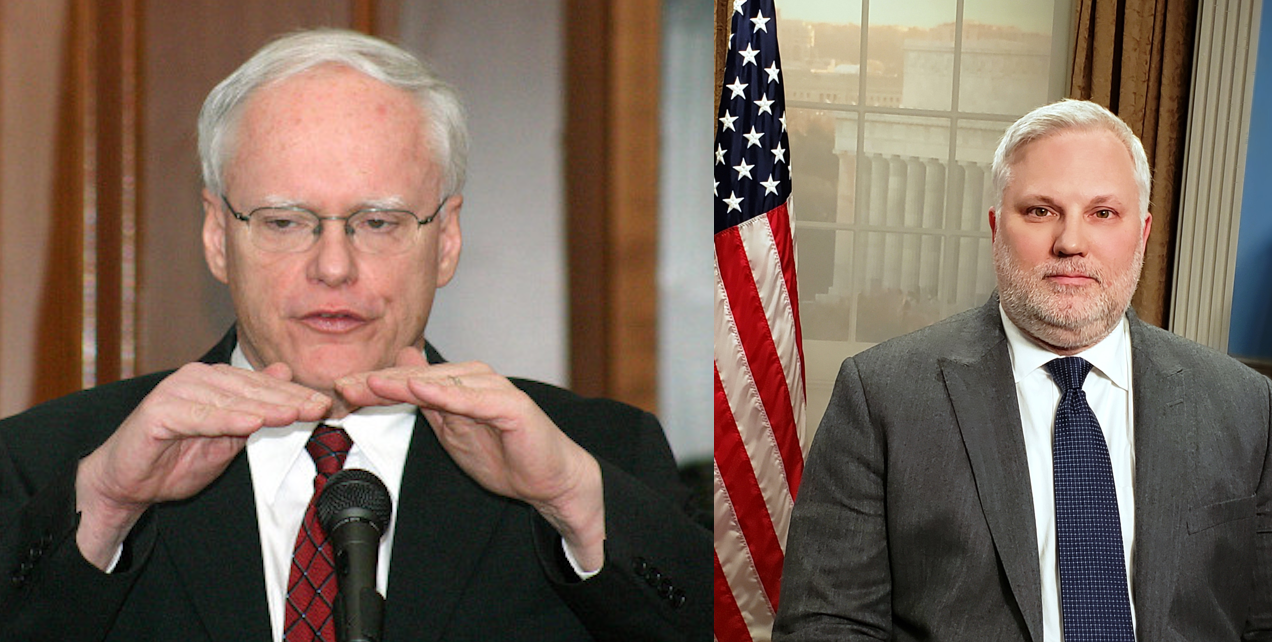
The United States regrets the lack of progress toward forming a Syrian Constitutional Committee, US Special Representative for Syria Engagement James Jeffrey told reporters on Tuesday.

“Frankly, we are disappointed that we have not seen more movements on the Constitutional Committee. We were very close to when we went to Sochi, but we have not taken that final step. We believe that the problem is first and foremost as usual is the Assad regime. But secondly, it’s a problem of Russia for not putting that regime under pressure,” Jeffrey said.

The initial agreement to form a constitutional committee was reached during the Syrian National Dialogue Congress in the Russian city of Sochi back in January 2018. The panel will be tasked with drafting reforms to the country’s constitution. It is expected to be made up of representatives of the Syrian government and opposition, experts, members of civil society, independents, tribal leaders, and women.

Ambassador James Jeffrey, U.S. Special Representative for Syria Engagement and Special Envoy to the Global Coalition to Defeat ISIS and Deputy Assistant Secretary of State Joel Rayburn.

America and its allies in the Middle East are trying to make sure Iran will “pull these forces back” from Syria before a UN political solution can proceed, James Jeffrey said.
He said this is being done through pressure on the Assad regime and through “talking with the Russians.”

“The Syrian government invited the Iranians in as their allies in the civil war but in addition the Iranians have introduced as they have done in other places, Yemen, Lebanon, long-range weapon systems essentially as part of their hegemonic quest to dominate the Middle East,” Jeffrey said.

The US is continuing its discussions about a safe zone in northeastern Syria, Amb. James Jeffrey, told journalists on Tuesday.

Jeffrey was in Cairo, where he has held talks with senior Egyptian and Arab League officials, as well as members of the Syrian opposition. He spoke to reporters in a telephone press briefing.
Asked, “Do you see a long-term reconciliation agreement between the SDF (Syrian Democratic Forces) and Turkey,” Jeffrey explained, “We’re not trying to reconcile Turkey and the SDF”—which is led by the Kurdish People’s Protection Units (YPG.)

“What we’re trying to do is to continue our campaign to defeat ISIS in the northeast of Syria,” Jeffrey added, “where the SDF is our partner in this fight and has been a very effective partner.”
He described the two conflicting perspectives that Washington is trying to reconcile, as it plans the withdrawal of most US forces there.

“We understand Turkey’s concerns about the origins of the SDF and its ties with the PKK (Kurdistan Workers’ Party).” But we also “understand the concerns of many people in [Syria’s] northeast of Turkey coming in militarily,” Jeffrey said.

The safe zone is, thus, intended to address those opposite concerns, he explained, as he outlined the status of the ongoing discussions.

The safe zone would run from the Euphrates River to the Iraqi border, Jeffrey said. It “would involve a withdrawal of the YPG, which is the core military focus of the SDF, some distance back from the border,” he continued.

It would also involve “the destruction of military fortifications” in that area and “a withdrawal of heavy weapons even further back,” Jeffrey added.

Finally, it would involve the “monitoring of the situation there by the US and Turkey.”

Those are the “basic set of principles” and “everybody that we deal with is agreed” on them, is how Jeffrey summarized the discussions.

Notably, it was unclear if his phrase—“everybody that we deal with”—included the leadership of the SDF. If it does, it would suggest that the US is involved in what are, in effect, indirect talks between Turkey and the SDF.

Jeffrey also listed two issues that “we’re still debating”: how deep the safe zone should be and what Turkey’s role in Syria should be, and he concluded, “We haven’t reached a final agreement yet.”
In the briefing, Jeffrey also described the three strategic US goals in Syria, the first of which is “the enduring defeat of ISIS and its allies.”
The second objective is “the withdrawal of all Iranian-commanded forces, including Lebanese Hizbollah,” and the third is a peaceful resolution of Syria’s civil war, in line with UN Security Council Resolution 2254.

He condemned the Syrian regime and Russia for their “indiscriminate bombing attacks” against civilians in Idlib and called for a return to the ceasefire agreement that Turkey and Russia reached last September.

Russia, Turkey and Iran have been facilitating the committee’s establishment, while the United Nations has been helping to draft the list of the its members. Egypt Minister of Foreign Affairs Sameh Shokry met on Tuesday with United States Special Representative for Syria Engagement and Special Envoy for the Global Coalition to Defeat ISIL James Jeffrey in Cairo.

Shokry and Jeffrey examined the latest developments on the Syrian scene and the updates of counterterrorism efforts, as stated by the ministry’s spokesperson Ahmed Hafez.

Turkey that decided in 2017 to purchase Russia’s S-400 air defense system. Today Turkish media portrays that decision as Ankara’s desire to get a state-of-the-art system when the US wouldn’t sell it the Patriot missile system. In December 2018 the US approved the Patriot sale.

But the real story of Turkey’s brinkmanship is more complex. Turkey and the US have been close allies since the late 1940s. In 1952, Turkey joined NATO and became part of the Baghdad Pact in 1955 in the context of the Cold War. A US Air Base at Incirlik in south central Anatolia was built in the 1950s, and US Jupiter missiles were stationed in Turkey in 1961.

Tensions grew worse after 2015 when the Turkey-PKK ceasefire broke down and Turkey launched increasingly larger operations against the PKK, first inside Turkey, then increasingly in northern Iraq, and then operating in Afrin in northwestern Syria where hundreds of thousands of mostly-Kurdish civilians fled a Turkish offensive in January 2018.

Turkey believed if it pushed the US a bit more, Washington would leave Syria and then maybe Turkey could even get its Patriots and the S-400, and keep the F-35 program.

Turkey was a partner in the F-35 warplane program since 1999 with eight Turkish companies supporting the program, many of them since 2005. Ankara doesn’t think the US threats to end this program are realistic. How can a 20-year program end so quickly?

But the Pentagon has tried to make it clear that as the deadline draws close for Turkey to finally receive the S-400, the F-35 program is in jeopardy.

US Secretary of Defense Patrick Shanahan says that Turkey will not receive the F-35 if Turkey takes delivery of the S-400. But it will take until 2020 to get Turkey out of the program because more than 937 parts are made in Turkey, 400 of them solely in Turkey.

Ambassador James Jeffrey, U.S. Special Representative for Syria Engagement and Special Envoy to the Global Coalition to Defeat ISIS and Deputy Assistant Secretary of State Joel Rayburn.

Below is a full rush transcript of the press conference by Ambassador James Jeffrey, U.S. Special Representative for Syria Engagement and Special Envoy to the Global Coalition to Defeat ISIS and Deputy Assistant Secretary of State Joel Rayburn.

Ambassador Jeffrey: Today the biggest news as far as the U.S. government is concerned on the Syria issue is the designation by the U.S. Treasury of Syrian Oligarch Samer Foz and his Luxury Reconstruction Business Empire.  My colleague, Deputy Assistant Secretary of State Joel Rayburn, and Syria Envoy, Joel Rayburn, will go into this designation and what it means in a little bit more detail in a second.  What I want to do is discuss that today’s actions against Foz are in direct support of the President’s foremost strategic objectives concerning Syria — the achievement of the enduring defeat of ISIS and its allies, the withdrawal from Syria of all Iranian commanded forces including Lebanese Hezbollah, and a peaceful settlement of the Syrian conflict in line with UN Security Council Resolution 2254.  

To achieve these strategic objectives the Trump administration is exercising a whole of government approach including political, diplomatic, and economic tools such as today’s designations.  And if the Damascus regime verifiably uses, once again, chemical weapons against its own people, the United States will, as in the past, use other U.S. tools in response.

Such tools are meant to pressure the Assad regime to constructively participate in a political solution that will end this conflict that has killed over 500,000 Syrians, something that that regime has yet to do.

DAS Rayburn:  Today’s new designation by the U.S. Department of the Treasury’s Office of Foreign Assets Control or OFAC, are on 16 targets in connection to an international network benefiting the Assad regime, and the State Department is proud to support these efforts for the reasons that Ambassador Jeffrey just gave.

The scheme amounted to the Assad regime taking over property owned by ordinary Syrians and handing it to wealthy regime insiders to develop luxury properties and others while ordinary Syrians lose everything and suffer as a result of the conflict.  As the suffering of ordinary Syrians goes on, Bashar al-Assad and his friends continue to accumulate wealth.

Specifically, Samer Foz and 15 other individuals and entities designated today have used their ties with the Assad regime and exploited this horrific conflict for their own financial benefit.  Mr. Foz also owns the Four Seasons Damascus and the Orient Club, which are also being designated today.

Today’s actions in addition to being in direct support of the President’s objectives for Syria, as Ambassador Jeffrey mentioned, are also significant in that they hold accountable some of those people who have been providing support to and profiting from the Assad regimes murderous activities.  This is something the United States is committed to doing as part of our Syria policy.

I’d like to stress that today’s Treasury actions are aimed at the Assad regime and its elite circle of supporters, not at the Syrian people.  In fact today’s action literally targets those who are profiting from the misery and murder of the Syrian people.

I would also like to note that today’s actions against the Samer Foz network will also put pressure on the Assad regime’s key supporters such as the Iranian regime and Lebanese Hezbollah.  Some of Samer Foz’s activities involved helping the Iranian regime illicitly ship oil to the Assad regime and it’s worth noting in that vein that today’s Treasury actions target one of the final remaining outlets for the Iranian regime’s oil exports, thereby helping our overall Iran strategy.

We urge all states in the international community to join us in this approach of maintaining pressure on the Assad regime and its enablers so as to compel them to participate in the UN-sponsored political process and to bring about a peaceful end to the conflict, one that reflects the will of the Syrian people.

Any effort at reestablishing or upgrading diplomatic relations or economic cooperation with the Assad regime will only undercut efforts to move toward a permanent peaceful and political solution to the Syrian conflict in line with UN Security Council Resolution 2254.

Now for further details on the exact entities and individuals beyond Samer Foz that are being designated today, I would recommend that you look at the U.S. Department of the Treasury Press Release which is available on the Treasury Department’s web site, along with a very instructive graphic that illustrates how this particular illicit financing ring operated.

Question:  What are the details of your meeting today with Egyptian officials?  Is there a new American vision to find a way out of the political impasse of the Syrian crisis? 

Ambassador Jeffrey:  Thank you very much.  Deputy Assistant Secretary Rayburn and I held meetings today with senior Egyptian officials as well as with the Arab League leadership and members of the Syrian opposition to discuss our ongoing efforts to promote stability and security in Syria including the implementation of the UN Security Council Resolution 2254.

The Egyptian government has been a particularly close partner of the United States in these issues and we are looking forward to continued close cooperation and coordination with our partners here in Cairo.

Question: I wanted to ask about repatriation of EU citizens back to their home countries.  There hasn’t been much movement on that.  Why have Europeans been so reluctant to repatriate their citizens?  And how much time do you think they have before the camps such as al-Hol and others in Syria are dissolved and their citizens slip away from custody?  

Ambassador Jeffrey: First of all, the United States has taken back their citizens that have been caught up in this conflict and people who we strongly suspect as being involved on the side of Daesh or ISIS.  So it’s an issue in the first instance for the Europeans to answer.  Our position is that countries should take back both family members caught up in this conflict, and there has been some movement, and also people who are verifiably considered to be members or supporters of Daesh.  There there have been many problems.  But still, it is not a solution to leave these people in camps in Northeast Syria.  This is a burden on the population of Northeast Syria that has to provide assistance with some support from the United States and other countries, but it is also still a war zone.  We still have Daesh there.  Syria itself is a conflict zone in the larger sense of the word.  Therefore, we think it is absolutely imperative that countries take action as necessary to deal with their own citizens.

Question:  In Idlib, Hayat Tahrir al-Sham, with support from al-Qaida, is controlling huge areas in the territory.  Does the U.S. see this kind of terrorist group as a danger both in the region and the U.S.? 

DAS Rayburn:  Thank you, Mohamed.  Yes, Hayat Tahiri al-Sham is a danger as well as some other groups in Idlib Province such as Huras al-Din and remnants of Daesh that have managed to gather there. 

The most urgent thing that exacerbates the terrorist problem, though, is the Assad regime and the Russian air force’s indiscriminate bombing attacks against civilian areas which are escalating the conflict in Idlib and making all the dire consequences that all of us hoped not to see such as the possibility of a wave of refugees or even, God forbid, the use of chemical weapons has made them much likelier to happen.  So we think the first step in handling all the problems that are contained in Idlib which is a thorny problem, is for the Assad regime and its allies, including Russia and Iran, to cease their attacks against civilians, to return to the ceasefire arrangement that was made made in Sochi between Turkey and Russia last September, and deescalate the conflict so that we can have rational approaches to all of these problems.

Question:  Do you see a long-term reconciliation agreement between SDF and Turkey?  What is the shape of the safe zone that you are intending to establish a way that guarantees your objective of preventing Daesh’s return and blocking Iranian expansion from the North?

Ambassador Jeffrey: We’re not working to try to reconcile Turkey and the SDF.  Rather, what we’re trying to do is to continue our campaign to defeat ISIS in the Northeast of Syria where the SDF is our partner in this fight and has been a very effective partner.

We understand Turkey’s concerns about the origins of the SDF and its ties with the PKK and we understand the concerns of many people in the Northeast of Turkey coming in militarily.  Thus we have been engaged with Turkey on the discussion of what we call a safe zone along the Turkish-Syrian border to the east of the Euphrates all the way to the Iraqi border that would involve a withdrawal of the YPG which is the core military focus of the SDF some distance back from the border, and then the destruction of military fortifications and such in that zone.  A withdrawal of heavy weapons even further back.  And monitoring of the situation there by the U.S. and by Turkey.

Everybody that we deal with is agreed on that basic set of principles.  The issues that we’re still debating are how deep that zone should be, what the role of Turkey would be in the neighboring state of Syria, and we haven’t reached a final agreement yet.  Thank you.

Question: My question is about the children of the wives of ISIS who are growing up in refugee camps for whom there is currently, there are very few rehabilitation options.  I’m wondering how Mr. Jeffrey sees those challenges as the situation potentially worsens, and is there anything the United States or any other international partners can be doing to stem this potential radicalization that’s happening with these children of ISIS?

DAS Jeffrey:  For the families of ISIS members, there are a large number of them now in the al-Hol camp, over 70,000.  And the first priority that we have is to ensure the humanitarian status of the camp, medical, food, drinking water and that kind of thing.  And there the international community has been quite helpful.  It’s still somewhat of a struggle.  We get a lot of help from the local administration in the Northeast, the SDC.  But again, that job is not finished.

In terms of the larger issue of deradicalization, this is an extremely complex problem under any and all circumstances.  We’ve experienced it ever since 9/11 with people that we have picked up.  Family members are a particular problem because they in and of themselves are not guilty of anything, but they have attitudes and a mindset.

What we’re hoping is that these people can largely be returned to their communities.  We’ve seen this work in other parts of the Middle East where the family, the clan, the tribe, the community takes responsibility for the people and the people feel responsible for those people who have embraced them and taken them back in.

The vast majority of the families we’re talking about are either Iraqi or Syrian, so therefore it is a relatively simple logistical and to some degree political issue to get them to go back to their families.

The SDC for example recently had almost a thousand people from the camp, removed from the camp and resettled in the areas they came from along the Euphrates, among their families and among the areas that they grew up in. 

We’re hoping that if we can accelerate this, first of all, the logistical burden on the camp will be reduced; and secondly, the people will be in an environment where they’re surrounded by folks who do not like Daesh as opposed to now in the camps where they’re surrounded by many people who do.

Question: I want to go back to the objectives that you mentioned at the beginning.  I want to ask you about the position on the Syrian President.  To what extent are you ready to compromise and accept that he will stay in his position?  And if the Russians would help you get the Iranians out from Syria ?

Ambassador Jeffrey:  Two questions, let me take the first one.  We’re not committed to any personality one way or the other.  We’re committed to the letter of the relevant UN Resolution 2254 passed by the Security Council in December of 2015, and based upon many resolutions and many proclamations on the Syrian conflict going back to 2012.  In that, it talks about a new constitution.  It talks about free and fair elections monitored by the United Nations including among the diaspora, which is approximately half of the population has fled their homes.  And finally, a governance that meets the international standards and avoids the crisis that we have seen in Syria since 2011.

We are willing to work to that end and we are going to work with any Syrian authorities that are willing to cooperate with us on that objective.  So far the Assad regime has shown very little interest in doing that, and that’s one reason why we do the sanctions, we do the designations, we do the other actions we have.

In terms of the Iranians leaving, this is a question that ultimately the Syrian government is responsible for.  The Syrian government invited the Iranians in as their allies in the civil war, but in addition, the Iranians have introduced, as they have done in other places, Yemen, Lebanon, long-range weapon systems, essentially as part of their hegemonic quest to dominate the Middle East.  That is what we and essentially everybody that we work with in the Middle East, which is essentially everybody in the Middle East, are hoping that we will achieve is through pressure on the regime, through talking with the Russians, a decision that Iran will pull these forces back.

Question:  How do you see the role played by Bahrain and other Gulf countries in cracking down against IS sympathizers?  Cutting down their funds and also playing a vital role in Operation inherent Resolve in Iraq and Syria?

Ambassador Jeffrey:  We’re very happy with the very close relationship we have with the Gulf states in what we call the International Coalition, which is some 80 countries and organizations all committed to defeating Daesh.  Not just in Syria and Iraq, but everywhere around the world.  The contributions, the efforts, the military advice and commitments that the Gulf states have made are a very important component of that because they come from the region.  They signal to the world that the region is standing with the international community against this horrific terrorist force.

Question: After your visit to Russia with Secretary Pompeo, you came back optimistic that Russia would be more helpful, especially regarding the formation of the constitution committee.  So far we haven’t seen any progress in this regard other than the escalation in Idlib.  What can we expect from Russia, or what do you expect from Russia and what about the political process regarding the Geneva process exactly?

Ambassador Jeffrey:  Frankly, we’re disappointed that we have not seen more movement on the Constitutional Committee.  We were very close when we went to Sochi but we have not taken that final step.  We believe that the problem is first and foremost, as usual, the Assad regime.  Secondly, it’s the problem of Russia for not putting that regime under enough pressure.

Let me be clear.  That regime has no military capabilities to speak of without Russian military support, particularly air support.

Secondly, we’re extremely upset, as President Trump indicated a week ago Sunday, with this offensive in Idlib and the deliberate targeting from the air of the civilian population that has driven hundreds of thousands of people from what they call home, although many of them have fled from other areas.  This is a humanitarian disaster of the first order.  It is absolutely essential that this stop before there can be any significant further progress on finding a solution to the underlying conflict in Syria.

Question: I wanted to go back regarding the designation of the Four Seasons Hotel.  As you know, this is used pretty much as a UN base for operations in Damascus.  Does this complicate things for the UN?  And does this also complicate the U.S. humanitarian aid that is funneled through the UN?

DAS Rayburn:  The UN has a general license to operate in Syria so this won’t affect UN operations.  And the Four Seasons parent company has already severed its ties with Four Seasons Damascus.  So this will be squarely on Samer Foz and the ownership of the Four Seasons Damascus.  

We also don’t expect that this will inhibit our humanitarian assistance that goes into Syria which will continue apace.

Question:  I wonder if you can elaborate a bit about your expectations of the summit meeting at the end of this month in Israel.  It’s unprecedented one between the national security advisors of the U.S., Russia, and Israel.  I assume that most of the meeting will be devoted to the situation in Syria and Iran ?

Ambassador Jeffrey:  First of all, we’ve taken a public position on this, that the issue will be regional affairs.  There is still work to be done on the agenda and the details of what will be discussed, but you’re absolutely right.  This is an extraordinary event.  This is something very important.  It sends a signal, I think, to Russia’s partners in Syria and elsewhere.  The Damascus regime in Iran.  That Russia has interests that go beyond those of its Syrian partners.  But we’ll have to see as we get closer to this what exactly we’ll discuss and what if any outcome, we will see.

Ambassador Jeffrey:  Once again, signifies that the United States is not taking its eye off the ball in Syria.  Be it the President’s comments about the situation in Idlib, be it our extraordinary diplomatic efforts from Sochi to Jerusalem, be it this designation today, this is one of the most important issues on American foreign policy. Joel?

DAS Rayburn:  I also want to add that also today’s actions are not a one-off.  This is part of a campaign that we and the like-minded countries have been coordinating together for some months now.  And so we’re prepared to continue to do actions like these in order to create the conditions to achieve U.S. and allied strategic objectives in Syria.

June 12, 2019 0 comments
0 FacebookTwitterPinterestEmail
Media Freedom

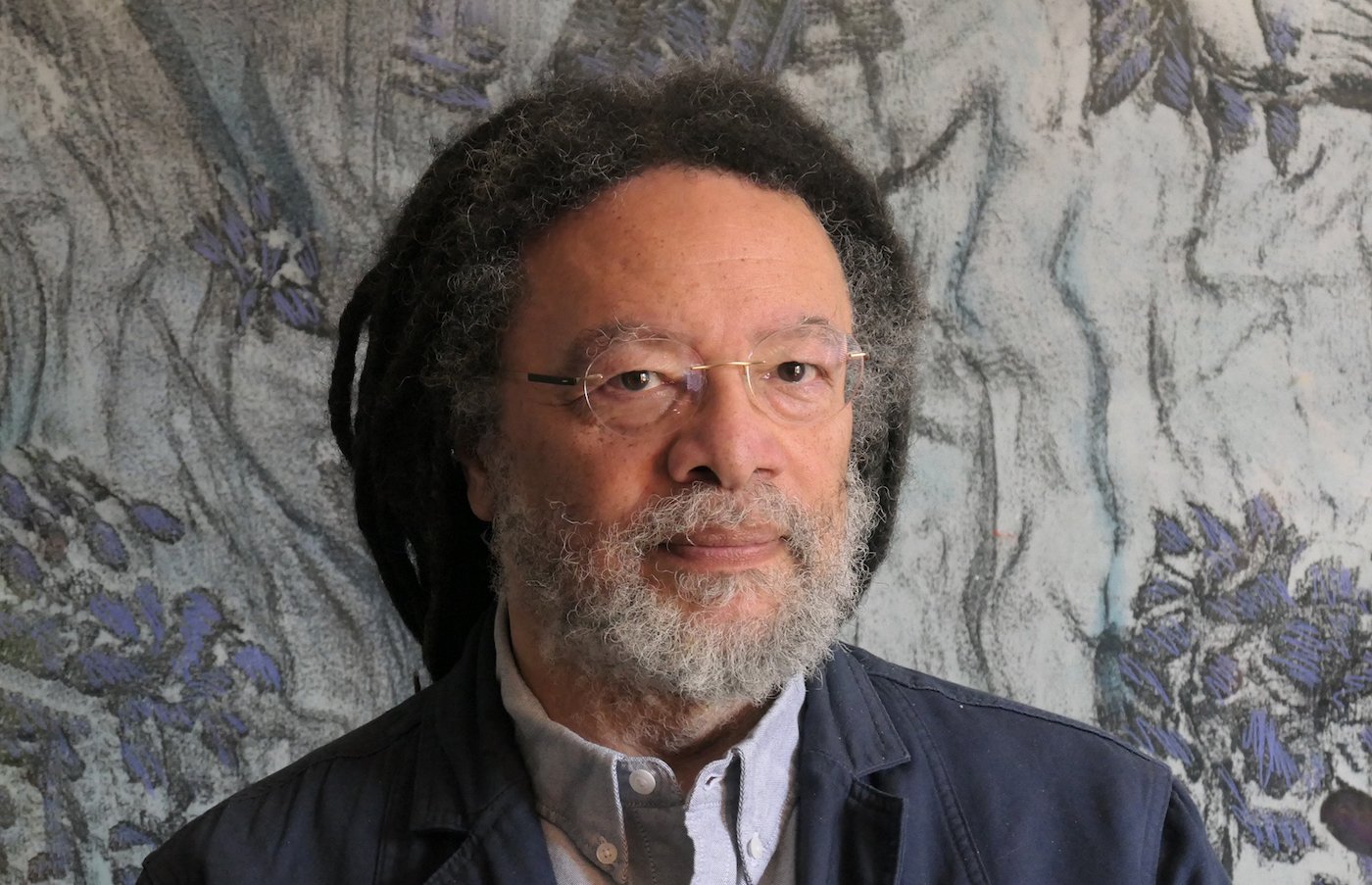
The Holberg Prize conferred upon Professor Paul Gilroy

by Nadarajah Sethurupan June 11, 2019
written by Nadarajah Sethurupan

(Bergen, Norway) – Today, the Holberg Prize was conferred upon Professor Paul Gilroy, King’s College London, by HRH Crown Prince Haakon of Norway.

At a prestigious award ceremony today in the University Aula in Bergen, Professor Paul Gilroy received the international research award from HRH Crown Prince Haakon of Norway. 

The Holberg Prize is worth NOK 6 million (approx. USD 700,000) and is awarded annually for outstanding contributions to research in the humanities, social sciences, law or theology. 

“I want to express my profound gratitude to the Holberg Prize Committee, and indeed to the people of Norway, for this extremely generous and very surprising award,” said the Laureate. “The award still feels baffling and will do for some time to come.”

As one of the most internationally renowned contemporary British intellectuals and a preeminent scholar of modernity’s counter history, Gilroy received the Holberg Prize for his strong influence upon a number of academic fields and sub-fields. These include cultural studies, critical race studies, sociology, history, anthropology and African-American studies. Gilroy’s scholarship has long set the terms for investigation and study in areas such as the Black Atlantic world, colonialism and the role of racial and ethnic hierarchies, as well as the cultures generated by diasporic relations.

In his acceptance speech, Gilroy recalled how he, during his secondary education, experienced “the pressures of everyday racism”. The degree of estrangement he felt was in some sense liberating, partly due to his love of books, which made him acquire “the life-changing, world-making habit of slow, deep reading”. The Laureate described how this has become more difficult in today’s civic environment:  “[…] the reading experiences that infused my imagination and shaped my intellect are no longer routine”, he noted.

Gilroy also described how the life and writings of Ludvig Holberg could inspire a preference for “holistic inquiry”, rather than fragmented knowledge. Such a multi-disciplinary orientation, stressed Gilroy, is also necessary in order to tackle the problems of racism and nationalism, and he emphasized his hope that the Prize may encourage others who have worked on these and similar topics: “Our efforts are connected by their focus on the political and moral problems that arise from the institutionalization of racial hierarchy and inequality, and by the need urgently to develop critical perspectives on the fields of inquiry which have legitimized them over centuries”, Gilroy said.

June 11, 2019 0 comments
0 FacebookTwitterPinterestEmail
Environment

Norway to Divest €5 Billion from Coal Giants like Glencore and RWE

by Nadarajah Sethurupan June 11, 2019
written by Nadarajah Sethurupan

• Norwegian Parliament approves new exclusion criteria for Pension Fund
• 8 coal companies likely affected by divestment
• Coal plant developers still pollute Pension Fund’s portfolio

Oslo, June 11, 2019     Tomorrow the Norwegian Parliament is expected to vote in favor of the government’s proposal to tighten the coal exclusion criteria of Norway’s Government Pension Fund Global (GPFG), Europe’s largest sovereign wealth fund. According to research by the NGOs Urgewald and Framtiden i våre hender (FIVH), this affects 8 coal companies that will be divested. The NGOs estimate the volume of the new divestment action to total €5.1 billion, which is more than the €4 billion the Fund shed in 2015, when it adopted its first coal exclusion criteria.

While the 2015 criteria were based on a company’s relative exposure to coal[1], the new criteria are based on absolute thresholds that capture the world’s largest coal producers and coal plant operators. After the expected parliamentary decision, all companies which are operating over 10 GW of coal-fired capacity or producing over 20 million tons of coal annually will be blacklisted by the Norwegian Government Pension Fund.

According to Urgewald’s Global Coal Exit List, the following coal companies in the Pension Fund’s portfolio[2] fall under the new criteria: AGL Energy (Australia), Anglo American PLC (UK), BHP Billiton (Australia), Enel (Italy), Glencore (Switzerland), RWE(Germany), South32 (Australia) and Uniper (Germany). The details on these investments are attached. 

Heffa Schuecking, director of Urgewald, comments: “It is great to see Norway divesting some of the biggest enemies of the Paris Climate Agreement. And we are happy that the Pension Fund has now adopted 2 of the 3 coal exclusion criteria we put forward in 2015.”[3] According to the NGOs, an important criteria is, however, still missing: the exclusion of companies that are planning new coal plants, coal mines or other coal infrastructure. “Limiting global warming to 1.5°C requires a speedy exit from all coal investments, yet the GPFG is still invested in 18 companies planning new coal power plants. We would like to see the Pension Fund follow the example of Norway’s biggest private investment manager Storebrand and set a date for banning all coal investments,” says Schuecking.

Anja Bakken Riise, Director of the Norwegian NGO Framtiden i våre hender, adds: “This is a timely update of the criteria and adjusts the policy to be in line with the intention from 2015 to be free from thermal coal. We believe however that the government should also say no to investing in companies planning increased coal power or mining production as we know that it is not compatible with our climate goals. It is a missed opportunity to adjust the coal criterion without including these.”

June 11, 2019 0 comments
0 FacebookTwitterPinterestEmail
NATO and Norway

NATO supports cyber exercise and US gives ultimatum to Turkey at GLOBSEC

by Nadarajah Sethurupan June 10, 2019
written by Nadarajah Sethurupan

The first-ever cyber crisis simulation workshop, called “Disruptive Dilemmas”, took place in Bratislava, Slovakia, on June 6 2019. Co-sponsored by NATO, this was the largest side event at the GLOBSEC Bratislava 2019 Forum. It featured a keynote address on navigating digital disruptions in countering terrorism by Dr. Benedetta Berti-Alberti, Head of Policy Planning at the Office of the NATO Secretary General.

The workshop used four real-world, interactive crisis simulations to challenge diplomats, policy makers, think tank representatives, and leaders from the private sector and civil society. The simulations covered a wide range of topics, from using cyber and artificial intelligence in managing refugee crises at sea, through the cyber security challenges posed by foreign investments, and leveraging cyber capabilities in the battle against disinformation.

Slovak Prime Minister Peter Pellegrini (L) and Russian President Vladimir Putin at their meeting in St. Petersburg on June 6, 2019 (photo by TASR)

Responding to cybersecurity crises requires not only technical knowledge, but also human emotional intelligence, which is why “Disruptive Dilemmas” encouraged participants to use both cognitive and emotional intelligence to formulate solutions for a variety of complex cyber crises. The proposed solutions will be published in a white paper in late 2019.

US – Speaking at the annual Globsec Security Forum here in Bratislava, Slovakia, Nato’s new Supreme Allied Commander Europe, Gen Tod Wolters, said “we are not interested in sharing the capabilities of our F-35 with Russia”.

“We do not want to have the F-35 in close proximity to the S-400 over a period of time because of the ability to understand the profile of the F-35 on that particular piece of equipment,” US Under Secretary of Defence Ellen Lord told reporters.

The first four F-35s due to be delivered to Turkey have still not left the US, officially to allow Turkish pilots to train in them in America.
Turkish President Recep Tayyip Erdogan said on Tuesday his country was “determined” to proceed with the S-400 deal.

“Unfortunately we haven’t received a positive proposal from the American side on the subject of Patriots like the S-400s from Russia,” he said.

Turkey has the second-largest army in Nato, a 29-member military alliance set up to defend against what was at the time the Soviet Union.

The head of Russia’s state defence conglomerate Rostec, Sergei Chemezov, was quoted as saying on Friday that Russia would start delivering the S-400 to Turkey in “about two months”.

China’s technological advances have been highlighted by the trade stand-off with but the threat they pose will not be resolved in the current round of negotiations, a leading member of the US Senate has told the Globsec security forum in Slovakia.

Ron Johnson, the chairman of the Senate’s homeland security committee, asked participants to look beyond the current row over tariffs at the wider challenges posed by Beijing’s rapid innovation in telecommunications and data.

America First, the campaign slogan that President Donald Trump has brought to the White House, is really about ensuring US autonomy and security in the digital era, Mr Johnson said.

“For every elected official their first duty is to their nation,” he said “We need to watch China in terms of their malign actions. We’re stronger [in America] by being united in demanding they comply.”

The ownership and exploitation of intellectual property and personal data was, he said, the key frontier battleground between the US and China.

“The most egregious offences aren’t going to be covered by a trade agreement,” he added. “It is the cyber theft, it is the espionage.”

One focus of US efforts has been to resist the role of the Chinese firm Huawei in the roll-out of 5G networks. Huawei has become the cheapest and an increasingly dominant supplier of switching and other network technologies for the next generation telecoms systems.

“If the world embraces Huawei there are dangers,” he said. “Most of us don’t understand the real technological risks but we need to be aware of it.”

The senator also called for the US to move into a different posture to resist and deter cyber attacks. Countries that had conducted such attacks were not meeting an adequate level of retaliation.

“Those on cyber offence have got the lead, we need to strengthen cyber defences but we also need to go on the attack,” he said.

Gregory Garrett, a cybersecurity expert at the accounting and consulting firm BDO, told a separate Globsec panel that the blow back from international cyber attacks was being felt behind domestic borders. “Rogue nations states that are bad actors in the world of cyber attacks are increasingly working with organised crime,” he said.

Gargash’s comments at the Globsec – The United Arab Emirates is concerned about the “massacre” in Sudan and supports calls for an investigation, Minister of State for Foreign Affairs Anwar Gargash said on Friday. 

Sudan’s new military leaders have been under pressure after the worst violence since Omar al-Bashir’s fall in April.

“We are concerned about the massacre we’ve seen. We support calls for proper investigation,” Gargash said at the Globsec security and policy conference.

“We think it has complicated issues. We recognize that after 30 years of Bashir’s rule you won’t have a unified opposition, the only way forward is really a dialogue,” he said.

Advancement of North Macedonia – This is a joint success and it should be appreciated, and we should all give us credit for making this achievement, which two years ago was considered impossible, says Minister of Defence of North Macedonia Radmila Šekerinska at the GLOBSEC 2019 Bratislava Forum on Friday.

The Minister explains at the panel “NATO at 80”: Alliance Navigating Disrupted Partnerships that the country is now expecting the ratification of NATO treaty in the US Senat this autumn, which is much quicker than its predecessor Montenegro.

As North Macedonia is set to become the 30th member of the Alliance, Šekerinska pointed out that it would not have been possible without strong US support, adding that the country did its share of taking the risks and responsibility and NATO followed.

When it comes to the strategic goals of North Macedonia, she points out that they are very clear – to join the EU and NATO.

“What we have seen in our history is that real results emerge when these two organisations which are essentially based on the same values and more or less the same strategic goals, cooperate well. In the history of our country, and to a certain extent in the history of our region, whenever this partnership worked everyone felt more secure and better,“ says the Minister of Defence of North Macedonia.

She also believes that the country and the region, as well, need a strong and clear NATO, with the same mission empowered by the new challenges, adding that they also need the EU that will take the responsibility for its continent, and not only with regards to defence.

On the question what comes next for North Macedonia, Šekerinska emphasised that the country now waits for the EU decision to start the accession talks.

“What we have given to our region, to ourselves and to the EU is one of the few successes. It was successful because we committed, and because we have shown the courage, together with the Greek government, but also because NATO and the EU were supporting us,“ she says.

Šekerinska notes that everyone can benefit from the stable Balkans and that North Macedonia should be seen as an example.
“We all have stakes in stable Balkans. We do see our advancement as an investment in the stability of the region. We are sending a message to the other countries of the region that compromises, good policy and political courage pay off and move the country forward,“ Šekerinska says.

She also points out that North Macedonia has a strong support of its neighbours when it comes to NATO membership.

“We do not expect that any of the countries in the region will be interested in creating an obstacle. The first countries to ratify an agreement were the countries from the region, our imminent neighbours. This would have been impossible to foresee 15 years ago. It says – with all the problems in the Balkans, that region has moved forward,“ Šekerinska concludes.

Slovakia is the only V4 country where it is possible to observe a direct correlation between the belief in conspiracy theories and higher education levels.

More than 50 percent of Slovaks would prefer to position their country between the East and West, up by 14 percent compared to last year. Moreover, Slovakia remains an outlier in central Europe in its support for Russia, with 13 percent of Slovaks preferring a pro-Eastern orientation in 2018. In other central European countries, support did not exceed 10 percent.

“Slovakia has historically been the country with the weakest support for the West (including NATO and the US) among the Visegrad Group and was also the last country to join NATO,” the report suggests. “With only 21 percent support, the country remains the least supportive of a pro-Western orientation.”

“While support for the EU rose among Czechs and Slovaks – originally more Eurosceptic countries – positive perceptions decreased in Poland and Hungary,” the report reads.

“Slovakia’s youth hold the most positive views on the EU, with 68 percent of 18-24 year olds perceiving it as a good thing for their country compared to 41 percent of 65 years old and above,” the report reads.

“Only 27 percent believe that Russia tried to influence the outcome of several elections in Europe, making Slovakia the least aware of such efforts,” the report reads.

“While Slovaks are more conspiracy-prone, Czechs are the most impervious to such theories,” the report reads.

Daniel Milo, the head of a strategic communications programme at the think tank, said his country – occupied by the former Soviet Union when part of Czechoslovakia – is a particularly vulnerable target.

“If you combine these two, add a bit of sugar-coating such as labelling Ukraine as a fascist state, the EU as pushing for some foreign alien, values, it is a perfect storm,” Mr Milo said.

“People saw this as a very easy way to score political points,” said Mr Milo.

“This type of narrative – bashing the EU, bashing NATO, bashing the US – could win potentially political points and this has been manifested recently in the polls.”

June 10, 2019 0 comments
0 FacebookTwitterPinterestEmail
Video clips

GLOBSEC 2019 Bratislava Forum II

by Nadarajah Sethurupan June 10, 2019
written by Nadarajah Sethurupan

GLOBSEC Morning Call with Nik Gowing / Explosive Data: Lifeblood of Our Times

Values and Interests: The Realities of Transatlantic Partnership

Vision for Europe

GLOBSEC Chat: American Leadership… /Chat: Technology and… / Chat: Space Race: New Frontier of…

Foreign Election Interference: Creating or Filling in the Cracks?

Leading Europe: Challenges and Expectations / Ideas Harnessing Disruption / Closing Remarks

GYLF Chat: Women Navigating Through Disruption

https://www.youtube.com/watch?v=vdBx7MeXz7o

GLOBSEC COUNTERING COMMON THREATS

June 10, 2019 0 comments
0 FacebookTwitterPinterestEmail
NATO and Norway

U.S. Navy names destroyer after Coast Guard hero Quentin Walsh

by Nadarajah Sethurupan June 8, 2019
written by Nadarajah Sethurupan

The U.S. Navy has named a future guided-missile destroyer in honor of Quentin Walsh, the first time an Arleigh Burke-class ship will honor a member of the Coast Guard.

Walsh, who died in 2000, was awarded the Navy Cross for his service during World War II.

Below is a full rush transcript of the press conference by Admiral Karl L. Schultz Commandant, U.S. Coast Guard

Admiral Schultz:  This is Admiral Karl Schultz, Commandant of the Coast Guard and we’re here in the Normandy American Memorial Cemetery this morning overlooking Omaha Beach.  It’s kind of a typical Normandy day.  It’s a privilege to be here.

As the Coast Guard Commandant, we came overseas here for the D-Day 75th Anniversary yesterday.  A lot of folks don’t realize the United States Coast Guard had 98 vessels, Coast Guardsmen participating in the D-Day attack, Operation Overload and specifically the amphibious operation was Operation Neptune.  We’re here to honor our fallen.  

One veteran here that was in Normandy with us is Gunner’s Mate 3rd Class Frank DeVita.  Frank DeVita was on board the landing craft vehicle and personnel, the Higgins Boats.  Frank came in in the morning, the early morning, 4 o’clock hours here, to  take one of the landings of the first boats during the course of D-Day, June 6, 1944.  Frank and his team actually made 15 runs in and out from their manned attack transport ship to Omaha Beach, what became Bloody Beach over the course of the day.

So we’re here honoring Frank and his 75 guests with him.  Last night aboard the United States Coast Guard Training Barque Eagle which is our training tall ship that trains our cadets and our officer candidates.  We had the distinct privilege of hosting the Secretary of the Navy, the Honorable Richard Spencer, and the Commander of Naval Forces Europe and the 6th Fleet, Admiral James Foggo.  We had the privilege of announcing the naming of a new United States Navy guided missile destroyer, the USS Quentin Walsh.  Quentin Walsh was another Coast Guard hero who was involved in the planning leading up to the war and then on Normandy on the beaches three days after the invasion.  And Quentin really played a critical role.  He was Commander Quentin Walsh at the time, and went on to survive and went back and had a Coast Guard career up through the ranks.  Captain Quentin Walsh was key to the efforts to gain control of the Port of Cherbourg.  Cherbourg was absolutely on the critical path in terms of supporting the warfighting efforts here in France from June through August in the march to Paris.

So that’s sort of the purpose that we’re here.  We had a chance to recognize Frank DeVita, Quentin Walsh, the naming of a guided missile destroyer to be built here in the next couple of years.

I’ll stop there and take your questions.  Thank you.

Question:  Admiral Schultz, we don’t often think, or at least I don’t often think of the Coast Guard and how it as involved in World War II.  Could you maybe talk a little bit more about what the Coast Guard did during World War II and specifically why you are in Normandy.

Admiral Schultz:  Sure, Kathy.  As I mentioned, the Coast Guard had 98 vessels here.  The vessels were all under USS Navy flag.  The Coast Guard moved to the Navy in time of war back in that era.  But we had a couple of those Navy ships that were commanded by Coast Guard folks.  

We had three what they called manned attack transports.  Those vessels were here coming across the channel.  We crewed 11 what they called the tank landing ships that bring the heavy equipment in, the tanks and other heavy armament, mechanized stuff.  And then we actually were over here on what they called the landing craft infantry.  The landing craft infantry was about a 158-foot ship, carries upwards of about 180 fully equipped troops.

So we were here essentially supporting the amphibious operations.  As I mentioned before, that story about Gunner’s Mate 3rd Class Frank DeVita, he was on that first wave of folks on those Higgins boats.

So the Coast Guard was art of the amphibious assault landing here on Omaha Beach and Utah Beach.  And we’re here to honor those fallen.  There are six Coast Guardsmen that are buried here in the cemetery.  There’s one amongst the missing, the tablets of the missing here that subsequently identified over the years.  So we’re paying honor to them today.  Then we had that privilege of recognizing Commander Quentin Walsh here and the future naming of a guided missile destroyer and doing that with the Secretary of the Navy.

So that was the purpose for me being here, Kathy, is to honor U.S. Coast Guard contributions to one of the most seminal events here I think in world order.  D-Day, a pretty seminal moment here for the European continent here and U.S. partnerships with other allied forces.

Question:  On June 5th Mrs. Maria Zakharova, the spokeswoman for the Russian Ministry of Foreign Affairs appealed that D-Day not be exaggerated and that Soviet merits not be underestimated.  How would you comment?

Admiral Schultz:  I appreciate the question.  I would say I don’t think there’s any intention to overestimate D-Day.  What I would say about the second part of that, the Battle of Stalingrad, clearly that five-plus month effort in the latter part of 1942 into February 1943 was treacherous battles.  In the history of warfighting one of the most intense warfights with upwards of two million killed in action, wounded in action, prisoners.  It was treacherous fighting.  It was a key defeat by the Russians of the axis of evil.

So I don’t think I’m here to make any comparisons.  I would say that Battle of Stalingrad I think stands for itself and is a seminal moment in the fight here against the axis of evil.  What we’re here to celebrate is that 75th Anniversary of the activities in France and Normandy.

So I appreciate the question.  I’m not going to really contrast the two.  I would say the Stalingrad Battle was that, and we’re here recognizing what occurred in France.

Question:  I know you’ve had a chance during your visit to go on board the U.S. Coast Guard Cutter Eagle which is a pretty unique ship.  It was earlier here in Belgium.  Could you tell our listeners a little bit about that?

Admiral Schultz:  Sure.  The Eagle has a fascinating history.  We acquired the Eagle as a war prize in 1945 here from the Germans.  We brought it into service as a training ship in 1946, and since then we’ve been training our Coast Guard Academy cadets.  That training has evolved to also include our Officer Candidate School.  Those are our folks that come in through our officer accession ranks other than through the Academy.  

Eagle came across the Atlantic here earlier this summer and she’s, as you mentioned, doing port calls throughout Europe.  She’ll be heading back through the Azores and Bermuda.  A great opportunity for our cadets to appreciate, and the embarked permanent party crew as well, to appreciate some of the Coast Guard history as well here with our contributions to the D-Day invasion.  Also a great chance for the development of seamanship skills and [inaudible] its lore here, going to sea on a tall ship.  America’s [inaudible].  It’s an elemental experience for future Coast Guard officers.

So we had a great evening on board with the Secretary of the Navy, international partners, representatives from the French military, the Australians, Dutch.  Terrific [inaudible].  [Inaudible] was on board.  [Jacques] is a former Coast Guardsman himself.  He served in combat in Vietnam on one of our point class cutters.  He also sailed aboard one of our icebreakers, circumnavigated the globe here.  I think him and his sister and their grandson.  They’re a two-family service.  One of the other brothers who couldn’t come for medical reasons served in the Marines.  A grandson was in the Army, and he’s a federal law enforcement agent.  It was a special day for that family, for their father and the grandson’s grandfather, to [inaudible] the future naming of a guided missile destroyer.  So that was our event on Eagle last night, Kathy.

Admiral Schultz:  My only closing comments would be it was quite an event here, to be here in the Normandy American Memorial Cemetery the day after D-Day.  It is packed with visitors from all over the world, and folks are laying flowers on headstones.  If folks [inaudible] the privilege to be here, the history is fascinating.  This is one of the largest amphibious assault operations I think in military history, two years in the making.  There was tremendous loss of life by allied and U.S. Soldiers, Sailors, Marines, Airmen.  It’s just a privilege to be here representing these men and women of the United States Coast Guard as we reflect on our history and our contributions to D-Day.

June 8, 2019 0 comments
0 FacebookTwitterPinterestEmail
NATO and Norway

Western Balkans waiting for NATO to do their Job

by Nadarajah Sethurupan June 8, 2019
written by Nadarajah Sethurupan

The NATO and European Union has supported its partners in the Western Balkans on their respective integration paths, but its recent coolness towards the Balkans has raised doubts that these efforts will ever yield a result.

“Russia, China and the others are seeking their place in the Balkans and how much of that they will get depends on how much Europe will give them,” Milo Dukanovic, President of Montenegro, said at the event. “And that’s why I would like to invite the NATO to do their job in our region, stop repeating only that the door is open” he said.

Kosovo President Hashim Thaçi, President of Montenegro Milo Đukanović, Serbia’s President Aleksandar Vucic, and the European External Action Service’s Angelina Eichhorst debate the Belgrade-Pristina dialogue at the Globsec Forum 2019.

Kosovo’s president is hopeful about reaching a deal with Serbia this year on normalising ties despite a recent increase in tensions and said a planned meeting on July 1 in Paris could prove a turning point.

Serbia’s President Aleksandar Vucic, speaking at the same event in Slovakia on Friday, said he was more pessimistic but that both sides must keep seeking a compromise.

“This process (of trying to normalise ties) is now in crisis, which brings opportunity for final agreement,” Kosovo’s President Hashim Thaci told the Globsec conference in the Slovak capital Bratislava.

“I believe this agreement can be reached this year.”

On Friday Vucic told the Bratislava conference he aimed to maintain peace in the region.

“I’m very much pessimistic (about a deal),” he said.

“We need to find a solution. If the political situation today is that bad it means other people will have to do it in the future. We need to find a solution, it has to be a solution in which both sides make concessions.”

President of Montenegro Milo Đukanović said that there is no plan B for the country when it comes to the European Union, adding that Montenegro has become a member of NATO and has advanced in European integrations more than other countries.

He warned that Balkans need to become EU’s zone of responsibility because geographically it is part of Europe.

“There are new players at the geopolitical scene and we have to open our eyes or else we would be very surprised. Russia, China, and others are seeking their place and their position in the Balkans. And how much they will get, depends on how much EU and NATO will give them”, warned Đukanović.

Answering the moderator’s question about the newly opened highway which was Chinese investment in Montenegro, Đukanović said that they didn’t have any room to choose any other offer. The offer that they got from China was so much more favorable that they couldn’t do anything else.

“Why haven’t we offered such a solution and such bid from European Investment Bank (EIB), why did we get it from China? Because China is taking the space, the EU leaves empty”, concluded Đukanović.

On the other hand, the President of Serbia, Aleksandar Vučić doesn’t see the problem with Serbia cooperating with non-EU actors such as Russia.

Speaking about Serbia’s trade agreement with Eurasian Union, he emphasized that it is very important for exporting Serbian goods to that market. On the other hand, Serbia is on the EU path and it will not be part of the Eurasian Union.

“If you ask me if we are going to conclude more arrangements with Russia and with China for the sake of our people – yes we gonna do it. And no one can stop us in that”, said Vučić and added that he will also always say to Vladimir Putin in person that Serbia’s strategic goal is the European Union.

Ekaterina Zaharieva, Minister of Foreign Affairs of the Republic of Bulgaria, said that Bulgaria wants to see all six Western Balkans country in near future, became part of the European family.

She thinks that EU leaders must not meet once in 15 years with the leaders of the Western Balkans, but must consistently support European integration of the Western Balkans.

“We continue after the presidency to be one of the strongest supporters, we organize meetings, delivering expertise and of course continue to convince more enlargement skeptical European member state that it is a win-win process“, said Zaharieva and added that she believes that the European project will not be complete without Western Balkan states.

Secretary General of the Regional Cooperation Council (RCC) Majlinda Bregu thinks that regional cooperation is not going forward and reminded that when she took office, she traveled the region.

She also pointed out that the EU will never be complete without the Western Balkans, and added that transformation and reconciliation through economic development are things that can really happen in the region.

June 8, 2019 0 comments
0 FacebookTwitterPinterestEmail
Video clips

GLOBSEC 2019 Bratislava Forum – Brexit and Europe’s Security , What’s Ahead for the U.S. and the Global Economy

by Nadarajah Sethurupan June 7, 2019
written by Nadarajah Sethurupan

GLOBSEC 2019 Official Welcome / GLOBSEC Navigating through Disruption

GLOBSEC Talk: Science Fiction in Healthcare / GLOBSEC Talk: Can We Reverse Climate Change?

GLOBSEC Talk: The EU in a Global Crisis of Leadership / Diplomacy for the Post-Rule World

Tackling Climate Crisis: The Business Case/ GLOBSEC Chat: The Spirit of Sibiu

GLOBSEC Talk: Future of War: Still a Human Affair?

Fuel to the Fire: Weaponising Islam in Europe /Cloak & Dagger: Enhancing the Resilience of Societies

GLOBSEC 2019 Bratislava Forum – Day 1 Recapitulation

EU’s New Political Landscape / GLOBSEC Talk: Winners and Losers of the US-China Trade War

NATO’s Readiness for…/NATO at 80: Alliance Navigating Disrupted…/Korean Peninsula: Keeping…

Impact Investment: Future of Sustainability

Global Trade on Life Support / GLOBSEC Chat: U.S. and Europe still in it together?

Belegrade-Pristina Dialogue: Getting to the Core

European Strategic Autonomy: Which Muscles … / Partners, Competitors and Rivals: The Future of …

Security Architecture in the Middle East: Building on Sand? / Western Balkans: Drifting from Europe?

5G: Geopolitics of the Network / On 30 Years of Democracy: Lessons (Not) Learned

Brexit and Europe’s Security / What’s Ahead for the U.S. and the Global Economy

June 7, 2019 0 comments
0 FacebookTwitterPinterestEmail
NATO and Norway

Russian S-400 system is “not Nato interoperable” – General Tod D Wolters

by Nadarajah Sethurupan June 7, 2019
written by Nadarajah Sethurupan

There has not been a shift in Nato’s stance towards the Arabian Gulf, the alliance’s top European commander said on Friday, amid heightened tensions in the region over Iran.

General Tod D Wolters, the Nato Supreme Allied Commander Europe, also said the Russian-made missile defence system Turkey plans to buy was not compatible with Nato’s military infrastructure or American-made planes.

The Russian S-400 system is “not Nato interoperable”, the general said at the Globsec meeting in Bratislava, Slovakia, meaning that it does not speak the same “language” as the alliance’s other technology.

Gen Wolters, an American general who is also the United States’ top commander in Europe, repeated concerns that the S-400 system might compromise the security of the US-made F-35 fighter jets, which Turkey is seeking to buy.

“You cannot operate an F-35 in the vicinity of an S-400, they won’t talk to each other, and what the two systems will attempt to do – certainly the S-400 against the F-35 – is attempt to exploit the F-35’s capabilities, and I will tell you we are not interested in sharing the F-35 capabilities … with the Russians,” Gen Wolters said.

The United States has been pressuring Turkey to cancel its S-400 order, deliveries of which are to start next month, and instead to buy US-made Patriot missiles. It has also threatened to cancel Turkey’s order of the F-35 jets on security grounds.

But Turkey is still a strong Nato ally, the Gen Wolters said. “There is a lot more convergence than there is divergence”, in Turkey’s relationship with the post-Cold War alliance, he said.

In what was his first public sit down conversation since taking office last month, the general also said he does not see Nato getting involved in the Arabian Gulf, as it did in Afghanistan, despite US concerns about the security threat posed by Iran.

“I do not envision direct involvement of Nato in the Middle East,” Gen Wolters said, qualifying the remark by saying that if there was a threat to Europe, the alliance might have to operate in “terrain that is a little further away than is of the norm”.

He said “time will tell” what happens in the Middle East but for now, “you do not see a large shift with respect to any Nato conversations”.

Iran has been accused of funding proxy warfare against countries in the Middle East, including Saudi Arabia. Last month drones launched by Yemen’s Iran-backed Houthi rebels attacked Saudi oil installations. The United States has moved 1,500 troops, B-52 bombers and an aircraft carrier to the region, as an act of deterrence.

June 7, 2019 0 comments
0 FacebookTwitterPinterestEmail
Asylum

Europe learnt “Some very Painful Lessons” on migration – Former US Homeland Security Secretary

by Nadarajah Sethurupan June 7, 2019
written by Nadarajah Sethurupan

Politicians are contributing to the increased anxiousness about immigration, which has been spurred by climate change and lack of rule of law, particularly in Mexico and central America, a former US Homeland Security Secretary has said.

Speaking at the GLOBSEC 2019 Bratislava Forum on Thursday, Michael Chertoff said that immigration had been “a big issue” for the US for a number of years.

“We have people who are fleeing from the northern triangle from the western hemisphere because there’s literally no control over the gangs that are preying on people,” he said. “So these major structural issues, whether it’s climate, lack of rule of law, real poverty or even disease and pollution, are driving people across borders.”

“It creates an exaggerated sense among many populations – of people feeling that not in control of their own destiny or their own country. I think that is the source a lot the stress we’ve seen, admittedly deliberately exacerbated by politicians or exploiting it.”

Mr Chertoff was Secretary of Homeland Security between February 2005 and January 2009, serving under President George W Bush.

Marietje Schaake, member of the European Parliament in Brussels, who was also speaking on the panel, said that Europe had learnt “some very painful lessons” on migration in recent years.

According to Eurostat, EU countries received over 1.2 million first-time asylum applications in 2015, more than double of that of the previous year. More than 1 million migrants crossed the Mediterranean Sea that year. Although numbers in the following years have sharply decreased, there are fears they will increase again due to conflicts in countries such as Libya that have caused people to flee.

“We have to step up the measures to make sure the people who have the right to asylum can come in, that we prevent all the worst case scenarios from happening, so Europe can influence other parts of the world,” said Ms Schaake.

She said she hoped that politicians “fanning the flames of fear” around immigration would come around and take the necessary steps to tackle climate change.

Ms Schaake said that she hoped the far right nationalists, who have recently come to the European parliament in droves after the May’s election results, will learn that “it’s often in our self-interest to impact peoples’ lives all over the world”.

June 7, 2019 0 comments
0 FacebookTwitterPinterestEmail
Economics

Economic Freedom Key to Dynamic Entrepreneurs – USA

by Nadarajah Sethurupan June 7, 2019
written by Nadarajah Sethurupan

THE HAGUE, Netherlands–Proactively promoting entrepreneurship, innovation, and economic freedom continues to be a critical pillar of U.S. engagement with the world.

U.S. Ambassador Pete Hoekstra said on Wednesday the Dutch government should ban Huawei outright from supplying equipment for a new 5G mobile telecommunications network in the Netherlands if it wants to prevent spying by the Chinese state.

Ambassador Maureen Cormack, Senior Advisor for the Global Entrepreneurship Summit For the Bureau of European and Eurasian Affairs.

Ambassador Maureen Cormack
Senior Advisor for the Global Entrepreneurship Summit
For the Bureau of European and Eurasian Affairs

Ambassador Cormack:  Thank you so much, As you know, this is the 9th Global Entrepreneurship Summit that the U.S. government has sponsored around the world from Kenya to Silicon Valley, and we are very excited to be here in The Hague, Netherlands.

President Trump and Dutch Prime Minister Rutte announced this together last July at the White House, and the Dutch have been great colleagues.  You’ve seen the beautiful venue here at the World Forum, they’ve decorated it incredibly.  Everything from the Amazon Room that has been basically turned into the jungle to very wonderful interactive rooms in order for debates and solution stages to take place.

We have about a thousand entrepreneurs with about 300 investors here and a whole bunch of ecosystem supporters and government and policy officers, and it’s been a very dynamic first day yesterday, and I’m, really excited about today’s program.

This year for GES we’re focusing on five topic areas.  We have agriculture and food, connectivity, energy, health and water, and we are looking at these through some of the broad issues that face us today.  Access to capital, how women entrepreneurs get capital and investment, things like industries of the future, from artificial intelligence to 5G, and we’ve had just great conversations about all of this here at GES.

This year for the first time we have worked really hard to recruit entrepreneurs who are investment ready, who have scalable enterprises rather than people who are just at the beginning of their careers.  So we have a much sort of higher caliber, just in the sense that they have raised their businesses to a certain level of entrepreneur.  

We’ve also brought a broad range of investors this year.  We do still have angel investors and venture capitalists, but we also have the big family offices, pension programs, corporate offices.  We have several trillion dollars of assets under management present in our investor group here.  

So we hope that this will lead to very good intersections, to investors finding entrepreneurs who they want to support, entrepreneurs being able to really scale their businesses. 

About nine or ten months from now we plan to do a survey to see what the outcomes of this is, because of course those decisions are not made on the spot.  People need to build relationships, look at business plans.  So we hope over time to really track the results of GES 2019.

Question:  What are the perspectives for economic public diplomacy initiatives at the GES level with Eastern European countries?

Ambassador Cormack:  First of all, I know that we have a number of Eastern Europeans here at GES, both as direct applicants and through a State Department program called YTLE which is our Young Transatlantic Leaders Exchange Program.  We have 50 YTLE participants from about 41 countries across Europe, a number of them from Eastern Europe, who are here at GES and who are part of this multi-month program that brings young leaders together, gives them mentoring, gives them exchange opportunities, and really helps them develop their interests.  These include entrepreneurs who are working in areas from fashion to energy, including a Ukrainian who has built a great platform for female entrepreneurs to come together to network, to share knowledge, and to provide mutual support.  

The State Department has a number of other exchange programs from Tech Women to Tech Camps for young people that bring people together across Europe in order to help build entrepreneurial skills and give people a chance to really build their own future, but also eventually create jobs and grow the economy for many of their fellow country people.

Question:  In the framework of Egypt’s presidency of the African Union, what measures can the U.S. government do to support Egypt in enhancing the role of entrepreneurship? 

Ambassador Cormack:  Thank you.  I understand from my colleagues that Egypt has already played an important role in moving forward the African Continent Free Trade Agreement which we very much welcome.  

What we heard yesterday over and over again from entrepreneurs on stages throughout GES is the important role that government plays in providing a welcoming framework for entrepreneurs. 

I know that we have done a lot of this work in the Middle East and Africa, and I certainly hope that in their role at the head of the African Union right now that Egypt can help countries understand that creating policies that allow entrepreneurs to try new business ideas, to get started.  

And one of the most important things that we do in America that is not common elsewhere in the world is to allow businesses to fail.  To allow an entrepreneur to try something, get to a certain point, realize it’s not going to work, close down that business, and then start new.  Our great entrepreneurs throughout American history are people who have tried over and over to do something, failed terribly, and had the courage to start again.  But that takes a governmental policy framework that allows a business to declare bankruptcy, allows them to let go of their staffs and then hire new people and they start a new business.  And that flexibility is what we heard yesterday from entrepreneurs, the most important thing that governments can contribute to this process.

Question:  Why is the U.S. interested in entrepreneurship and supporting entrepreneurship outside of the U.S.?

Ambassador Cormack:  We see entrepreneurship as a way for the global economy to rise.  America’s great businesses didn’t start as big businesses, they started as little entrepreneurial enterprises.  Whether you go back through history or you talk about things like Facebook and Amazon.  That is what has allowed our economy to grow so successfully.  And we look around the world to help entrepreneurs grow because it then creates trading partners for the United States.  It helps us build the kind of global partnerships that bring people together to develop businesses, to create sustainable jobs, to lift people out of poverty.  So we see this as very much in our interest but also in our mutual interest with partners around the world.  Successful economies lead to successful countries, and we all grow our world together.

Ambassador Cormack:  I only had time to go to a few of them yesterday, but certainly at the end of the day we did one called Land, Air and Sea: Autonomous for All.  Listening there to that intersection of new amazing ways to travel.  Bell Helicopter has what is no longer a helicopter, right?  It looks like sort of a space vehicle that they’re planning for urban transport.  Unmanned cars.  Drones.

First of all, we need policies that guide those.  You can’t just launch those in cities and over cities.  You need a policy framework that allows experimentation but also guards your citizens, your privacy, all the things that we care about.

I also went to the 5G panel, and what is interesting about that for all of us is it’s not just faster cell phones, more connectivity with friends.  It’s what it can bring to things like health care.

If you have a low latency communications network you can actually start doing in rural under-served areas medical care completely by robot because you have a firm connection that you will not lose in the middle of an operation.  You can do emergency response in a much more effective fashion if you have unbroken connectivity.

So the way that that will change our world for very positive reasons in areas that we don’t currently really think of.  We think of this as telephonic, but it’s much, much more than that.  I think it’s going to be fascinating to watch how this develops.

Ambassador Cormack:  I just want to encourage our interlocutors, both themselves by giving entrepreneurs support in the media, in the public; also by encouraging their governments to create the kind of framework that allows people to explore their ideas, to help develop the future.  Countries around the world have smart people who want to do these things, but the framework that they operate in often determines whether they can be successful or whether they aren’t, or whether they come to some place like the United States, right?  Part of our greatness is we welcome business people from around the world to come and try out their ideas.  But we would love to see other countries promote that kind of business opportunity as well.

June 7, 2019 0 comments
0 FacebookTwitterPinterestEmail
Middle East and Norway

Norway see unnamed ‘state actor’ behind attacks

by Nadarajah Sethurupan June 7, 2019
written by Nadarajah Sethurupan

UN representatives from the UAE, Norway and Saudi Arabia have briefed the UN Security Council on the preliminary findings on their investigation into attacks on four tankers at Fujairah last month, suggesting an unnamed “state actor” was probably responsible.

Four tankers — two of them Saudi owned, one UAE flagged and the other Norwegian flagged — were attacked in waters near the Middle Eastern hub of Fujairah on May 12. The Saudi press agency had reported “significant damage” to both Saudi vessels, while ship operator Thome Group has said its Norwegian-flagged vessel sustained hull damage.

In a joint statement late Thursday after the Security Council briefing, the governments of the UAE, Norway and Saudi Arabia said it was highly likely that trained divers from fast boats placed limpet mines on the tankers. The mines were likely to have been detonated by timer, all within less than an hour, according to the statement.

There are “strong indications that the four attacks were part of a sophisticated and coordinated operation carried out by an actor with significant operational capacity, most likely a state actor,” the governments said. “The attacks endangered international commercial navigation and the security of global energy supplies, and threatened international peace and security.”

The attacks were designed “to incapacitate the ships without sinking them or detonating their cargoes,” according to the statement.

The governments did not specify a particular state as being behind the attacks.

On 28 May US National Security Adviser John Bolton said naval mines “almost certainly from Iran” were used in the attacks, according to press reports. A spokesman for the Iranian Foreign Ministry called that a “ludicrous claim”, according to the Fars news agency.

June 7, 2019 0 comments
0 FacebookTwitterPinterestEmail
Srilanka and Norway

Norwegian Ambassador visits Chinese Military port in SL

by Nadarajah Sethurupan June 4, 2019
written by Nadarajah Sethurupan

Norwegian Ambassador to Sri Lanka, Thorbjorn Gaustadsaether, during his fact finding mission to the Southern province last week, also visited the Hambantota International Port (HIP).

He was met by HIP’s Chief Executive Officer, Ray Ren, who explained the opportunities that the port offered.

The HIP, which began operations in November 2010 incurred heavy losses, making debt repayment difficult, until it started making profits in 2016. In July 2017 the government reached an agreement to lease 70 percent of the port in a debt-for-equity swap with China Merchants Ports holding company (CMPort), which agreed to invest US$ 1.12 billion to revive the port under a Public–Private Partnership.

Norwegian Ambassador to Sri Lanka, Thorbjorn Gaustadsaether (second from left) with the Chief Executive Officer of the Hambantota International Port, Ray Ren and other officials, during his visit to the facility last week.

Later, it was decided that under the agreement, CMPorts will divest 20 percent of its shares to Sri Lanka Ports Authority within 10 years. In July 2018, the government announced that the naval base in Galle would be relocated to Hambantota, but it is yet to happen.

Ambassador Gaustadsaether also met with religious leaders, the business community, civil society workers and Southern Province Governor, Rajith Keerthi Tennakoon, with whom he discussed the recent tragic incidents and the political situation in Sri Lanka.

“It is encouraging to see all parties working together to keep their communities safe”, he observed, after discussions with Buddhist, Catholic and Muslim religious leaders.

During the Ambassador’s meeting with representatives from the Galle, Matara and Hambantota Chambers, the emphasis was on the role that the private sector has to play in the economic development of the region.

He also visited a project resource center run by Women In Need, which receives funds from the Norwegian Embassy and supports victims of domestic and sexual violence.

The Ambassador heard about the courageous work that the resource center did and also toured their paper recycling workshop. The Center’s theatre group did a performance that created awareness about social issues affecting women in particular.

June 4, 2019 0 comments
0 FacebookTwitterPinterestEmail
Asia and Norway

Kazakhstan marks new step into the future by AEF

by Nadarajah Sethurupan June 3, 2019
written by Nadarajah Sethurupan

Today, Central Eurasia is undergoing another broad transformation, one that may lead to regional cooperation and growth. This was the take-home message from my visit to Kazakhstan last month for the Eurasia Media Forum.  Kazakhs will vote for a new President on 9 June and, for the first time since the country’s independence. Diplomats say the winner will certainly be Kassym-Jomart Tokayev, but six other candidates have joined the race.

And speaking of growth, the Central Asian countries have themselves come of age and are increasingly playing roles beyond their region, punching above their relative international weight.

The Republic of Kazakhstan is not the sort of country that you hear about much in Norwegian media. Newspapers and TV networks have limited space, after all, and with so much happening in places like China and the Middle East, the dealings of this land-locked former Soviet territory don’t rate as much ink or airtime. Still, Kazakhstan’s story is significant and often entertaining — it’s a big, rapidly modernizing, resource-rich nation sandwiched between Russia and China — so it was an unusual treat to discover that NORWAYNEWS.com is devoting an entire special report to the country. This updates from Kazakhstan would seem to be a small but important landmark moment for NORWAY NEWS, bringing its enormous readers into contact with a corner of the world they might otherwise never experience.

The first Central Asian country to move beyond natural resources to an industrial and post-industrial, services-based economy is Kazakhstan, which has outperformed not just its “stan” neighbors, but also all other post-Soviet states, including Russia, in terms of the quality and pace of reforms. Only the Baltic States are considered today more developed than Kazakhstan.

As tensions subside, including talk of cooperation on hydropower generation at the huge-mountain dams and water supply for agricultural irrigation, investors are beginning to see Central Asia as a fifty-million-strong market, with consumers starved for goods and services.

As the largest landlocked country in the world, wedged between vying emerging powers Russia and China, sitting on a wealth of oil and mineral deposits, Kazakhstan’s location is unique – and vital. A potential gateway to the Caspian Sea and on to Europe, Kazakhstan’s future economic growth depends heavily on transport infrastructure and regional trade.

The Kazakh capital hosted another Astana Economic Forum, drawing the world’s attention and bringing together influential speakers from Europe, Asia, Africa and America. 

The XII Astana Economic Forum, the largest annual business event in Eurasia, took place in Nur-Sultan on 16-17 May. Politicians, investors, economists and world-renowned scientists discussed the global challenges of our time, focusing on the theme of this year’s Forum: “Inspiring growth: people, cities, economies”.

5,600 delegates and 460 speakers from 74 countries participated in the Forum. In addition, 381 journalists from 30 countries covered the event. Six venues were used – the Congress Center, the Hilton Hotel, the Astana International Financial Centre, the Astana Hub, St. the Regis Hotel and the Rixos Hotel.

For the first time in the 12-year history of the Forum, a completely new discussion format, unique for Kazakhstan, was held – the First Kazakhstan Forum on Achieving Sustainable Development Goals. The round table was organized for finance ministers and heads of central banks, with the participation of the International Monetary Fund (IMF). In addition, AEF Talks was organized for students and young people, which included open public lectures and meetings with Nobel laureates and politicians. The press center also organized one-on-one debates among speakers, in front of the media.

On the first day of the Forum, the plenary session was opened by Nursultan Nazarbayev, the First President of Kazakhstan, who initiated the AEF 12 years ago. He stressed the important role of the Forum in overcoming regional and global challenges.

“Ideas and recommendations discussed here in the past helped Kazakhstan to a great extent react to global challenges in a timely manner and successfully overcome difficulties. Kazakhstan’s development model, despite of all the circumstances and forecasts, proved its sustainability and efficiency. We set ambitious goals and we have reached them”, the First President said.

Christine Lagarde, the Managing Director of IMF, began her speech with the words of the famous Kazakh poet Abai Kunanbayev[l1] : “Walking slowly, step confidently.” In her opinion, this wisdom can be the key to developing effective measures to achieve inclusive growth in the countries of the Caucasus and Central Asia. Ms. Lagarde stated that Kazakhstan and other regional countries have great potential for further development.

Christine Lagarde believes that the mediation of Kazakhstan can relieve global tensions.

The Managing Director of the International Monetary Fund, Christine Lagarde, believes that global tensions are expected to decrease in the next six months, and Kazakhstan’s mediation can play an important role. She announced this on Thursday during the plenary session of the XII Astana Economic Forum.

“Our forecast indicated that 75% of the global economy has accelerated over the past two years, however, unfortunately, in 2019 we see that 70% of global GDP slowing down. I am not suggesting that there is a recession, but the slowdown is unambiguous compared to last year, where we see it has decreased from 3.6% to 3.3%.” said Lagarde.

She expressed the hope that next year the GDP will yet again increase to 3.6%, which suggests that “there will be no financial tightening of the belts and no additional risks.” Among the possible risks, she cited international tensions that are found in abundance, in particular between that of the United States and China.

“Although we expect a global economic rebound in the next six months, we cannot be certain. And we hope that the voltages that exist at the moment will be relaxed for certain reasons. And your mediation, perhaps Mr. President Nursultan Nazarbayev, will help with this, ”Lagarde stressed.

In general, the IMF Managing Director stressed that if Central Asia can use the opportunities of financial technologies, as the emerging market countries in other regions have done, this can significantly improve the situation of poor citizens, women and youth.

“In this morning’s session, I’ll look more at increasing inclusiveness within countries, but today’s forum also offers opportunities for expanding ties between countries,” she concluded. “We are expecting a rebound in late 2019, but it seems precarious and vulnerable to downside risks. These include country-related uncertainties, such as Brexit, and broader tension around trade and unease in global financial markets. To address these issues and put growth on a higher and more inclusive path, the world needs strong international cooperation in addition to good domestic policies. Events such as the Astana Economic Forum provide a platform for regional cooperation, she said. 

Armen Sarkissian, the President of Armenia, pointed out that not only heads of states, but all people should participate in the creation of a new system. He said: “Avoid calamities, design a world for newly born children. They live in a completely different world. I hope that the system we want to create will survive not only the competition between large countries but the main difficulties of a changing world.”

The President of the Republic of Armenia Armen Sarkisiyan believes that the worries about the multi-conceptual world are well grounded and appeals to build a new system. And all people not only presidents have to take part in this process.

“This world changes and people’s voices become louder and louder. For instance, the election of Mister Macron in France. His election took 3-4 months, though nobody knew him at all before. This was thanks to his dialogue with people. This is a new world. Regardless of what we will be building tomorrow, which will happen in 15-20 years, let us not forget that everything will be changing”, – Sarkisiyan imphasized.

We will also hear from others, including on how the IMF can help.” Hans-Paul Burkner, Chairman of the Board of Directors of BCG: “The Astana Economic Forum over the last few years has proven its status as the most prominent discussion platform in Central Asia, the venue where leaders meet.” 

Armida Salsiah Alisjahbana, Deputy Secretary-General of the United Nations, Executive Secretary of the United Nations Economic and Social Commission for Asia and the Pacific (UNESCAP): “The Astana Economic Forum has become one of the most important platforms to engage thought leaders from our region and internationally. I am hoping to have the opportunity to interact with the Forum participants to exchange ideas on regional and global policy issues ranging from inclusive growth, smart cities, technological progress and regional cooperation under the overarching framework of the 2030 Agenda for Sustainable Development.” 

Tatiana Valovaya, Member of the Board (Minister) for Integration and Macroeconomics at the Eurasian Economic Commission: “The Astana Economic Forum is always very ‘alive’, subtly reacting to the changes taking place, and setting the tone for finding answers to the current global agenda. 

Therefore, many of the questions that are being posed on the world stage today, including the changing economic paradigm, are being discussed at a representative Astana platform with the involvement of a wide range of reputable experts, important politicians and eminent economists.” Kenneth Rogoff, Professor of Economics at Harvard University and Chief Economist of the International Monetary Fund (2001-2003): “After four decades of miracle growth, trend growth in China has fallen significantly, and both China and the world will need to adjust. 

The Astana Forum offers an important opportunity to exchange views about these issues, as well as for discussion on risks and opportunities that emerging market economies, especially in Asia, may now face.” Juan Manuel Santos Calderon, President of Colombia (2010-2018), 2016 Nobel Peace Prize Laureate: “Forums like the AEF prove to be of the utmost importance to discuss global challenges, come up with creative solutions and trigger change. 

My goal is to mobilize opinion towards a more optimistic outlook on humankind and the challenges ahead. I think that optimism is a necessary quality in order to foster innovation, association between different individuals and much needed for the state of the world today. We are better than we were 20 years ago, now we need to create the necessary conditions to achieve a sustainable future for humankind and the world”, he said.

Rae Kwon Chung believes that Kazakhstan and Central Asian countries can cooperate with China as partners of the “One Belt – One Way” project and export renewable energy sources to the PRC and Korea via the Silk Way.

“Korea extremely needs renewable energy to meet our 2030 goals. Korea is ready to import renewable energy. 

Kazakhstan can export it through China. An underwater duct is being built from China to Korea. Therefore, it is not a dream, it can all be done in a few days. We need the political will to achieve this goal,” said the Nobel Prize winner.

Moreover, today all countries including Kazakhstan need to change their perception of waste management. For example, now, in Korea 3% of renewable energy is being produced from waste.

“We burn garbage and use this energy for heating and for producing electricity. Waste, garbage is now become a new source of renewable energy. The whole world suffers from garbage crisis. However, it can be a source of energy. Therefore, on the one hand, we can solve the problem of this garbage crisis, which is bad for the environment, on the other hand, to create energy. We solve two problems at the same time. This could be a major initiative for Kazakhstan, ”said Rae Kwon Chung.

As Askar Mamin, the Prime Minister of Kazakhstan, noted, the Government of Kazakhstan fully supports the UN on issues of quality, equality, ecology, peace and justice in the world. Most sustainable development goals are very closely embedded in Kazakhstan’s most important plans and strategies. In particular, currently more than 50% of the SDGs indicators are reflected in plans and strategies in development, education, health, environment and other sectors.

The Prime Minister emphasized: “As infrastructure becomes the basis for investment projects, our goal is to develop technological solutions, create opportunities for green investment and their implementation in Kazakhstan and in Central Asian countries. Our country’s deep commitment to the world makes Kazakhstan one of the most peaceful countries of the world.”

However, during the panel session “Towards becoming a top thirty developed countries: the view by rating agencies” at the XII Astana Economic Forum, Arturo Bris, Professor of Finance at IMD and Director of the World Competitiveness Center IMD, said that in order to improve the country’s position in the Global Competitiveness Ranking, Kazakhstan needs to develop the private sector.

Mr Bris said: “What difficulties does Kazakhstan face? In 2018, Kazakhstan’s rankings fell due to external factors, including the drop in oil prices. This is an uncontrollable situation. But we see that in 2019 the economic situation has changed for the better. However there was a serious decline in the competitiveness of Kazakhstan. I would describe it as a unique situation.”

According to the expert, when compiling a competitiveness rating, often most countries face problems in the public sector, while the private sector “carries the economy”. In Kazakhstan, the situation is completely reversed.

“There is a very efficient state machine in Kazakhstan that implements a huge amount of regulations, strategies, well-developed policies that have a long-term vision”, explained the professor.

He noted that competitiveness can be compared to a bicycle. To win, you need a good bicycle and a good racer. And if there is a good bicycle in Kazakhstan, then the problem is in the second component.

Mr Bris explained: “The bicycle in Kazakhstan is the state sector. You have a great state car, good tires, good pedals, good steering. But the one who pedals is the private sector, that’s who you need. You need a private sector that is healthy and adapts to the direction of the bicycle. In this sense, we see difficulties for Kazakhstan. In the coming years, political strategies should be implemented, while at the same time it is necessary to involve the private sector, to create more PPPs, to listen to the private sector.”

According to Kairat Kelimbetov, Governor of the Astana International Financial Center, the development of financial technologies, artificial intelligence and big data in the framework of the so-called fourth industrial revolution, helps the world to create a completely new type of financial centers. Their main priority will be to create a comfortable environment for investors. “Thanks to new technological solutions, the role of financial centers is becoming increasingly important in the modern world”, Kelimbetov stressed.

The Turkish politician announced the interest of Turkish companies to implement joint projects. “If you can save money that comes from oil and gas, create fiscal rules, then you need to direct these resources to improve the quality of education, spend this money on reforms, on creating a research and development ecosystem, on supporting start-ups. Technologies are being successfully implemented only where there is an attractive environment”, the expert concluded.

In addition, Askar Mamin, the Prime Minister of Kazakhstan, noted that all conditions have been created in Kazakhstan for the development of entrepreneurial activity and business.

In 2018 alone, the inflow of foreign direct investment in Kazakhstan increased to billion. The head of the Kazakh government said: “A favourable business climate and our new focus on new and promising industries lead to economic growth. Today, Kazakhstan has the most friendly business environment in the region. Understanding the importance of investments for our economy, we have created a Coordinating Council for attracting foreign investments, and I have been entrusted with the duties of an investment ombudsman.”

As noted by Monika Froehler, CEO of the Ban Ki-moon Centre for Global Citizens, Kazakhstan’s great contribution is not only in bringing together leading experts at AEF platform, but also discussing such ideas as G-Global. In her opinion, work on this direction should be done with “right persons”, she advises to focus and give a chance for participation on this platform to women and youth, and allocate to them more possibilities to work for goals of sustainable development and Climate Change Agreement.

“We should give the women and youth more opportunities, because their demands shape the future. Because we take decisions on their lives. Demands of women and youth are clear: they want to speak now- they are our future. We want equal opportunities in this global transformation. We are the first generation to stop poverty, but the last generation who can do something to prevent climate change. We can stop physical or verbal violence against women. We want to live in a world, free of nuclear threat. Kazakhstan is highly appreciated for efforts, applied in this area. Let us fight the climate change together, before it’s too late”, – proposed Ms Frohler.

According to Sergey Stanovkin, Head of BBC World News regional Representation in Eurasia, G-Global platform is a unique one in many aspects, being Nursultan Nazarbayev’s initiative.

“Kazakhstan is the country, which understands the meaning of love. The country which understands the meaning of friendship. It is the country, which has good relations with the entire world. Living in peace with the world is a unique attribute, you cannot be just smart for this, you must be wise. That is why, G-Global Platform has all the grounds to invite the world on this beautiful trip to the future, great future”, – he said, mentioning, that it is simply necessary to develop communication for this purpose.

Alexander Idrissov, Founder and President of Strategy Partners, outlined key “ingredients”, necessary for transformation of cities. First of all, city management should be keen on this.

“A mayor or governor, interested in promoting digital agenda, looking into the future, being a leader and active driver of changes, is one of the essential success factors”, – he stressed.

According to Justin Lin, Professor, National School of Development, Peking University, People’s Republic of China, Chief Economist and Senior Vice President of the World Bank (2008-2012), high tension between the USA and China, and the atmosphere of volatility, lack of clarity and uncertainty should be discussed today.

“We can talk on need for negotiations and some transactions in these bilateral relations. Unconditionally, there are a lot of details, in particular geopolitical problems, that are too obvious. It is a geopolitical rivalry between the USA and China. The USA is in “jealous” position towards rapidly developing China. This struggle for global influence creates very volatile environment,” – thinks Mr. Lin.

Dauren Abayev, the Minister of Information and social development of the Republic of Kazakhstan expressed this point of view today, at XII Astana Economic Forum, in the framework of panel session “Involvement of civil society in wellbeing policy”.

“During 28 years of Kazakhstan’s independence, every year we observe growth of GDP. But have citizens of Kazakhstan become happier to some extent, over these 28 years? We must think on this and discuss it. If overcoming the point of no return to poverty was a key goal for many countries in ХХ century, today the bar for us are such subjective concepts and happiness and wellbeing”, – stated Mr. Abayev.

As an example, he took the World Happiness report. Its composers base it on such criteria as GDP per capita, social support and expected life span. As a result, leading positions are occupied by Finland, Denmark, Norway and Iceland. Alongside with that, a very interesting experience was presented by the New Economy Fund, which has developed its own unique index, based on subjective life satisfaction.

“In 2012, Costa Rica, Vietnam and Colombia took the first places in this index. Since 2011, the OECD has been conducting a comprehensive study to measure a better life index. The index identifies 2 groups of well-being parameters. The first group includes such material criteria as housing conditions, revenue from work. The second group is education, ecology, civil rights, state of health, life satisfaction, safety, balance of work and personal life,” – said Abayev.

“Avoid calamities, design the world for the recently born children. They live in an absolutely different world. I hope the world that we want to create and the system that we want to establish, they will outlive the competition between the major countries and the main problems of the changing world”, – said the President of Armenia at the international conference devoted to the 100th anniversary of the International Labor Organization held as a part of the XII Astana Economic Forum.

Sberbank CEO Herman Gref, who is known for his passion for education, said: “We are all students. We try to be guided by the principle of Mahatma Gandhi – ‘Live as if you were going to die tomorrow. Learn as if you would live forever’.”

Other Forum participants voiced the following opinions: Jeffrey Sachs, Professor at the Columbia University: “Kazakhstan is one of the leaders in the field of commitment to peace”;

Armida Salsiah Alisjahbana, Under-Secretary-General of the UN and Executive Secretary of the United Nations Economic and Social Commission for Asia and the Pacific: “Kazakhstan has great potential for achieving sustainable development goals”; Juan Manuel Santos, former President of Columbia and Nobel Peace Prize winner in 2016: “Over the past few years, the progress of the sustainable development goals has been phenomenal, but this is not enough”;

Chairman of Azerbaijan Railways Javid Gurbanov and Director General of Baku international Sea Trade Port Taleh Ziyadov attended the 10th Astana Economic Forum.

Stanley Fischer, former Vice Chairman of the US Federal Reserve Board of Governors: “Productivity growth is very difficult to predict. We just do everything in our power. ”

The AEF has always been a platform for concluding important agreements and memorandums. This time is no different. 43 agreements were signed at the Kazakhstan Global Investment Roundtable, totaling 8.7 billion dollars.

In particular, in the field of gas chemistry, the Mayor’s Office of the Mangystau region and Singaporean company Westgasoil signed an agreement on cooperation in the project of methanol and olefins production. The implementation of the project will localize the production of chemical products and promote export through the development of the gas chemical industry of Kazakhstan.

In order to develop exports, Yıldirim Holding (Turkey) and the Mayor’s Office of the Zhambyl region signed an agreement on the construction of a soda ash plant in the Zhambyl region, with the design capacity of 400,000 tons per year.

An agreement was also signed between KAZAKH INVEST and the Russian investor of Agricultural Industrial Holding “ECO-Culture” to construct greenhouse complexes, in order to export agricultural products. In the food industry, a Memorandum of Cooperation was signed by the Mayor’s Office of the Pavlodar region and the Beijing NAALE GROUP (China) for the construction of a sugar factory.

In the field of transport and logistics, YDA Holding (Turkey) signed an agreement with the Mayor’s Office of the Turkestan region on the construction and operation of an international airport. This will be the first airport in the history of Kazakhstan constructed from scratch. In addition, an agreement was signed by KAZAKH INVEST and the AEON Corporation (Russia) to create a logistics hub on the territory of the international airport in Aktobe.

In the mining and metallurgy sector, an agreement was reached between Canarax Trading LLC (UAE) and the Mayor’s Office of the Pavlodar region on the production of technical silicon with the prospect 165,000 tons per year capacity. The plant’s products will be used for the production of metal alloys, organic compounds, electronics and solar energy.

In the field of healthcare, an agreement was signed with the Shanghai Constructions Group (China) on the construction of a multidisciplinary clinic with 1,000 beds in Shymkent. It is planned that the state of the art clinic, equipped with new technologies and tools, will provide a full range of medical services and will become the only center of proton therapy in Central Asia.

In the field of education, a Road Map for the implementation of the project “Construction of an Educational Metropolis – Kindergarten, School, College, University” was signed with Singaporean investor Kinder World in three cities: Nur-Sultan, Almaty and Shymkent. In the coming years, a network of international schools, colleges and universities will be built in the capital of Kazakhstan.

In addition, agreements were reached on projects such as the construction of data centers and the implementation of 5G in Kazakhstan.

A memorandum of understanding was signed between the Eurasian Economic Commission (EEC) and the United Nations Economic and Social Commission for Asia and the Pacific (UNESCAP). The document was endorsed by Timur Zhaksylykov, a member of the EEC collegium, and Armida Salsiah Alisjahbana, Deputy Secretary-General of the United Nations, Executive Secretary of UNESCAP.

The Astana Economic Forum was established by the initiative of Elbasy Nursultan Nazarbayev, is always held with his participation. AEF-2019 is not an exception. First President of the Republic of Kazakhstan taken part in the plenary session of the forum.

Survey is prepared by «Economic Research Institute» JSC and dedicated to XII Astana Economic Forum. The main purpose of this document is to analyze international and world trends and extrapolate them to Kazakhstan. In modern conditions, it is necessary to understand our development directions and keep «synchronizing watches» with international economic situation.

«Astana Economic Forum has become one of the most important platforms to engage thought leaders from our region and internationally. AEF became opportunity to interact with the Forum participants to exchange ideas on regional and global policy issues ranging from inclusive growth, smart cities, technological progress and regional cooperation under the overarching framework of the 2030 Agenda for Sustainable Development», – says Armida Salsiah Alisjahbana, Executive Secretary, United Nations Economic and Social Commission for Asia and the Pacific.

The Kazakhstan Economic Research Institute published an analytical review “Kazakhstan and the Global World: Challenges and Opportunities”. According to Yerlik Karazhan, the Chair of the Board of the Institute: “We want to demonstrate to the world the level of Kazakhstan’s participation in solving key global problems, the country’s focus on open development, and readiness to search for effective solutions in various sectors.”

For the first time in 11 years of the Astana Economic Forum presented AEF Talks format, targeted to young people and students.

Astana Economic Forum is not just a platform designed to discuss the most important problems of the world economy, but also a place for an effective exchange of experience, development of the partnership, promotion of the most ambitious ideas and innovative projects.

The subject of the Astana Economic Forum is updated annually and covers a wide range of issues and objectives of global development. The main theme of AEF-2019 is INSPIRING GROWTH: PEOPLE, CITIES, ECONOMICS is divided to five key areas: the global agenda; regional macroeconomics agenda; cities of the future; technology agenda; human capital and inclusive development of Kazakhstan.

The Astana Economic Forum is the flagship business event in Eurasia. Kazakhstan’s strategic task is to join the top 30 most developed global economies. The country is entering a new period of development, with emphasis being made on breakthrough scientific, technological and economic development, reducing corruption, and raising living standards. The Government’s work to increase the country’s competitive potential is directly reflected in well-known global rankings, including WEF’s Global Competitiveness Report, IMD World Competitiveness Rankings, World Bank’s ‘Doing Business’ ranking, and the Corruption Perceptions Index. Kazakhstan already ranks 28th in the latest ‘Doing Business’ report, is not in the list of the most corrupt countries in the world, according to Transparency International, and is showing steady growth in the PRS Group and IHS Markit ratings.

The Astana International Financial Centre (AIFC) and World Islamic Economic Forum Foundation recently signed an agreement to hold World Islamic Economic Forum (WIEF) in Astana on July 4. The forum will attract more attention to the AIFC and promote it as a regional hub of Islamic finance.

Kazakhstan’s new International Centre for Green Technologies and Investment Projects was presented during the Astana Economic Forum called Global Challenges Summit during a panel discussion by high officials and experts on the project. 

Kazakhstan intends to increase its contribution to UN peacekeeping operations, said Kairat Umarov, Kazakhstan’s Permanent Representative to the UN stated.

Routes Silk Road 2019 approved the Kazakh capital as the next forum venue to discuss and develop air routes for the Commonwealth of Independent States (CIS), Central and Eastern Europe and the Middle East. The Astana Economic Forum is an opportunity for international dialogue, discussion and brainstorming on a range of economic issues facing Central Asia and the rest of the world.

During the 12th annual Astana Economic Forum taking place in Nur-Sultan, President of the Republic of Armenia Armen Sarkissian met with Chairman of the Board of Directors of the famous Nokia Corporation Risto Siilasmaa. Georgia’s Prime Minister Mamuka Bakhtadze annou­nced that together with Kazakhstan, the country will offer international companies joint logistics projects.

“I would like to take this opportunity and express my great respect to First President of Kazakhstan Nursultan Nazarbayev who was the initiator of the forum and express high recognition to the Government of Kazakhstan for the high level of the forum,” Vice Premier of the State Council of China Han Zheng said, taking the floor at the XII Astana Economic Forum. Turkic-speaking States established the Joint Chambers of Commerce and Industry at the signing ceremony organized by the Turkic Council Secretariat in Nur-Sultan (former Astana) as part of the Astana Economic Forum, Trend reports via the press office the Turkic Council.

The AEF is the global discussion platform in Central Asia. Since the launch of the AEF eleven years ago, the event has become one of the most influential international platforms for discussing issues of the world economy and the financial system. Over 50,000 delegates participated in the forum from 150 countries, including more than 20 Nobel laureates and 30 high-level foreign political figures.

As a result of previous Forums, more than 300 memorandums and agreements have been signed worth more than billion.

The theme of the AEF is updated annually and covers various global development issues, and sets the direction for a wide range of discussions.

The international media noted the effectiveness and credibility of the Forum. Euronews described the AEF as one of the most influential international platforms, where issues of the development and restoration of the world economy and the financial system are being discussed. Bloomberg also considers the AEF the main discussion platform in Central Asia: “Since the launch of the Forum 11 years ago, the event has become one of the most influential international platforms for discussing the issues of the world economy”.

The Forum’s foreign guests noted the high level of organization of the event, including excellent planning at the venues, developed infrastructure, interesting discussion formats, a memorable opening ceremony of the plenary session and an original design of the halls. Many participants shared the opinion that “the AEF was free from the official narrative, the communication was highly valued here.” The productive, lively dialogues fully correspond with the concept of the Astana Economic Forum.

These are the results of the AEF-2019, organized this year by Astana EXPO-2017. The next 2020 Forum is promising to be just as spectacular as this year.

June 3, 2019 0 comments
0 FacebookTwitterPinterestEmail
Asia and Norway

The Economic and Socio-Political importance of Kazakhstan to Eurasia and the world – Deputy FM Vassilenko

by Nadarajah Sethurupan June 3, 2019
written by Nadarajah Sethurupan

Ahead of the June 2019 presidential election in Kazakhstan, the Deputy Minister of Foreign Affairs of the country, Roman Vassilenko, in an interview with N. Sethurupan, reiterates how Kazakhstan has developed into a well-regarded Eurasian state through its bilateral relations with European states, infrastructural development, and regional relations in Central Asia, through various EU-related strategies and other domestic strategic ties in the Eurasian community.

The First President of Kazakhstan, Nursultan Nazarbayev has met with President of the European Council Donald Tusk. Having greeted the guest, Nursultan Nazarbayev noted the high level of development of relations between Kazakhstan and the European Union. In turn, Donald Tusk emphasised Nursultan Nazarbayev’s special role in the making and development of Kazakhstan and enhancing the global stature of the country.
– You have a special and important role in the region. We highly appreciate your reasonable and responsible approach to the transit of power. I think that all of Europe was impressed by this step,” the President of the European Council noted. – ( Photos from akorda.kz)

In this interview on the eve of last month’s Eurasian Media Forum in Almaty, he talks about the achievements of the government, led by President Nursultan Nazarbayev for almost thirty years until his resignation last March – especially in the areas of infrastructural development and international conflict resolution strategies – the highs and lows of the present Kazakhstan state, vis-a-vis various political conflicts amongst neighbours, the role of the forthcoming election for the country, and the need for the international community to reckon with a country that is fast becoming a Eurasian powerhouse. Here are the excerpts below:

Roman Vassilenko: Over the past fifteen years, we have been bringing together not only media experts and professionals, but also politicians, global leaders, business leaders, scholars from think tanks, et cetera, to discuss salient issues of the day, and try to look into the future. 

So, the word Eurasian Media Forum is a bit of a misnomer, but because it is such a wide-range event that creates an atmosphere of free discussion, it is valued by the participants. Hence, year after year, it has more and more interesting speakers and attendees. 

I hope you will enjoy in the next two days in Almaty. Kazakhstan is indeed the first country on the way from China to Europe, and it’s not surprising that an American journalist recently labelled Kazakhstan as “the buckle in the belt” of the Belt and Road Initiative, because without the buckle, the belt will not hold. 

You are quite right that this cannot but impact the development of the region or the dynamics of geopolitics in this part of the world. Going forward, I would say that Kazakhstan has embraced that initiative fully, it is part of our strategic thinking. The Belt and Road Initiative was launched in Astana, as it was called then, now Nur-Sultan, in September 2013, by President Xi Jinping of China. He spoke at the university here and outlined this vision. However, before that was done, we ourselves had been making efforts to create both hard and soft infrastructure for Kazakhstan, in order for her to be able to play a role as the connecting bridge in the heart of Eurasia, just as it used to be centuries ago, along the Silk Road. 

It is common knowledge that the Silk Road basically disappeared with the advent of maritime transportation, and the competing interests between the Russian and British empires. Central Asia was sealed off from the rest of the world for very, very long time. It was certainly sealed during the Soviet times because there was virtually zero trade going East, towards China, or going south, towards Afghanistan. 

So, what we did, even before this Belt and Road Initiative was launched, was build infrastructure in Kazakhstan. We built new railways and new roads. Speaking of railways, we have built 2,500 kilometers of new railways, reconnecting the west and the east of the country. 

In the past, in the Soviet times, those connections were done from the southeast to northwest, then to Russia, where all the raw materials were shipped for processing. There were virtually zero connections among the eastern and western regions of the country. So, we have done that. By the way, when we talk of new railway constructions since the year of independence, 1991, that number of 2,500 kilometers of new railways is larger than the length of new railways built in all other member countries of the Commonwealth Independent States, including Russia. We have also built 5,000 kilometers of new motor roads, including the 2800km stretch of the Western Europe-Western China highway that cuts across Kazakhstan.

European Council President Donald Tusk (L) and Kazakh President Kassym- Jomart Tokayev shake hands during a meeting in Nur-Sultan, Kazakhstan. – ( Photos from akorda.kz)

In terms of soft infrastructure, President Nazarbayev, in 1994, proposed the creation of the Eurasian Union, which is not a recreation of the Soviet Union, but an economic union, where interests of all participants are taken into consideration, and where all matters of principle are resolved based on the principle of consensus. This is currently happening in Eurasian Economic Union, which was founded in Astana, our capital, on 29th May, 2014. So, we are coming to the fifth anniversary of that union, which now includes five countries: Armenia, Belarus, Kazakhstan, Kyrgyzstan and Russia. 

The union is, first and foremost, a customs union. It is a union aimed at achieving the four freedoms of movement – labour, goods, capital and services. The customs union is working and it means that there are now only two customs borders on the way from China to Europe. One is the border between China and Kazakhstan, the other is a border between Russia or Belarus and Poland. There, the goods go through the European common market into the European Union. So, that has removed a lot of obstacles to the land-based transportation across Kazakhstan. 

As a result, since 2011, we have seen the doubling of container transportation through Kazakhstan from China to Europe, and backwards. In 2010, there was zero container traffic across Kazakhstan, last year, we had 365,000 containers moving both ways. These containers go hundred percent loaded from China to Europe, and 50 percent loaded from Europe to China. 

Of course, you need to find something to ship back to China is the global workshop. It ships its goods to Europe. Still, there are examples of successful transportation being done by European companies from Europe to China. For example, fiber cellulose is shipped to China from Finland, engines for Volvo cars are shipped to China from Sweden, French vines are shipped to China by train, just to mention a few.

Right now, Kazakhstan implements fifty-five joint projects with China worth 27 billion dollars. These are, to the largest extent, Chinese investments. These are not loans, and that means that this cooperation between Kazakhstan and China is a stable one. It’s one where the relationship does not create dependency, as in the case of other countries. Here, it’s more of an equal relationship. 

The Kazakhstan economy is robust. It is worth about 200 billion dollars in terms of GDP value. Kazakhstan is a middle-income country. In fact, according to the World Bank and the UN, it is an upper middle-income country. Our bilateral trade is also balanced, it’s not in one direction. We, for example, have the European Union as our biggest trading partner, accounting for fifty percent of our trade. Then, in terms of bilateral relations, Russia is number one country, with about 18 percent of our trade, and China, second, with about 12 percent of our external trade. 

That gives you an idea about how these relations are balanced. 

Another notable feat is that Kazakhstan has attracted 320 billion dollars in foreign direct investments since independence. The overwhelming majority of these investments are Western, European and American. 

Another example of how these relations are balanced is seen in the oil and gas sector in the country, where we have Western, European and American, companies, accounting for about 45 percent of oil production, and Chinese companies accounting for about thirty percent of oil production. We have Kazakhstan national oil companies accounting for about 20 percent of our oil and gas production, and the rest is accounted for by other countries. So, Kazakhstan has worked on a political level to make sure that these relations in Central Asia, between Kazakhstan and our largest neighbours, Russia and China are stable. We have done this through the establishment of both bilateral relations and multilateral frameworks. 

Khorgos, Kazakhstan – October 2017. A freight train arriving from China just left the Khorgos dry port to cross all Kazakhstan to reach Europe. Kazakhstan is a crucial country for the Chinese Belt and Road Initiative, and the Khorgos dry port is quickly becoming the China west gate for land import and export.

These are organizations such as the CIS or the Eurasian Economic Union, beginning with Russia and other countries. Moreover, there is the Collective Security Treaty Organization with Russia and countries, like Armenia, Belarus and Tajikistan, and other organizations such as Shanghai Cooperation Organization with China, Russia, and now, with India and Pakistan as full members since 2017.

Furthermore, I will highlight an organization, which is called the Conference on Interaction and Confidence-Building Measures in Asia (CICA). CICA works on interaction and confidence building measures in Asia. This was an initiative proposed by Kazakhstan in 1992, along the lines of the Organization for Security and Cooperation in Europe (OSCE). And right now, that organization brings together 27 countries in the Eurasian region; stretching from Israel and Iran; to India and Pakistan; to China and Vietnam; to Russia and other countries in the CIS. In fact, it is, perhaps, the only other organization outside of the UN that includes both Israel and Iran as members. Also, up until recently, there was only one organization that included India and Pakistan. Now, India and Pakistan are members of Shanghai Cooperation Organization.

All these achievements were made possible by the country through the efforts of our first president, Nursultan Nazarbayev, who is also holding the title of leader of the nation. In recognition of his contributions to the establishment of the country as an independent state, he participated in the second BRI forum in Beijing in April after acting as president in the first forum in 2016. In his address to the participants of the forum, he, in fact, called for the Concept of Three Dialogues to be implemented in Eurasia, and I think this is worth looking at.

President Nazarbayev said that there should be a three-level dialogue. One is among the four key players internationally right now – the US, the EU, Russia, and China – that can deliberate on global security matters and global arrangements, so to speak. 

The second one is about cooperation between these two security-related organizations in Eurasia – OSCE and CICA. 

And the third dialog the first president of Kazakhstan proposed was the economic dialogue among the EU, Eurasian Economic Union, ASEAN and Shanghai Cooperation Organization. We are now going to pursue these initiatives and ideas, because we think they are relevant for the international community and for the relations in Eurasia. 

N. Sethurupan: Speaking of the Chinese, is China’s “One Belt, One Road” used for public purpose, business purpose or any other purpose as well?  Some countries have said Kazakhstan became ‘Safe Haven’ for the Chinese economical interventions to Europe.

Roman Vassilenko: I don’t know who thinks that. I wouldn’t even comment on this because I think it is not what this Belt and Road Initiative is about.

N. Sethurupan: Can you compare this with Northern Sea Route? It’s now connecting with the Russian initiative. How can it damage other Asian countries in Asia and Africa?

Roman Vassilenko: You know I wouldn’t use the word damage. Instead, I would say that there is growing competition in terms of the available transportation routes. 

However ambitious we could be, we expect that there would be about two million containers transported across Kazakhstan from China to Europe in few years. That, however, is only a very small percentage of the overall volume of fifty million containers that are being transported annually between China and Europe by sea. So, maybe the northern route will be regarded as a competition. But, however ambitious we could be in terms of our statements, we have to be realistic that this southern maritime transportation routes are still going to be for a long while, the most widely used. 

It’s cheaper and about twice or three times as long as the land based transportation, and herein is our advantage. So, we are saying that if you need to have your goods delivered from China to Europe faster then that’s the railroad. That’s the road that is used by companies, such as Hewlett Packard, which produces computers, Apple, the producers of iPhones, etc. They ship through Kazakhstan from China because they need their products transported faster, and this transportation network offers a 15-day delivery, as opposed to 30 or 40 days by sea.

N.Sethurupan: How do you see the Ukraine and Iranian crisis? How do they affect Kazakhstan economy and currency value because of the affected oil price?

Roman Vassilenko: Speaking of the currency,it’s been stable, it has been kept stable for more than a year. Let me say this. First, Kazakhstan has been a very strong supporter of dialogue, cooperation and peaceful resolution of conflicts since the very beginning of our independence.

Mr. Roman Vassilenko, Deputy Minister of Foreign Affairs of the Republic of Kazakhstan

And that is why we have supported the resolution of the Ukrainian crisis from the very beginning. Kazakhstan and President Nazarbayev had played an important role in organizing the Minsk one and the Minsk two meetings, which have so far been the only viable options for the resolution of the crisis. Concerning Iran, Kazakhstan has hosted two rounds of talks on the Iranian nuclear program, Kazakhstan has participated in the implementation of Joint Comprehensive Plan of Action (JCPOA), and Kazakhstan is strongly in support of keeping the JCPOA. We have, in fact, as I said, participated in the implementation by shipping raw uranium to Iran, paid for by the Norwegian government, in exchange for Iran shipping enriched uranium to Russia, so the Norwegian government also participated in this in a very concrete way. 

Right now Kazakhstan is very much in favour of the resolution of all these tensions among the global powers, which I mentioned earlier. However, the situation with [US relations with] Iran and China are different, because [with China] there are trade conflicts. There are tariffs and counter tariffs being placed on each other, and this cannot but impact the trade between China and US, but also it cannot but impact our trade with China. 

Similarly, with Russia, sanctions that the West imposed on Russia and Russia’s counter measures against the West have an impact on our economy. We are in this situation where we are affected by actions of others and we have no say. We shouldn’t have any responsibility for the actions of others, but in some ways, we are affected in a negative way by all these stand offs. 

So that’s why we are in full support of any initiative internationally to help resolve these differences among these players and decrease the tensions. That’s why President Nazarbayev proposed the 3D initiative. 

We just hosted the 12s round of Astana process talks a few weeks ago. We have always said that we would provide the facilities, the grounds, and be the hosts for these talks. We did not participate in these talks, because they are done by the so-called guarantor estates – Russia, Turkey, Iran, – as well as the Syrian government, with the participation of UN special envoy and Norwegian diplomat Geir Pedersen.

Speaking of Norway, we are very close countries. There is only one country in between us (laughs), because Russia borders Kazakhstan and then borders Norway. But if you look at history, there would be a lot of commonalities found in our histories and our national psyches, so to speak. 

You know the Kazakhs were nomads from the East, while the Norwegians were nomads of the seas.  And we have set up and then built up this National Fund in Kazakhstan based on the Norwegian model. Now, Norwegian fund is one trillion dollars while ours is eighty billion dollars, which is also reasonable. We use resources of this fund for rainy day purposes, and try to replenish after.

Mr. Roman Vassilenko, Deputy Minister of Foreign Affairs of the Republic of Kazakhstan (Private Photo)

Also, like Norway, Kazakhstan is a very strong advocate for nuclear non-proliferation and nuclear disarmament, just like Sweden as well as like Finland. We have, in fact, hosted the speaker of the Swedish parliament (Riksdag). He visited not only Astana, but he travelled to former Semipalatinsk nuclear test site which were shut down by President Nazarbayev in 1991, and this was the test site where Soviet Union conducted 456 nuclear tests. So, Norway has contributed immensely to the global peace keeping process by financial contributions et cetera. 

Kazakhstan has now also begun that work. Our first contingent of peacekeepers was deployed last year to Lebanon to serve in the UN field service contingent under the Indian command and we are now going to expand this. So, this is another area where we find strong commonalities with Norway. We want people in Norway to know more about Kazakhstan because I think there are just so many interesting rooms for cooperation. Not to mention interesting commonalities in culture. I’ve been to Norway many times, I have many, many friends there. And I was told (I wasn’t served) that Norwegians, just like Kazakhs, serve boiled sheep head also. It is such a rare commonality. You don’t find many nations that have that in their national cuisines. 

The First President of Kazakhstan, Nursultan Nazarbayev has met with President of the European Council Donald Tusk. – ( Photos from akorda.kz)

I would also highlight the important political moment in Kazakhstan now, because we are going through a political transit – we are going through an election campaigs. The presidential election is set for June 9th, and this is already the most competitive election in Kazakhstan’s history, as nine candidates sought to run. Seven candidates are registered to run, including a woman contesting to be president for the first time in our history. We are naturally looking forward to a very interesting campaign because these candidates represent various interests and political platforms. For example, there is the liberal platform, there is pro-business platform, there is a communist running, and, of course, a representative of the ruling Nur Otan party. 

So, I think it is important for the international community to realize at this stage that, this is a critical moment for Kazakhstan, but it is being done in a stable and orderly way. It is important that this election is seen as the most competitive in Kazakhstan history, and as the next step forward in Kazakhstan development. It is important that the result of the election is embraced by the international community because this will be the expression of the will of the people of Kazakhstan. 

I think that even at this stage, we can already talk about the commitment of all the candidates running to preserve Kazakhstan’s international commitment towards playing a constructive role in this part of the world, and to be a partner of the international community in resolution of the global issues, such as the Syrian conflict that you mentioned earlier, or towards being the partner in the economic development of our region, where we have been seeing very promising trends in relations among all Central Asian states in the past two to three years.

June 3, 2019 0 comments
0 FacebookTwitterPinterestEmail
Asia and Norway

Norway is Vietnam’s important partner in Northern Europe

by Nadarajah Sethurupan June 1, 2019
written by Nadarajah Sethurupan

Vietnam strives to develop the traditional friendship and multi-faceted co-operation with Norway, and important partner in Northern Europe, Vietnamese Prime Minister Nguyễn Xuân Phúc said yesterday.

The leader made the statement during talks with Norwegian Prime Minister Erna Solberg in Oslo, held as part of his official visit to the country.

Norwegian PM Erna Solberg expressed her belief that PM Phúc’s visit will help strengthen relations.

Host and guest both said they valued the recent developments in bilateral ties, nothing that the two sides have help a number of high-level meetings.

They agreed to step up delegation exchanges at all levels to create momentum for co-operation in various areas.

Vietnam PM Phúc thanked the Norwegian government and people for their continuous provision of official development assistance (ODA) to Vietnam over the years, helping the country to develop, fulfil the UN Millennium Development Goals (MDGs) and work towards international integration.

He called on Norway to maintain its development co-operation with Vietnam and support the Southeast Asian nation in fields such as environment, education, economic management, administrative reform and bomb and mine clearance.

Progress has been made in other areas, especially forestry, fisheries, renewable energy, maritime transportation and shipbuilding, the two leaders said. However, bilateral trade has not yet reached its potential.

They agreed to push ahead with negotiations of the free trade agreement between Vietnam and the European Free Trade Association (EFTA), for which Norway is the co-ordinator.

The two countries will encourage their businesses to expand operations in each market, particularly in solar energy, petroleum technology and the marine economy.

They will also promote the quality and consumption of their seafood, including Vietnamese tra fish and Norwegian salmon.

The leaders talked about partnering in education-training and cultural exchange, and agreed to assign ministries to foster collaboration in new spheres regarding women, peace and security, tourism and sports and people-to-people exchanges.

PM Erna Solberg lauded the role of the 20,000-strong Vietnamese community in Norway in developing the friendship between the two peoples.

PM Phúc suggested the Norwegian government create more favourable conditions for the community to work and integrate into the host society.

The leaders agreed Vietnam and Norway should strengthen their co-ordination at multilateral forums, especially at the United Nations and within the framework of the ASEAN-Norway and the Asia-Europe Meeting (ASEM).

This is especially important as both countries are running for non-permanent seats on the UN Security Council, with Việt Nam seeking a spot for the 2020-21 term and Norway for the 2021-22 tenure.

Both PMs noted the countries’ mutual support at multilateral forums as well as their efforts to work with the international community towards global peace.

They restated their common commitment to sustainable and inclusive development in accordance with the UN’s Sustainable Development Goals, emphasising forest protection, responding to climate change and sea level rise and plastic waste management.

Regarding the South China Sea (known in Vietnam as the East Sea) issue, they exchanged views on the need to ensure peace, stability, security and freedom of navigation and aviation in the area.

All disputes should be settled by peaceful measures in line with international law including the 1982 United Nations Convention on the Law of the Sea and other relevant regional documents, they said.

Norwegian PM Erna Solberg congratulated Việt Nam on its economic achievements and praised its role in the region and the world, especially its hosting of recent major international events.

PM Phúc invited his Norwegian counterpart to visit Việt Nam again, and PM Erna Solberg accepted the invitation.

Meeting with the King

Vietnam Prime Minister Nguyễn Xuân Phúc also had a meeting with King Harald V of Norway as part of his ongoing official visit to the European country.

During the meeting, PM Phúc conveyed the regards of Party General Secretary and State President Nguyễn Phú Trọng.

While expressing his pleasure at visiting Norway, the Vietnamese leader spoke highly of the achievements in all areas made by the Norwegian people under the King’s reign.

King Harald V welcomed PM Phúc’s visit and said he valued the results of talks between the two nations’ Prime Ministers.

He said the Norwegian royal family supports developing the friendship and co-operation of the two countries.

PM Phúc stressed that the Vietnamese Government and people attach importance to the relationship with Norway.

He said the close friendship between the two peoples is the basis for deepening co-operation to the benefit of both sides. He also said he hopes for continued support from the government and royal family of Norway.

PM Phúc extended an invitation from Party General Secretary and State President Nguyễn Phú Trọng to King Harald V to return to Vietnam. The King accepted the invitation with pleasure

(VNS, vietnamnews)

June 1, 2019 0 comments
0 FacebookTwitterPinterestEmail
Peace Talks

Venezuela talks in Norway end without deal

by Nadarajah Sethurupan June 1, 2019
written by Nadarajah Sethurupan

Government and opposition envoys meeting in Norway have failed to reach an agreement in their latest rounds of talks. Opposition leader Juan Guaido has vowed to press ahead with street protests.

A second round of talks in Norway between representatives of Venezuelan President Nicolas Maduro and opposition leader Juan Guaido aimed at resolving the nation’s political crisis have ended “without agreement,” Guaido’s office has announced.

The office said the opposition remained willing to continue the mediation so long as progress was being made. The talks are part of international efforts to resolve a conflict between Maduro and Guaido, who declared himself interim president of the South American nation in January in an attempt to oust Maduro.

“We have insisted that mediation will be useful for Venezuela whenever there are elements that allow us to advance in support of a true solution,” Guaido’s office said in a statement late Wednesday.

During the meeting in Norway, Guaido’s representatives said they had laid out a road map for ending Maduro’s presidency, installing a transition government and holding free elections that would “resolve the tragedy that Venezuela is suffering.”

‘We want a peace deal’
Speaking on national television, Maduro said the government had prepared for the Norway talks with months of secret negotiations.

“The only way forward is dialogue,” the Venezuelan president said. “We want a peace deal.”

Meanwhile, Guaido told Fox Business Network that street protests would continue.

“There was no immediate agreement, so the chance that we have today is to remain in the streets,” Guaido said, speaking via an interpreter. “We want to reach a solution to the conflict.”

Talks progressing
Norway said the two sides had made progress in the second round of meetings in the Norwegian capital, Oslo.

“The parties have demonstrated their willingness to move forward in the search for an agreed-upon and constitutional solution for the country, which includes political, economic and electoral matters,” said Norwegian Foreign Affairs Minister Ine Eriksen Soreide.

In a statement, Oslo called on both sides to show discretion in public comments so as to not damage the ongoing process.

June 1, 2019 0 comments
0 FacebookTwitterPinterestEmail
Middle East and Norway

Iran, Norway discuss parliamentary ties in Oslo

by Nadarajah Sethurupan June 1, 2019
written by Nadarajah Sethurupan

In a meeting between an Iranian delegation headed by Chairman of Parliament’s National Security and Foreign Policy Commission, Heshmatollah Falahatpisheh, and a Norwegian delegation headed by Vice President of the parliament Storting, Eva Kristin Hansen, the two sides discussed bilateral ties as well as international issues.

Falahatpisheh said Iran is ready to expand parliamentary cooperation with the European country. He also handed the official invitation of Iranian Parliament Speaker Ali Larijani for Storting President Tone Wilhelmsen Trøen.

Senior lawmakers of Iran and Norway met in Oslo on Thursday to confer on the bilateral parliamentary ties.

Touching upon recent developments in the region, he said that Iran believes in the management of tensions while maintaining its readiness for any incident.

Eva Kristin Hansen, for her part, welcomed efforts to boost bilateral parliamentary ties. She also hoped that differences in the Middle East would be solved through diplomacy and dialogue.

Heading a parliamentary delegation, Falahatpisheh is making an official visit to Norway to confer on the expansion of bilateral relations and regional and international issues.

June 1, 2019 0 comments
0 FacebookTwitterPinterestEmail
China and Norway

China and Norway mark stronger ties

by Nadarajah Sethurupan June 1, 2019
written by Nadarajah Sethurupan

The ceremonial event of the Constitution Day of Norway took place on May 23, drawing the participation of several hundred guests to review friendship while tasting Norwegian seafood in the embassy’s courtyard. The Norwegian Ambassador to China Signe Brudeset gave a speech, followed by a speech by Vice Foreign Minister Qin Gang. In Brudeset’s speech, she talked about the growing bilateral ties and extended wishes for deepening relations in the future.

Vice Foreign Minister Qin Gang (left) and the Norwegian Ambassador to China Signe Brudeset propose a toast on the Constitution Day of Norway. Photo: Yin Yeping/GT

“This year, we are celebrating the 65th anniversary of diplomatic relations, and as the Chinese saying goes “Dong Xi Shi Xin De Hao, Peng You Shi Lao De Qin [Everything is good when new, but friend when old], with more than six decades behind us, we are old friends indeed. In the next six decades, new generations will make their own contributions to the Sino-Norwegian relationship,” the ambassador said.

“To meet the challenges of the 21st century, such as achieving the sustainable development goals and fighting climate change, we need to work together.” Qin briefed the high-level exchanges that mark a very good momentum in the bilateral relationship.

“Recently, President Xi Jinping sent a congratulatory message to His Majesty Harald V for the National Day of Norway, in which he extended warm congratulations and best wishes on behalf of the Chinese government and people. Last week, National People’s Congress Chairman Li Zhanshu paid an official friendly visit to Norway, injecting new impetus for the development of China-Norway relations,” Qin said.

Source: – (Global Times )

June 1, 2019 0 comments
0 FacebookTwitterPinterestEmail
Middle East and Norway

UAE pledges $10m in support of ending sexual, gender-based violence

by Nadarajah Sethurupan June 1, 2019
written by Nadarajah Sethurupan

The UAE has pledged $10 million to support ending of sexual and gender-based violence. This came when a UAE delegation led by Zaki Nusseibeh, Minister of State, co-hosted the “International Conference on Ending Sexual and Gender-based Violence in Humanitarian Crises” which was held in Oslo, Norway on May 23-24, 2019.

In his opening address, Zaki Nusseibeh emphasised “that the empowerment and protection of women is a key pillar of the UAE’s strategy, women’s empowerment has always played an important role in the journey of the UAE’s development and has acted as a main driver of the country’s ascent to the global arena.”

A delegation from the UAE led by Zaki Nusseibeh, Minister of State in Oslo, Norway.

“The UAE’s commitment to the empowerment and protection of women spurs from the legacy of late Sheikh Zayed Bin Sultan Al Nahyan, and is upheld by the wise leadership of President His Highness Sheikh Khalifa Bin Zayed Al Nahyan, His Highness Sheikh Mohammed Bin Rashid Al Maktoum, Vice President, Prime Minister and Ruler of Dubai and His Highness Sheikh Mohamed Bin Zayed Al Nahyan, Crown Prince of Abu Dhabi and Deputy Supreme Commander of the UAE Armed Forces, and the endeavours of H.H. Sheikha Fatima Bint Mubarak, Chairwoman of the General Women’s Union, Supreme Chairwoman of the Family Development Foundation and President of the Supreme Council for Motherhood and Childhood”, he added.

Zaki Nusseibeh remarked that the empowerment and protection of women is one of the key pillars of the UAE’s foreign aid strategy, backed up by the country’s pledges to continue support for the countering of gender-based violence in armed conflict, and enhancing gender equality and women’s empowerment.

Zaki Nusseibeh added that: “The United Arab Emirates is committed to the Conference’s objective to end gender-based violence in humanitarian emergencies and crises, by providing the required financial resources needed to implement various women’s protection programmes, and by providing support to NGOs and women-focused organizations active in vulnerable and conflict afflicted areas.”

Zaki Nusseibeh also pointed out that over the last five years, the UAE has dedicated US$ 322 million for humanitarian initiatives and interventions focused on women and girls. Additionally, the UAE has developed a “100 percent Women” Policy which aims to enhance the UAE’s commitment to the protection of women and girls’ as a part of all UAE funded humanitarian programmes and projects implemented in humanitarian crises.

Zaki Nusseibeh mentioned that the UAE hosted technical meetings to develop Abu Dhabi’s “Every Woman, Every Child, Everywhere” initiative, which aims to determine which sectors should be prioritised during humanitarian response in order to protect women and children. The UAE, through its Ministry of Defence, signed a memorandum of understanding with “UN Women” pledging to increase the amount of women that participate in peacekeeping operations, pursuant to Security Council resolution #1325. Accordingly, 134 women from seven Arab countries were trained over two months and the geographical scope of the programme was expanded to include women from African and Asian countries.

The UAE also signed a MoU with the International Committee of the Red Cross, ICRC, to implement humanitarian projects in Myanmar in support of the Rohingya community and in the Democratic Republic of the Congo. These programs focus primarily on issues concerning women and children.

In conclusion, Zaki Nusseibeh emphasized that ending all forms of gender-based violence requires supporting all international efforts exerted towards this goal.

On the sidelines of the conference, Zaki Nusseibeh met with UNICEF Executive Director Henrietta Fore. The two sides explored means and ways to protect women and girls during international crises and armed conflicts. He also held a bilateral meeting with Norwegian Minister of Foreign Affairs, Ine Marie Eriksen, during which he presented her with a “Peace Carpet”.

In 2014 the Peace Carpet Project was established by H. H. Sheikha Fatima Bint Mohammed Bin Zayed Al Nahyan’s Initiative, FBMI, to replace the infamous Afghan war rugs. The “war rug” tradition of Afghanistan arose as a result of decades of military conflict in the country. Carpet weavers began to incorporate images of war into their designs, including images of weapons, tanks and soldiers. The Peace Carpet Project seeks to take the traditional skills to carpet weavers and counter the infiltration of war in this art. FBMI’s Peace Carpet Project invites carpet weavers to create carpets without a predetermined design, encouraging the maker to weave her vision of peace. The peace carpets commonly contain designs incorporating the scales of justice, herds of livestock signifying working freely on lands, and buildings that represent schools. Unlike war rugs, the peace carpet is free of chemical dyes and made using 100% ethically sourced Afghan wool.

The Sheikha Fatima Bint Mohammed Initiative, FBMI, is an Emirati initiative that aims to empower women and raise living standards of the people in Afghanistan.

The initiative has resulted in over 4,000 jobs for Afghan artisans, 70 per cent of which are women, 35 percent widows. FBMI’s impact has had a true ripple effect on Afghanistan’s economy, benefiting not only FBMI employees, but also the children and relatives of FBMI artisans, as well as their communities. The success and exciting future of FBMI is a testament to the vision and commitment of H.H. Sheikha Fatima Bint Mohamed Bin Zayed and the government of the UAE to the empowerment of women, a vital element in achieving international peace and security.

(WAM)

June 1, 2019 0 comments
0 FacebookTwitterPinterestEmail
Norwegian Aid

Norway supports climate-resilient reconstruction after cyclones in Mozambique

by Nadarajah Sethurupan June 1, 2019
written by Nadarajah Sethurupan

‘The cyclones Idai and Kenneth caused massive devastation. Mozambique will require substantial international support for a long time to come. Norway will contribute approximately NOK 138 million to climate-resilient reconstruction, with an emphasis on vulnerable groups. This includes support for the reconstruction of critical energy infrastructure in the affected areas. Further support will be considered in the time ahead,’ said Dag-Inge Ulstein, Minister of International Development.

The cyclones Idai and Kenneth, which struck Mozambique in March and April, caused enormous devastation that will affect the country for a long time to come. The costs of reconstruction are expected to exceed USD 3 billion. Some 2 million people are affected, and the poverty rate is expected to increase considerably in the affected areas. Women, children and people with disabilities are particularly vulnerable.

‘Reports of the large-scale devastation in the wake of Idai and Kenneth have made a deep impression. As we now move into the reconstruction phase, it will be important to strengthen local communities so that they are more resilient and better equipped to handle future natural disasters, which unfortunately are bound to come,’ said Mr Ulstein.

Norway has supported the energy sector in Mozambique for many decades and will increase its support for the reconstruction of climate-resilient energy infrastructure. In addition to its bilateral support, Norway is also making significant contributions to the reconstruction efforts in Mozambique through multilateral channels, such as the World Bank and the African Development Bank.

Furthermore, Norway has contributed NOK 47 million in humanitarian aid to the three countries affected by Cyclone Idai and NOK 10 million to Mozambique and the Comoros following Cyclone Kenneth. Before the cyclones struck, Norway had already provided around NOK 21 million in humanitarian aid to the countries later affected by Cyclone Idai, through the Central Emergency Response Fund (CERF).

June 1, 2019 0 comments
0 FacebookTwitterPinterestEmail
Killing

Backpacker killings has lost faith in Islamic State

by Nadarajah Sethurupan May 31, 2019
written by Nadarajah Sethurupan

A Moroccan man who has confessed to being involved in the murders of Danish backpacker Louisa Jespersen, 24, and her Norwegian friend Maren Ueland, 28,  has said he regrets their deaths.

He is one of four men currently on trial for the December 2018 murders.

“I used to love Islamic State, but now I don’t know,” he also told the court.

Should the men be executed for the murders, they will be the first to be handed the death penalty in the country since 1993.

Trial recalling the atrocity committed in the beautiful Atlas mountain range (photo: Michel Gagnon)

Violent death in Vanløse the result of a simmering feud
A 19-year-old man has been sentenced to 12 years in prison for murdering a 35-year-old man in the Greater Copenhagen suburb of Vanløse in December 2017. However, his co-defendant, a 57-year-old Greenlandic man, who restrained the victim around the leg while he was attacked, has been acquitted. The court in Frederiksberg heard how the incident on Randbølvej quickly evolved from a fist fight into deadly assault with a weapon. First the 19-year-old man used a sharpened drinking vessel and then he used a knife. It is believed two wounds made by the knife in the victim’s back caused his death. The two men knew one another before the incident. A fortnight earlier they had rowed in public over the younger man’s girlfriend.

Serial killer to be medically examined
A Copenhagen judge has called for a medical examination of the man currently being held in custody who is suspected of killing three elderly people in Østerbro in February and March. The police, meanwhile, are becoming increasingly fearful that the media coverage of the murders will be detrimental to their attempts to build a case. The police already suspect that some of their ‘witness testimonies’ are false.

Upgraded from manslaughter to murder
The Vestre Landsret high court has doubled the sentence of a 42-year-old man found guilty of murdering a 49-year-old man in Frederikshavn in 2017 from six to 13 years. At the original trial at a court in Hjørring, he only faced a charge of manslaughter. A second man, 59, was give a life sentence at the original trial. Both men blamed one another for the murder, which the courts concurred took place after the pair caught up with the victim after he had broken into an apartment in search of a woman.

Young German man arrested following suspicious housefire near Esbjerg
A 19-year-old German man was arrested late on Wednesday evening following a house fire that killed two people in Blåvand in western Jutland near Esbjerg. The police discovered the bodies on Tuesday at a villa on Bytoften, and an autopsy on Wednesday confirmed that one of the victims, a 61-year-old man, had died before the fire. The other victim was a 85-year-old woman.

May 31, 2019 0 comments
0 FacebookTwitterPinterestEmail
Newer Posts
Older Posts

Norwegian Nobel Prize 2025

101207 The Norwegian Nobel Committee has decided to award the Nobel Peace Prize for 2025 to Maria Corina Machado for her tireless work promoting democratic rights for the people of Venezuela and for her struggle to achieve a just and peaceful transition from dictatorship to democracy.

Special Interest

  • Africa and Norway
  • Asia and Norway
  • Asylum
  • China and Norway
  • Corruption in Norway
  • Crimes
  • Defence
  • Diplomatic relations
  • Economics
  • Environment
  • Farming
  • Killing
  • Media Freedom
  • Middle East and Norway
  • NATO and Norway
  • Nobel Peace Prize
  • Norwegian Aid
  • Norwegian American
  • Oil & Gas
  • Peace Talks
  • Politics
  • Racism in Norway
  • Religion
  • Russia and Norway
  • Royal House
  • Science
  • Sex scandal
  • Sports
  • Spy War
  • Srilanka and Norway
  • Svalbard
  • Terrorist
  • Taiwan and Norway
  • Video clips

Follow Us

Recent Posts

  • Two dead, one injured after shooting in Norway

    October 4, 2026
  • Syrian, Norwegian migration officials discuss cooperation in Oslo

    October 2, 2026
  • Norwegian premier says peace institute funding had no link to Epstein

    October 1, 2026
  • Norwegian ministers grilled in parliament over ties to Epstein

    October 1, 2026
  • Tesla rise across Europe, extending recovery

    October 1, 2026
  • Norway Provides $2.6 Million to UN Afghanistan Trust Fund

    September 29, 2026

Social Feed

Social Feed

Editors’ Picks

Norway opens market for Sri Lankan fish exports...

May 13, 2016

Sri Lanka – Nordic Business Council holds discussions...

May 15, 2016

Good governance to Sri Lanka

May 15, 2016

Shock and Joy in Sri Lanka – Erik...

May 15, 2016

Sri Lanka-Norway plenty of new opportunities for business–...

May 15, 2016

NORWAY NEWS is an online news site, written in English, dedicated to Norwegian affairs at home and abroad. Norway News.com is published online. It is a daily online newspaper in existence since May, 2003. The site is run by an Independent Journalist.

Facebook Twitter Youtube

Useful Links

    • Work With Us
    • Contact Us
    • Collaboration
    • Data Collection
    • Workplace
    • Adverstising
    • Privacy Policy
    • International Collab
    • Feedback
    • Terms of Use
    • About Our Ads
    • Help & Support
    • Entertainment
    • News Covering
    • Technology
    • Trending Now

Politics

Syrian, Norway to boost cooperation on mine clearance
Erna to step down as Conservative Party leader in 2026
Norwegian Labour Party on re-election win

Latest Articles

Two dead, one injured after shooting in Norway
Syrian, Norwegian migration officials discuss cooperation in Oslo
Norwegian premier says peace institute funding had no link to Epstein
Norwegian ministers grilled in parliament over ties to Epstein

Norway News 2025 . All Right Reserved. Designed and Developed by Norway News

  • Home
  • About us
  • Disclaimer
  • Contact us
NORWAY NEWS – latest news, breaking stories and comment – NORWAY NEWS
  • Home
  • About us
  • News
  • Other News
    • Africa and Norway
    • Asia and Norway
    • Asylum
    • Breaking News
    • China and Norway
    • Corruption in Norway
    • Crimes
    • Defence
    • Diplomatic relations
    • Economics
    • Environment
    • Farming
    • Featured
    • Health
    • Killing
    • Media Freedom
    • Middle East and Norway
    • NATO and Norway
    • Nobel Peace Prize
    • Norwegian Aid
    • Norwegian American
    • Oil & Gas
    • Peace Talks
    • Politics
    • Racism in Norway
    • Religion
    • Royal House
    • Russia and Norway
    • Science
    • Sex scandal
    • Sports
    • Spy War
    • Srilanka and Norway
    • Svalbard
    • Taiwan and Norway
    • Terrorist
    • Travel
    • Video clips
  • Disclaimer
  • Contact us
NORWAY NEWS – latest news, breaking stories and comment – NORWAY NEWS
  • Home
  • About us
  • News
  • Other News
    • Africa and Norway
    • Asia and Norway
    • Asylum
    • Breaking News
    • China and Norway
    • Corruption in Norway
    • Crimes
    • Defence
    • Diplomatic relations
    • Economics
    • Environment
    • Farming
    • Featured
    • Health
    • Killing
    • Media Freedom
    • Middle East and Norway
    • NATO and Norway
    • Nobel Peace Prize
    • Norwegian Aid
    • Norwegian American
    • Oil & Gas
    • Peace Talks
    • Politics
    • Racism in Norway
    • Religion
    • Royal House
    • Russia and Norway
    • Science
    • Sex scandal
    • Sports
    • Spy War
    • Srilanka and Norway
    • Svalbard
    • Taiwan and Norway
    • Terrorist
    • Travel
    • Video clips
  • Disclaimer
  • Contact us

Editor’s Picks

  • Norway’s Long Shadow Over Sri Lanka: UN Report Exposes Reform Failure as Oslo Faces Pressure to Act

    September 8, 2026
  • UN concern over Sri Lanka’s cases of enforced disappearances

    October 8, 2025
  • UN Human Rights Council Resolution on Sri Lanka’s Path to Reconciliation

    October 7, 2025
  • International should support Sri Lanka: Solheim

    October 4, 2024
  • Norwegian Meets Sri Lankan’s Challenges

    May 3, 2024
  • Norwegian Ambassador meets JVP in Sri Lanka

    May 2, 2024

Newsletter

@2025 - All Right Reserved. Designed and Developed by Norway News