NORWAY NEWS – latest news, breaking stories and comment – NORWAY NEWS
  • Home
  • About us
  • News
  • Other News
    • Africa and Norway
    • Asia and Norway
    • Asylum
    • Breaking News
    • China and Norway
    • Corruption in Norway
    • Crimes
    • Defence
    • Diplomatic relations
    • Economics
    • Environment
    • Farming
    • Featured
    • Health
    • Killing
    • Media Freedom
    • Middle East and Norway
    • NATO and Norway
    • Nobel Peace Prize
    • Norwegian Aid
    • Norwegian American
    • Oil & Gas
    • Peace Talks
    • Politics
    • Racism in Norway
    • Religion
    • Royal House
    • Russia and Norway
    • Science
    • Sex scandal
    • Sports
    • Spy War
    • Srilanka and Norway
    • Svalbard
    • Taiwan and Norway
    • Terrorist
    • Travel
    • Video clips
  • Disclaimer
  • Contact us
NORWAY NEWS – latest news, breaking stories and comment – NORWAY NEWS
  • Home
  • About us
  • News
  • Other News
    • Africa and Norway
    • Asia and Norway
    • Asylum
    • Breaking News
    • China and Norway
    • Corruption in Norway
    • Crimes
    • Defence
    • Diplomatic relations
    • Economics
    • Environment
    • Farming
    • Featured
    • Health
    • Killing
    • Media Freedom
    • Middle East and Norway
    • NATO and Norway
    • Nobel Peace Prize
    • Norwegian Aid
    • Norwegian American
    • Oil & Gas
    • Peace Talks
    • Politics
    • Racism in Norway
    • Religion
    • Royal House
    • Russia and Norway
    • Science
    • Sex scandal
    • Sports
    • Spy War
    • Srilanka and Norway
    • Svalbard
    • Taiwan and Norway
    • Terrorist
    • Travel
    • Video clips
  • Disclaimer
  • Contact us
Monday, October 5, 2026
NORWAY NEWS – latest news, breaking stories and comment – NORWAY NEWS
  • Home
  • About us
  • News
  • Other News
    • Africa and Norway
    • Asia and Norway
    • Asylum
    • Breaking News
    • China and Norway
    • Corruption in Norway
    • Crimes
    • Defence
    • Diplomatic relations
    • Economics
    • Environment
    • Farming
    • Featured
    • Health
    • Killing
    • Media Freedom
    • Middle East and Norway
    • NATO and Norway
    • Nobel Peace Prize
    • Norwegian Aid
    • Norwegian American
    • Oil & Gas
    • Peace Talks
    • Politics
    • Racism in Norway
    • Religion
    • Royal House
    • Russia and Norway
    • Science
    • Sex scandal
    • Sports
    • Spy War
    • Srilanka and Norway
    • Svalbard
    • Taiwan and Norway
    • Terrorist
    • Travel
    • Video clips
  • Disclaimer
  • Contact us
Copyright 2025- All Right Reserved Norway News
Terrorist

Norwegian-Indians maintain a memorial in entrance of Parliament

by Nadarajah Sethurupan February 22, 2019
written by Nadarajah Sethurupan

The Norwegian-Indian association held a memorial in front of Parliament on Thursday to honor the victims of the terrorist attack in Indian-controlled Kashmir last week.

India has accused the Pakistani Islamist group Jaish-e-Mohammed of being behind the attack.

The Norwegian-Indian association encourages the Norwegian government to list the group.

“We cannot accept terrorist organizations such as Jaish-e-Mohammed. We therefore ask the Norwegian authorities to list the group on the terror list and to work to list them as well at the UN,” says Manoj Mishra, who is one of the initiators of the marking.

Parliamentary representative Himanshu Gulati (FRP) appealed against terror during the memorial, and received the petition on behalf of the governmental parties.

“This is a worthy memorial mark for the 42 victims of the terrorist attack and an opportunity for all Norwegians to show that we stand together against terror.

I have understood that the Norwegian-Indian association will also hand over a call for terrorist lists to some organizations, and I will bring it to the government,” Gulati says.

(© NTB Scanpix / #Norway Today)

February 22, 2019 0 comments
0 FacebookTwitterPinterestEmail
Science

Scientists create new 3D printing equipment for industry

by Nadarajah Sethurupan February 21, 2019
written by Nadarajah Sethurupan

Researchers from Portugal and Norway have developed a first-ever robotic system for 3D printing with six movement axes which allow “the printing of large-scale metal parts in various angles and planes”.

This was announced on Wednesday by Portugal’s Faculty of Science and Technology of the University of Coimbra (FCTUC). The new system represents a new generation of 3D printing for the entire industry and has already attracted the interest of the Indian multinational Tata Steel, one of the largest metal suppliers in the world.

The new system represents a new generation of 3D printing for the entire industry that uses “large metal materials” (aeronautical and oil industries, for example), with relevant impacts on time reduction and production costs,” the faculty added.

In addition to enabling double the performance of traditional 3D printers (using three axes), “the added value of this new robotic system” is, according to the faculty, its flexibility, allowing “to engage a set of tools never achieved before,” especially real-time simulation software.

To obtain this robotic configuration, researchers had to overcome various challenges, the first of which was to “realise whether the current robotic technology was available to absorb a system of this complexity.”

The entry of this solution into the market depends on the high investment, according to Norberto Pires, the faculty’s researcher and professor from the mechanical engineering department, estimating a value of €2 million. For this reason, Pires formed and leads a Consortium that brings together research centres of New University of Lisbon and several universities in Germany, Austria, Spain and Norway, as well as companies from different branches of activity.

The results of the research, funded by the community support programme PT 2020 (Portugal 2020) and by ignition grants, were published in the scientific journal Emerald.

February 21, 2019 0 comments
0 FacebookTwitterPinterestEmail
Religion

Muhammad is the top name in Oslo again – for the 11th year

by Nadarajah Sethurupan February 20, 2019
written by Nadarajah Sethurupan

Norway’s fertility rates have reached all-time lows, risking the country’s economic stability. Muslim immigrants are keeping the labour force alive, as the country undergoes demographic changes.

Muhammad was the most popular name among male children in Oslo in 2018, for the 11th year in a row, according to statistics released on Wednesday by the Norwegian Statistics Department. 

The name, with its many variations, surpassed Oscar, Aksel and Jacob as it maintained its lead. 

Mohammad has been the most popular name in Oslo since 2008, reflecting a strong and growing Muslim community in the large city. 

In 2017, 8.7 percent of Oslo’s population identified as Muslims, with their largest communities originating from ethnic Pakistanis, Somalis, Iraqis and Morrocans.

Nearly 40,000 Norwegian Pakistanis make up the largest ethnic group among Norwegian Muslims. Many migrated to the country as guest workers in the 1960s to 1970s and played a significant role in the country’s construction and development.

Oslo is home to the largest immigrant population in the country. Out of Oslo’s 624,000 residents, almost 190,000 are immigrants or born to immigrant parents, making up nearly 31 percent of the city’s population. 

Falling birth rates, changing demographics

The statistics department also found evidence of demographic change underway, with fewer traditional Norwegian surnames ending with “sen”, as with as Jensen, Hansen or Andersen. Today, “sen” surnames make up only 14.7 percent of the population, compared to 22.4 percent in 1995.

While Norway once enjoyed a significant baby boom after World War II, that lasted until the mid-1960s. But it has been struggling with low fertility rates since the 1980s.

The fertility rate, once a high 2.9 in 1960, has fallen to 1.7 in 2018, according to the World Bank. 

The minimum fertility rate in any country needs to sustain its population, without including migration, is 2.1. 

If this rate is not met, the country faces the challenges of an increasingly aged workforce eventually in need of care, with an increasing burden on young people to care for the elderly. Faced with this responsibility, young people are more likely to remain unmarried or have fewer children altogether. 

With a decreasing labour force that has no prospect of renewal, economic productivity falls, while government budgets are forced to spend more on social security and health care.  

Muslims in Norway

While Muslims in Norway are a minority, Islam is the second largest religion in the country after Christianity. Meanwhile, an increased number of Norwegians are choosing to become Muslim, according to reports by Norway’s leading Verdens Gang newspaper, up to 3,000 in recent years from 500 during the 1990s.

Research estimates that the number of Muslims in Norway varies between 120,000 (2005) and 163,000 (2009). The Pew Research Centre estimates that with a high flow of migration, this number could reach 2,200,000 by 2050. 

February 20, 2019 0 comments
0 FacebookTwitterPinterestEmail
Norwegian Aid

Indonesia reports reduced deforestation, triggering first carbon payment from Norway

by Nadarajah Sethurupan February 18, 2019
written by Nadarajah Sethurupan

Indonesia confirms that carbon emissions from deforestation declined in 2017. When the emission figures are independently verified, Norway will guarantee payments to Indonesia for approximately 4.8 millions tons of CO2. This will be the first payment for reduced emissions during the climate and forest partnership between the two countries that started in 2010. Halting deforestation is essential for the world to meet the Paris Climate Goals.

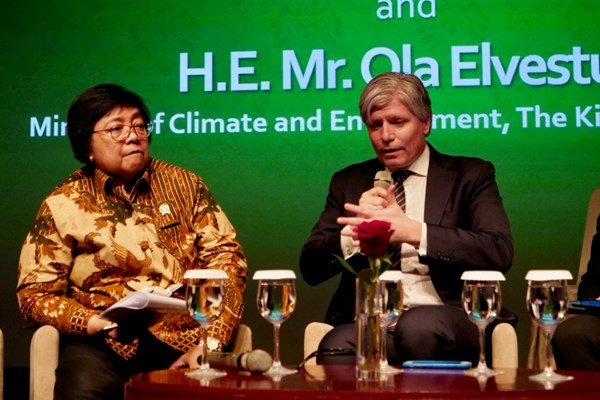
Meeting in Jakarta on Saturday, the Minister of Environment and Forests of Indonesia, Ms. Siti Nurbaya Bakar and the Minister of Climate and Environment of Norway, Mr. Ola Elvestuen, announced that the two countries were launching a new phase of their landmark bilateral climate and forest partnership that started in 2010. The two countries have agreed to the rules for results-based payments from Norway to Indonesia for reduced emissions. With that, Indonesia will be the largest rainforest nation to receive payments for reduced deforestation at the national level.

“I am glad during the last four years, the Indonesian government led by President Joko Widodo has managed to undertake a series of corrective measures in the forest and land use sector. The bold measures have resulted in significant reduction of deforestation, forest degradation, as well as GHG emissions”, said Minister Siti Nurbaya.

The Minister of Environment and Forests of Indonesia, Ms. Siti Nurbaya Bakar and the Minister of Climate and Environment of Norway, Mr. Ola Elvestuen. Credit: Snorre Tønset

She added “I’m also pleased that Indonesia and Norway have agreed on the rules for results-based payments. With these developments, we are ready to step into the third phase of the partnership, in which emission reductions on the field is rewarded by Norway.”

“Indonesia has embarked on bold regulatory reforms, and it is showing results”, said Minister Elvestuen. “It may be too early to see a clear trend, but if deforestation continues to drop we stand ready to increase our annual payments to reward Indonesia’s results and support its efforts.” The minister’s remarks came at the end of a successful weeklong visit to Jakarta and a West-Papua, where he met Governor Dominguus Mandacan and visited mangrove forests.

Indonesia has implemented a number of critical reforms and actions in the forest and land use sectors over the last few years. The government has introduced new measures to protect forests, including a ban on destroying primary forests and peatlands. In 2018, president Jokowi announced a policy to drive future increases in palm oil production from existing plantations instead of opening new forest areas. Indonesia has embarked on a comprehensive legal review of existing forestry and agriculture concessions, and increased law enforcement efforts against forest crimes. Importantly, the adat and other local communities have gained rights to land.

Following an independent third-party verification of the annual emission reduction numbers Indonesia presented today, Norway will guarantee payment for a portion of the result. Assuming the verified result matches the reported result for 2016-17, the first payment would be for approximately 4.8 million tons CO2. In 2010, Norway pledged to support Indonesia with up to 1 billion USD depending on results. So far, about 13% of this pledge has been spent to support the efforts of the Indonesian government to address deforestation.  

Indonesia has the world’s third largest tropical rainforest. The total emissions from deforestation and peatland destruction has put Indonesia amongst the world’s top emitters, but Indonesia has set ambitious targets for reducing its emissions from deforestation. It has called for international partnerships to increase its ambitious contributions to the Paris Climate Agreement and reduce emissions by up to 41% by 2030.

Forests are critical for meeting both the Paris Climate Agreement and many of the Sustainable Development Goals. Substantial actions on reducing emissions from deforestation are necessary if the world is to keep global temperature increase below 1,5–2 degrees.

About the new results protocol

  • Starting from the forest year 2016-17, results are estimated for reduced deforestation and forest degradation at the national level.
  • Results are measured against a 10-year historical average emissions level. For the period 2006- 16 that was estimated at approx. 237 mill tons CO2 per year from deforestation and approx. 42 mill tons for forest degradation.
  • Emission reductions from peat degradation and peat fires will be included in the results protocol in the near future, as estimates improve.
  • Indonesia will set aside 20% of the results to account for uncertainty, and another 15% to reflect its own ambition in reducing emissions. The remaining 65% of the results can be rewarded by Norway or other financiers.
  • Norway will guarantee payment for a portion of the available tons. Norway will not use emission reductions from Indonesia to offset its climate commitments.

https://www.regjeringen.no/en/aktuelt/indonesia-reports-reduced-deforestation-triggering-first-carbon-payment-from-norway/id2629504/

February 18, 2019 0 comments
0 FacebookTwitterPinterestEmail
Crimes

Norway Helicopter Crash: Two Confirmed Dead

by Nadarajah Sethurupan February 18, 2019
written by Nadarajah Sethurupan

Western Norway Emergency Services and Police on Monday announced Two People have been found dead after a helicopter crashed into a mountainside.

The civilian helicopter was reported missing on Sunday, triggering a search and rescue operation led by the Joint Rescue Coordination Centre for southern Norway.

The two people on board were a man and woman, both in their 40s, from the western county of Rogaland, public broadcaster NRK reported.

The terrain where the bodies were recovered was challenging and visibility was poor, the emergency services said.

“There were no signs of an attempted emergency landing,’’ Johan Mannsaker of the rescue centre told local daily newspaper, Bergensavisen.

The helicopter was a Robinson 44.

The planned flight was from a ski centre at Roldal to Karmoy, just north-west of the city of Stavanger.

The helicopter took off about 3.20 p.m. (1420 GMT).

The crash site was located about 2.5 kilometres north of Roldal.

The cause of the accident was not immediately clear.

Police have launched an accident investigation and inspectors from the national accident investigation board were also heading to the scene.

Initial reports said the helicopter’s emergency beacon was not activated.

The emergency services tried to trace a mobile phone linked to one of the passengers and were aided by a tracking device installed in the helicopter by a former owner, Mannsaker said.

February 18, 2019 0 comments
0 FacebookTwitterPinterestEmail
Asia and Norway

US slams Iran for blocking peace

by Nadarajah Sethurupan February 15, 2019
written by Nadarajah Sethurupan

US Special Representative for Iran Brian Hook underlined a difference between the US and Europe in dealing with Iran. While he said that no government participating in the Warsaw conference has defended the Iranian regime, he affirmed his country’s determination to tighten the grip on Tehran and its regional proxies.

Speaking to Media at the Middle East conference in Warsaw, Washington’s special representative for Iran Brian Hook said there had been extensive discussion at the meeting of the war, which is now in its fifth year.

While Hook accused Tehran of being the biggest obstacle to peace in the Middle East, he urged the regime to play a positive role in the process that seeks to bring an end to the conflict in Yemen.

“This conference was a very useful opportunity for us to educate the world about the very dangerous role Iran has played and continues to play in Yemen,” Hook said.

“We have a very good agreement that came out of Sweden, Stockholm, but we now need the will of Iran and Houthis to implement the agreement. That is the diplomatic role that we need to take and we very much urge Iran and the Houthis to take that role.”

Hook said Iran had “organized, equipped and trained” the Houthi militia, which seized the capital Sanaa in 2014 to spark the conflict.

“Iran has intensified, prolonged and widened the conflict in Yemen,” he said. “They have allowed this war to go well beyond the course it would otherwise take.”

Hook accused the Western media of missing the story of Iran’s involvement in Yemen. Weapons shipments from Iran have been intercepted heading to the Houthis on dhows and ballistic missiles fired at Saudi cities from Yemen have been supplied by Iran.

Below is a full rush transcript of a press conference by Brian H. Hook, Special Representative for Iran and Senior Policy Advisor at the Secretary of State.

Special Representative Brian Hook: Good morning from Warsaw. I thank everybody for joining the call.

Secretary Pompeo was very pleased with the Warsaw Ministerial in the last couple of days. It was an excellent forum for almost 70 countries from every region of the world to come together. We’re all nations who are concerned about instability in the Middle East. They were able to share their assessments and security, and offer ideas on a better way forward. We had a very ambitious agenda, and we had sessions on regional crises, how we respond to those crises, missile development and proliferation, cyber attacks, terrorism, illicit finance. It was a very broad and ambitious agenda, but I think that very much reflects the administration’s policy agenda in the Middle East.

We had a very high-level delegation from the United States which underscores the priority this administration is placing on our policy in the Middle East.

Secretary Pompeo said a number of times, but we recognize that every country attending is going to have different perspectives, and there will be times when their views conflict with our own. But we see this as essential to having a useful discussion, a useful debate. bringing together countries with some kind of interest in stability, stakeholders in the Middle East. The Middle East has a global impact, and I think that’s why we wanted to have a global ministerial, to bring a lot of countries around the world together. And really, it was a great chance for us to think about some old and recurring problems in new ways.

We re building consensus so that we are stronger and more united in the actions that we are taking going forward, whether that is something which is done [with] United States policy but also sometimes through a group of like-minded countries or multilateral.

Question: With the Iran, Turkey and Russian presidents meeting on Syria as the ministerial was being held in Poland, what can the Americans and their Gulf allies realistically hope to achieve in reducing Iran’s presence in Syria, Yemen, Lebanon, and the Middle East in general?

Special Representative Brian Hook: We did have an entire session at the Plenary dedicated to Syria. Secretary Pompeo led the discussion. We had a lot of key relations there, people who are very actively engaged in promoting an irreversible political process, and that included the Secretary’s Special Representative for Syria James Jeffrey. We reiterated our policy of doing everything we can to diminish Iran’s influence in Syria. It is very difficult to envision a peaceful and stable Syria with Iranian forces on the ground. I don’t think , for the constructive role that Iran plays in Syria’s future.
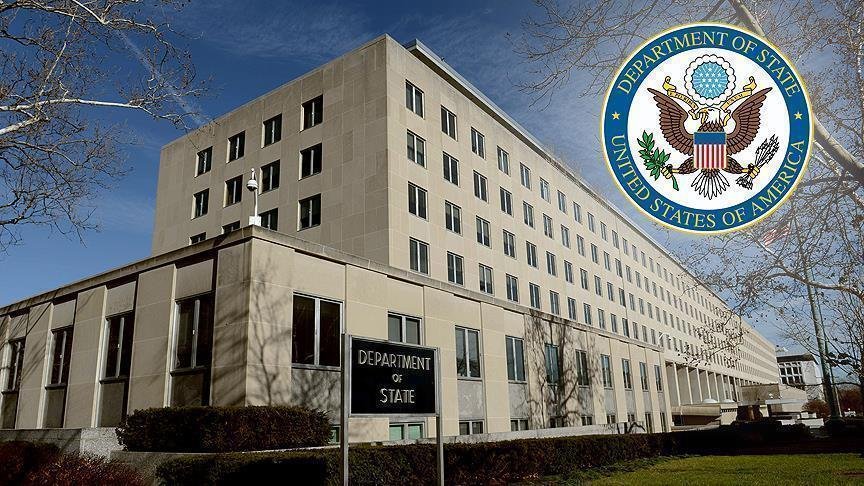
So we had a very long discussion about Syria. Very useful to hear the views of Arab Ministers from around the region. We also had Prime Minister Netanyahu there who spoke about what Israel is doing to prevent Iran from installing forward deployed missile bases.

What we notice is this pattern of behavior by the Iranian regime where they export missiles to other parts of the Middle East, and then either they or one of their militias fire those missiles onto countries that Iran has decided is an adversary. So whether it’s missiles and rockets in Lebanon that fly into Israel or missiles and rockets in Syria that fly into Israel, or missiles and rockets that fly from Yemen with the Houthis into Saudi Arabia.

So it’s the same kind of play book, and this is what in part this ministerial was designed to focus on, is to educate and to talk about the vast range of threats that Iran presents. I just described the missile aspect in Syria. It is the case that since 2013 Iran has spent $16 billion in Syria and in Iraq and in Yemen and no one is arguing that that is money well spent.

Question: U.S. ally Turkey did not participate in the meeting in Warsaw and has different opinions regarding Venezuela, Iran, and of course Syria. It’s not aligning itself with the U.S. I would like to know how you evaluate Turkey’s policies and what do you expect from Turkey?

Special Representative Brian Hook: Turkey was certainly invited to the meeting so you’ll have to, I guess, direct your question Turkey as to why they decided not to attend. But we were very happy to invite Turkey.

The Secretary has very regular and frequent discussions at all levels with Turkey. James Jeffrey has been very involved in his role as the Special Envoy. So we have very regular dialogue with Turkey. That channel is wide open. And with respect to why they didn’t attend, you’d have to ask Turkey.

Question: Prime Minister Netanyahu did an interview with Andrea Mitchell yesterday and said that in the Middle East Iran’s aggressions have to be countered now. Do you believe that you are making headway with regard to the Europeans coming on board in terms of implementations of sanctions going forward?

Special Representative Brian Hook: We have been very pleased with actions that Europe has taken on Iran, really at the time since the President has left the Iran deal. The President was out of the deal in May.

In June the Austrian, Belgian, French and German governments exposed the Iranian plot to bomb an opposition in Paris and they arrested several Iranian operatives. That same month the Netherlands expelled two Iranian diplomats in connection with the November 2017 assassination.

In July you had, Bavaria arrested an Iranian diplomat for his connection, his complicity with the bomb plots in Paris. September, French Foreign Minister Le Drian condemned Iran’s attacks on U.S. diplomatic missions in Iraq. And then also the same month France announced that it had frozen the nomination of [their] ambassador to Tehran in relation to the Paris bomb plot. October, France froze the assets of and two agents in connection with the bomb plot. Belgium extradited an Iranian from Germany for his role in the Paris attacks.

October, Serbia revoked visa-free travel for Iranian citizens. In October, Denmark recalled its ambassador to Tehran and condemned an Iranian plot to assassinate members of a dissident group in Denmark.

In November the E3 sent a letter to the UN Security Council raising concerns about Iran’s launching of short-range ballistic missiles on targets in Syria. In December France condemned Iran’s medium range ballistic missile launch.

Then in December you have the E3 — Poland, Netherlands and the EU raised concerns regarding Iran’s ballistic missile program at a meeting of the UN Security Council. I was at that meeting. Very pleased with the strong statements that those countries made about Iran’s ballistic missile program in clear defiance of the UN Security Council.

In December, Albanian expelled Iran’s ambassador and another Iranian diplomat for being involved in terrorist plots. In December the E3 sent a letter to the UN Security Council condemning Iran’s testing of the medium range ballistic missiles.

In January, the European Union for the first time since adoption of the Iran nuclear deal imposed sanctions on Iran in connection with Iran’s terrorism in both acts of terrorism and terrorist plots in Paris and in Denmark.

You had Germany in January announce that it is banning flights of Mahan Air. In January, you had German authorities arrest a German civilian who was working as a spy for Iran. In January you also had the Dutch, they announced for the first time that Iran was likely behind the murders of two Dutch citizens who were Iranian dissidents.

And that’s just in the last seven or eight months. So I think we’ve seen, an answering your question about what kind of pressure have we seen Europe place on Iran, and I think that list underlines a lot of the work that the United States has been doing to build greater international unity to respond to Iran’s acts of aggression and terrorism and the other threats to peace and security they present.

There is no question that we disagree with our European partners about the Iran nuclear deal, but when you look at the non-nuclear threats, the broad range of threats to peace and security that Iran presents, we share the same threat assessment with Europe and we’ve also seen Europe take a number of actions as all the initiatives that I’ve just described.

Question: Is the U.S. administration preparing countermeasures against INSTEX? And can you be specific?

Special Representative Brian Hook: This is a question I’ve received many times but I’m happy to answer it again. We don’t see any corporate demand for a special purchase vehicle to evade American sanctions. I think any international corporation that has links to the U.S. financial system is always going to choose the American market over the Iranian market. I think we’ve made clear, everybody understands that we will sanction any sanctionable activity. I think that point has been made very clear. We’ve backed that up. Since that time our sanctions have been reimposed. Treasury has issued sanctions against individual and entities who have violated our sanctions. And we’re doing that because we’re committed to our campaign of maximum economic pressure on the regime. It’s something which is a necessary thing to do if we want to deny the Iranian regime the revenue it needs to conduct its foreign policy, terrorism, and sort of its expansionist foreign policy that introduces a degree of sectarianism that would otherwise not be there.

Secretary Pompeo in May announced a new Iran strategy. We have made clear the kind of changes in behavior that we are expecting. Those 12 objectives reflect a global consensus prior to the Iran nuclear deal. If you look through that list it’s not too much to ask.

I think Iran has been behaving like an outlaw regime for so many decades that we’ve become desensitized to their activities, and we shouldn’t normalize Iran’s foreign policy. We shouldn’t accept it as just the natural order of things in the Middle East. And at this ministerial we were very pleased with the frustration that was expressed by so many countries from all over the world with Iran’s foreign policy and its regional aggression and its missile program, its missile testing, its missile proliferation, down the line. So we’re very pleased with the discussion we had here.

Question: President Trump last month appear to support President Erdogan of Turkey’s plan to establish a safe zone in Syria in territory now controlled by the Syrian Kurds. Could you tell me, is the U.S. still backing that policy by Turkey? And more broadly, what stage of discussions are you at with Turkey about your withdrawal from Syria? can you tell me what steps you are taking to ensure that the weapons intelligence and expertise that you’ve supported the Kurds with over the past are not going to be transferred to the Syrian regime once you withdraw, given that the Kurds are in discussions with Damascus at the moment?

Special Representative Brian Hook: You’ve asked two very good questions. We were originally scheduled to have my colleague, Ambassador James Jeffrey, on this call. Because of logistical complications we had to move the call time. So I’m going to stay in my lane and not answer a question in his lane. But maybe there’s a way that we can get your question to Ambassador Jeffrey and then we will have him follow up with you directly.

Question: Warsaw was the first international forum that includes Arab and Israeli leaders. Do you think it achieved any kind of progress and normalization between the two sides? And what kind of progress if any?

Special Representative Brian Hook: Yes, we did. We did see progress. Iran’s foreign policy has done an excellent job of driving Arab states and Israel much closer together. And when you look at the most urgent and pressing threats to the Middle East, if you want to get serious about the future of peace and security in the Middle East with what you’ve seen at this ministerial, you have to increase our focus on the threats that Iran presents. We heard that from key Arab states and we heard it from Israel. And we also heard it from countries from every region of the world.

There is a growing international unity, especially among Arab states and Israel, to resist Iranian aggression. And to restore deterrence against Iran’s expansionist foreign policy. Iran [turns] into a country, dissolves national identity, creates parallel systems of security and governance, and undermines regimes. We saw that first in Lebanon, and they have been trying to replicate that playbook around the Middle East to create a Shia corridor of power. You see that certainly in Bahrain. Iran has been undertaking efforts to overthrow the government in Bahrain since 1981. In 1979 with the Revolution, it introduced into the Middle East an entirely new dynamic. I don’t think the Middle East has recovered from it ever since. There is a, at this conference you heard a deep frustration with that and a desire to resist Iran’s hegemonic ambitions and to counter as best we can together Iran’s violent foreign policy and its foreign policy of terrorism and creating a climate of fear.

We heard coming out of this Warsaw Ministerial a real desire to not make this a one-off. We heard this from Arab states and from Israel. That we hope that this can create a foundation for greater coordination and cooperation and certainly you would organize that around the most pressing threats. The most significant security threat we face in the Middle East today is the Iranian regime. And it’s important to bring allies and friends together to talk about it and to deepen our cooperation. I think that’s a very important outcome from this ministerial. We want to, and we will have follow-on meetings from this. We want to create a foundation that can focus in a very timely fashion on these threats that Iran presents. That foundation of working together can create opportunities that could open the doors to other areas of coordination and cooperation that on the whole will promote a more safe and secure and prosperous Middle East.

Special Representative Brian Hook: Other than to say our deep appreciation for all of the 65-70 countries that came to Warsaw here. I think as some people know, this is the 100th anniversary of diplomatic ties between the United States and Poland. Poland put on an exceptional ministerial. It was a terrific gathering of nations that came together. Secretary Pompeo is very grateful to Poland for everything that they’ve done, and we look forward to building on the work that started here in Warsaw, and we’re very pleased with all of the outcomes of the ministerial.

February 15, 2019 0 comments
0 FacebookTwitterPinterestEmail
Norwegian Aid

Norway Announces €100,000 Voluntary Contribution to OPCW’s Trust Fund for Syria Missions

by Nadarajah Sethurupan February 14, 2019
written by Nadarajah Sethurupan

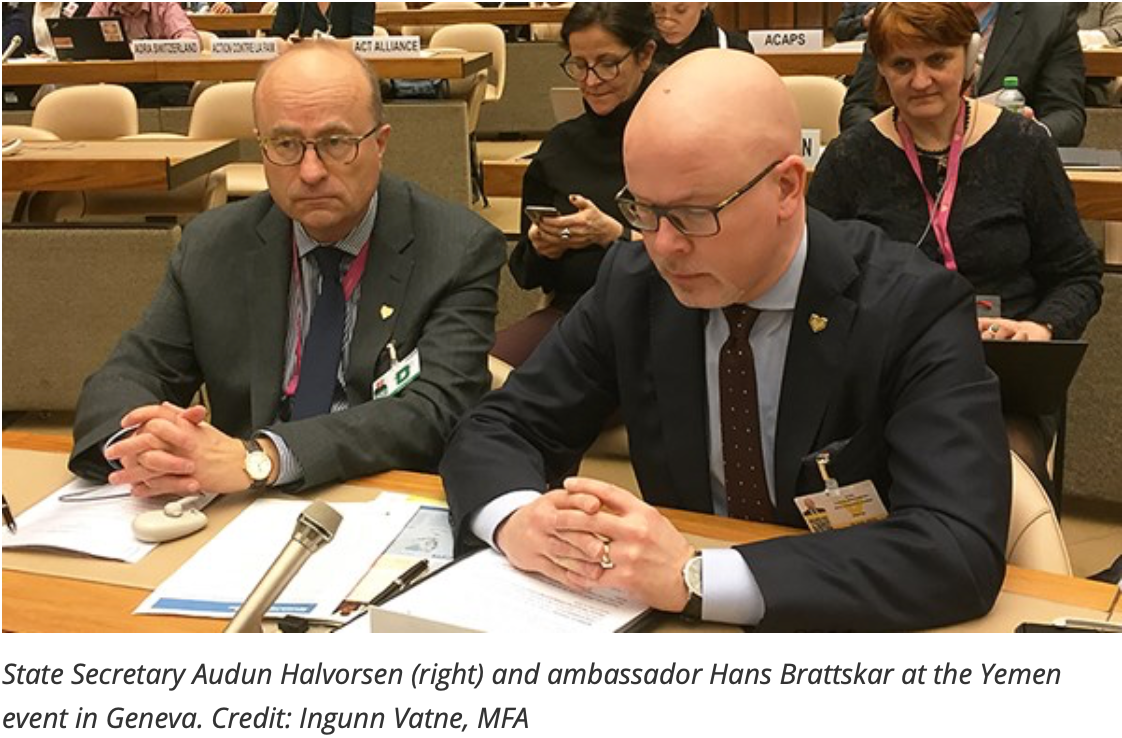
The Director-General of the Organisation for the Prohibition of Chemical Weapons (OPCW), H.E. Mr Fernando Arias, met with the State Secretary for Foreign Affairs of the Kingdom of Norway, H.E. Mr Audun Halvorsen, during a visit to OPCW Headquarters in The Hague today.

The Director-General and the State Secretary discussed progress in the implementation of the Chemical Weapons Convention (CWC), as well as the June 2018 decision by the States Parties to address the threat from chemical weapons use.

The State Secretary for Foreign Affairs of the Kingdom of Norway, H.E. Mr Audun Halvorsen

With reference to that decision, and in accordance with the Programme and Budget decision of the OPCW for 2019, the State Secretary announced a voluntary contribution of €100,000 from Norway to the Trust Fund for Syria Missions.  He remarked: “Norway has always been a strong supporter of the work of the OPCW to keep the world free of chemical weapons. This is now more important than ever. This grant will contribute to the identification of the perpetrators of chemical weapons use in Syria, and, hence, contribute to increased security and diminishing human suffering in Syria.” 

The discussions further focused on the implications of the recent Fourth Review Conference for OPCW’s future activities, and the expansion of the Organisation’s laboratory capabilities through the construction of a Centre for Chemistry and Technology.

The Director-General thanked the State Secretary for Foreign Affairs for the contribution and expressed: “The work of the OPCW is sustained by the humanity’s desire to live in a world free of chemical weapons and underpinned by the support of State Parties to the Chemical Weapons Convention. I want to express my thanks to Norway for its long-standing and staunch commitment to verifiably eliminating chemical weapons.”

Background

The Kingdom of Norway joined the Chemical Weapons Convention in 1997 and has actively contributed to a variety of OPCW’s programmes and projects.

As the implementing body for the Chemical Weapons Convention, the OPCW, with its 193 Member States, oversees the global endeavour to permanently eliminate chemical weapons. Since the Convention’s entry into force in 1997, it is the most successful disarmament treaty eliminating an entire class of weapons of mass destruction.

Over 96% of all chemical weapon stockpiles declared by possessor States have been destroyed under OPCW verification. For its extensive efforts in eliminating chemical weapons, the OPCW received the 2013 Nobel Peace Prize.

February 14, 2019 0 comments
0 FacebookTwitterPinterestEmail
Environment

PSA investigates Norwegian ice impact risk

by Nadarajah Sethurupan February 14, 2019
written by Nadarajah Sethurupan

The Norwegian Petroleum Safety Authority (PSA) has been assessing the potential for collisions between floating glacial ice and semisubmersibles in the far north of Norway.

Work has included studying interactions between a modeled body of ice and a semisubmersible platform.

The study, part of a wider program investigating structural safety in the region, looked at the likely points of impact and associated collision speeds.

It involved use of SAMS simulation software to draw up an energy map for the required energy absorption at possible impact points on the structure.

The calculated energy absorption was distributed between the ice and the structure, and damage assessments were based on the energy the structure was assumed to have absorbed.

For the model studied – encountering glacial ice of 15 m (49 ft) extent – the largest absorption energy was 7.32 MJ, which resulted in moderate damage to the hull. However, the PSA stressed that different ratios of stiffness and strength between a structure and ice will generate different conclusions.

Over the past few years there has been steadily increasing exploration drilling and field development activity in the High North, and at the same time discussions as to whether knowledge of the HSE challenges in the region is adequate.

The PSA has called for further improvements and has initiated a series of knowledge-gathering projects.

February 14, 2019 0 comments
0 FacebookTwitterPinterestEmail
Srilanka and Norway

Norway and FAO launch findings of the Nansen survey on Sri Lanka marine resources

by Nadarajah Sethurupan February 14, 2019
written by Nadarajah Sethurupan

National Aquatic Resources Research and Development Agency (NARA) and Institute of Marine Research, Norway (IMR) held an event to launch the main research findings of the survey carried out by the Norwegian Research Vessel Dr. Fridtjof Nansen in Sri Lanka in 2018. 

Norwegian Research Vessel Dr. Fridtjof Nansen successfully completed an ecosystem survey in the coastal waters of Sri Lanka from June 23 to July 16, 2018.

The survey was part of the EAF-Nansen Programme implemented by the Food and Agriculture Organization of the United Nations (FAO) in close collaboration with the Institute of Marine Research, Norway and funded by the Norwegian Agency for Development Cooperation (Norad). 

The survey was a result of Sri Lanka – Norway bilateral agreement to provide technical assistance to improve management of the fisheries sector in Sri Lanka and it provided training for Sri Lankan scientists and post survey data analyses.

The aim of the survey last year was to carry out a marine resources survey around Sri Lanka with the expectation that the survey should provide Sri Lanka with up-to-date data, which will be useful for future management of the country�s fisheries resources.

Welcoming the research findings, Ambassador of Norway to Sri Lanka and Maldives, H.E. Thorbjørn Gaustadsæther stated that Norway is committed to bilateral cooperation on oceans and to helping Sri Lanka put in place data based management of ocean resources, which will enable Sri Lanka to better monitor its fish stocks.

Ambassador Gaustadsæther also highlighted the importance of sharing these research findings with other Sri Lankan stakeholders both in the public and in the private sector to make informed decisions related to oceans and fisheries. He also reiterated the importance of Sustainable Development Goal 14 (SDG 14) on conserving and sustainably using the oceans, seas and marine resources to achieve Sri Lanka�s economic growth.

Ms Nina Brandstrup, FAO Representative in Sri Lanka said, the successful completion of this program in Sri Lanka is a testament to the longstanding relations between FAO, the Government of Norway and Sri Lanka. “The findings of the survey will be an important baseline for FAO in supporting Sri Lanka achieve sustainable management of fisheries resources amidst mounting pressures such as climate change and pollution.”

The visit of the RV Dr. Fridtjof Nansen was also an opportunity to highlight the longstanding development cooperation between Sri Lanka and Norway, especially in the field of fisheries, which started in 1971. The Norwegian fisheries cooperation with Sri Lanka includes fisheries management, research and education, and private sector development. From 2013 to 2017, NOK 11.1 million (approx. 1.3 million USD) has been disbursed for these activities.

P. Harrison, Minister of Agriculture, Rural Economy Affairs, Livestock Development, Irrigation and Fisheries and Aquatic Resources Development and Dilip Wedaarachchi, State Minister, Ministry of Fisheries and Aquatic Resources Development also highlighted the importance of the resource survey and its findings to take necessary management decisions.

Mr. K. D. S. Ruwanchandra, Secretary of the Ministry of Agriculture, Rural Economy Affairs, Livestock Development, Irrigation and Fisheries and Aquatic Resources Development, representatives of IMR, NARA, National Aquaculture Development Authority of Sri Lanka and a number of other government officials were present at the event.

February 14, 2019 0 comments
0 FacebookTwitterPinterestEmail
Farming

Norwegian salmon farm loses 2.8 million fish in fire

by Nadarajah Sethurupan February 14, 2019
written by Nadarajah Sethurupan

A fire at one of the world’s largest salmon farm killed almost 3 million fish. 

Norwegian firm Leroy Seafood said a blaze tore through its Laksefjord facility on the northern coast of the country on Sunday morning.

“Lerøy Seafood Group will continue to assist the subcontractor, the police and other public bodies in conducting an enquiry into what has happened. Initially the focus has been to obtain an overview of the situation, and implement mitigation measures,” the company said in a statement.

Hundreds of fish were lost in a blaze in Norway. EPA

It added that a maintenance contractor is listed as missing following the blaze.

“Large fire in an industrial building in relation to a salmon farm in Friarfjord,” local police tweeted on Sunday.

“Major resources have been deployed to the location which is some way outside of civilisation.”

Lerøy Seafood Group is Norway’s 35th largest company.

February 14, 2019 0 comments
0 FacebookTwitterPinterestEmail
NATO and Norway

NATO Deputy Secretary General visits Norway

by Nadarajah Sethurupan February 14, 2019
written by Nadarajah Sethurupan

NATO Deputy Secretary General Rose Gottemoeller traveled to Oslo on Monday (4 February 2019), to participate in the Leangkollen Security Conference organized by the Norwegian Atlantic Committee. She delivered a keynote address on “The Future of Transatlantic Relations: Security, Policy and Technology”, which was followed by a panel discussion with the Norwegian Minister of Foreign Affairs, Ine Eriksen Søreide. The Deputy Secretary General and the foreign minister had a short pull aside at the conference, discussing the upcoming Foreign Ministers Meeting in Washington in April and burden sharing within the Alliance.

During her visit, Ms. Gottemoeller also had a meeting with the Minister of Defence, Mr Frank Bakke-Jensen. She commended Norway for its continuous strong commitment to NATO missions, including their long-term engagement to the Resolute Support Mission in Afghanistan, to NRF and to the enhanced Forward Presence battlegroup in Lithuania. Ms. Gottemoeller reiterated the importance of the Wales pledge on defence investment, agreed by all Allies in September 2014. They also discussed the upcoming Meeting of Defence Ministers being held in Brussels later this month.

February 14, 2019 0 comments
0 FacebookTwitterPinterestEmail
Asia and Norway

Iraqi prime minister receives invitation to visit Norway

by Nadarajah Sethurupan February 14, 2019
written by Nadarajah Sethurupan

Iraqi Prime Minister Adil Abdul-Mahdi on Tuesday discussed with Norway’s Foreign Minister Ine Marie Eriksen ways to develop bilateral relations and benefit from the European country’s experience in the field of optimal use of oil resources.

During the meeting, Abdul-Mahdi praised the vital role played by Norway in the fight against terrorism in Iraq and its participation in the Kuwait’s donors conference for the reconstruction of areas liberated from Islamic State militants, Iraqi website Alghad Press quoted his media office as saying in a statement.

Iraqi Prime Minister Adil Abdul-Mahdi on Tuesday discussed with Norway’s Foreign Minister Ine Marie Eriksen ways to develop bilateral relations.

The premier further called for expanding support programs and training courses provided by Norway to hone skills of Iraqi security forces and improve the humanitarian situation of the displaced families.

For her part, Eriksen expressed “her country’s desire to reinforce relations with Iraq, increase opportunities of economic cooperation, and exchange visits between officials of the two countries to give a push to partnership between.”

She also conveyed greetings of the Norwegian prime minister to Abdul Mahdi and invited him to visit Norway soon. At the end of the meeting, Eriksen expressed pleasure at the development and stability in Iraq.

February 14, 2019 0 comments
0 FacebookTwitterPinterestEmail
Racism in Norway

Norway’s report on human rights to the UN

by Nadarajah Sethurupan February 14, 2019
written by Nadarajah Sethurupan

‘Norway’s third report to the UN Human Rights Council shows that the Government has done a great deal to strengthen human rights in Norway,’ said Minister of Foreign Affairs Ine Eriksen Søreide.

Under the Universal Periodic Review (UPR) mechanism, the human rights record of all UN member states is reviewed by the Human Rights Council once every five years. The review assesses the actions countries have taken to follow up their human rights obligations. Norway will be reviewed for the third time on 6 May this year, and the report is being presented in connection with this.

As part of the UPR, UN member states make recommendations to other countries regarding what should be done to improve the human rights situation. All countries receive recommendations and all countries can make recommendations. The reviewed countries can choose which recommendations to accept.

‘Since its last review, Norway has, among other things, implemented various measures to combat domestic violence and sexual abuse. We have also strengthened national complaints procedures for children. But, although Norway has made a lot of progress, certain challenges still remain. Improving healthcare services for prisoners with serious mental health problems is one such challenge,’ Ms Eriksen Søreide said.

The report that is being presented today gives an account of the steps Norway has taken to follow up the recommendations it accepted in the previous review in April 2014 and describes the general human rights situation in Norway.

‘The implementation of human rights obligations is a continuous process in all countries. The Universal Periodic Review provides a good basis for constructive dialogue on human rights between countries and with civil society. Norway makes active use of the UPR process to raise human rights issues in other countries. I would like to thank everyone who has contributed to the preparation of Norway’s third report,’ Ms Eriksen Søreide said.

February 14, 2019 0 comments
0 FacebookTwitterPinterestEmail
Environment

Oslo, Norway’s downtown goes virtually car-free

by Nadarajah Sethurupan February 14, 2019
written by Nadarajah Sethurupan

Oslo, Norway made its downtown practically car-free with notable positive results.

The city converted parking spots to bike lanes and added plants, tiny parks, and benches. Cars were banned on some streets, discouraging driving in the downtown.

Without cars, mass transit is more efficient, air quality has improved, and the streets are full of people. In 2015, the government proposed banning cars completely downtown, but resistance from merchants and others produced the alternative strategy of removing parking spots.

A few spots have been converted into parking for disabled drivers or EV charging, and some streets allow delivery trucks for a couple of hours in the morning. Most drivers have to park in garages on the fringe of downtown, and traffic restrictions prompt drivers who don’t need to go through the city center to take a ring road around it.

February 14, 2019 0 comments
0 FacebookTwitterPinterestEmail
Economics

Tesla’s Musk visits Norway to review delivery delays

by Nadarajah Sethurupan February 14, 2019
written by Nadarajah Sethurupan

Tesla’s Elon Musk visited Norway to review service in the automaker’s third-biggest global market where delays have upset customers.

Tesla doubled its Norwegian service staff last year to more than 360, seeking to resolve customer frustration at delays before delivering the new Model 3, a company spokesman confirmed two weeks ago.

Prices for the Model 3 vary depending on the country, with customers in Belgium paying a base price of 58,800 euros ($66,600), compared with 55,400 euros in Germany and 53,500 euros in France.

The automaker’s Norway operations are closely watched, as the country has the world’s highest number of electric cars per inhabitant thanks to generous government incentives for low-emission vehicles. Capacity shortages at Tesla have caused in long service queues, frustrating customers.

Tesla has 13 service centers in Norway and is working to get two more running as soon as possible, Musk said. The company also got approval for mobile service units last year, allowing it to test three of them through June.

Prices for the Model 3 in Europe vary depending on the country, with customers in Belgium paying a base price of 58,800 euros ($66,600), compared with 55,400 euros in Germany and 53,500 euros in France.

Tesla has cut the Model 3 sticker price in the U.S. twice this year to $42,900 to partially offset a reduction in federal tax credits.

Musk tweeted on Saturday that he was visiting in Europe over the weekend for the launch of the Model 3.

Besides Norway, he said he planned visit Tesla’s headquarters in Amsterdam, as well as the company’s European distribution center in Tilburg in the Netherlands and the Belgian port city of Zeebrugge. Musk’s tweet included an image of what appeared to be a number of Model 3s.

February 14, 2019 0 comments
0 FacebookTwitterPinterestEmail
Srilanka and Norway

Norwegian Ambassador Chief Guest at Advanced Materials conference at University of Jaffna

by Nadarajah Sethurupan February 14, 2019
written by Nadarajah Sethurupan

Ambassador of Norway to Sri Lanka and Maldives, Thorbjørn Gaustadsæther recently visited Jaffna to attend the International Conference on Advanced Materials for Clean Energy and Health Applications (AMCEHA), jointly organized by Western Norway University of Applied Sciences and University of Jaffna. 

Opening the conference as the Chief Guest, Ambassador Gaustadsæther highlighted the importance of creating fora to provide opportunities for exchange of research ideas and form local and global partnerships. About 500 local and foreign participants attended the conference.

During this visit to the North, the Ambassador also met with several government officials in the area such as Governor of Northern Province Dr. Suren Raghavan, Major General Darshana Hettiarachchi, Commander of the Security Force Headquarters – Jaffna (SFHQ-J), and A. Pathinathan, Chief Secretary, Northern Province. The Norwegian Ambassador also called on Bishop of Jaffna Rev. Monsignor Justin Bernard Gnanapragasam.

February 14, 2019 0 comments
0 FacebookTwitterPinterestEmail
NATO and Norway

Nato chief vows response to Russian missile pact violations

by Nadarajah Sethurupan February 14, 2019
written by Nadarajah Sethurupan

Nato’s secretary-general has warned that the military alliance will respond to what it insists are Russia’s violations of a key Cold War-era treaty – but will not station more nuclear missiles in Europe.

Jens Stoltenberg urged Moscow to return to compliance with Intermediate-Range Nuclear Forces (INF) treaty it agreed bilaterally with the US in 1987.

On February 2, Washington launched the six-month process of leaving the INF, insisting that a missile system Russia calls the Novator 9M729 – known at Nato as the SSC-8 – breaks the pact’s range requirements.

The INF bans production, testing and deployment of land-based cruise and ballistic missiles with a range of 500-5,500 kilometres (310-3,400 miles).

“Any steps we take will be co-ordinated, measured and defensive, and we do not intend to deploy new ground-based nuclear missiles in Europe,” Mr Stoltenberg told reporters at Nato headquarters in Brussels on the eve of a meeting of allied defence ministers.

He said the ministers will on Wednesday discuss “what steps Nato should take to adapt to a world with more Russian missiles”. He declined to say what measures are being considered.

“Moscow continues to develop and deploy several battalions of the SSC-8 missile,” Mr Stoltenberg said. “We all know that a treaty that is only respected by one side cannot keep us safe.”

The Pentagon believes that Russia’s ground-fired cruise missile could give Moscow the ability to launch a nuclear strike in Europe with little or no notice.

Russia insists it has a range of less than 500 kilometres, and claims that US target-practice missiles and drones also break the treaty.

President Vladimir Putin has announced he is pulling Russia out of the INF too.

European Nato members are especially keen to avoid any nuclear build-up and a repeat of the missile crisis in the 1980s. Nato allies decided to deploy US cruise and Pershing 2 ballistic missiles in Europe in 1983 as negotiations with Moscow faltered over its stationing of SS-20 missiles in eastern Europe.

The US ambassador to Nato, Kay Bailey Hutchison, sought to reassure them.

“Our allies want to know what the future will be, and the future will be that we will start the development of a defensive mechanism and we will keep our allies informed all along the way. We will consult at every turn,” she said.

February 14, 2019 0 comments
0 FacebookTwitterPinterestEmail
Environment

Norway’s radiation officials detect slight uptick of radioactive iodine in the air

by Nadarajah Sethurupan February 14, 2019
written by Nadarajah Sethurupan

Norwegian authorities have reported trace amounts of radioactive iodine 131 in the atmosphere, which emerged last week in measurements taken in the country’s far northeast near the city of Tromsø.

Officials with the Norwegian Radiation and Nuclear Safety Authority were at pains to emphasize that levels of the radioactive isotope were extremely low and posed no threat to human health.

But they added that the source of the iodine emissions remained unknown – though, as noted by the Barents Observer, the half-life of iodine 131 is only seven days, implying that the source of the higher measurements can’t be too far from Tromsø.

Radiation symbol. (Photo: Nils Bøhmer)

Iodine is widely used for medical purposes, and in research and industry, but it can also be a by-product of nuclear reactor accidents. It’s also linked to cancer when its found in high concentrations and can contaminate dairy products and produce.

Still, such harmless blips in radioactivity seem to occur in Norway on a routine basis and often become fodder for elaborate conspiracy theories. Such was the case in February of 2017, when a bevy of online nuclear enthusiasts, abetted by Russian websites peddling radiation intrigues, concluded that trace iodine measurements taken that month in Europe must surely indicate a hushed-up disaster at Norway’s Halden Reactor.

A report by Bellona was even drawn into the controversy and cited as proof that Oslo was scheming to hide a simmering catastrophe at the country’s single reactor – despite the fact that Bellona had said precisely the opposite.

The less dramatic solution to that whodunit was that the source of that particular iodine leak remains, unsettlingly, a head-scratcher to this day. Still, one can’t help trying to connect the dots. Yet another small-scale non-threatening iodine spike was reported the next month, in March of 2017.

The origins of this one, too, remain mysterious. However, the timing of the two iodine spikes, which occurred less than a month apart, suggested at the time that, somewhere, there must have been an ongoing leak of the isotope.

The Norway’s atmosphere remained, apparently, iodine-free until earlier this week, when the nuclear authorities reported a spike in levels of the isotope between January 8 and February 4.

Small upticks in iodine 131 levels have, in the past, indicated leaks of the substance from facilities that use the isotope for various scientific purposes. In 2012, a heightened amount of iodine detected over Europe was traced to a Hungarian laboratory that was manufacturing the isotope for use in nuclear medicine.

More ominously, iodine can be released by nuclear reactor malfunctions and accidents. Such was the case after the triple meltdown at Fukushima, when much of Northeast Japan was coated in the isotope contaminating mild and vegetables. No accidents in Europe or Russia, however, have been reported.

That said, it may take some time to establish the origins of this recent uptick in iodine levels – and in that time, the world of social media and armchair nuclear scientists may draw conclusions of its own. For now, the biggest consequence of the iodine presence is an uptick of the national pulse, which will, in time, like the iodine readings return to normal.

February 14, 2019 0 comments
0 FacebookTwitterPinterestEmail
Defence

Prince Harry meets helicopter crews in Norway

by Nadarajah Sethurupan February 14, 2019
written by Nadarajah Sethurupan

The Duke of Sussex has been meeting army pilots and ground crew from Suffolk who are on an extreme training mission in Norway.

Members of the Army Air Corps from Wattisham have been on a cold weather exercise at a Royal Navy base in the Arctic Circle. 

Prince Harry served with the Apache attack helicopters during his time in the army.

Prince Harry arrives at the military base Credit: MoD
February 14, 2019 0 comments
0 FacebookTwitterPinterestEmail
NATO and Norway

Nato response to Russian missile pact violations

by Nadarajah Sethurupan February 13, 2019
written by Nadarajah Sethurupan

Nato’s secretary-general has warned that the military alliance will respond to what it insists are Russia’s violations of a key Cold War-era treaty – but will not station more nuclear missiles in Europe.

Jens Stoltenberg urged Moscow to return to compliance with Intermediate-Range Nuclear Forces (INF) treaty it agreed bilaterally with the US in 1987.

On February 2, Washington launched the six-month process of leaving the INF, insisting that a missile system Russia calls the Novator 9M729 – known at Nato as the SSC-8 – breaks the pact’s range requirements.

The INF bans production, testing and deployment of land-based cruise and ballistic missiles with a range of 500-5,500 kilometres (310-3,400 miles).

“Any steps we take will be co-ordinated, measured and defensive, and we do not intend to deploy new ground-based nuclear missiles in Europe,” Mr Stoltenberg told reporters at Nato headquarters in Brussels on the eve of a meeting of allied defence ministers.

He said the ministers will on Wednesday discuss “what steps Nato should take to adapt to a world with more Russian missiles”. He declined to say what measures are being considered.

“Moscow continues to develop and deploy several battalions of the SSC-8 missile,” Mr Stoltenberg said. “We all know that a treaty that is only respected by one side cannot keep us safe.”

The Pentagon believes that Russia’s ground-fired cruise missile could give Moscow the ability to launch a nuclear strike in Europe with little or no notice.

Russia insists it has a range of less than 500 kilometres, and claims that US target-practice missiles and drones also break the treaty.

President Vladimir Putin has announced he is pulling Russia out of the INF too.

European Nato members are especially keen to avoid any nuclear build-up and a repeat of the missile crisis in the 1980s. Nato allies decided to deploy US cruise and Pershing 2 ballistic missiles in Europe in 1983 as negotiations with Moscow faltered over its stationing of SS-20 missiles in eastern Europe.

The US ambassador to Nato, Kay Bailey Hutchison, sought to reassure them.

“Our allies want to know what the future will be, and the future will be that we will start the development of a defensive mechanism and we will keep our allies informed all along the way. We will consult at every turn,” she said.

February 13, 2019 0 comments
0 FacebookTwitterPinterestEmail
Russia and Norway

U.S. Warns Turkey on Arms

by Nadarajah Sethurupan February 12, 2019
written by Nadarajah Sethurupan

“Our government is firmly in the camp of looking for an opportunity to have an arms control agreement that would include all the countries that have these intermediate ballistic missiles,” U.S. Ambassador to NATO Kay Bailey Hutchison said during a telephone conference, a day before the alliance’s defense ministers meet in Brussels. “Now America is going forward with the treaty protocol to give notice that we need to begin to develop a defense to the violating missiles that Russia has been developing.”

“We are very concerned about any kind of Russian missile defense in one of our alliance countries,” Hutchison said. “The whole alliance is concerned about this and we hope that Turkey will make the right decision and look for another system.”

U.S. Ambassador to NATO Kay Bailey Hutchison briefs the media ahead of a NATO defence ministers meeting at the Alliance headquarters in Brussels, Belgium, October 2, 2018. REUTERS/Francois Lenoir

Below is a full rush transcript of the press conference by Ambassador Kay Bailey Hutchison, U.S. Permanent Representative to NATO.

Ambassador Hutchison: I’m happy to be able to welcome Acting Secretary of Defense Shanahan to Brussels tomorrow. We are looking forward to a productive and very good Defense Ministerial. It will be his first, of course. We are really going to have a good schedule.

Certainly, first of all, we will welcome the accession protocol for North Macedonia. As many of you know, we have been looking forward to working with Macedonia and having them come into NATO. They have now started that process, working together with our ally Greece. They are now in the process of coming into NATO and each parliament of our member states will be asked to agree to this. I am very supportive, our country is very supportive of Macedonia becoming the 30th member of NATO when all of the ratifications have been completed.

We will be talking about the INF Treaty. As many of you also know, we have been working with Russia for over five years and have documented since 2007 that Russia has tried to withdraw from the treaty, wanted to, and America tried very hard to stay in the treaty, to make sure that both sides were complying. But unfortunately, we began to see the evidence that Russia was not complying, that they were in fact building a missile that violated the treaty starting in the mid-2000’s. Now America is going forward with the treaty protocols to give notice that we need to begin to develop a defense to the violating missiles that Russia has been developing.

We will be talking about defense investments. I think that the allies have made great strides in beginning to step up with more in burden sharing. We have what we call the three C’s — Cash, Capabilities and Contributions — to make for a strong alliance.

On the cash side we’re asking, and all of our allies have committed in the past to go toward two percent of their defense spending in their countries so that we do have capabilities that we must have to be a strong alliance.

The capability targets are 20 percent of the two percent, and that is the airplanes and the submarines and the ships that we all know that collectively we will need for a strong defense.

The contributions are the contributions to the mission of NATO. Our allies are stepping up in all three areas, and we’re very pleased to have a good report. We’re not where we want to be in the end, but we have made huge progress since 2016 and I think by the end of 2020 we expect to have an increase from all of our allies of $100 billion which has been verified by the data that we have received in the national plan. And by 2024 we expect the majority of allies to meet the full pledge and look for over $300 billion, more like $350 billion according to the national plans that have been submitted.

So this is a huge step in the right direction, and we are working towards the goal being reached as soon as possible for the strength of our alliance.

We will be talking about deterrence and defense and the capabilities that we are trying to achieve. We have a target of what we call the four 30s. That’s 30 battalions, 30 air squadrons, 30 ships in 30 days, wherever they are needed. That is a very bold goal, but one that we have established that we will have.

We will be meeting with our European allies, our EU allies along with the issues that we are working on together — certainly our military mobility — so that we can achieve the 30 days getting through the European countries if we are ever called to do so.

And we will be talking about telecommunication security. As we are going toward — all of us — a stronger network and the most current technology, we are looking at security efforts and assessing where we are and what we need to be doing there.

The last major part of our Defense Ministerial will be discussing Afghanistan. Ambassador Khalilzad, who is the U.S. Special Envoy into Afghanistan for the peace process, was here yesterday with our whole Resolute Support Mission group of 41 to talk about where we are in the peace process. I think that he is breaking new ground, but we certainly know that we are not where we need to be at this time, but we are going in the right direction.

That will be the basic schedule for our Defense Ministers. It will be a very information packed and conversation packed ministerial, and we are looking forward to welcoming all of the Defense Ministers to NATO.

Question: As you mentioned the protocol for Northern Macedonia joining NATO, could you give us some overview, when is the United States Senate going to ratify this document? And what are your expectations, how smoothly this process is going to go by your opinion in all 28 parliaments, having in mind that Greece has already ratified the protocol?

Ambassador Hutchison: I think that we will have a smooth transition. All of our governments have been consulted, and every one of us that is at NATO that signed the protocol did so with the support of all of our governments.

Of course the parliaments must act, and we believe that our parliaments will be in support. The time line has not yet been set. It has not been formally put on the schedule yet. But we would probably look towards the end of the year as the time line when all of the parliaments that have different schedules and different session times and different processes, we would hope that by the end of the year that this would be complete and we’re all very much looking forward to welcoming our 30th member.

Question: whether you think there is significant risk to NATO from anti-democratic governments within the alliance, particularly Hungary and increasingly Poland and Turkey. And if you do believe there is a risk, what should NATO do about it? Thank you.

Ambassador Hutchison: All of us are aware that there are certain parts of the democracies in our alliance that have been changed or amended or in a different position. NATO has never taken up an issue that is a direct intervention in any kind of way, but we are always encouraging a better democratic value. There are different issues in different countries. That probably will always be the case. But these are democracies, they do have elections, and the people speak. So we, the United States, certainly are counseling with allies when we see areas that are of concern. We do that on a bilateral basis, and I know other countries do that with each other as well.

There’s no formal process, but I will say that every one of our allies is a strong supporter of NATO. There has never been a question of that. And the significance of the alliance contributions both in missions as well as the cash and capabilities is the unity and the strength that we have. Everything is not perfect, but we are a strong and unified alliance that is very capable of providing this security umbrella that was the original mission for the alliance.

Question: I wanted to come back to the INF Treaty, and I just wanted to know if the U.S. are ready to negotiate a new treaty with Russia and to open up the treaty to other countries like China.

Ambassador Hutchison: The U.S. has said, in fact all along, that we would welcome a new treaty that includes all the countries that have the ballistic missiles that would be a violation of the treaty. Only Russia is the one that is a party to the treaty, but there are other countries that have missiles that would violate.

We are for nuclear disarmament, we’re for arms control, we are for nonproliferation, and our government is firmly in the camp of looking for an opportunity to have an arms control agreement that would include all of the countries that have these intermediate ballistic missiles.

With all of the new technology and defense capabilities that many countries have, arms control is very high on our agenda when all the parties are compliant.

Question: Russia accused Norway of pushing ahead with a military buildup, saying it requires some sort of Russian response. How do you see Russia’s reaction as Norway is a member of NATO?

Ambassador Hutchison: I’m not totally familiar with what exactly happened in that situation, but we do know there have been some hiccups in the past with overflying and those have been deconflicted in an appropriate way, and we would certainly work toward deconflicting any kind of transgression that would happen between those two countries.

Question: The policies regarding Venezuela, Iran or S-400s from Russia, Turkey is aligning itself with countries confronting the U.S. How does this affect the functioning of the alliance and defense cooperation? Are there any discussions about a possible NATO role in protecting Turkey ?

Ambassador Hutchison: To your last question, there is no role of NATO being discussed right now. However, I will say from the United States standpoint, we are very concerned about any kind of Russian missile defense in one of our alliance countries. We are urging Turkey not to go forward with that because it will affect the types of defenses that we can have in Turkey if they buy a Russian missile system that would in any way be capable of either disrupting our interoperability or in any way allowing for any of our alliance security or intelligence to be in any way violated.

So it is very troubling. The whole alliance is concerned about this and we hope that Turkey will make the right decision and look for another system, which we know Turkey wants to have its own sovereignty and security for internal needs, but we would ask that they go in with a neutral or allied country in that regard.

Question: Denmark has recently made additional defense commitments that would bring the Danish defense spending up from 1.3 to 1.5 percent of GDP in 2023. I’d like to know whether from an American point of view that is sufficient progress right now? Or is it too little?

Ambassador Hutchison: I think that we want Denmark to be a full contributing partner. I will say that Denmark does very much on the capability side and on the contributions to our missions, and we certainly acknowledge that. They are a strong partner in every respect, but we would hope that they would continue to go further toward the two percent commitment that was made previously. That is part of the strength of our alliance, that they would do so.

Question: What do you think about the European Intervention Initiative, and can it complement NATO?

Ambassador Hutchison: We certainly hope that it will be able to complement NATO. And we hope that it will not be duplicative of NATO.

The initiative for the European countries to be able to work together to strengthen their defenses is a good one, as long as it doesn’t in any way encroach on or duplicate what NATO is doing because we want all of our dollars to be used for efficiency as well as for assuring the strength of our collective defense.

Question: There is a crises let’s say in connection with Kosovo and the United States. General Timothy Orr has suspended his visit to Kosovo because of the tariffs on Serbian goods. Do you think this is exactly the right thing to do? And my second question is, there are many people saying that Kosovo in the future is going to be the very first member of NATO. Do you think this could be real, this could be happening?

Ambassador Hutchison: I don’t know about a tariff on the products. I can’t answer that question, I just don’t have the information.

On the area of Kosovo, however, we are working with Kosovo to try to assure that as they move forward that first of all they have a strong and normalized relationship with Serbia. That would be in both countries’ interest. And secondly, that there be in all respects with the new Kosovo Security Force that minority members and rights would be respected. Kosovo must continue to work toward reform, work toward inclusion with its minorities, and NATO is going to be helpful in every way possible as they are setting up this security force and as we hope that they are also instituting the reforms for a strong democracy and rule of law and human rights protection. Those are the things that are so important for any future NATO member and most certainly for the future of the strength of the governance and democracies and freedom of the people who live in those countries.

Question: U.S. military leaders in Germany confirmed that they are evaluating stationing more U.S. troops and materiel in Poland. Will this be at the expense of installations in Germany, especially Ramstein Air Base?

Ambassador Hutchison: We have a very large number of forces and bases in Germany that we don’t expect to change. And in fact NATO is setting up another secondary hub in Germany for our military mobility and logistics. That’s in our new command structure, that there would be a new division in Germany as well as another one in America for maritime.

So there’s nothing that will be less in Germany that we have heard of or have discussed.

On Poland, certainly Poland has made an offer that is being considered and it’s not clear exactly how that’s going to go forward. It’s under advisement now in the Department of Defense to see what could be helpful in Poland, but it would not be at the expense of Germany.

Ambassador Hutchison: I appreciate the questions and the interest. We are looking forward to a very good Defense Ministerial. And as I said earlier, we’re looking forward for our colleagues to meet the Acting Secretary of Defense Patrick Shanahan, who is very much looking forward to meeting all of his colleagues and getting to know them so that they can have open lines and a lot of communication.

So thank you very much for your interest, and I’ll look forward to maybe seeing some of you in the next few days.

Thank you.

February 12, 2019 0 comments
0 FacebookTwitterPinterestEmail
Srilanka and Norway

Sri Lankan National Day celebrated in Norway

by Nadarajah Sethurupan February 11, 2019
written by Nadarajah Sethurupan

The Embassy of Sri Lanka in Oslo celebrated the 71st Anniversary of National Day of Sri Lanka with the Sri Lanka’s Ambassador in Norway H.E. Prof. Arusha Cooray and Religious representatives ,delegations, Norwegian Foreign Ministry officials.

Sri Lankan national day , has been celebrated annually on 4th February to commemorate independence from British rule in 1948. Since then Sri Lanka is heading toward progress, development and is on the path of rapid economic growth.

The event was well attended by the community, Tamil, Muslim and Sinhala diaspora members , diplomatic corps, Norwegian Foreign Ministry, and other officials.The traditional observances including the lighting of the lamp, hoisting of the flag, playing of the national anthem and religious observances were performed. The event showcased Sri Lanka products, and Sri Lanka culture with dance performances.

The number of participants was great therefore, the hall and the corridor became insufficient to cater the guests which were invited at the reception . Cultural dances made the event more fascinating and mesmerising. The guests were amazed by the Performance on this auspicious occasion. The performances successfully portrayed Sri Lanka’s culture, traditions and lifestyle.

Sri Lankan classical dance is famous all around the world. There are three main styles of Sri Lanka dance which differ in their styles of body-movements, in the costumes worn by the performers and in the shape and size of the drums used to provide the rhythmic sound.

The Kandyan is the dance of the hill country. It is also known as Uda Rata Natum. The low country dances (Ruhunu ) of the southern plains is known as Pahatha Rata Natum , the third is Sabaragamuwa Natum. The main distinguishing feature between Kandyan and Saharagamu and Ruhunu is that Ruhunu dancers wear masks.

The Ambassador highlighted Sri Lanka’s achievements including the country’s high human development levels, promotion of SDG goals, blue-green budget, and the Sri Lanka governments’ strong commitment to the welfare state.

The Ambassador also mentioned the strengthening of ties between Sri Lanka and Norway, and thanked the Norwegian government for their continued support. She went on to mention the importance of reconciliation by embracing Sri Lanka’s diversity.

February 11, 2019 0 comments
0 FacebookTwitterPinterestEmail
Russia and Norway

World War 3 WARNING ?

by Nadarajah Sethurupan February 7, 2019
written by Nadarajah Sethurupan

The Pentagon will begin researching and developing intermediate range missiles after the US withdrawal from the Intermediate-Range Nuclear Forces (INF) Treaty and will consult with allies on how the new weapons will be used, Undersecretary of State for Arms Control and International Security Andrea Thompson told reporters on Wednesday.

“Now the Department of Defense [DoD] will be able to to conduct those research and development activities banned under INF [Intermediate Nuclear Forces] treaty,” Thompson said. “So DoD will start those steps on building those systems they couldn’t before.”

“The president will fund every system that we need to ensure that we have security and safety of the American people and our partners and allies”, Thompson told reporters during a video conference.

Allied and partner nations will be consulted before, during and after the process, Thompson added.

U.S. Undersecretary of State Andrea Thompson argued in Wednesday’s phone call with reporters that there is enough time to discuss the treaty’s extension.

“We have until 2021,” Thompson said. “It is a relatively simple treaty to extend, so we have time with that.”

The United States , Russia and France have test-launched nuclear-capable missiles within hours of one another as fears rise of a return to a Cold War-era arms race amid the abandonment of the Intermediate-Range Nuclear Forces (INF) Treaty.

The French military announced Tuesday its air force conducted a rare test Monday of the nuclear-capable medium-range air-to-surface missile (ASMP). The US then followed with firing a nuclear-capable Minuteman III intercontinental ballistic missile on Tuesday night. Shortly after, Russian armed forces fired a nuclear-capable RS-24 Yars ICBM.

Tensions are high following President Donald Trump’s announcement to abandon the INF treaty with Russia.

The INF treaty has been suspended following accusations from the US that Moscow violated the deal with the new Novato 9M729 missile.

The purpose of the treaty was to avoid a potential nuclear war as it prohibited the US and Soviet Union from stationing short and intermediate-range land missiles in Europe.

The 1987 treaty eliminated the medium-range missile arsenals of the world’s two biggest nuclear powers, but leaves other countries free to produce and deploy them.

Below is a full rush transcript of the press conference by Andrea L. Thompson, Under Secretary for Arms Control and International Security.

Under Secretary Thompson: Wonderful. Again, an important announcement last week from Secretary Pompeo and from the President, and I am just back from Beijing where I met with my Russian counterpart, so I look forward to taking your questions.

Question: What are the U.S. future plans regarding the control of nuclear arms and the further relationship with Russia?

Under Secretary Thompson: For the control of nuclear arms, there is no change for the United States. We continue madridbet to uphold our obligations and the standards that we’ve set.

I mentioned previously, I just returned from the P5 in Beijing where we talked about the importance of nonproliferation and the standards for our nuclear weapons and our nuclear programs. I had those discussions with my Chinese counterpart, my Russian counterpart, Brit and French. So those standards remain unchanged. A steadfast commitment to upholding our obligations with that.

And our relationships with Russia. I mentioned the same thing to the Deputy Foreign Minister. I am a diplomat. Our job is never done. Dialogue remains an important piece, and diplomacy is key and essential to that.

Again, it’s the responsibility for Russia to get back into compliance, but we’ll continue to engage where appropriate.

Question: Is there a possibility for the U.S. to deploy missiles in Europe, which are forbidden under the INF Treaty now or after August 2nd?

Under Secretary Thompson: We’ve worked hand-in-hand with our partners and allies on next steps. We made mention as well to our counterparts that the conventional weapon systems, the R&D that we’ve talked about that we’ve been in compliance with the Treaty. The Department of Defense will now move out on that. Again, we’ve been following the rules since 1987 while Russia in the last six-plus years has violated that treaty.

The Department of Defense will start those R&D efforts, but there’s no plans to do that. The most important thing to remind folks is we’ve done this, we’re partners and allies. We engaged early and often as partners and allies. After I met with my Russian counterparts in Geneva January 15th, the next day we flew to Brussels to meet with the Secretary General and our NATO partners and allies to continue to have those discussions with partners and allies, so no change for that.

Question: Why did the U.S. not offer Russia access to its land-based Aegis system in Romania as a confidence-building measure? In return, the U.S. could demand access to Russia’s SSC-8 missile systems. It might be a way to save the INF Treaty.

Under Secretary Thompson: It’s important to remember the United States remains in compliance with the INF Treaty. Our systems are INF Treaty compliant. So there’s no reason to look at systems that are compliant.

I’d also add that with our partners and allies no one, and again I reiterate, no one other than Russia has come forward to way the U.S., these systems aren’t treaty compliant.

I’d also like to remind folks that the transparency, and I call that loosely, the transparency measures that were raised by Russia clearly were not transparency measures. Our static display of a system does not tell you how far that missile can fly. The static display of a system does not tell you what the fuel source is.

So Russia tried some propaganda, a last-ditch effort, bringing the system out, the SSC-8, the 90729 for the Russian system. Again, people called it what it was. It was a show. The people that came to watch it were not allowed to ask questions and it didn’t prove or disprove anything of the treaty violations.

We’ve shown Russia, handed them the list of things they need to do to get back into compliance multiple times, as have partners and allies, and they continue to disavow that violation.

Question: To what extent is Washington’s decision to withdraw from the treaty motivated by concerns over China’s nuclear arsenal, and the fact that it falls outside of the INF? And another question, would Washington support a multilateralized INF Mark II Treaty to rope in China, India, Israel and other countries with nuclear arsenals?

Under Secretary Thompson: The INF Treaty is about Russia. The decision on the INF Treaty is about Russia and Russia’s failure to abide by the tenets of the treaty.

Again, I remind folks that we’ve worked across two administrations, almost six years, 30-plus engagements with our Russian counterparts describing the importance of getting back into compliance. So this decision on the INF Treaty was clearly about Russia, continues to be about Russia. They have six months to get back into compliance.

I also recognize that China has quite an arsenal that isn’t INF Treaty compliant. Their systems would not meet the standards of the INF Treaty. So that’s discussions in the future, but as I remind folks, the INF Treaty today, for the next six months, is all about Russia.

Question: Did you receive any signals from China regarding their willingness to negotiate an arms control treaty that includes them?

Under Secretary Thompson: I’ve not. I just returned back from Beijing. I was there, again, for our P5 conference and China did not raise that. I don’t anticipate that they will raise that, again, because their systems wouldn’t meet the INF Treaty. They’ve already exceeded that. So the short answer is no. They didn’t raise that issue.

Question: How would the U.S. withdrawal from the INF Treaty affect the security of the Baltic states? Would you expect a stronger militarization in the Kaliningrad Oblast?

Under Secretary Thompson: I was in the Baltics last year. I’ve been in the Baltics twice now with this administration. Once with the Vice President, and once as Under Secretary. Important partners, they continue to be important partners.

And as I remind folks, the system that Russia has fielded, the SSC-8, again from the NATO nomenclature, this isn’t a prototype. This isn’t in a lab. This isn’t in a warehouse somewhere. These are fielded battalions, multiple battalions across Russia that can range our partners and allies now.

So the decision was made for us to withdraw from the INF Treaty, again, so we can build the systems that will defend Americans at home and abroad and work with our partners and allies. Again, as I remind folks, the Russian system is already fielded. It can range our European partners today.

Question: What was the U.S. reaction to the statements made by Russia that it will leave the INF Treaty as well, and is going to develop new missiles? Will you try to conduct any negotiations with Russia after that? Or is the U.S. planning to do something else?

Under Secretary Thompson: Russia left the INF Treaty years and year ago. Russia left the INF Treaty when it decided to design and deploy systems that violated the treaty. We’ve had engagement, we’ll continue to have engagement, but where the announcement of late with President Putin saying that he’s leaving the treaty, the truth of the matter is it’s more Russian propaganda. They left the treaty years ago when they decided to design and field the system.

Question: Given the situation around the INF Treaty, is the New START Treaty also in jeopardy?

Under Secretary Thompson: New START — again, the premise of arms control, and I like to remind folks of this as well when they talk about the INF Treaty and New START. Arms control only works if the parties adhere to the standards that they signed up for. And when you allow violations of those treaties to occur you undermine the principles of arms control.

So again, year after year Russia has violated the INF Treaty. We have an obligation to call them out, hold them responsible.

That said, we’ve both met our central limits for the New START Treaty February of last year. Both are in compliance.

The other point to raise with some folks that may not be familiar is the New START Treaty is in effect for two more years. We have until 2021. It is a relatively simple treaty to extend, so we have time with that.

The important piece here is to work the INF Treaty, to ensure that arms control continues to maintain those standards and where appropriate take action when they’re not.

Question: Is the U.S. considering extra deployments of non-INF compliant missiles in Europe? And if so, what, where and when?

Under Secretary Thompson: First, that’s an answer for our partners over at Department of Defense. As we mentioned with suspension and intent to withdraw, but now the Department of Defense will be able to conduct those research and development activities that they hadn’t because we’d been complying.

So DOD will start those steps on the systems that they couldn’t before.

The other important piece to mention is this is in connection with partners and allies before, during and after. So that dialogue will occur with Department of Defense and our partners.

Question: Russia’s Minister of Defense yesterday stated that they will create new land-based missiles within the next two years. Is the U.S. going to respond with similar steps?

Under Secretary Thompson: The U.S. doesn’t do things based on reactions for Russia. We take actions that will support and defend the security of the American people, whatever that takes. We’ll develop systems and we’ll continue to refine and innovate those systems that increase the security of the American people.

We have a wide range of adversaries, but at the end of the day it’s not important. Protecting American people, we’ll do what it takes to do so.

Question: What is your assessment of the threat from Russia’s Poseidon system which is designated by NATO as Kanyon, the nuclear-armed autonomous torpedo?

Under Secretary Thompson: Well, we have a full range of threats, Russian and others. Again, the important thing to remind folks is that we have the strongest military in the world. We have in the past, we have currently, and we’ll continue in the future. You heard it from President Trump last night in his State of the Union Address, he will continue to fund the systems necessary and we have the strongest military. And again, I don’t give much credence to the propaganda of Russia. I have utmost faith and confidence in the United States military.

Question: After Russia has suspended its participation in the INF Treaty, what immediate measures should be taken to ensure Euro Atlantic security? Do you see any international and multilateral format for new arms control treaties to keep nonproliferation under control?

Under Secretary Thompson: We currently have a strong arms control regime. Again, I just mentioned the P5 discussions. We have had meetings at my level, at the Secretary’s level, the technical experts. I’ve been at NATO multiple times at those levels.

So the relationship is there. I’m confident that will continue to be. There are multilateral organizations and we have strong bilateral relationships. You’ll see Defense Ministerials, you’ll see the 2+2 Dialogue with the Ministers of Defense and Foreign Affairs. So we’ll continue with that. It’s one of the strong suits of our relationship.

Question: President Trump said in the State of the Union that the U.S. wants to negotiate a new agreement to replace the INF, “adding China and others”. Have you decided on whom else to invite to join the negotiations? And how soon may you issue the invitations?

Under Secretary Thompson: Actually what he said was maybe we will, maybe we won’t negotiate a new deal. So it’s too soon to tell. Again, right now we’re in that six-month window engaging with Russia to get them back into compliance with the INF Treaty.

Question: What will the response to the announced improvement of the Caliber systems and hypersonics missiles be?

Under Secretary Thompson: Again, I go back to the discussions we had a little bit earlier with Department of Defense and the President. The President will fund every system that we need to ensure that we have the security and safety of the American people and partners and allies. You’ve seen it in his budget, you’ve seen it in his actions, and the Department of Defense will move out accordingly.

So with a wide range of worldwide threats, at the end of the day the United States is best postured to address those threats.

Question: What do you say to European countries that are worried about being caught in a new arms race between the United States and Russia?

Under Secretary Thompson: What I’d say to our European partners is first, Thank you for your partnership. We saw a strong NATO statement not only in December when Secretary Pompeo made the announcement about a suspension, and then the statement last week with the follow-up with a very strong NATO statement.

That’s a telling indicator of our relationship with our European partners and allies. They continue to call out Russia. Not one country has said, you know, you’re right. Maybe Russia isn’t in violation. So that’s another indicator of the strong relationship that we have.

I also tell folks that the systems that Russia has can range them today. So this isn’t a discussion of what if, what if they build a system? The system’s already there. So we need to continue with our partnership, continue with next steps, but remind folks, this is Russia’s violation and it’s up to Russia to destroy the systems that are a threat to the U.S. and our partners.

Question: What control mechanisms could be set in the future should other countries with missile capabilities be included?

Under Secretary Thompson: With the control systems, again, arms control writ large is working. We have standards. We uphold those standards. And it’s recognized worldwide. We have multiple forums where we discuss the importance of fulfilling our obligations. And as you’ve seen, the party that is destroying that reputation is Russia.

So we’ll continue to uphold those standards and we’ll continue to abide by our treaties. We’ll continue to remind folks, when you sign that piece of paper it’s much more than that. It is ensuring the safety and security and the standards of our arms control regimes.

February 7, 2019 0 comments
0 FacebookTwitterPinterestEmail
Norwegian Aid

UNICEF signs partnership agreement with NRC

by Nadarajah Sethurupan February 7, 2019
written by Nadarajah Sethurupan

UNICEF signed the first 2019 partnership agreement with the NRC – Norwegian Refugee Council.

According to the organization’s media office, the partnership aims to promote access to education for girls and boys in Tripoli and Benghazi, including displaced children.

Innovative education models will be implemented in public and community schools, ensuring national participation (Ministry of Education and municipal education offices), to transfer knowledge and expertise, and contribute to capacity development.

February 7, 2019 0 comments
0 FacebookTwitterPinterestEmail
Economics

Norway Oil, Gas Investments to Peak

by Nadarajah Sethurupan February 6, 2019
written by Nadarajah Sethurupan

Total investments in oil and gas in Norway are set for a second annual increase in 2019, but this year will likely be the peak of oil investments on the Norwegian Continental Shelf, as investments are seen declining in 2020 through 2023, the Norwegian Oil and Gas Association, NOG, said on Monday.

According to the industry lobby group, total investments will increase from around $18.64 billion in 2018 to $21.5 billion in 2019, Reuters reported.

 In the years 2020 and 2021, investments in Norway’s oil and gas industry will be higher than the 2018 investments, but lower than the projection for 2019, according to NOG.

After 2019, investments will gradually drop to reach $16.5 billion in 2023, the industry group said. The expected jump in 2019 investments compared to 2018 levels would come from increased competition that will make more projects profitable and from some shifts in budgets from 2018 to 2019, according to the industry group.  

“It is good news that activity is so high on the Norwegian continental shelf. We believe this is because of the significant restructuring the industry has done in recent years, which has increased competitiveness,” Reuters quoted the group as saying in a statement.

The forecast for the investment is based on a survey of companies conducted before the sharp fall in oil prices after October last year, but according to the group’s head Karl Eirik Schjoett-Pedersen, the oil price slump woud not significantly change investments because companies have been working to plan and design projects able to break even in low oil prices.

“Although the oil price has fallen quite substantially since the beginning of October, lower costs and expectations of an oil price of over $60 per barrel will make many petroleum investments profitable in the years ahead,” Statistics Norway said in its Q4 2018 Economic Survey published on December 17, 2018.

February 6, 2019 0 comments
0 FacebookTwitterPinterestEmail
Newer Posts
Older Posts

Norwegian Nobel Prize 2025

101207 The Norwegian Nobel Committee has decided to award the Nobel Peace Prize for 2025 to Maria Corina Machado for her tireless work promoting democratic rights for the people of Venezuela and for her struggle to achieve a just and peaceful transition from dictatorship to democracy.

Special Interest

  • Africa and Norway
  • Asia and Norway
  • Asylum
  • China and Norway
  • Corruption in Norway
  • Crimes
  • Defence
  • Diplomatic relations
  • Economics
  • Environment
  • Farming
  • Killing
  • Media Freedom
  • Middle East and Norway
  • NATO and Norway
  • Nobel Peace Prize
  • Norwegian Aid
  • Norwegian American
  • Oil & Gas
  • Peace Talks
  • Politics
  • Racism in Norway
  • Religion
  • Russia and Norway
  • Royal House
  • Science
  • Sex scandal
  • Sports
  • Spy War
  • Srilanka and Norway
  • Svalbard
  • Terrorist
  • Taiwan and Norway
  • Video clips

Follow Us

Recent Posts

  • Two dead, one injured after shooting in Norway

    October 4, 2026
  • Syrian, Norwegian migration officials discuss cooperation in Oslo

    October 2, 2026
  • Norwegian premier says peace institute funding had no link to Epstein

    October 1, 2026
  • Norwegian ministers grilled in parliament over ties to Epstein

    October 1, 2026
  • Tesla rise across Europe, extending recovery

    October 1, 2026
  • Norway Provides $2.6 Million to UN Afghanistan Trust Fund

    September 29, 2026

Social Feed

Social Feed

Editors’ Picks

Norway opens market for Sri Lankan fish exports...

May 13, 2016

Sri Lanka – Nordic Business Council holds discussions...

May 15, 2016

Good governance to Sri Lanka

May 15, 2016

Shock and Joy in Sri Lanka – Erik...

May 15, 2016

Sri Lanka-Norway plenty of new opportunities for business–...

May 15, 2016

NORWAY NEWS is an online news site, written in English, dedicated to Norwegian affairs at home and abroad. Norway News.com is published online. It is a daily online newspaper in existence since May, 2003. The site is run by an Independent Journalist.

Facebook Twitter Youtube

Useful Links

    • Work With Us
    • Contact Us
    • Collaboration
    • Data Collection
    • Workplace
    • Adverstising
    • Privacy Policy
    • International Collab
    • Feedback
    • Terms of Use
    • About Our Ads
    • Help & Support
    • Entertainment
    • News Covering
    • Technology
    • Trending Now

Politics

Syrian, Norway to boost cooperation on mine clearance
Erna to step down as Conservative Party leader in 2026
Norwegian Labour Party on re-election win

Latest Articles

Two dead, one injured after shooting in Norway
Syrian, Norwegian migration officials discuss cooperation in Oslo
Norwegian premier says peace institute funding had no link to Epstein
Norwegian ministers grilled in parliament over ties to Epstein

Norway News 2025 . All Right Reserved. Designed and Developed by Norway News

  • Home
  • About us
  • Disclaimer
  • Contact us
NORWAY NEWS – latest news, breaking stories and comment – NORWAY NEWS
  • Home
  • About us
  • News
  • Other News
    • Africa and Norway
    • Asia and Norway
    • Asylum
    • Breaking News
    • China and Norway
    • Corruption in Norway
    • Crimes
    • Defence
    • Diplomatic relations
    • Economics
    • Environment
    • Farming
    • Featured
    • Health
    • Killing
    • Media Freedom
    • Middle East and Norway
    • NATO and Norway
    • Nobel Peace Prize
    • Norwegian Aid
    • Norwegian American
    • Oil & Gas
    • Peace Talks
    • Politics
    • Racism in Norway
    • Religion
    • Royal House
    • Russia and Norway
    • Science
    • Sex scandal
    • Sports
    • Spy War
    • Srilanka and Norway
    • Svalbard
    • Taiwan and Norway
    • Terrorist
    • Travel
    • Video clips
  • Disclaimer
  • Contact us
NORWAY NEWS – latest news, breaking stories and comment – NORWAY NEWS
  • Home
  • About us
  • News
  • Other News
    • Africa and Norway
    • Asia and Norway
    • Asylum
    • Breaking News
    • China and Norway
    • Corruption in Norway
    • Crimes
    • Defence
    • Diplomatic relations
    • Economics
    • Environment
    • Farming
    • Featured
    • Health
    • Killing
    • Media Freedom
    • Middle East and Norway
    • NATO and Norway
    • Nobel Peace Prize
    • Norwegian Aid
    • Norwegian American
    • Oil & Gas
    • Peace Talks
    • Politics
    • Racism in Norway
    • Religion
    • Royal House
    • Russia and Norway
    • Science
    • Sex scandal
    • Sports
    • Spy War
    • Srilanka and Norway
    • Svalbard
    • Taiwan and Norway
    • Terrorist
    • Travel
    • Video clips
  • Disclaimer
  • Contact us

Editor’s Picks

  • Norway’s Long Shadow Over Sri Lanka: UN Report Exposes Reform Failure as Oslo Faces Pressure to Act

    September 8, 2026
  • UN concern over Sri Lanka’s cases of enforced disappearances

    October 8, 2025
  • UN Human Rights Council Resolution on Sri Lanka’s Path to Reconciliation

    October 7, 2025
  • International should support Sri Lanka: Solheim

    October 4, 2024
  • Norwegian Meets Sri Lankan’s Challenges

    May 3, 2024
  • Norwegian Ambassador meets JVP in Sri Lanka

    May 2, 2024

Newsletter

@2025 - All Right Reserved. Designed and Developed by Norway News