NORWAY NEWS – latest news, breaking stories and comment – NORWAY NEWS
  • Home
  • About us
  • News
  • Other News
    • Africa and Norway
    • Asia and Norway
    • Asylum
    • Breaking News
    • China and Norway
    • Corruption in Norway
    • Crimes
    • Defence
    • Diplomatic relations
    • Economics
    • Environment
    • Farming
    • Featured
    • Health
    • Killing
    • Media Freedom
    • Middle East and Norway
    • NATO and Norway
    • Nobel Peace Prize
    • Norwegian Aid
    • Norwegian American
    • Oil & Gas
    • Peace Talks
    • Politics
    • Racism in Norway
    • Religion
    • Royal House
    • Russia and Norway
    • Science
    • Sex scandal
    • Sports
    • Spy War
    • Srilanka and Norway
    • Svalbard
    • Taiwan and Norway
    • Terrorist
    • Travel
    • Video clips
  • Disclaimer
  • Contact us
NORWAY NEWS – latest news, breaking stories and comment – NORWAY NEWS
  • Home
  • About us
  • News
  • Other News
    • Africa and Norway
    • Asia and Norway
    • Asylum
    • Breaking News
    • China and Norway
    • Corruption in Norway
    • Crimes
    • Defence
    • Diplomatic relations
    • Economics
    • Environment
    • Farming
    • Featured
    • Health
    • Killing
    • Media Freedom
    • Middle East and Norway
    • NATO and Norway
    • Nobel Peace Prize
    • Norwegian Aid
    • Norwegian American
    • Oil & Gas
    • Peace Talks
    • Politics
    • Racism in Norway
    • Religion
    • Royal House
    • Russia and Norway
    • Science
    • Sex scandal
    • Sports
    • Spy War
    • Srilanka and Norway
    • Svalbard
    • Taiwan and Norway
    • Terrorist
    • Travel
    • Video clips
  • Disclaimer
  • Contact us
Monday, October 5, 2026
NORWAY NEWS – latest news, breaking stories and comment – NORWAY NEWS
  • Home
  • About us
  • News
  • Other News
    • Africa and Norway
    • Asia and Norway
    • Asylum
    • Breaking News
    • China and Norway
    • Corruption in Norway
    • Crimes
    • Defence
    • Diplomatic relations
    • Economics
    • Environment
    • Farming
    • Featured
    • Health
    • Killing
    • Media Freedom
    • Middle East and Norway
    • NATO and Norway
    • Nobel Peace Prize
    • Norwegian Aid
    • Norwegian American
    • Oil & Gas
    • Peace Talks
    • Politics
    • Racism in Norway
    • Religion
    • Royal House
    • Russia and Norway
    • Science
    • Sex scandal
    • Sports
    • Spy War
    • Srilanka and Norway
    • Svalbard
    • Taiwan and Norway
    • Terrorist
    • Travel
    • Video clips
  • Disclaimer
  • Contact us
Copyright 2025- All Right Reserved Norway News
Middle East and Norway

UAE Embassy in Oslo celebrates National Day

by Nadarajah Sethurupan December 14, 2018
written by Nadarajah Sethurupan

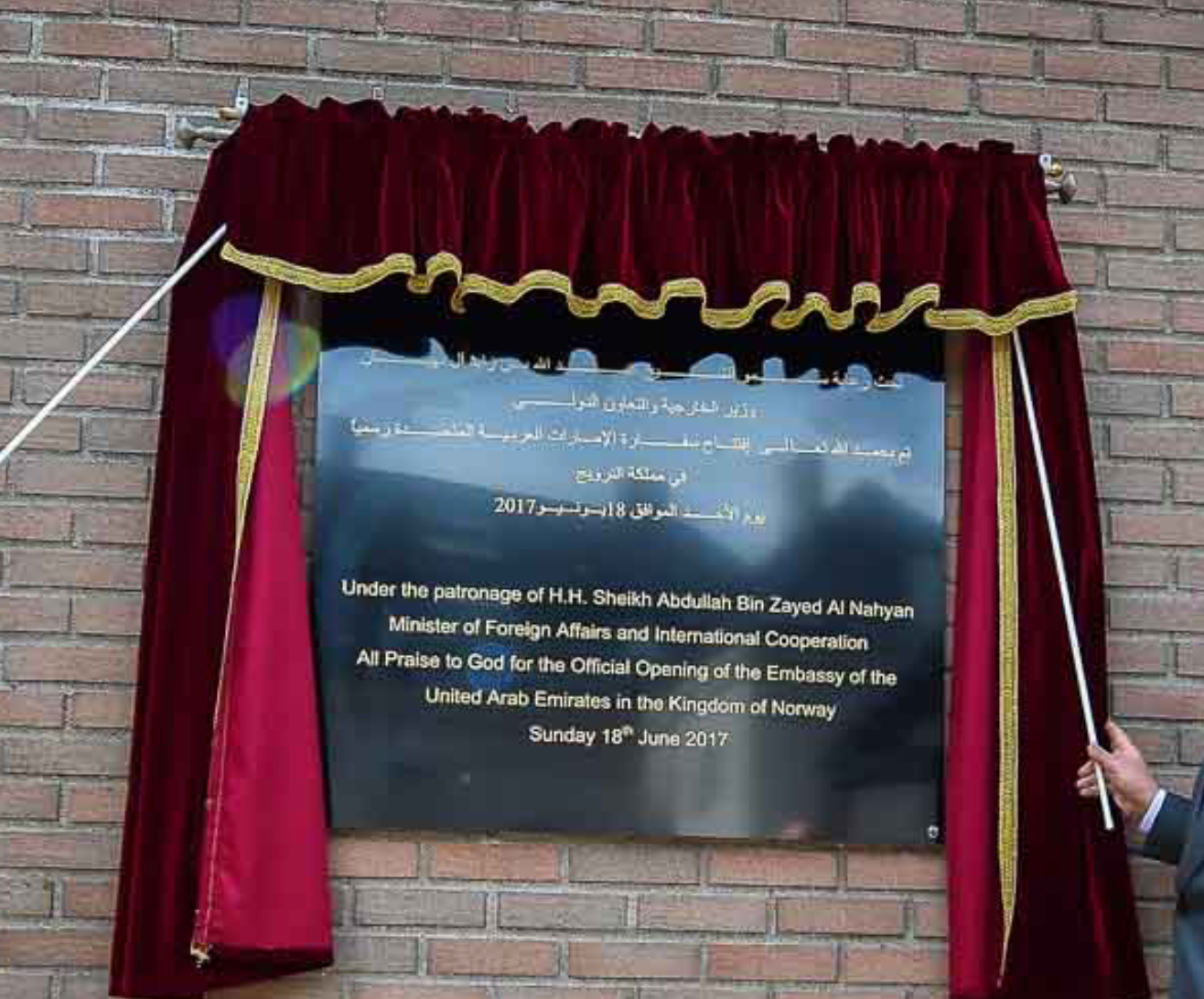
The Embassy of the United Arab Emirates to the Kingdom of Norway today celebrated the 47th National Day anniversary at a ceremony that was attended by representatives of Norwegian government, parliament Expo 2020 committee, as well as diplomats, dignitaries and businessmen.

In her speech at the ceremony, Acting Charge D’Affairs Hiba Al Junaibi, highlighted the country’s achievements during 2018, the ‘Year of Zayed’.

She lauded the progressive relations between the UAE and Norway, saying bilateral trade had soared by 92 percent from AED 1.6 billion in 2016 to AED 2.3 billion in 2017.

December 14, 2018 0 comments
0 FacebookTwitterPinterestEmail
Norwegian American

Norwegian Fund makes new investment in Boston

by Nadarajah Sethurupan December 13, 2018
written by Nadarajah Sethurupan

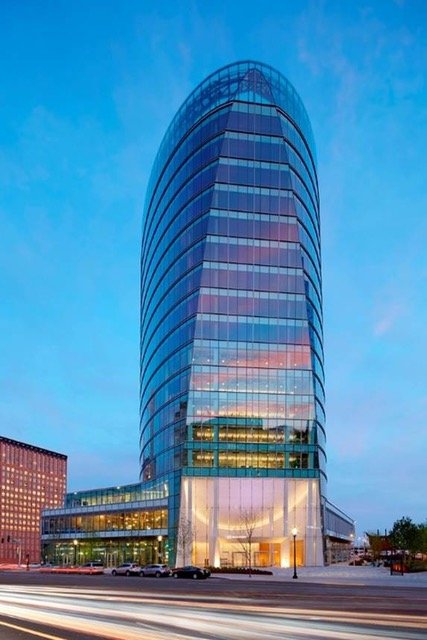
Boston, MA (December 13, 2018) – American Realty Advisors (“ARA”), an institutional fund manager with more than $9.3 billion in assets under management, has entered into a joint-venture partnership with an affiliate of Norges Bank Real Estate Management (“Norges Bank”) to acquire 121 Seaport, a Class A office property located in the highly desirable Seaport submarket of Boston, MA.

 “Partnering with Norges Bank to acquire an asset of this caliber in a key urban market will allow us to drive increased cash-flow and returns for both Norges Bank stakeholders and ARA investors,” says Austin Maddux, Executive Vice President, Deputy Portfolio Manager at American Realty Advisors. “121 Seaport is a top-tier office asset with long-term leases in an irreplaceable location, which we view as a generational investment and the foundation for our new relationship and future joint efforts with Norges Bank.” 

The newly-constructed 17-story tower features 400,342 SF of rentable space, one-of-a-kind elliptical architecture with a distinctive angled glass façade, a three-story lobby with floor-to-ceiling windows, and abundant building amenities. 

In addition to its highly-efficient floor plan, 121 Seaport is LEED Platinum certified and constructed to the highest sustainability and resiliency standards. This significantly contributes to minimizing operating costs and environmental impacts. 

“This investment is well-aligned with our core strategy to target modern, sustainable office properties that are highly sought after by tenants and positioned to perform over time. Its flexible layout with a column-free design and highly sustainable attributes contribute to an 85% efficiency factor that enables companies to maximize their workspace and expand their employee base.” explains David Willett, Senior Director, Investment Group at ARA.

Strategically positioned along Harbor Way within Seaport Square, 121 Seaport is surrounded by 7.6 million square feet and 23 acres of mixed-use development, including Amazon’s brand-new flagship office, which is set to be completed in 2021, and will accommodate over 2,000 employees. One block from 121 Seaport is the $650 million One Seaport Square complex featuring over 800 apartment units with ample shopping, dining, and entertainment options. The Seaport Common is also a unique component to the property. Located directly between 121 Seaport and the Boston Harbor waterfront, Seaport Common is an urban green space and community gathering place, which regularly hosts farmer’s markets, fitness classes, and local art and entertainment events. The space also facilitates panoramic views of the harbor.  

Boston’s Seaport District is the city’s top destination for tech and innovation firms as well as established Fortune 500 companies that include BCG, PwC, GE, and MassMutual. Surrounded by over 70 colleges and universities in the area, the city has a highly educated workforce retaining over 40% of graduates. 121 Seaport also offers convenient access to Downtown Boston and the Logan International Airport through the Silver Line subway, just steps from the property. 

“Boston, and specifically the Seaport, is thriving and makes for a desirable investment market due to its strong concentration of med, ed, tech, and financial services industries. The region’s unemployment rate is consistently below the national average and has driven office rents to experience a 25% increase in the last five years followed by declining vacancy rates for Class A office space” adds Willett. 

Other notable amenities of the property include three outdoor terraces, a three-level below-grade parking garage with the ability to accommodate 325 vehicles, a 24/7 concierge, fitness center, and lower level retail including a day-care center set to open in early 2019. 

121 Seaport is located at 121 Seaport Boulevard, Boston, MA. The seller, Skanska USA was represented by Robert Griffin, Edward Maher, Matthew Pullen, and James Tribble at Newmark Knight Frank. 


December 13, 2018 0 comments
0 FacebookTwitterPinterestEmail
Norwegian American

Russia can’t be trusted on gas transits – Assistant Secretary Francis R. Fannon

by Nadarajah Sethurupan December 12, 2018
written by Nadarajah Sethurupan

European efforts to keep Russia shipping gas through Ukraine after the opening the Nord Stream 2 pipeline across the Baltic Sea are futile, the top U.S. energy diplomat said on Tuesday, saying Russia could not be trusted.

“There is a problem because you are expecting to trust Russia to maintain and not cut off that gas,” Fannon, the U.S. assistant secretary for energy resources at the State Department, told reporters in a teleconference.

“With the Kerch Strait closure and other incidents, it is hard for anyone to rely on and trust that,” he added. “We do not see the maintaining of gas transit volumes, however modest, as a real proposal.”

Fannon, who made the comment after a tour of eastern Europe, warned that if gas volumes via Ukraine fell it would over time degrade the pipeline infrastructure and harm the continent’s energy security.

Europe, which relies on Russia for over a third of its gas needs, currently gets most of its supplies delivered via Ukraine, which derives up to 3 percent of its gross domestic product from transit charges.

Below is a full rush transcript of the press conference by Assistant Secretary Francis R. Fannon , Bureau of Energy Resources.

Assistant Secretary Francis R. Fannon : I had some very great positive engagements in Budapest, Prague and Zagreb, and then throughout the other locations that you mentioned. In each of these we discussed the critical importance of our shared values in the transatlantic alliance in the context of energy security.

I think that given Russia’s aggression in recent weeks, this is a good time to spotlight our diplomacy in this area. The energy security of our European partners and allies is a longstanding strategic priority of the United States. The United States strongly condemns recent Russian aggression in the Sea of Azov. The Russian Federation’s closure of the Kerch Strait is a clear violation of international law. Russia’s actions have strengthened the international consensus that Nord Stream 2 is a direct affront to the transatlantic energy security relationship and our shared national security goals.

So, I’d like to talk to you a little bit about some of the diplomatic work that we’ve been engaging with with respect to partners in Europe, who really recognize the centrality of energy diversity and achieving energy security. More European countries than ever are recognizing the importance of diversification as fundamental to energy security, and that’s in part why the European Union, the Commission, moved forward with the projects of common interest model, which seeks to open markets and encourage new key energy infrastructure to facilitate integration and support diversity. These projects include the Greece-Bulgaria Interconnector Pipeline and the synchronization of the Baltic States’ electricity grid with continental Europe. The Krk Island LNG project in Croatia is another project of common interest. I’ve had some very positive discussions with Prime Minister Plenkovic in Zagreb, where we discussed this project and its potential to support energy security and diversification.

This terminal could import LNG from a wide range of suppliers and allow for diversification in the region as well and in particular for Hungary. Once key energy infrastructure projects like Krk are built it provides optionality and introduces real market competition.

Russia dies not want options. It does not want a real transparent market. The important thing is the impact on optionality, once infrastructure is built is not a notional concept. We have a proof of concept. Take, for example, Lithuania’s floating storage and regassification unit, the Independence. It was built as a strategic investment, yet the FSRU introduced market competition and lowered Lithuania’s gas prices.

Diversification includes all sources of energy. And when we talk about energy sources we include renewable energy and nuclear energy as well, though of course much of the discussion on this call is about gas.

Things worth noting, the United States is the world’s second largest renewable energy producer, and it’s important to weigh in on that as my engagements throughout Europe have all included robust discussions on renewable energies, as well as nuclear.

America’s calling to diversify sources and delivery routes of natural gas in particular predates our relatively new role as a natural gas exporter. U.S. steadfast support for the $40 billion plus Southern Gas Corridor has spanned multiple administrations and continues today, despite the fact there’s no direct American investment in the project.

The United States will continue to support European energy diversification, including alternative sources of energy such as LNG.

I should also note that there are new sources of gas coming on-line all the time. In the Eastern Mediterranean where I was a few weeks prior, significant new volumes and integration in the region are allowing for new gas supplies to find their way on world markets and potentially certainly to Europe.

Regardless of where a country ultimately sources its gas, American-driven competition increases choices and reduces prices for European consumers regardless of the producer.

In contrast, Nord Stream 2 and expanded Turkish Stream Pipeline seek to deepen dependency on Russian gas rather than strengthen security. They’re not commercial projects. They are political tools.

Unlike the United States, Russia’s energy companies are an extension of the state and the Russian state uses energy for coercive geopolitical aims. Through Nord Stream 2 Russia seeks to increase its leverage over the West while severing Ukraine from Europe.

The U.S. and Europe share Western values. We look at commerce as mutually beneficial and reciprocal. But doing business with Nord Stream 2 is just not consistent with those shared transatlantic values. Nord Stream 2 threatens to directly undermine Ukraine’s security.

Earlier this month when Secretary Pompeo hosted Ukrainian Foreign Minister Klimkin, he reiterated how we will “keep working together to stop the Nord Stream 2 project that undermines Ukraine’s economic and strategic security and risks further compromising the sovereignty of European nations who depend on Russian gas.”

U.S. opposition to Nord Stream 2 is rooted in our abiding concern that the pipeline presents broad geostrategic threats to our transatlantic energy security, a point that we’ve consistently conveyed to leaders across the continent. The Secretary reminds us that: “We do not want our European friends to fall prey to the kind of political and economic manipulation Russia has attempted in Ukraine since it cast off its Soviet shackles.”

Question: I just want to look specifically about what you’ve been seeing in the Kerch Sea, and can you relate how that impacts on European energy security at this time as regards to the Nord Stream 2 Pipeline, please?

Assistant Secretary Francis R. Fannon: Thank you for the question. I opened my comments with reference to this. What I think it speaks directly to, is that even under clear international law, clear consensus, it calls to question the entire notion of the relative reliability of Russia as a responsible actor and as a part of this international community.

We spoke about shared values, shared transatlantic values. And this is another illustration that Russia does not just share those values, but they reject them entirely.

I think we have to consider these hostilities as we consider, as countries consider entering into relative partnership with such an actor.

Question: Can I just follow up quickly, just in terms of for Ukraine itself. At the moment they rely on a certain amount of revenue that they get from Russian as supplies bypassing the country. Long term, that doesn’t seem particularly sustainable, based on the arguments you’re making around the intentions of Russia. What suggestions do you have for the long-term future of Ukraine and energy security?

Assistant Secretary Francis R. Fannon: We mentioned earlier, Kathy mentioned that I spent some time in Kyiv and I both engage with officials there as well as in Washington and Brussels. The issue in our support for Ukraine and EU’s support for Ukraine is steadfast. I think the point about gas transit it an important one. It’s an important source of revenue. But also it’s a physical linkage to the West proper. Yes, it’s a pipeline, and it’s a means of transit revenues, but it’s also much more than that. As we see Russia seeking to effectively carve up Ukraine, the pipeline has an even greater significance. Which is why we’re very concerned about Nord Stream 2 and Multi-Line Turkish Stream which would divert gas transit away from Ukraine and effectively starve Ukraine from being able to not just collect the transit revenues but maintain that critical linkage to the West.

In terms of Ukraine’s, the relative sustainability of Ukraine, it’s an important question. It’s something we at the State Department have been focused on for a considerable amount of time in terms of enabling Ukraine, supporting the ongoing reform efforts. And other countries, I should note, have supported that in terms of in particular Slovakia, Poland, Hungary, they’ve all engaged in meaningful agreements with Ukraine for reverse flow to help Ukraine be free of having to contract with Russia gas. Obviously, Ukraine knows better than most that Russia is not a reliable supplier.

In terms of ourselves, the department, we’ve been providing technical support and assistance to NAFTAGAS and its subsidiaries to strengthen corporate governance and align operations with international best practice. We’re very pleased that NAFTAGAS has moved forward with a framework for unbundling which is a requirement under EU law, and we very much are supportive of these reform efforts.

NAFTAGAS and Ukraine has done quite a bit. We’re encouraged by the momentum, but the work certainly isn’t over. And we will continue in our steadfast support as they continue on to these reform efforts.

Question: We hear that you are very critical of Russia and its position as an energy supplier. We know the U.S. President has the power to sanction companies involved in Nord Stream 2. So why hasn’t the U.S. President sanctioned companies in Nord Stream 2? And are the companies providing the pipe-laying services for Nord Stream 2 Pipeline, are they the companies most at risk? Because Russia can afford to finance the pipeline itself but it can’t lay the pipes itself.

Assistant Secretary Francis R. Fannon: Thank you. As you rightly point, the U.S. government has the ability to sanction Russia energy export pipelines under Section 232 of the Counter-Americas Adversaries Through Sanctions Act. We also have a longstanding policy to not comment on potential future sanctions, future sanction actions.

But we have been very clear, and I will reiterate it now, that firms working the Russian energy export pipeline sector are engaging in a line of business that carries sanctions risk. We continue to review potential sanctions actions and encourage governments or companies to contact us if they have questions about this process.

I think what we seek to do, and we continue to do at all levels, is encourage all parties to stop the project. Germany can certainly remove their political support from the project. Support the update of the gas directive. That policy has been languishing for over a year and a half. That would be a positive step in advancing energy security. And then have a review on national and energy security grounds under EU law.

These are things we are encouraging and we’ve had some very fruitful discussions and we continue to engage to this day.

Question: Denmark has sort of a special position in this given that the government can make a rejection of the pipeline through Danish territorial waters. If the Danish government decides to do that, reject the application, I mean if the government decides to approve the project, will it affect the U.S. administration’s view upon Denmark in that case?

And another question is that Germany has underlined the importance of Ukraine still being a transit country after the establishment of the pipeline. Do you think such a guarantee, in case it should be established, would have any effect? And what do you think about this idea?

Assistant Secretary Francis R. Fannon: We have, thank you. With respect to our position in Denmark, the U.S. has encouraged Denmark to not approve, continue to reject the routing. So our position is quite clear on that.

In terms of maintaining some gas transit through Ukraine, in part we think, I guess I see that in two ways. One, it’s a question of mass. Assuming the total volumes that are transiting Ukraine versus the volumes that would be transited via Nord Stream 2 and Multi-Line Turkish Stream, there would be some delta left over. So I suspect that that is in part how they would be able to maintain some gas transit through Ukraine.

But there’s a problem with that. One, the volumes are relatively insignificant. Insignificant such that it would over time degrade the integrity of the pipeline because sufficient pressure would not be maintained.

But more broadly there’s a problem because you’re expecting to trust Russia to maintain and not cut off that gas. And I think, as I started my comments with the Kerch Strait closure and other incidents, it’s hard for anyone to rely on and trust that. And in fact Mr. Putin, when this idea was raised, said that, and I’m paraphrasing now, that they would consider it only if it makes commercial sense to Russia.

So we do not see the maintaining of gas transit volumes, however modest, as a real proposal.

Question: Ukraine considers Nord Stream 2 a purely political project and a real threat to security to both Ukraine and Europe. Not everyone in Europe shares this view. What are the incentives you are going to use to persuade European leaders to block the pipeline deal?

Assistant Secretary Francis R. Fannon: We have a full, whole-of-government diplomatic approach on this, and I think our friends in Ukraine and throughout the continent have seen that and will continue to see it. We’re engaging bilaterally, we’re engaging through multilateral fora, and we’re engaging in foras like this, publicly.

One of the things that I think is important for our European friends to consider also is these projects are long-term in nature like Nord Stream 2, and what they effectively do is lock in kind of an old way of doing business, and they’re ignoring this near-term energy abundance that we’re seeing.

We’re really at a turning point in that energy abundance, not just in the United States, but globally. Of course in the United States we’ve seen that and we’re proud of our record. In a decade, we’ve nearly doubled our gas production from 570 bcm in 2008 to 900 today.

But in the U.S. we are still nascent in this journey. We only have two LNG export facilities. We expect to double that export capacity in the next five years. We anticipate doubling recovery rates of gas and oil along the same time horizon within some of our key, most prolific basins. Our industry continues to innovate new and more flexible contracting models. U.S. production and market innovations will drive down prices globally.

At the same time we’re seeing new and sizeable finds in locations which didn’t exist as gas supply just ten years ago. Places like the Eastern Mediterranean, which I mentioned earlier. Mozambique has huge gas that will be coming on-line. Qatar and Australia are both increasing their capacities.

And on the nuclear side, we expect to see new, safe nuclear in the form of small modular reactors to be commercially available in the relatively near term.

So what we see here is a new form of energy abundance that can be a real win/win for all of us, which is all the more reason why it’s incumbent for European partners to consider the long-term relationship and energy dependency on Russia. And by locking that in, they’re losing the opportunity that stands before us to have free, transparent, very real markets, to improve energy diversification and energy security.

Question: The Portuguese government was very keen on using that port to import American LNG and to make it an entry point into Central Europe by having a pipeline crossing Spain and into France. France was not very keen on that idea, however, and it seems to have fallen off the radar. Can you tell us what’s happening there?

Assistant Secretary Francis R. Fannon: Thanks. We certainly support Midcat and continue to call on it as an important project that supports the broader energy diversification in Portugal, given its proximity, geographic benefit, it makes all the sense that they should be an important import location.

In terms of the specifics on the political questions at issue, as you mentioned France, I leave that to the discussion within the European political context.

Question: I would like to ask how the United States will support Ukrainian energy diversity, and I would like to ask your opinion about outlook of the central-eastern European countries on the Nord Stream 2 Gas Pipeline, especially Czech Republic and Hungary.

Assistant Secretary Francis R. Fannon: Thank you. With respect to Ukraine, we have longstanding support for Ukraine in really helping to improve their governance structure to bring their state companies in to international best practice standards. And in particular I mentioned the unbundling of NAFTAGAS. That’s a critical step and we’re very pleased to support that. Of course it’s a big firm. It takes some time. But we have a framework agreement in place. They do, they have an MOU which will initiate unbundling in January of 2020.

Assistant Secretary Francis R. Fannon: Thank you very much.

We have shared transatlantic values. We have a shared view of energy security through diversification. A project that’s intended to support a free Europe should not be a project that divides it.

We have to stand together, and we very much support the continued energy diversification and energy security goals that advance our shared transatlantic values.

December 12, 2018 0 comments
0 FacebookTwitterPinterestEmail
Nobel Peace Prize

Prizes are Worthless Without Global Action: Prize Nobel Laureates

by Nadarajah Sethurupan December 12, 2018
written by Nadarajah Sethurupan

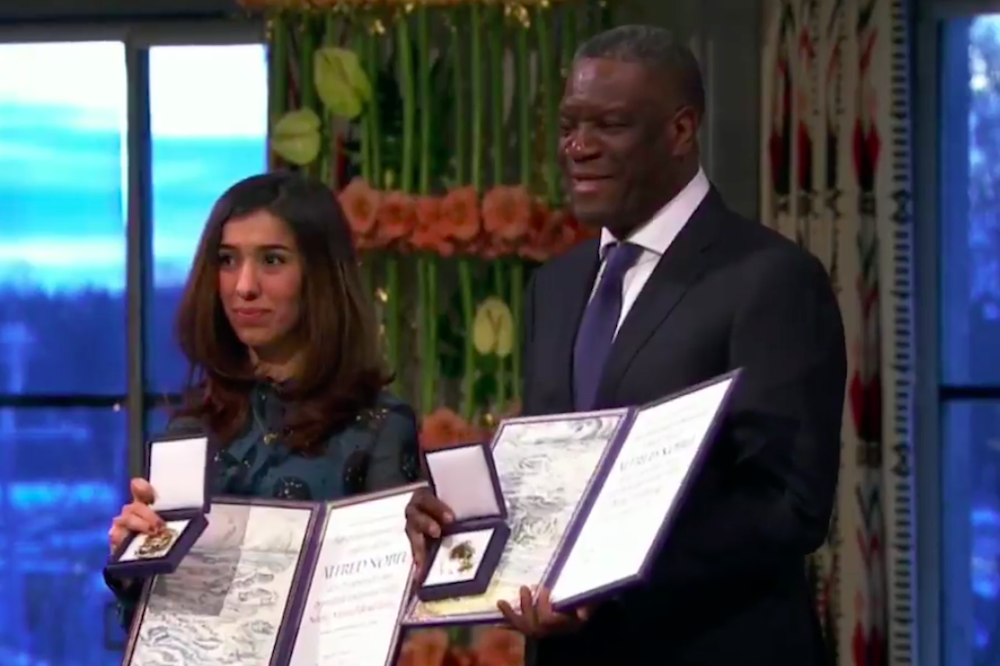
Nobel Prize winners Dr. Denis Mukwege and Nadia Murad urged world leaders to end sexual violence around the world.

The laudable accomplishments of Nobel Prize winners Dr. Denis Mukwege and Nadia Murad are worthless without global action, the pair said Sunday, 24 hours before accepting their awards in Oslo.

“This prize, one prize cannot remove all the violence and all the attacks on pregnant women, on children, on women and give them justice,” said Yazidi women rights advocate Murad, who narrowly escaped an Islamic State camp where she was held prisoner and sexually abused like thousands of others in her community.

Murad was 21-years-old in 2014 when state militia attacked her Iraqui village and she was taken into captivity and sold repeatedly for sex as part of Islamic State’s slave trade.

She eventually escaped captivity with the help of a Sunni Muslim family in Mosul and became an advocate for the rights of her community around the world.

Mukwege, a gynecologist from the Democratic Republic of Congo, urged the international community to intervene, “We can’t stand idly by while people just destroy our humanity.”

The son of a pastor, Mukwege, was awarded the peace award for his dedication to sexual assault victims and treatment of some 50,000 survivors.

“We cannot say that we didn’t act because we didn’t know. Now everyone knows. And I think now the international community has a responsibility to act,” he said.

The pair of laureates said they don’t consider their prize as a “victory,” but as the beginning of a new struggle which they hope will “open doors” to repair” the judicial system, bring the perpetrators to justice, and resolve the regional violence.

When news of the prestigious prize reached him, Mukwege was in surgery, caring for one of his many patients in the Democratic Republic of Congo.

“I just feel that to treat the consequences is not the solution. We should treat the root causes and the root causes are war, the root causes are the minerals of Congo, the root causes are people who want to do business in Congo and don’t pay tax,” he said.

“Indifference creates consequences for you and for me. It is a kind of complicity. We have to stand up to it,” said Mukwege.

December 12, 2018 0 comments
0 FacebookTwitterPinterestEmail
Nobel Peace Prize

Nobel Peace Prize winners demand end to sexual violence as a weapon of war

by Nadarajah Sethurupan December 12, 2018
written by Nadarajah Sethurupan

Two inspirational campaigners spoke of the fight against rape and sexual violence as weapons of war when they received their Nobel Peace Prizes today.

Dr Denis Mukwege, a doctor who helps victims in the Democratic Republic of Congo, and Nadia Murad, a Yazidi rights activist and survivor of sexual slavery by Islamic State, were honoured in Oslo.

Fittingly, they accepted their joint prizes on the 70th anniversary of the Declaration of Human Rights.

Dr Mukwege, a 63-year-old gynaecologist, said: “For all women, for all men and children of Congo, I call upon you not only to award this Nobel Peace Prize to my country’s people, but to stand up and together say loudly ‘The violence in the DRC, it’s enough. Enough is enough. Peace, now’.”

Murad, 25 – one of an estimated 3000 Yazidi girls and women who were victims of rape and other abuses by Islamic State in Iraq – said: “Today is a special day for me. It is the day when good has triumphed over evil, the day when humanity defeated terrorism, the day that the children and women who have suffered persecution have triumphed over the perpetrators of these crimes.”

The pair had been named as joint winners of the Nobel Peace Prize in October.

Nobel Prize committee chairwoman Berit Reiss-Andersen said: “Both Denis Mukwege and Nadia Murad have made significant contributions to combating this type of war crime by focusing attention on the suffering inflicted on women in Iraq, the Democratic Republic of the Congo and everywhere else in the world where sexual violence is used as a weapon. 

“We must be aware of these crimes if we are to combat them. The war waged on women through the use of sexual violence has been a hidden war.”

The clinic founded by Dr Mukwege treats thousands of women and girls each year in the DRC. It led to the Global Survivors Network of women sharing their experiences to effect change.

Accepting his award, he told of the horrors of rape and sexual violence in his country and demanded that the perpetrators be prosecuted.

He said: “With this Nobel Peace Prize, I call on the world to be a witness and I urge you to join us in order to put an end to this suffering that shames our common humanity.”

Theirworld President Sarah Brown – who interviewed Mukwege for a special episode of her Better Angels podcast – said: “Where girls and women are subjected to horrific sexual violence they can lose hope – were it not for the likes of Dr Mukwege and Nadia.

“And where girls can be kept safe in schools they have the opportunity to learn, thrive, protect themselves better and have a brighter future.”

Murad’s life was shattered in 2014 when militants attacked her village, killing six of her brothers and her mother. After three months of torture and beatings, she escaped captivity and began to talk about her ordeal.

In her acceptance speech, Murad told how her childhood dream had been to finish high school and open a beauty parlour. That dream was brutally shattered at the hands of Islamic State extremists.

She added: “Education plays an essential role in nurturing civilised societies that believe in tolerance and peace. 

“Therefore, we must invest in our children because children, like a blank slate, can be taught tolerance and co-existence instead of hatred and sectarianism.”

December 12, 2018 0 comments
0 FacebookTwitterPinterestEmail
Africa and Norway

Norwegian city to help in war against extremism in Kenya

by Nadarajah Sethurupan December 11, 2018
written by Nadarajah Sethurupan

Kristiansand deputy mayor Jorgen Kristiansen (second right) and his team before he signed a deal with Mombasa Governor Hassan Joho to combat violent extremism. PHOTO | LABAN WALLOGA | NATION MEDIA GROUP

The county government of Kenya Mombasa will partner with a Norwegian city to fight radicalisation.

Governor Hassan Joho added that his administration had made tremendous progress in the war against violent extremism.

Mr Joho spoke after signing of Strong Cities Network MOU with City of Kristiansand on fighting violent extremism.

He invited investors saying the town was free of terrorism attack fears and asked them to sieve the opportunity to invest in the region.

“We have made a lot of progress, but certainly, there is a lot that still needs to be done because the dynamics keep on evolving,” Mr Joho said.

The aim of signing the MOU is to provide more opportunities for cities around the world to continue working together to address global challenges.

Deputy Mayor of the City of Kristiansand, Mr Jorgen Kristiansen, lauded the agreement, saying the two leaders were finalising on a journey that according to SCN project manager Sabine Barton, started in 2015 when they first met in New York.

“The signing of the MOU will enable the two cities to work together in various fields including fighting global extremism, exchanging cultural heritage and education programs for youth in both cities,” he said.

December 11, 2018 0 comments
0 FacebookTwitterPinterestEmail
Nobel Peace Prize

Nobel Peace Prize: Stronger efforts needed to prevent sexual violence in war

by Nadarajah Sethurupan December 10, 2018
written by Nadarajah Sethurupan

Statement by Jan Egeland, Secretary General of the Norwegian Refugee Council, ahead of the Nobel Peace Prize ceremony Monday 10 December, where Nadia Murad and Denis Mukwege will recieve the prize:

“This long overdue prize must be the beginning of a strengthened effort to protect women and men against sexual violence and abuse in wars and to ensure that those who commit what is pure war crimes are held accountable. In too many conflicts, sexual violence is being used as a barbaric weapon of war, in breach of international laws and with the victims of these crimes suffering in silence.

Nadia Murad is a truly inspiring, heroic woman, who has given an important voice to the thousands Yazidi victims of sexual violence and genocide and many more victims of atrocities worldwide. 

The prize is also a very timely reminder that hundreds of thousands of victims of the Islamic State group in Iraq are still languishing homeless, with no justice. One year since the Iraqi government announced victory over Islamic State group, Ms Murad’s city, Sinjar, remains largely uninhabitable. More than 200,000 people from Sinjar, mostly Yazidis, remain displaced in Iraq and abroad. Across all of Iraq, some 1.8 million people are still internally displaced. For this year’s Nobel Peace Prize to be really meaningful, the international community and the Iraqi government need to listen to Ms Murad and right the historical wrongs by giving all the victims of mass atrocities access to justice.

Denis Mukwege has for a long time been my personal favorite for the prize. With a danger to his own life, he has not only helped victims of sexual violence and abuse at the well-known Panzi hospital in DR Congo, but has also tirelessly advocated for change, to prevent more people from undergoing the same horrors.” 

December 10, 2018 0 comments
0 FacebookTwitterPinterestEmail
Nobel Peace Prize

Nobel laureates challenge world to end sexual violence

by Nadarajah Sethurupan December 10, 2018
written by Nadarajah Sethurupan

Nobel peace laureates Nadia Murad and Denis Mukwege said Sunday they hoped their award would help them push the international community to act to end rape in conflict and deliver justice for victims.

Yazidi activist Murad and Congolese doctor Mukwege will be jointly presented with the prize in Oslo on Monday for “their efforts to end the use of sexual violence as a weapon of war and armed conflict”.

Murad, 25, who was taken hostage in Iraq by the Islamic State group (IS) in 2014 but escaped, said the prize was an honour for all of her Yazidi community, and “a sign” for the thousands of women still held by jihadists.

“This prize, one prize cannot remove all the violence and all the attacks on pregnant women, on children, on women and give them justice,” she told a press conference in Oslo.

But she said she hoped it would “open doors so that we can approach more governments”, to bring the perpetrators to court and “so that we can find a solution and actually stop what is happening”.

Fellow laureate Mukwege, who has spent two decades treating rape victims at his hospital in conflict-torn eastern DR Congo, said the Nobel spotlight made it harder for the world to ignore sexual violence.

“We cannot say that we didn’t act because we didn’t know. Now everyone knows. And I think now the international community has a responsibility to act,” he said.

He said the prize was not a “victory”, but could be seen “as the start of a new struggle, a new struggle against this type of evil”.

Murad has spent the years since her escape campaigning for the Yazidis, a Kurdish-speaking community that follows an ancient religion and was targeted by IS as it swept through her homeland.

More than 6,800 Yazidis were kidnapped, of whom 4,300 either escaped or were bought as slaves, while 2,500 remain missing, according to a recent report from the International Federation for Human Rights (FIDH).

The United Nations is due to send a team into Iraq next year to investigate atrocities, following a Security Council resolution in September 2017 to bring those responsible for IS war crimes to justice.

The UN has described the massacre of the Yazidis by IS jihadists as possible genocide.

Murad, now a UN ambassador for victims of human trafficking living in Germany, said the “steps towards justice” had given her hope.

But she stressed that “not a single ISIS terrorist” has appeared in court, adding “this injustice will continue in this world if it is not dealt with now”.

(SBS)

December 10, 2018 0 comments
0 FacebookTwitterPinterestEmail
Racism in Norway

Committee on the Elimination of Racial Discrimination discusses situation Republic of Korea and Norway with civil society

by Nadarajah Sethurupan December 10, 2018
written by Nadarajah Sethurupan

The Committee on the Elimination of Racial Discrimination this morning held an informal meeting with representatives of non-governmental organizations with respect to the Republic of Korea and Norway, whose reports on the implementation of the provisions of the International Convention on the Elimination of All Forms of Racial Discrimination will be considered this week.

The report of Albania will also be reviewed by the Committee this week, but no civil society representatives spoke on the situation in that country.

Noureddine Amir, Committee Chairperson, welcomed the representatives of non-governmental organizations to the second informal meeting with civil society representatives held during the Committee’s ninety-seventh session.  

During the discussion, civil society organizations from the Republic of Korea drew attention to widespread xenophobia against migrants and the stereotype of foreigners as criminals.  Over two million migrants who came from China, Viet Nam, Thailand, Uzbekistan, Philippines, Cambodia and others were living in the Republic of Korea.  They were treated as aliens or foreigners who did not fully belong to the society.  There was no legal framework to combat racial discrimination, which allowed some hate groups, including conservative Christian groups and Internet groups, to produce and spread fake news with the intention of justifying discrimination.  Migrant workers faced discrimination in terms of minimum wage and they could not change their jobs unless they had permission from the employer.  The situation of migrant women in domestic service, agriculture and small businesses was particularly precarious due to the temporary nature of their employment.  Undocumented migrant children could not enjoy their rights just because they did not have Korean nationality, whereas the refugee status determination process was used as a device not to protect refugees but to keep them out.  When they could not be returned home, foreigners were often detained without due process.

Representatives of civil society from Norway highlighted the lack of responsible conduct by politicians, public authorities and media professionals in their public statements, in spite of the recently adopted national strategy against hate speech.  There had been fewer open and crude hateful statements by political leaders since the previous report of the State party, but there had been more populist statements that encouraged xenophobia and influenced generally negative views of Muslim migrants.  The organizations further drew attention to ethnic profiling by the police, due to the Government’s targeting of illegal migrants.  As a result, some 9,000 persons had been deported.  Turning to discrimination against minorities in the labour market, speakers reminded that the unemployment rate of minority women was alarmingly high compared with that of the general population, and they were overrepresented in low-paid and unskilled jobs where they were more exposed to abuse.  Speakers also warned of the increasing exposure of the Sami and Kven communities to the outside pressure of new industries and infrastructures, endangering traditional livelihoods.  Finally, speakers highlighted discrimination against Roma and against lesbian, gay, bisexual, transgender and intersex persons who did not have permanent residence in Norway.  

Speaking on the Republic of Korea were Joint Committee with Migrants in Korea, Migration and Human Rights Institute, Minbyun Lawyers for a Democratic Society, Immigrants Advocacy Centre Gamdong, GongGam Human Rights Law Foundation, Dongcheon Foundation, and Korean Bar Association.

Norwegian Centre against Racism, Institution against Public Discrimination, MIRA Resource Centre for Women with Minority Backgrounds, Queer World, Teternes Association, Norwegian Kven Association, Romano Kher/the Church City Mission, Sami Parliament, and Sami Council spoke on Norway.

The Committee will next meet in public today at 3 p.m. to consider the combined seventeenth to nineteenth periodic report of the Republic of Korea (CERD/C/KOR/17-19). 

Statements on the Republic of Korea

The first speaker, on behalf of a coalition of 47 non-governmental organizations, said the Republic of Korea had created a myth of a one ethnic Korea for a long time.  People who did not conform to that had mostly lived invisibly.  There was a strong assimilation drive towards homogeneity which left ethnic minorities in situations of prevalent exclusion and oppression.  The recent large influx of migrants had changed the scene of diversity.  Over two million migrants who came from China, Viet Nam, Thailand, Uzbekistan, Philippines, Cambodia and others, were living in the Republic of Korea.  They were treated as aliens or foreigners who did not fully belong to the society.  The racial prejudice and systemic discrimination against migrants with low skills were especially severe.  The wide spread instigation to xenophobia and Islamophobia was also of particular concern.  The news created a stereotype of foreigners as criminals.  In July 2018, over 700,000 persons had petitioned the President asking for the deportation of Yemeni asylum seekers.  The Government called undocumented migrants illegal residents and criminalized them.  There was no legal framework to combat racial discrimination, which allowed some hate groups, including conservative Christian groups and Internet groups, to produce and spread fake news with the intention of justifying discrimination.  It was urgent for the Republic of Korea to enact a comprehensive law prohibiting all forms of discrimination, and immediate measures were necessary to regulate hate speech.  

Joint Committee with Migrants in Korea recounted an experience of a woman born to a Filipino father and a Korean mother.  When she took a bus with her father, she was conscious of how people were staring at them.  She had discovered the discrimination did not occur only on the streets where xenophobic protests took place and racist slogans were shouted.  Mere judgmental stares made her want to deny her identity.  There was still no anti-discrimination law in the Republic of Korea and discrimination flowed clearly from laws and policies, in the schools and supermarkets and bus stations.  The speaker said she was called of mixed blood at the time, now the correct word was multi-cultured, and this word followed a person indefinitely.  In the Korean society, differences led to discrimination based on class, country of origin, skin colour and gender.  Cultural and institutional racism was prevalent in the Republic of Korea.  Living in the Republic of Korea without nationality were migrant workers, migrant women and refugees, and they were treated as labour force, means of reproduction, non-existent beings or simply targets of hate.

Migration and Human Rights Institute addressed the discriminatory aspects in the Republic Korea’s labour migration system and attempts to discriminate against migrant workers in the minimum wage level.  They could not change their employer unless they had permission from the employer or unless they could prove violations of their rights.  The Government claimed that migrant workers were covered by domestic labour laws but that was not true for all.  Migrant workers working in agriculture or fisheries were not covered; they worked long hours and were paid less than the legal minimum wage.  Migrants were excluded from social security rights, especially from the healthcare system.  Many migrants in the Republic of Korea were working and paying taxes, but most were excluded from the right to social security, including healthcare, except for recognized refugees and marriage migrants who met certain conditions.  The crackdown on undocumented migrants was extremely violent, especially if they were migrants from low-income migrants.  In the past decade, 10 undocumented migrants had died and 77 were injured during violence and crackdowns against migrants.

Minbyun Lawyers for a Democratic Society reminded that there were many hard-working migrant women with various legal statuses in domestic service, agriculture and small businesses on a temporary basis.  For that reason, their labour rights were violated by long working hours with low pay, lack of breaks and days off, and exclusion from occupational insurance.  Because of their legal status, migrant women workers tended not report sexual violence affecting them.  All female migrant workers should have equal rights to a support system and should not be discriminated against in maternity leave protection and childcare.  Women from Thailand were exposed to sexual exploitation and human trafficking.  A married migrant who was separated from her Korean spouse through death or divorce had to return to her country, unless she was already a Korean national or had Korean children.  Some marriage migrants were considered as baby-making machines.  The Korean Government should revise its discriminatory rules on migrant women and multi-cultural families.

Immigrants Advocacy Centre Gamdong recalled that undocumented migrant children were excluded from the application of laws and policies for children just because they did not have Korean nationality.  Undocumented migrant children were categorized as illegal residents and denied the rights of the child.  They could be subject to detention and deportation.  Only Korean nationals could register the birth of a child in the Republic of Korea, although the Government had received repeated recommendations by various United Nations treaty bodies to allow universal birth registration.  Registration of all births should be allowed by the Republic of Korea as it was the first step to the protection of the rights of the child.  All children, regardless of the parents’ status, should be able to enjoy the basic social rights without any kind of discrimination.  Migrant children in the Republic of Korea could go to primary and middle school under the law, but admission into a school was entirely up to the Principal’s discretion, and there had been cases where admission was denied without any valid reason.  Since 2015, more than 200 children had been detained for violation of the Immigration Act.  

GongGam Human Rights Law Foundation said the refugee status determination process was used as a device not to protect refugees but to keep them out.  In 2017, almost 10,000 people applied for asylum in the Republic of Korea, but only 100 were recognized as refugees.  The refugee recognition rate was 1.5 per cent.  One of the main reasons for this was the chronic lack of resources.  Only 37 refugee status determination officers were handling those more than 10,000 refugee cases, and adequate translation and legal aid were not provided.  This led to the poor treatment of asylum seekers.  Persons with humanitarian status only enjoyed rights to stay and work in the Republic of Korea.  The refugee status determination process operated to accept as few refugees as possible.  When around 500 Yemini refugees had come to Jeju island in the Republic of Korea seeking asylum under a no visa policy, the Minister of Justice had responded by banning the Yemeni asylum seekers from leaving the island and added Yemen as a country whose nationals required a visa.  This made Koreans feel that refugees were dangerous, and protests against them were held every week.  Around 700,000 Koreans had signed a petition to abolish the refugee law.  

Dongcheon Foundation drew attention to the flaws in the country’s refugee status determination procedure, noting that asylum seekers were not given sufficient time during interviews to explain the reasons for their requests.  For one family which had not been granted asylum, it was found that the transcript of the interview was different from what the family had said.  The Government had cancelled its decision when the family filed a lawsuit, and eventually the family received refugee status.  This was not a standalone case.  The same interviewer and interpreter had interviewed and rejected 100 asylum seeks, and the Government had later cancelled 55 of those decisions.  However, no disciplinary action had been taking against these officials.  The Government had recently stated its intention to amend its refugee status determination procedure to screen and prevent “abusive cranks”.  The Foundation asked the Government whether there was enough to prevent “abusive decisions”.    

Korean Bar Association regretted that migrants could be placed in detention without due process when it was not possible to send them back home.  The law did not provide for access to legal aid for foreigners in detention, nor did it specify the length of detention.  Furthermore, detained foreigners had to pay a high fee upon release.  The Association also called attention to widespread hate speech in traditional and new media, despite the existence of laws prohibiting the spread of such speech through the media.  For example, the Korean media had spread false news that Yemeni refugees had committed crimes on Jeju island.       

Questions by Committee Experts

GAY MCDOUGALL, Committee Member and Country Rapporteur for the Republic of Korea, complemented the non-governmental organizations for having briefed the Committee on the situation in the country.  Had there been positive developments in the country since the Committee’s previous concluding observations? 

The Experts asked civil society associations to provide data on stateless persons, domestic violence, and racially motivated crimes.  They also inquired about the different types of visas issued to foreign nationals, such as the D6 visa, which was normally issued to artists, but which could be used to promote trafficking of women for prostitution, in particular when it came to women from Thailand working as masseuses.   

An Expert asked for clarification regarding the lack of a comprehensive definition of sex trafficking.  She also wanted to clarify whether 200 children had been detained for violation of the Immigration Act.    

Another Expert inquired about equal treatment before courts and about foreign detainees’ access to consular assistance and interpretation services.   

How had civil society participated in the preparation of the State party’s report?  Had their opinions had been reflected in the report?   What effect did the ruling by the Constitutional Court have on indirect discrimination on the country’s legal system? 

Replies

On behalf of the coalition of 47 non-governmental organizations, speakers clarified that there was no specific data on domestic violence.  There should be official statistics on that issue.  As for trafficking of migrant women, in the past many women from the Philippines had come to the Republic of Korea on the D6 visa, whereas nowadays it was women from Thailand who came to work in massage parlours.  They were afraid to report any abuse because they did not hold proper working visas.  The law narrowly defined sex trafficking and it lacked provisions on victim protection.  It should be brought in line with the Palermo Protocol.  Turning to stateless persons, they were usually children born in the Republic of Korea but who were not registered.  There might be about 10,000 de facto stateless children in the country, even though the State party had acceded to the 1954 Convention relating to the status of stateless persons.  Many defectors from the Democratic People’s Republic of Korea had come to the Republic of Korea from China and they could not prove their nationality.  

The humanitarian status visa was issued to those who did not fit the category of refugees, but who could not return to their countries of origin.  More than 300 Yemenis had been granted humanitarian status visas, which had to be renewed every year and they could not work with that visa.  The right to consular assistance was only stated in police directives and it was not binding.  There was no data on racially motivated crimes, which was very problematic.  Furthermore, there was no law on indirect discrimination and foreigners were not entitled to the same level of protection as Korean nationals.  The level of consultation with civil society was very superficial and the Government had only approached the non-governmental organizations that toed its line.  

Statements on Norway

Norwegian Centre against Racism highlighted the lack of responsible conduct by politicians, public authorities and media professionals in their public statements, in spite of the recently adopted national strategy against hate speech.  There had been fewer open and crude hateful statements by political leaders since the previous report of the State party, but there had been more populist statements that encouraged xenophobia and influenced generally negative views of Muslim migrants.  The organization warned of the rise of extremist movements, such as the Nordic Resistance Movement across Scandinavian countries.  The Movement had organized numerous public demonstrations without proper authorization.  The authorities had treated their demonstrations solely as verbal transgressions.  The underreporting of hate crimes was a serious problem due to the fact that not all crimes were classified as hate crimes, and because victims did not trust the authorities to deliver justice.  

Institution against Public Discrimination drew attention to ethnic profiling by the police, due to the Government’s targeting of illegal migrants.  As a result, some 9,000 persons had been deported.  That situation had created an atmosphere of alienation and decreased trust in the authorities.  The Police Academy was currently revising its curriculum, so it was a good moment for the Committee to bring that topic on board when reviewing the State party’s report.  Another problem was the examination of young girls in suspected cases of female genital mutilation, which was not based on sufficient knowledge about the situation in Norway.  The heavy-handed approach to female genital mutilation was in contrast with the Government’s healthcare policy.  There was a gap between research and knowledge of people’s needs.  There was also little knowledge about what caused the discrimination against minorities in the labour market.  The Government should do more to implement the International Decade for People of African Descent, given that Norway had a large Somali community.  

MIRA Resource Centre for Women with Minority Backgrounds noted that all persons in Norway whose status was connected with immigration legislation had had rights curtailed in the past several years.  Minority women experienced serious barriers in the labour market.  Their unemployment rate was alarmingly high compared with the rate of unemployment of the general population, and they were overrepresented in low-paid and unskilled jobs where they were more exposed to abuse.  The organization recommended an intersectional approach to address structural barriers that prevented minority women in Norway to enter the labour market.  Applicants for permanent residence permit in the country had to have stable jobs and earnings of a certain level.  Trafficked women and children still lacked protection and residence permits.  Minority women also suffered from a high rate of partner killings.

Queer World underlined the problem of access to healthcare and family reunion for lesbian, gay, bisexual, transgender and intersex persons who did not have permanent residence in Norway.  

Teternes Association called attention to the Government’s withdrawal of collective compensation to the Teternes, based on the argument that they had committed economic crimes, leading to the bankruptcy of the Teternes Foundation.  A thorough investigation of the Government’s compensation scheme was needed, and an Ombudsperson for ethnic minorities should be established.  

Norwegian Kven Association stressed that minority civil society organizations received very little funding.  It also noted that the northern regions of Norway had been long inhabited by the Sami and Kven people, but that the State was aggressive in claiming property rights over those regions.  Kven customs and conditions had to be considered when assessing the property rights because the loss of land had also threatened traditional Kven fishing and livelihood.  The organization thus proposed that the coastal fishing quota be extended to the entire northern region of the country.  Furthermore, there should be Kven-speaking personnel in healthcare, and the Kven language should be strengthened in education and media.   

Romano Kher/the Church City Mission pointed out the discrimination against the Roma community in Norway, who were distinguished by their names and dressing style.  In the public sector, they were often treated as belonging to a group rather than individuals.  Many Roma were discouraged from reporting cases of discrimination.  There should be more public awareness campaigns to combat stereotypes against the Roma.  Public servants, particularly child welfare officers, often did not understand the Roma culture or language.  Roma women were particularly endangered as victims of physical and psychological violence.  

Sami Parliament warned of the increasing exposure of the Sami community to the outside pressure of new industries and infrastructures, endangering their pasture lands and traditional reindeer herding.  The current regulations on sea salmon fishing were too restrictive and they were not sufficient in safeguarding Sami fishing rights.  The Norwegian Supreme Court had recently issued two judgements that had done nothing to promote consultation with the Sami people, to protect their way of life and language.  The Sami Parliament expected that the bill on effective participation of the Sami people that was agreed with the Norwegian Government would be adopted.  The new law should clarify the rules for the implementation of free, prior and informed consent.     

Sami Council recalled that Norway had made no progress with respect to the Committee’s several recommendations on reindeer herding, fishing and the exploitation of minerals in Sami territories.  The Government was intent to interpreting provisions on indigenous peoples’ participation in decision-making below international standards.  It was regrettable that the Government had limited the fishing rights of the Sami people in the coastal areas and in the Tana River.  The new Tana River Fishery Agreement signed by Norway and Finland in 2016 had been adopted against the will of the Sami people on both sides of the border.   The agreement should be re-negotiated in order to be viewed as legitimate and fair by the local rights holders.  
  
Questions by Committee Experts

KEIKO KO, Committee Member and Country Rapporteur for Norway, noted that Norway had sound laws and institutions, but that the problem seemed to be in implementation.  The elimination of discrimination in the labour market was imperative, particularly when it came to the Somali people.  What cases of discrimination against the Sami people had actually been brought to courts?

An Expert inquired about the high school drop-out rates among immigrant children, especially among boys.  What were the reasons behind the failure of the Norwegian Government to implement the International Decade for People of African Descent?  

Replies

MIRA Resource Centre for Women with Minority Backgrounds noted that minority candidates were seldom given full-time jobs.  The Oslo commune was the most multiracial and multicultural commune in the country, but the leadership was always ethnically Norwegian.  Middle-aged women were most vulnerable because they could never cross the line and obtain full-time jobs.  The Government focused a lot on providing language and skills training, instead of paying attention to discrimination in the labour market.  As for the lack of implementation of the International Decade for People of African Descent, it seemed that the Government did not find it important as it had little to do with being Norwegian.  When it came to the high school dropout rate among migrant children, the organization reminded that many were placed in special needs schools because they did not speak Norwegian well.  

Norwegian Centre against Racism confirmed that there was definitely discrimination in the labour recruitment process, as well as lack of awareness at the workplace about discrimination against minorities.  Africans were generally less employed than Europeans, but there was very little research done on the reasons behind that situation.  It could be that employers found that refugees from Africa with traumatic experience would not be able to fit into the expected employment pattern.

December 10, 2018 0 comments
0 FacebookTwitterPinterestEmail
Environment

IEA Executive Director visits Norway and Denmark

by Nadarajah Sethurupan December 9, 2018
written by Nadarajah Sethurupan

IEA Executive Director Dr Fatih Birol (right) with Norwegian Prime Minister Erna Solberg (Photograph: IEA)

Dr Fatih Birol, the Executive Director of the International Energy Agency, visited Norway and Denmark to present the latest findings from the World Energy Outlook, highlight the IEA’s emphasis on carbon capture, utilization and storage, and discuss the state of the global energy system.

In Norway, Dr Birol met with the Norwegian Prime Minister, Erna Solberg. The discussed the importance of oil and gas production from stable and reliable suppliers such as Norway to ensure supply security. Dr Birol also emphasized the need to develop CCUS as a tool to reduce carbon missions. The Prime Minister stressed the importance of innovation and praised the IEA’s leadership on CCUS.

Dr Birol also met with Norway’s energy minister, Kjell-Børge Freiberg, to discuss the IEA’s policy of opening the doors to emerging countries. With the recent addition of South Africa into the IEA family, the Minister praised the IEA for completing in record time its association agenda, with the IEA family now accounting for about 75% of global energy demand.

They discussed the upcoming International CCUS Summit meeting in Edinburgh, which the minister will attend. The Summit, which is co-hosted by the IEA and the Government of the United Kingdom, will bring together energy ministers and high-level government officials, chief executives and other representatives from the energy and financial industries to provide a new global impetus for carbon capture utilization and storage, a critical technology in achieving climate agreements while meeting growing energy needs.

Both the Prime Minster and the Energy Minister reiterated Norway’s commitment to support the Paris Agreement, but said that to meet the agreed targets will require a faster pace of transformation than we have ever seen. To achieve a rapid transformation, international cooperation is crucial and all parts of the world need to work together.

Dr Birol also presented the findings from the World Energy Outlook 2018 at Equinor’s annual autumn conference, one of the country’s most important energy conferences with more than 800 industry leaders, politicians and members of the wider energy community.

During the WEO presentation in Copenhagen, Denmark’s energy minister, Lars Christian Lilleholt, stressed the importance of energy efficiency and system integration of renewables, and pointed to the IEA’s recent estimation that carbon emissions would increase in 2018.

Dr Birol also attended a panel discussion with Danish State Secretary Morten Bæk, Secretary General for Eurelectric Kristian Ruby, and the CEO for the Danish Energy Association, Lars Aagaard, where they talked about electrification, decarbonisation, and the role of IEA in navigating the energy transitions in energy economies.

December 9, 2018 0 comments
0 FacebookTwitterPinterestEmail
Science

Norwegian intelligent camera company Huddly acquires AI startup Epigram

by Nadarajah Sethurupan December 9, 2018
written by Nadarajah Sethurupan

Norwegian-founded vision technology company Huddly has acquired a local AI startup Epigram in order to further develop its “intelligent camera” tech. The deal will see Epigram’s “tools, IP and all [seven] AI engineers” move over to Huddly, the company stated in a press release.

Founded in 2017, Epigram has developed a set of tools for big data processing and has worked with a number of clients including Huddly itself. One of the project it’s helped with was an extension of the AI models that run on Huddly’s smart cameras, training them to detect and count people in real time.

Huddly’s IQ camera is marketed as an AI-powered product that has features like framing all people in the room and performing advanced space analytics.

December 9, 2018 0 comments
0 FacebookTwitterPinterestEmail
Economics

Norway firm offers €146m bid to acquire Kotipizza

by Nadarajah Sethurupan December 8, 2018
written by Nadarajah Sethurupan

Norwegian consumer goods conglomerate Orkla is offering to buy the Finnish-owned Kotipizza Group for 23 euros per share.

Norway’s Orkla has made an offer to buy the Kotipizza Group, which includes the Kotipizza chain of franchise pizza joints, for what amounts to just over 146 million euros in cash. The board of Kotipizza Group has unanimously recommended that the company accept the takeover bid, and over 32 percent of the shareholders in the enterprise have approved of the deal under certain terms and conditions.

Orkla is a leading supplier of branded consumer goods to the grocery, retail, pharmacy and bakery sectors. It owns well-known food brands sold in Finland such as Abba, Ahti, Boy and Taffel.

Kotipizza Group CEO Tommi Tervanen said he is confident that Orkla will be able to give support and provide possibilities for the future growth of the Kotipizza chain.

“Together the two companies will be a good position to respond to changing consumption habits. I am looking forward to being a part of this journey,” Tervanen said in a 22 November press release.

Orkla’s CEO Peter A. Ruzicka said that for the Norwegian company’s part, the purchase will be a good extension of its development plans.

“The acquisition of Kotipizza is in line with our strategic goals, which are to strengthen our presence in fields with larger growth than the traditional food trade,” he said.

Largest pizza chain in the Nordics

Vaasa resident Rabbe Grönblom founded the Kotipizza franchise in 1987. Since then the Finnish chain has expanded to become the largest of its kind in the Nordic countries, with 270 locations employing 1,700 people. In 2017, sales accounted for over 106 million euros.

Kotipizza Group consists of four companies: Kotipizza, the Chalupa Mexican food franchise, and The Social Burger Joint. The fourth group company, Helsinki Foodstock, provides food-related supply, logistics and selection services for a number of companies.

Sources
Yle
December 8, 2018 0 comments
0 FacebookTwitterPinterestEmail
Middle East and Norway

Abu Dhabi Airports to Host ACI Airport Exchange 2019

by Nadarajah Sethurupan December 8, 2018
written by Nadarajah Sethurupan

Abu Dhabi Airports is to host the Airport Council International (ACI) Airport Exchange 2019. The announcement was made during an official handover ceremony at the 2018 edition of the event last week in Oslo, Norway.

The special handover ceremony at the close of ACI Airport Exchange 2018 saw Mohammed Al Katheeri, SVP Strategy and Communications at Abu Dhabi Airports officially receive the hosting rights and responsibilities to Abu Dhabi Airports.

Bringing together 1,500 airport leaders and hundreds of speakers, the ACI Airport Exchange is a major annual event that is hosted by airport groups around the world, with Abu Dhabi Airports being selected to host the November 2019 edition.

Bryan Thompson, CEO of Abu Dhabi Airports, said: “This is a prestigious international event, during what will be a significant time for us as we near the unveiling of one of our most significant projects to date. Our selection to host the 2019 edition of ACI Airport Exchange is a source of pride for Abu Dhabi Airports. We look forward to welcoming the world’s airport industry and community to Abu Dhabi next year.”

Thompson added: “This major event is in line with our mission and vision of becoming the world’s leading airports group. It contributes to our mandate of bolstering Abu Dhabi’s status as a global hub for business and leisure travelers.”

Hosting the event in the nation’s capital falls in line with Abu Dhabi Plan and UAE Centennial 2071. The announcement also follows Abu Dhabi Airports’ reception of a series of awards from the Airports Council International.

In December 2017, ACI named Abu Dhabi International Airport (AUH) the world’s fastest growing airport in hub connectivity. AUH also received Gold Certificate Recognition from ACI Asia-Pacific, and an accreditation level of ‘Reduction’ from its Airport Carbon Accreditation program.

Airport Council International is the world’s only global trade representative of the world’s airport authorities. Its annual Airport Exchange event provides dedicated conference streams focusing on vital areas of airport operations, such as digital innovation, airport security, airport operations and sustainability.

December 8, 2018 0 comments
0 FacebookTwitterPinterestEmail
Sex scandal

‘Biggest sexual offence case in Norway’s history’

by Nadarajah Sethurupan December 7, 2018
written by Nadarajah Sethurupan

A 26-year-old man has been charged with sexual offences involving more than 300 boys and young men, in the biggest case of its kind in Norwegian history.

The case follows an exhaustive two-year investigation by Oslo police against an unnamed man who is alleged to have targeted his victims – most of whom were between 13 and 16 at the time of the abuse, with some as young as nine – on internet chat services and via the Snapchat messaging app.

The suspect, reportedly a football referee, pretended to be a teenage girl and persuaded the boys to perform sex acts in exchange for the promise of erotic photos, recording the video chats and threatening to publish them online unless the boys sent him further films, according to the 81-page indictment.

Verdens Gang newspaper reported that police found 16,463 different films on the suspect’s computer, of boys in Norway but also in Sweden and Denmark. The indictment mostly concerns online abuse, but the suspect met some of his victims and has also been charged with rape, Norwegian media said.

The alleged assaults occurred between 2011 and 2016, when the man was arrested and detained after chatting, meeting and subsequently sexually abusing a youth who had previously worked with him as an assistant, Verdens Gang reported.

The suspect’s lawyer, Gunhild Laerum, told the public broadcaster NRK that his client, who is expected to face trial early next year, was cooperating with police and had “admitted the facts”. He was profoundly sorry for his actions but had yet to respond to each individual charge, Laerum said.

The state prosecutor, Guro Hansson Bull, told NRK the case was “the biggest of its kind in Norway to date”.

Only two of the alleged victims had come forward, he said. “Only one boy managed to tell his parents, and the mother of another found out. That says a lot about how hard it is for young people to talk about abuse of this kind.”

Norway’s attorney general, Christian Lundin, said the case was “incomparable in Norwegian legal history. Virtually all the alleged victims were “struggling” because “they have a huge sense of guilt”, he said.

December 7, 2018 0 comments
0 FacebookTwitterPinterestEmail
Diplomatic relations

Bulgaria and Norway to Work Together on Joint Projects Related to Western Balkans

by Nadarajah Sethurupan December 7, 2018
written by Nadarajah Sethurupan

Bulgaria and Norway are going to work together on joint projects in the Western Balkans in order to urge young people to stay and develop in their home countries, reported the Bulgarian National Radio.

This was agreed by Bulgarian Deputy Prime Minister and Minister of Foreign Affairs Ekaterina Zaharieva and Norwegian Minister of Foreign Affairs Ine Marie Eriksen Søreide.

Norway also actively supports projects in Bulgaria within the framework of the European Economic Area Financial Mechanism, whereby Norway provides 97% of funding, and the Norwegian Financial Mechanism.

For the 2014-2021 programming period, Bulgaria has access to 210 million euros for innovation and SME development, justice, home affairs and civil society support. According to statistics, 7000 Bulgarians live in Norway.

December 7, 2018 0 comments
0 FacebookTwitterPinterestEmail
Sports

Oslo: Local Star Warholm To Tackle Clement and Bett

by Nadarajah Sethurupan December 7, 2018
written by Nadarajah Sethurupan

One of the sensations for Norwegian athletics in 2016 was the exciting development of Karsten Warholm. He started the season as a decathlete that dabbled in 400m and 400m hurdles. By the end of 2016, the twenty-one-year-old from Ulsteinvik had established himself as a major global threat at the 400m hurdles. Last season he broke the Norwegian record for 400m hurdles on numerous occasions. He achieved it at the European Championships in Amsterdam with a time of 48.84! Then he stepped up again at the Rio Olympics Games with another national record of 48.49 seconds and his only disappointment was to not earn a place in that final.

During the recent winter months, the former World Youth Decathlon Champion focused more on the one lap and broke 46 seconds for 400m indoors, whilst also establishing a new world record at the 300m hurdles indoors. At the IAAF Diamond League event, the Oslo Bislett Games on 15 June, Warholm will face a very stern test of character, ability and preparation.He will face, amongst others, the reigning Olympic and four-time World Champion Kerron Clement. The tall American has shown extraordinary consistency at major championships and first came to the spotlight in 2004 at the World Junior Championships. He won his first senior global title in 2007 (World Championships in Beijing) and has been a superstar in the event since then. Besides Clement, virtually the full field from the 400m hurdles Olympic Final in Rio will line up against Warholm.

This feature event of the 2017 Oslo Bislett Games will be viewed by a very special spectator. The absolute icon of the event, Edwin Moses, will be the guest of honor at Bislett stadium that night. Edwin Moses’s name is synonymous with the event. He was twice Olympic and World Champion, established new world records and at one stage of his illustrious career was unbeaten in 122 consecutive races. Moses redefined the event with his unique stride pattern and still holds the stadium and meet record at Bislett with a time of 47,67 set in 1979.

Here is the start list for the 400m at Oslo Bislett Games 15 june.

NameCredentialRIOPB
Karsten Warholm (NOR)World Record-Holder Indoor 300m hurdles9th48,49
Kerron Clement (USA)Olympic Champion (Rio 2016) & four times World Champion1st47,24
Nicholas Bett (KEN)Reigning World Champion 400m Hurdles ( Moscow 2015) DNS47,79
Yosmani Copello (TUR)Olympic Bronze medal Rio 2016 / Winner Bislett Games 20163rd47,92
Thomas Barr (IRL)Irish record-holder / 4th in Rio Olympic Games 400mH4th47,79
Ramus Maggi (EST)Estonian record-holder / 6th in rio Olympic Games 400mH 6th48,40
Boniface Mucheri(KEN)Olympic Silver Medal 400m Hurdles Rio 20162nd47,78
Kariem Hussien (SUI)European Champion 2014 in ZurichDNS48,45
December 7, 2018 0 comments
0 FacebookTwitterPinterestEmail
Norwegian Aid

Norway to pay USD 70 million to Brazil

by Nadarajah Sethurupan December 7, 2018
written by Nadarajah Sethurupan

Norway will pay USD 70 million (NOK 600 million) to Brazil for reduced emissions from deforestation in the Amazon in 2017, line with climate and forest cooperation between the two countries.

– After two years of increasing deforestation, Brazil’s efforts in 2017 were encouraging: Deforestation dropped by 12 percent compared to the year before, and was 64 percent below the average of the decade prior to Brazil’s initiation of large-scale forest reforms in 2004, says Norwegian Minister of Climate and Environment, Ola Elvestuen.

– It is encouraging that Brazil managed to reduce deforestation in the Amazone in 2017, despite economically challenging times, says Norway’s Minister of Climate and Environment Ola Elvestuen. Credit: Bjørn Stuedal

Elvestuen says Brazil has achieved very good results in the Amazon over the last decade.  Over the period of collaboration, Brazil has saved the atmosphere from emissions of more than 4,5 billion tons of CO2, almost 100 times Norway’s annual emissions.

This year’s payment from Norway to Brazil of USD 70 million is remuneration for the reduction of deforestation in the Brazilian Amazon achieved in the forest year 2017 (August 2016-July 2017). The funds are disbursed to Brazil’s Amazon Fund, which supports projects that further reduce deforestation and improve the livelihoods of people living in the Amazon region (see fact box below on how Norwegian contributions are spent).

Alongside Norway, Germany also makes significant contributions to the Amazon fund.

– It is encouraging that Brazil managed to reduce deforestation in the Amazon last year, despite a challenging economic situation, says Elvestuen.

Recent deforestation trends are worrying

While Brazil can demonstrate reduced deforestation in 2017, preliminary figures indicate that logging increased in the forest year 2018. In a recently published estimate, Brazil’s  National Institute for Space Research (INPE) presented 2018 deforestation figures at 7900 km2. This corresponds to a 13,7 percent increase in deforestation from 2017 to 2018. The figures are still preliminary, but the possible increase gives reasons to concern both in Brazil and in Norway.

History has shown that deforestation in the Amazon rainforest often increases during election years.Brazil has just completed presidential and congressional elections in 2018.

The figures will only be verified next year, and will first then give the basis for payment from Norway in 2019, in line with the rules of the results-based cooperation between the two countries.  

– We look forward to talking to the new government about Brazil’s future plans and our bilateral cooperation. We hope and believe that Brazil will continue to show the world that it is possible to reduce deforestation while increasing agricultural production in a sustainable way. It is very positive that Brazilian businesses, and especially the agribusiness, are increasingly contributing to the efforts against deforestation in the Amazon.

Brazil has previously shown that growth in agricultural production is possible without negatively affecting the rainforest. 
According to Brazil’s Ministry of Environment, there are several reasons behind the rise in deforestation in 2018.  Increased demand for Brazilian agricultural products has stimulated the opening of new forest areas.  Longer and more severe dry seasons have led to a significant increase in forest fires. The increase in organized crime and illegal logging is often tied to other criminal activities, such as the illegal arms trade..

Norway is a proud partner of Brazil

Ola Elvestuen says Norway is a proud partner of Brazil, and considers the partnership to be a great success.

– Brazil’s results in reducing deforestation from 2005 to 2014 are one of the largest efforts to combat climate change in the last decade. Norway will continue to support the Amazon Fund until 2020, in accordance with our Joint Declaration with Brazil at the Paris Climate Summit in 2015 and our Contribution Agreement with the Amazon Fund. We look forward to discussing the way forward with the new administration.

( Ministry of Climate and Environment)

December 7, 2018 0 comments
0 FacebookTwitterPinterestEmail
Science

Swedish e-scooter startup VOI raises $50 million to expand across Europe

by Nadarajah Sethurupan December 6, 2018
written by Nadarajah Sethurupan

Swedish electric scooter startup VOI Technology has raised $50 million in a Series A funding round led by Balderton Capital, with participation from Vostok New Ventures, LocalGlobe, and Raine Ventures, as well as several angel investors. The company, which already operates in Stockholm, Madrid, Zaragoza, and Malaga, plans to use the money to expand to Benelux, France, Germany, Italy, Norway, and Portugal within the next few months.

Founded in Stockholm earlier this year, VOI claims to be the first and only European company that has launched in more than one country. The startup boasts over 120,000 users who took its e-scooters for over 200,000 rides for a total of more than 350,000 km. The rental costs are €1 to unlock the e-scooter and a further €0.15 per minute.

Europe has been seeing a rise in e-scooter sharing platforms launching in different places, from local players like Berlin-based Tier that recently raised €25 million to the US-founded Lime that has raised a whopping $467 million and already operates in Austria, the Czech Republic, France, Germany, Spain, and Switzerland.

In the meantime, some countries and cities are less welcoming to the new mode of transportation than others. E-scooter sharing is de-facto banned in the UK and in Amsterdam; the city authorities in Stockholm have mulled banning e-scooters as well but ended up deciding against it. The main argument against shared e-scooters is that the customers tend to left the two-wheelers clogging the sidewalks, which is also the reason why Amsterdam banned dockless bicycle sharing as well.

Seeing the regulatory landscape getting more and more difficult, VOI takes pride in working closely with the municipalities in the cities of its operation.

“We strongly believe that using city streets and infrastructure to do business cannot be done without the full cooperation – and support – of the host city concerned,” said VOI’s CEO Fredrik Hjelm. “We have, for example, decided to hold off launching in cities where regulation clearly states that we shouldn’t, whereas some of our competitors have launched anyway only to be kicked out 24 hours later.”

The news about the funding comes almost a month after the rumours about the round surfaced in a report by TechCrunch. Before the round, VOI had only received one capital injection of $2.9 million from Vostok New Ventures.

In the photo: VOI team

December 6, 2018 0 comments
0 FacebookTwitterPinterestEmail
Crimes

Norwegian govt calls on Pacific to help fight against fisheries crime

by Nadarajah Sethurupan December 5, 2018
written by Nadarajah Sethurupan

The Norwegian fisheries minister, Harald Nesvik, has asked for the assistance of Pacific island nations to combat fisheries crime.

Speaking at the recent Our Ocean Conference in Indonesia, Nesvik said small island areas with large seas were highly vulnerable to transnational organised fishing crime.

He invited ministers in the Pacific to support Norway in the fight against fisheries crime.

He extended the invitation to all those present at the conference who had not already taken a stand against fisheries crime.

Norway has previously backed Indonesia in seeking to declare illegal fishing as a transnational organised crime.

December 5, 2018 0 comments
0 FacebookTwitterPinterestEmail
Africa and Norway

ACP investment in Angola reaches $40 million in ten years

by Nadarajah Sethurupan December 4, 2018
written by Nadarajah Sethurupan

Angola Capital Partner (ACP), which manages the investment funds of Norway, has invested $40 million in Angola provinces over the last 10 years.

The value was applied in the creation of projects of an agricultural nature, fishing, environmental management, communication and marketing, block plant and treatment of petroleum residues.

Investments in the provinces of Luanda, Zaire and Namibe generated more than 3,000 jobs and revealed that the private sector can make a significant contribution to the development of Angola.

These data were provided today by the director of the ACP, Tiago Laranjeira, in the margins of the presentation of a study of the economic and social impact of his investments in Angola during the 10 years of activity in the country.

Laranjeira stressed the need to invest in small and medium-sized enterprises in the private sector to generate employment and economic development.

Likewise, he stressed that Angola’s real asset is not oil or diamond, but the millions of Angolans who live in the country.

The report on ACP activity in Angola, prepared by EBS Advisory, highlights, among other things, the contribution to food security and import substitution through investment in the agriculture and fishing industry.

Contribution to national environmental protection and sustainability through investment in the waste management sector, national reconstruction through investment in the building materials industry, and the growth of the economy by generating tax revenues from supply chains and creation of indirect jobs.

ACP is an investment fund management company which results from a partnership between the Angolan Investment Bank and Norfund – the Norwegian State Investment Fund for developing countries.

The ACP Investment is based on pillars such as “Economic viability and financial return, Environmental and social impact, and Good corporate governance and transparency”.

December 4, 2018 0 comments
0 FacebookTwitterPinterestEmail
Economics

Yara appoints new CFO

by Nadarajah Sethurupan December 3, 2018
written by Nadarajah Sethurupan

Lars Røsæg will take up the position of EVP and Chief Financial Officer (CFO) with immediate effect. Petter Østbø has stepped down as CFO and will leave the company.
“I am pleased to welcome Lars Røsæg into Yara management, where his strong analytical skills and broad financial and strategic experience will be highly valued,” said Svein Tore Holsether, President and Chief Executive Officer of Yara.

Lars Røsæg joined Yara in 2017, and has since March 2018 held the position of Vice President Global JVs & CEO Office. Røsæg holds a degree (“Siviløkonom”) from the Norwegian School of Economics (NHH) and has broad experience from senior finance and strategy positions at Sapa (2012-2017) and Orkla (2005-2012).

“I am excited to accept this position, and look forward to joining Yara’s experienced and competent finance organization in driving prudent capital allocation and growing shareholder value,” said Lars Røsæg, EVP and Chief Financial Officer of Yara.

“I want to thank Petter for a good job for Yara over many years, including having a key role in implementing and driving Yara’s production improvement program. I also want to underline that this change is not related to Yara’s financial performance nor any disagreement around strategic direction. We separate on good terms, and I wish Petter the best of luck for the future,” said Holsether.

Contact

Thor Giæver, Investor Relations

Mobile: (+47) 48 07 53 56

E-mail: thor.giaver@yara.com

Kristin Nordal, Head of External Communications

Mobile: (+47) 90 01 55 50

E-mail: kristin.nordal@yara.com

About Yara

In collaboration with customers and partners, Yara grows knowledge to responsibly feed the world and protect the planet, to fulfill its vision of a collaborative society, a world without hunger and a planet respected.

Our crop nutrition solutions and precision farming offerings allow farmers to increase yields and improve product quality while reducing environmental impact. Our environmental and industrial solutions improve air quality and reduce emissions, and are key ingredients in the production of a wide range of products. We foster an open culture of diversity and inclusion that promotes the safety and integrity of our employees, contractors, business partners, and society at large.

Founded in 1905 to solve emerging famine in Europe, Yara has a worldwide presence with more than 17,000 employees and operations in over 60 countries. In 2017, Yara reported revenues of USD 11.4 billion.

www.yara.com

This information is subject to the disclosure requirements pursuant to section 5-12 of the Norwegian Securities Trading Act.

December 3, 2018 0 comments
0 FacebookTwitterPinterestEmail
Oil & Gas

Norway’s Equinor plans more onshore wells in 2019, including in Turkey

by Nadarajah Sethurupan December 2, 2018
written by Nadarajah Sethurupan

Norwegian oil and gas firm Equinor plans to drill more exploration wells internationally and more onshore wells in 2019 compared to this year, the company’s head of exploration said on Tuesday.

“In general, there will be more international activity, and a larger share of onshore activity,” Tim Dodson told Reuters on the sidelines of a conference of Equinor, formerly known as Statoil.

Equinor’s plans include high-impact wells off Canada, the United States, Mexico and Brazil, as well as onshore wells in Turkey, Argentina, Algeria and Russia.

Exploration on the Norwegian continental shelf is expected to remain around 2018 levels, 20-25 wells, he added.

December 2, 2018 0 comments
0 FacebookTwitterPinterestEmail
Russia and Norway

Norway will help Ukraine reform education

by Nadarajah Sethurupan December 1, 2018
written by Nadarajah Sethurupan
Norway and Ukraine will share experiences and maintain contacts as part of the implementation of national education reforms.


The agreement was reached at a meeting of Ukrainian Education and Science Minister Lilia Hrynevych with Minister of Education and Integration of Norway Jan Tore Sanner in Oslo, the press service of the Education Ministry of Ukraine reported.

“Our school education reform has started this year – and it is a priority of the government and the state as a whole. I want to emphasize that, speaking about the secondary education in Ukraine, we mean about 3.9 million students, 441,000 teachers, more than 16,000 schools. This is a huge system, and it is also a challenge for us. The number of children in our school system is equivalent to 74% of the total population of Norway. The Education Ministry cannot do such transformations alone, and we, in particular, are grateful to the European Wergeland Centre (EWC), established by the Council of Europe and Norway, for supporting changes, as it has become our good partner in introducing democratic governance in our educational institutions and in developing civic competence,” the minister said.

The parties noted that the exchange of experience would help both countries find mechanisms and share educational practices.

The Ukrainian minister also suggested concluding a bilateral agreement or a memorandum on cooperation in the field of education and science between Ukraine and Norway, since today the cooperation is carried out without such a document and certain priorities.

As reported, Ukrainian Education and Science Minister Lilia Hrynevych was on a working visit to Norway. In particular, she actively participated in the European Wergeland Centre’s 10th Anniversary Conference held in Oslo, Norway, November 14 – 16.

(ish)

December 1, 2018 0 comments
0 FacebookTwitterPinterestEmail
Economics

Norwegian startup Memory secures $5 million

by Nadarajah Sethurupan November 30, 2018
written by Nadarajah Sethurupan

Norway-based startup Memory that works on AI-powered time tracking and time management solutions for businesses has raised $5 million in a funding round led by Concentric and Investinor, with participation from existing investor SNÖ Ventures. The startup plans to double its 30-strong team and add new tools to its offering.

Memory’s first product, Timely, is an AI-based time tracking system for the service industry, which is currently used by more than 4,000 paying customers across 160 countries.

The tool automatically tracks the active native and web apps on the user’s computer, location and travelling, mobile calls, and calendar events, and suggests time slot descriptions. It also learns on the go as the users interact with the suggestions. Timely’s subscription fee starts at $7 per month with yearly billing.

The startup plans to use the fresh funding to build new tools for businesses to manage time more efficiently by “freeing space for cognitively-enriching ‘deep work’,” it stated in a press release.<!

November 30, 2018 0 comments
0 FacebookTwitterPinterestEmail
China and Norway

Hainan Airlines Announces New Direct Service to Oslo

by Nadarajah Sethurupan November 29, 2018
written by Nadarajah Sethurupan

Chinese airline Hainan Airlines is opening a direct route between the Chinese capital Beijing and Oslo airport in the spring of 2019, with three weekly departures.

The Chinese airline will be the first to fly scheduled flights between Norway and China, opening in the spring of 2019.

“The coming new route of Beijing to Oslo is the first direct route between China and Norway operated by Chinese carrier Hainan Airlines. These efforts have gained Hainan Airlines with an optimized network between China and Europe. This new route will certainly intensify the communications between the two countries, thus stimulating the development of a prosperous economic tie for China and Norway, as well as the Nordic region”, says Mr. LIU Jichun, Vice President of Hainan Airlines.

“This is excellent news for Norwegian travel, business and tourism. Hainan Airlines is a major international airline, and this will mean that even more Chinese tourists will have an opportunity to experience everything Norway has to offer.” says airport director Øyvind Hasaas at Oslo Airport.

“Norway is the Nordic country with the largest number of Chinese tourists. This trend has seen very positive developments in recent years. It is therefore only natural that a large and recognized airline such as Hainan Airlines would want to open a direct connection to Oslo Airport,” Hasaas says.

From Beijing, onward connections to other Chinese and Asian destinations are excellent.

“With Hainan Airlines, onward connections are very good to the major city of Shanghai. There are also good connections to many other cities in China and Asia, which are interesting destinations for both Norwegian tourists and not least Norwegian business.” Hasaas explains.

Innovation Norway is of the opinion that direct connections to China are important to Norwegian tourism and the travel industry.

“In cooperation with Avinor and the travel industry, we have taken a long-term and dedicated approach to creating interest in Norway on the Chinese market. We have succeeded in this, but direct flights are a precondition to making Norway more relevant as a year-round destination. With the new route, we believe visitors will spend both more time and money experiencing Norway,” says director of tourism with Innovation Norway, Bente Bratland Holm.

Demand for Norwegian seafood has taken off in recent years, with 2017 breaking all records. The new route between Oslo and Beijing means that Norwegian fish will arrive even fresher in the shops and restaurants in the Chinese capital and the surrounding areas.

“A direct route to China will be extremely positive for the export of fresh Norwegian seafood to the quickly expanding Chinese market. Fresh fish has a short shelf-life, and faster transport times will help ensure the products’ quality.” says Martin Langaas, Director Cargo in Avinor.

The route between Oslo and China will be operated by an Airbus A330-300 aircraft with 292 seats in a two class configuration with 32 flatbed business class seats and 260 economy class seats.

Hainan Airlines will have three weekly departures from Oslo Airport.

November 29, 2018 0 comments
0 FacebookTwitterPinterestEmail
Newer Posts
Older Posts

Norwegian Nobel Prize 2025

101207 The Norwegian Nobel Committee has decided to award the Nobel Peace Prize for 2025 to Maria Corina Machado for her tireless work promoting democratic rights for the people of Venezuela and for her struggle to achieve a just and peaceful transition from dictatorship to democracy.

Special Interest

  • Africa and Norway
  • Asia and Norway
  • Asylum
  • China and Norway
  • Corruption in Norway
  • Crimes
  • Defence
  • Diplomatic relations
  • Economics
  • Environment
  • Farming
  • Killing
  • Media Freedom
  • Middle East and Norway
  • NATO and Norway
  • Nobel Peace Prize
  • Norwegian Aid
  • Norwegian American
  • Oil & Gas
  • Peace Talks
  • Politics
  • Racism in Norway
  • Religion
  • Russia and Norway
  • Royal House
  • Science
  • Sex scandal
  • Sports
  • Spy War
  • Srilanka and Norway
  • Svalbard
  • Terrorist
  • Taiwan and Norway
  • Video clips

Follow Us

Recent Posts

  • Two dead, one injured after shooting in Norway

    October 4, 2026
  • Syrian, Norwegian migration officials discuss cooperation in Oslo

    October 2, 2026
  • Norwegian premier says peace institute funding had no link to Epstein

    October 1, 2026
  • Norwegian ministers grilled in parliament over ties to Epstein

    October 1, 2026
  • Tesla rise across Europe, extending recovery

    October 1, 2026
  • Norway Provides $2.6 Million to UN Afghanistan Trust Fund

    September 29, 2026

Social Feed

Social Feed

Editors’ Picks

Norway opens market for Sri Lankan fish exports...

May 13, 2016

Sri Lanka – Nordic Business Council holds discussions...

May 15, 2016

Good governance to Sri Lanka

May 15, 2016

Shock and Joy in Sri Lanka – Erik...

May 15, 2016

Sri Lanka-Norway plenty of new opportunities for business–...

May 15, 2016

NORWAY NEWS is an online news site, written in English, dedicated to Norwegian affairs at home and abroad. Norway News.com is published online. It is a daily online newspaper in existence since May, 2003. The site is run by an Independent Journalist.

Facebook Twitter Youtube

Useful Links

    • Work With Us
    • Contact Us
    • Collaboration
    • Data Collection
    • Workplace
    • Adverstising
    • Privacy Policy
    • International Collab
    • Feedback
    • Terms of Use
    • About Our Ads
    • Help & Support
    • Entertainment
    • News Covering
    • Technology
    • Trending Now

Politics

Syrian, Norway to boost cooperation on mine clearance
Erna to step down as Conservative Party leader in 2026
Norwegian Labour Party on re-election win

Latest Articles

Two dead, one injured after shooting in Norway
Syrian, Norwegian migration officials discuss cooperation in Oslo
Norwegian premier says peace institute funding had no link to Epstein
Norwegian ministers grilled in parliament over ties to Epstein

Norway News 2025 . All Right Reserved. Designed and Developed by Norway News

  • Home
  • About us
  • Disclaimer
  • Contact us
NORWAY NEWS – latest news, breaking stories and comment – NORWAY NEWS
  • Home
  • About us
  • News
  • Other News
    • Africa and Norway
    • Asia and Norway
    • Asylum
    • Breaking News
    • China and Norway
    • Corruption in Norway
    • Crimes
    • Defence
    • Diplomatic relations
    • Economics
    • Environment
    • Farming
    • Featured
    • Health
    • Killing
    • Media Freedom
    • Middle East and Norway
    • NATO and Norway
    • Nobel Peace Prize
    • Norwegian Aid
    • Norwegian American
    • Oil & Gas
    • Peace Talks
    • Politics
    • Racism in Norway
    • Religion
    • Royal House
    • Russia and Norway
    • Science
    • Sex scandal
    • Sports
    • Spy War
    • Srilanka and Norway
    • Svalbard
    • Taiwan and Norway
    • Terrorist
    • Travel
    • Video clips
  • Disclaimer
  • Contact us
NORWAY NEWS – latest news, breaking stories and comment – NORWAY NEWS
  • Home
  • About us
  • News
  • Other News
    • Africa and Norway
    • Asia and Norway
    • Asylum
    • Breaking News
    • China and Norway
    • Corruption in Norway
    • Crimes
    • Defence
    • Diplomatic relations
    • Economics
    • Environment
    • Farming
    • Featured
    • Health
    • Killing
    • Media Freedom
    • Middle East and Norway
    • NATO and Norway
    • Nobel Peace Prize
    • Norwegian Aid
    • Norwegian American
    • Oil & Gas
    • Peace Talks
    • Politics
    • Racism in Norway
    • Religion
    • Royal House
    • Russia and Norway
    • Science
    • Sex scandal
    • Sports
    • Spy War
    • Srilanka and Norway
    • Svalbard
    • Taiwan and Norway
    • Terrorist
    • Travel
    • Video clips
  • Disclaimer
  • Contact us

Editor’s Picks

  • Norway’s Long Shadow Over Sri Lanka: UN Report Exposes Reform Failure as Oslo Faces Pressure to Act

    September 8, 2026
  • UN concern over Sri Lanka’s cases of enforced disappearances

    October 8, 2025
  • UN Human Rights Council Resolution on Sri Lanka’s Path to Reconciliation

    October 7, 2025
  • International should support Sri Lanka: Solheim

    October 4, 2024
  • Norwegian Meets Sri Lankan’s Challenges

    May 3, 2024
  • Norwegian Ambassador meets JVP in Sri Lanka

    May 2, 2024

Newsletter

@2025 - All Right Reserved. Designed and Developed by Norway News