
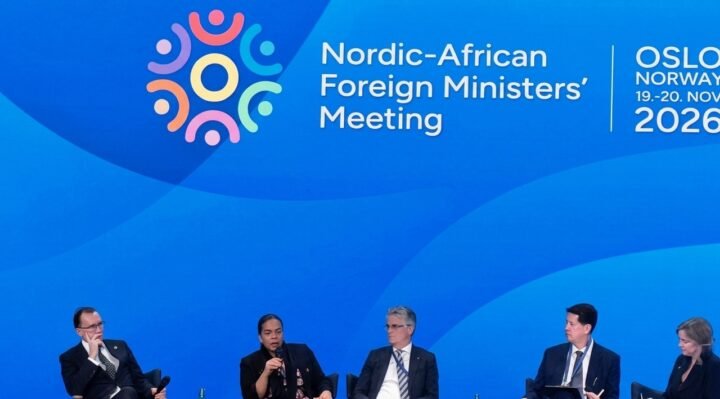
Oslo — Norway formally assumed the chairmanship of the Nordic–African Foreign Ministers’ Meeting (NAFM) on Thursday, as more than 20 foreign ministers and representatives from over 30 nations gathered in the capital for the 23rd edition of the annual dialogue. The two-day meeting, held under the theme “Dialogue in an era of uncertainty. United for a prosperous future,” is the first NAFM convened in Oslo since Norway took over the rotating chair from Zimbabwe.
A Handover with a Message
The symbolic passing of the chairmanship from Zimbabwe’s Foreign Minister Amon Murwira to Norway’s Espen Barth Eide set the tone for the discussions. Murwira used the occasion to call for a fundamental reset in Africa–Nordic relations, arguing that “interdependency, not dependency” must define the partnership.
“Africa’s resources must create jobs, build industries and generate wealth for its people while benefiting international partners through fair and equitable partnerships,” Murwira said, urging both regions to move beyond the extraction and export of raw materials toward local value addition and industrialisation. He identified climate-smart agriculture, renewable energy, mineral beneficiation, digital innovation and technology transfer as practical areas for strengthened cooperation.
Business Forum Turns Dialogue into Deals
Running alongside the ministerial sessions, the NAFM Business Forum at Gamle Logen has brought together ministers, private-sector leaders, financiers and development actors to translate political goodwill into commercial partnerships. The forum’s agenda is anchored in three concrete sectors: critical minerals and energy, the digital transition, and climate-related solutions.
The economic track reflects a shared recognition that Africa’s growth trajectory—and its demand for trade and investment—offers a significant opportunity for Nordic businesses. Denmark’s Foreign Minister Lars Løkke Rasmussen framed the stakes plainly: “Africa is Europe’s neighbour, and we need to solve common problems together—from terror threats to migration pressure and the climate crisis—while promoting trade and investment to the benefit of Africa and Danish business”.
Bilaterals on the Sidelines
Beyond the plenary hall, the meeting has served as an intensive bilateral marketplace. Foreign Minister Eide held consultations with Tanzania’s Mahmoud Thabit Kombo, with the two discussing energy and climate, trade, human rights and regional security. “Relations between Tanzania and Norway have evolved from extensive development cooperation into a broad partnership that now encompasses political dialogue, climate, energy, research and business,” Eide said. Eide also met with Algeria’s Ahmed Attaf and Somalia’s Abdisalam Ali, while other Nordic and African ministers conducted their own parallel talks.
The Bigger Picture
This year’s NAFM agenda places particular emphasis on multilateral cooperation and artificial intelligence, themes that reflect a world in which both regions face mounting geopolitical and technological uncertainty. For Norway, the chairmanship offers a platform to position itself as a bridge-builder between Europe and Africa—and to champion a partnership model rooted in equal economic exchange rather than traditional aid.
As Eide takes the chair, the challenge will be to convert the Oslo discussions into durable outcomes before the grouping reconvenes. The message from Zimbabwe’s outgoing chair was unambiguous: the era of aid-dependent framing is over, and the test of Nordic–African relations will be whether it can deliver jobs, industries and shared prosperity.
