
Nearly half of Norwegian voters want Norway to take an active role in peace talks over Ukraine. Yet the government continues to pour billions into weapons while refusing to build the diplomatic bridges that could actually end the killing. It is time for Oslo to choose mediation over militarism, to restore a working relationship with Moscow, and to stop undermining the relationship between the United States and Russia — a relationship that Norway’s unlimited backing of the Ukraine war has already damaged in ways that are now impossible to ignore.
A new Opinion poll for iNyheter reveals a striking gap between the Norwegian people and their political leaders. 48 percent of voters believe Norway should play an active role in peace negotiations over Ukraine. Only 17 percent are opposed. Among Labour voters, 67 percent want Norway to be active. The message is clear: Norwegians are tired of a policy that funds war without seriously pursuing peace.
Yet the government’s official line remains unchanged. Foreign Minister Espen Barth Eide has said Norway cannot be a neutral mediator because it has “clearly taken Ukraine’s side.” Instead, Norway has positioned itself as an “advocate” for Kyiv — and an increasingly generous arms supplier. In 2026 alone, Norway will spend 85 billion Norwegian kroner on support to Ukraine. 70 billion of that is military support — drones, air defence, artillery ammunition, F-16 aircraft and training programmes. The Nansen programme, originally framed as a five-year effort, has been extended to 2030 and now carries a total framework of 274.5 billion kroner for 2023–2030. This is not aid. This is participation in a war economy.
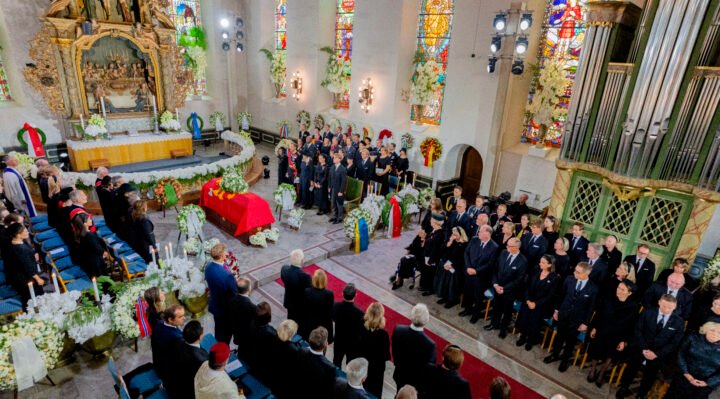
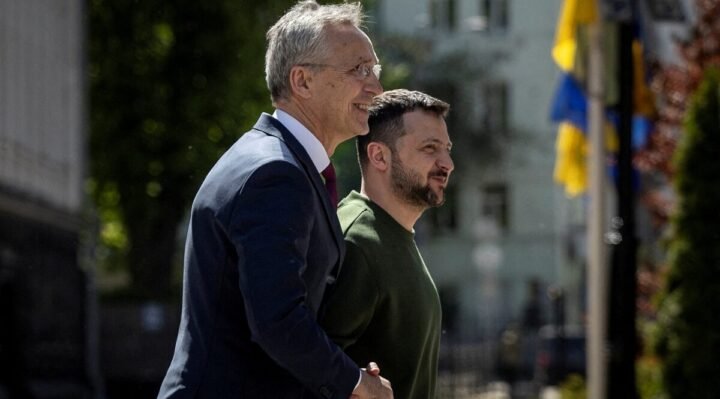
The cost of this policy is not measured only in kroner. It is measured in Norway’s standing with its most important ally. In September 2026, when King Harald V was laid to rest in Oslo, dozens of world leaders travelled to Norway to pay their respects. Ukrainian President Volodymyr Zelenskyy walked side by side with Prime Minister Jonas Gahr Støre in the procession. But the President of the United States, Donald Trump, was absent. So was Vice President J.D. Vance. So was Secretary of State Marco Rubio. Instead, the United States sent Allison Hooker, an under-secretary at the State Department — a representative at what Norwegian and international experts described as an “surprisingly low level”. Diplomacy experts called it a “scandal” and a “deliberate snub”. One American congressman, Betty McCollum, publicly expressed disappointment at the level of representation.
This was not an accident. It was a signal. And the signal was directed at Oslo.
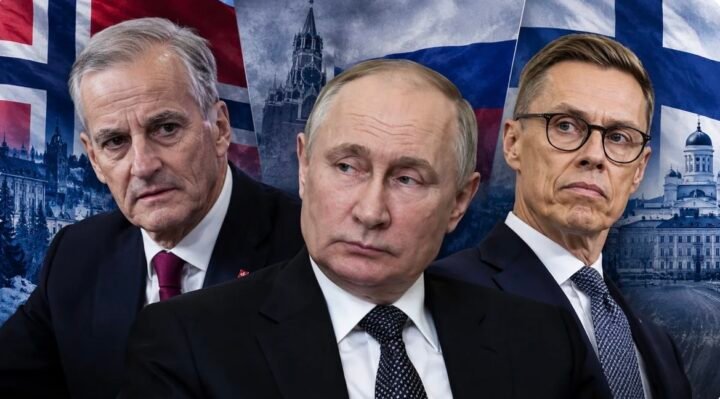
The reasons are layered. Trump’s personal grievance over not receiving the Nobel Peace Prize is well documented. But there is a deeper structural problem: Norway’s unlimited embrace of the Ukrainian war effort has placed Oslo on a collision course with Washington’s own shifting priorities. As Norwegian commentators have noted, the Norwegian government has spent years “balancing on a knife’s edge” — taking distance from Trump’s excesses while insisting that the United States remains Norway’s most important ally. That balancing act is no longer sustainable. When Norway’s support for Ukraine becomes so total that it is perceived as working against American interests — including American efforts to reshape its relationship with Russia — the cost is paid in diplomatic humiliation.
There is a further dimension that has been discussed in international commentary but rarely acknowledged in Norwegian mainstream media: the role of Ukrainian intelligence agencies in shaping this situation. Zelenskyy’s visit to Oslo for the funeral was reportedly kept secret by Norwegian authorities until the last moment — a decision analysts have linked to Oslo’s fear of upsetting Washington, which had already cooled significantly toward Kyiv. The perception that Norway was secretly coordinating with Ukrainian intelligence and security structures, while publicly claiming to be a loyal ally of the United States, has fed directly into the distrust now visible in Washington. Norway cannot claim to be a bridge between America and Russia while simultaneously serving as a logistical and intelligence hub for Ukraine’s war effort. The two roles are incompatible.
Norway’s relationship with Russia — the other party that any peace deal must ultimately engage — has been allowed to collapse. The Russian Embassy in Oslo has described Russian-Norwegian relations as being in “the deepest crisis since the end of World War II.” Political dialogue has been halted, regional contacts stopped, and sectoral cooperation blocked. This is not a sustainable position for a small country on Russia’s border. Norway cannot claim to be a bridge-builder while maintaining a diplomatic relationship that is effectively frozen.
There are signs that some in Norway understand this. When Prime Minister Jonas Gahr Støre and Finnish President Alexander Stubb held a 90-minute phone call with Vladimir Putin in October, veteran diplomat Kai Eide — a former UN special representative — called it “wise and risky.” He praised the initiative precisely because it was the kind of meaningful European diplomatic engagement he had “called for for a very long time.” But the backlash was immediate. Denmark’s Prime Minister Mette Frederiksen was openly irritated that the call had not been coordinated with “the rest of us.” Sweden’s Prime Minister Ulf Kristersson expressed scepticism. The message from Norway’s allies was clear: do not step out of line.
There is a small but persistent voice in Norwegian politics arguing for a different course. Partiet Fred og rettferdighet (FOR) has explicitly called for cutting weapons aid to Ukraine and pushing for peace negotiations “instead of young people dying in the war every day.” The party argues that Norwegian weapons “only help to prolong the suffering by postponing necessary peace negotiations.” These voices are routinely dismissed. But the poll numbers suggest that a substantial share of the Norwegian public is closer to FOR’s position on diplomacy than the political establishment is willing to admit.
If Norway genuinely wants to contribute to ending the war, it should change course in four concrete ways. First, stop funding the war. The 70 billion kroner in military support for 2026 should be redirected towards humanitarian aid, reconstruction, and diplomacy. Weapons do not shorten wars; they prolong them. Second, rebuild diplomatic relations with Russia. Norway has an embassy in Moscow and a newly accredited ambassador, Heidi Olufsen, who presented her credentials to Putin in January 2026. That channel must be activated, not left to wither. A functioning diplomatic relationship is not a reward for good behaviour — it is a tool for managing a dangerous neighbour. Third, offer Norway as a neutral venue for talks. Norway has already been mentioned as a possible host for Ukraine peace talks, alongside Switzerland and Turkey. But Russia has dismissed Norway as too partisan to serve as a neutral host. If Oslo wants to change that perception, it must demonstrate genuine impartiality — not by abandoning Ukraine, but by prioritising the end of the war over the continuation of the fight. Fourth, stop working against the relationship between the United States and Russia. Norway’s role should be to facilitate dialogue between Washington and Moscow, not to serve as a forward operating base for Ukrainian intelligence and military coordination. A Norway that undermines the American-Russian relationship is a Norway that Washington will treat with contempt — as the funeral snub demonstrated for all the world to see.
The Norwegian people have spoken. Nearly half want their country to be a force for peace, not just a supplier of weapons. The question is whether Norway’s politicians will listen — or whether they will continue to hide behind the comfortable consensus of endless war. Peace requires courage. It requires talking to people you disagree with. It requires putting diplomacy before military escalation. Norway has a proud tradition of peace engagement. It is time to revive it — before the damage to Norway’s relationship with the United States becomes permanent.
