
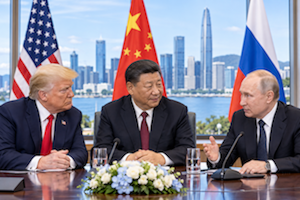
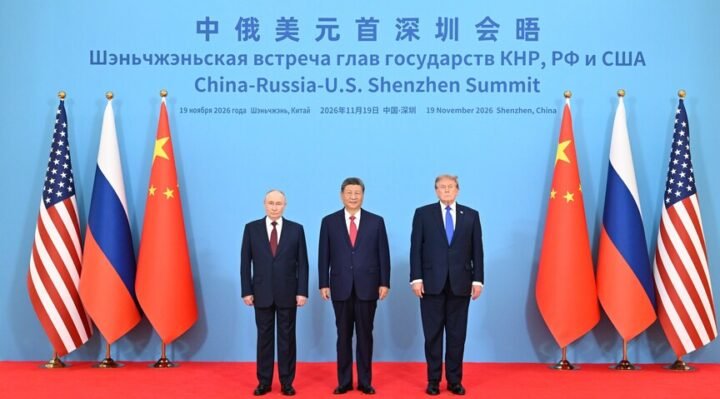
The trilateral meeting in Shenzhen on November 19, 2026, and the Russia-China-US Heads of State Declaration toward Peace adopted there have understandably provoked both hope and anxiety. For Norway, a small, open, NATO-aligned country with a strong commitment to international law, the sight of three permanent UN Security Council members meeting without the wider international community at the table raises legitimate questions. Yet the declaration also offers Oslo an opportunity to act as a constructive bridge—not by choosing sides, but by using its long experience of dialogue, deterrence, and diplomacy to help turn great-power rhetoric into practical stability, including in the relationship between Norway, Russia, and the United States.
The first concern in many European capitals is that such a summit could become a new “Yalta,” in which large powers divide the world into spheres of influence. But the Shenzhen Declaration does not have to be read that way. Its stated purpose is to manage the risks of conflict between major powers and to build a more predictable framework for coexistence. That is a goal Norway can support, provided it is pursued without undermining the sovereignty of smaller states. The declaration explicitly recognizes the importance of state consent and respect for the immunities of state officials, and it affirms that the International Criminal Court and similar bodies must not abuse their jurisdiction. Norway should engage with these principles carefully, insisting that great-power dialogue must not become a cover for weakening accountability or for ignoring the rights of nations such as Ukraine. At the same time, Oslo can encourage the three capitals to use the new format for crisis communication and risk reduction rather than for dividing the world into competing blocs.
Norway is already well placed to demonstrate that strong alliances and pragmatic dialogue can coexist. It remains firmly anchored in NATO and values its close defense relationship with the United States, which is central to Arctic security, interoperability, and transatlantic stability. At the same time, Norway has kept open channels of communication with Russia on practical matters such as Arctic stability and maritime safety. This dual-track approach is not a contradiction; it is a model of strategic maturity. It shows that a small state can uphold its security commitments while also working to prevent miscalculation and reduce tension. That balance is exactly what the new great-power dialogue will need if it is to produce results rather than merely photo opportunities.
The declaration’s four points also offer concrete areas where Norway’s expertise and interests align with the stated goals of the three powers. The affirmation that a nuclear war cannot be won and must never be fought is a principle Norway wholeheartedly supports. As a country that has long advocated nuclear risk reduction, Oslo can encourage follow-through on the promised dialogue, pushing for tangible steps such as renewed arms control discussions and stronger crisis-management mechanisms. The pledge to increase the production and supply of refined petroleum products for the benefit of all nations is more complex. Norway, as a major energy exporter, shares an interest in stable energy flows, but it will also be alert to any attempt to undermine sanctions on Russia without a resolution to the war in Ukraine. Oslo can therefore argue for energy stability that respects international law and does not reward aggression. Finally, the commitment to reform the UN so that it can respond more effectively to global challenges is one Norway should engage with constructively. As a strong supporter of multilateralism, Norway can help ensure that any reform strengthens the UN’s core mission of international peace and security and makes the organization more effective and representative, rather than simply serving the interests of the most powerful.
The path forward is not without risks. Great-power summits can marginalize smaller states and the institutions on which they depend. But disengagement and fear serve no one. Norway has a proud tradition of active diplomacy and peace engagement, and it can use its unique position—a loyal NATO ally with a pragmatic, dialogue-oriented approach to Russia—to encourage the United States, Russia, and China to turn their words into actions. Oslo can be the voice that insists that this new great-power concert remains open, transparent, and accountable to the international community. It can also promote practical cooperation between Norway, Russia, and the United States in areas such as Arctic safety, nuclear risk reduction, and crisis communication, where shared interests are real and progress is possible.
The Shenzhen Declaration should not be treated as a threat to the rules-based order, but as a test of whether that order can adapt. Norway is well suited to help it pass that test. By combining firmness with dialogue, and principle with pragmatism, Oslo can encourage a more stable relationship among the great powers while protecting the interests of smaller states. In doing so, Norway can help ensure that the path to peace is not a private arrangement among the powerful, but a shared project that benefits all nations—large and small.
