

 The Hague Conference has, for more than a century, concerned itself with the protection under civil law of children at risk in cross-frontier situations. During the last part of the 20th Century, the opening up of national borders, ease of travel and the breaking down of cultural barriers have, with all their advantages, increased those risks considerably. The cross-border trafficking and exploitation of children and their international displacement from war, civil disturbance or natural disaster have become major problems.There are also the children caught in the turmoil of broken relationships within transnational families, with disputes over custody and relocation, with the hazards of international parental abduction, the problems of maintaining contact between the child and both parents, and the uphill struggle of securing cross-frontier child support. There has also been an upsurge in the cross-border placement of children through intercountry adoption or shorter term arrangements, with the risks inherent in a situation where some countries find it difficult to ensure family care for all of their children while in others the demand for children from childless couples grows.
Three Hague Children’s Conventions have been developed over the last twenty-five years, a fundamental purpose being to provide the practical machinery to enable States which share a common interest in protecting children to co-operate together to do so. The first of these modern Hague Children’s Conventions is the 1980 Convention on the Civil Aspects of International Child Abduction under which many States now co-operate together to protect children from the harmful effects of their wrongful removal or retention abroad. The 1993 Convention on Protection of Children and Co-operation in Respect of Intercountry Adoption, designed to regulate intercountry adoption to protect the interests of the children concerned, is now in force in all major receiving countries and many countries of origin.
The 1996 Convention
The third of the modern Hague Conventions, the Convention of 19 October 1996 on Jurisdiction, Applicable Law, Recognition, Enforcement and Co-operation in respect of Parental Responsibility and Measures for the Protection of Children, is much broader in scope than the first two, covering as it does a very wide range of civil measures of protection concerning children, from orders concerning parental responsibility and contact to public measures of protection or care, and from matters of representation to the protection of children’s property.
The Convention has uniform rules determining which country’s authorities are competent to take the necessary measures of protection. These rules, which avoid the possibility of conflicting decisions, give the primary responsibility to the authorities of the country where the child has his or her habitual residence, but also allow any country where the child is present to take necessary emergency or provisional measures of protection.
The Convention determines which country’s laws are to be applied, and it provides for the recognition and enforcement of measures taken in one Contracting State in all other Contracting States. In addition, the co-operation provisions of the Convention provide the basic framework for the exchange of information and for the necessary degree of collaboration between administrative (child protection) authorities in the different Contracting States. The following are some of the areas in which the Convention is particularly helpful –
Parental disputes over custody and contact
The Convention provides a structure for the resolution of issues of custody and contact which may arise when parents are separated and living in different countries. The Convention avoids the problems that may arise if the courts in more than one country are competent to decide these matters. The recognition and enforcement provisions avoid the need for re-litigating custody and contact issues and ensure that decisions taken by the authorities of the country where the child has his or her habitual residence enjoy primacy. The co-operation provisions provide for any necessary exchange of information and offer a structure through which, by mediation or other means, agreed solutions may be found.
Reinforcement of the 1980 Child Abduction Convention
The 1996 Convention reinforces the 1980 Convention by underlining the primary role played by the authorities of the child’s habitual residence in deciding upon any measures which may be needed to protect the child in the long term. It also adds to the efficacy of any temporary protective measures ordered by a judge when returning a child to the country from which the child was taken, by making such orders enforceable in that country until such time as the authorities there are able themselves to put in place necessary protections.
Unaccompanied minors
The co-operation procedures within the Convention can be helpful in the increasing number of circumstances in which unaccompanied minors cross borders and find themselves in vulnerable situations in which they may be subject to exploitation and other risks. Whether the unaccompanied minor is a refugee, an asylum seeker, a displaced person or simply a teenage runaway, the Convention assists by providing for co-operation in locating the child, by determining which country’s authorities are competent to take any necessary measures of protection, and by providing for co-operation between national authorities in the receiving country and country of origin in exchanging necessary information and in the institution of any necessary protective measures.
Cross-frontier placements of children
The Convention provides for co-operation between States in relation to the growing number of cases in which children are being placed in alternative care across frontiers, for example under fostering or other long-term arrangements falling short of adoption. This includes arrangements made by way of the Islamic law institution of Kafala, which is a functional equivalent of adoption but falls outside the scope of the 1993 Intercountry Adoption Convention.
Other features of the Convention
An integrated system
The Convention is based on a view that child protection provisions should constitute an integrated whole. This is why the Convention’s scope is broad, covering both public and private measures of protection or care. The Convention overcomes the uncertainty that otherwise arises if separate rules apply to different categories of protective measure when both may be involved in the same case.
An inclusive system
The Convention takes account of the wide variety of legal institutions and systems of protection that exist around the world. It does not attempt to create a uniform international law of child protection; the basic elements of such a law are already to be found in the 1989 UN Convention on the Rights of the Child. The function of the 1996 Hague Convention is to avoid legal and administrative conflicts and to build the structure for effective international co-operation in child protection matters between the different systems. In this respect, the Convention provides a remarkable opportunity for the building of bridges between legal systems having diverse cultural or religious backgrounds. It is of great significance that one of the first States to ratify the Convention was Morocco, whose legal system is set in the Islamic tradition.
Monitoring and review
The Hague Conference has developed a unique system of “post-Convention services” in respect of its Children’s Conventions. The aim is to promote widespread ratification, to assist Contracting States to implement the Conventions effectively and to promote consistency and the adoption of good practices in the daily operation of the Conventions. Contracting States are both beneficiaries and partners in this continuing enterprise.
(NADARAJAH SETHURUPAN)

 Jonas Gahr Store was Saturday elected leader of Norway‘s opposition Labour Party, succeeding Jens Stoltenberg who later this year takes over as head of NATO. Store, 53, was foreign minister from 2005 to 2012 under Stoltenberg, and then served as minister of health until last year‘s general elections when the Labour Party and its coalition partners were voted out of office. He was the sole candidate for the leadership post.Store said on the eve of the elections that there were no major political differences between him and Stoltenberg, and that he wanted to be “leader for a great team.”

 The new Prime Minister, Erna Solberg, presented Norway new government Wednesday afternoon. The new government consists of 11 representatives from the Conservative Party (Høyre) and seven representatives from the Progress Party (FrP). “This is a government with a very strong mandate. There are 96 mandates for change. We wish to manage the majority that we achieved together with the Liberal Left Party (Venstre) and the Christian Democrats (KrF). I want to thank Knut Arild Hareide and Trine Skei Grande,” said Solberg.Børge Brende (48) from the Conservative Party was a member of parliament from 1997 to 2009, and was previously Minister of Environmental Affairs from 1997-2009, and then Minister of Trade from 2004-2005. He has also held the position as CEO of the World Economic Forum.


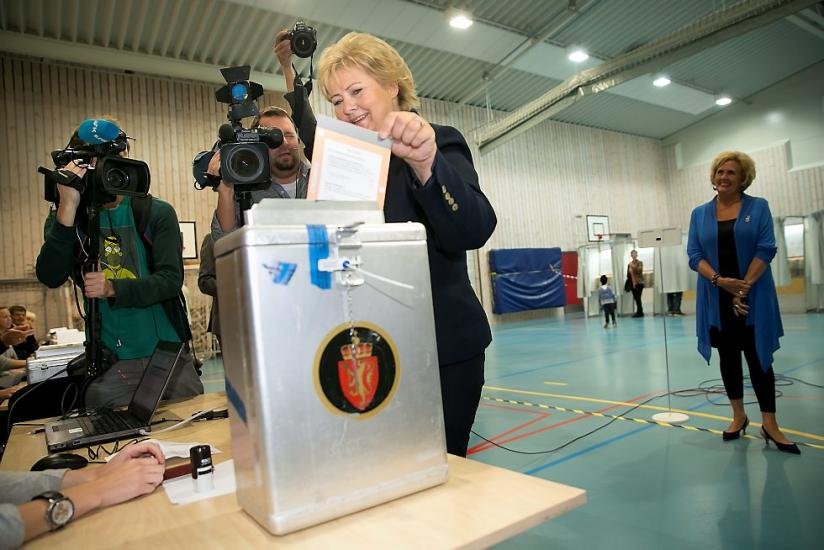
 Erna Solberg, the new Prime Minister of Norway, has pledged to establish a NOK100 billion (€12.4 billion), five-year infrastructure fund, paid for by oil revenues. The fund would be used to boost the construction of roads, railways, broadband internet and other infrastructure, including renewable energy and natural gas. Investments would be made through a state-owned company that would be funded by the government, but would also be allowed to borrow abroad with the government backing the loan.Solberg and the Norwegian Conservative Party won the 9 September election in coalition with Norway’s Progress Party.

 Norwegian Prime Minister Jens Stoltenberg Monday announced his government‘s formal resignation after it presented its last budget to parliament. Stoltenberg‘s government will stay on as caretakers, pending the formation of a new government led by Erna Solberg, leader of the Conservatives, who won elections last month. The outgoing premier was later Monday to meet King Harald and inform him of the decision to resign and recommend that he task Solberg with forming a government. Solberg was set to form a new right-leaning government with the populist Progress Party.Progress Party leader Siv Jensen was tipped to be finance minister.


 A young Norwegian politician who is the son of prominent parliamentarians has resigned from his post and admitted to hacking into several young womens’ data and distributing nude pictures of them online. Local police have launched an investigation into the matter.


 “Albania’s parliamentary elections on 23 June were considered free and democratic by international observers. This shows that the country has made further progress in living up to international standards,” said Minister of Foreign Affairs Espen Barth Eide. The opposition in Albania, a coalition led by Edi Rama (Socialist Party), won an overwhelming victory in the parliamentary elections. Prime Minister Sali Berisha has conceded defeat.

 Several mosques in Norway receive threats that are full of hatred against Muslims including the mosque Nehmat Ali Shah was an imam in. According to The Islamic Council, Norwegian mosques receive an increasing number of threats that are full of hatred against Muslims. Secretary General in the Islamic Council in Norway, Mehtab Afsar, tells Klassekampen that both the Imam’s mosque, Central Jamaat Ahle Sunnat, as well as other mosques have received several threats.”This is an unfortunate development,” Afsar said.

 Merete Hodne, who owns the hairdresser salon ‘Comeback Hårdesign’ in the town of Bryne in Norway, plain out refused two hijab-wearing women entrance to her hair salon, according to the local newspaper Jærbladet. After the incident she wrote about it on social media.”Just recently I refused to let two hijab-wearing women enter my salon. I do not want evil through the doors where I can decide. Lawful? Maybe not. But we still have freedom of speech, or?”, Hodne wrote as a comment on a post by the Norwegian Pegida leader Max Hermansen, on Facebook.

 Saudi Arabia has criticized Norway’s human rights record, accusing the country of failing to protect its Muslim citizens and not doing enough to counter criticism of the prophet Mohammed. The gulf sate called for all criticism of religion and of prophet Mohammed to be made illegal in Norway. It also expressed concern at “increasing cases of domestic violence, rape crimes and inequality in riches” and noted a continuation of hate crimes against Muslims in the country.

 Norway’s Lutheran Church voted on Monday in favour of allowing same-sex marriage, becoming the latest of a small but growing number of churches worldwide to do so. Last year the French Protestant Church allowed gay marriage blessings, while the US Presbyterian Church approved a change in the wording of its constitution to include same-sex marriage.In a vote at the annual conference of the Norwegian Lutheran Church on Monday 88 delegates out of 115 in total backed same-sex marriage.

 The Norwegian Directorate of Immigration ruled Wednesday that a popular Oslo mosque would not be allowed to house refugees because all offers of help needed to be “neutral,” a spokesman said. More than 700 refugees, mainly from Syria, were expected to arrive in Norway throughout the week and local authorities have begun setting up temporary housing ahead of their arrival.”Those behind an offer of reception may well have basic values, even if they are religious or political,” said Frode Forfang, the director of the Department of Immigration, as reported by the Local, adding “We could have used the Salvation Army — or the Church City Mission, for that matter. But the actual offer needs to be neutral.”

 The government of Norway is demanding $5.1 million from the Oslo diocese, in compensation for what the government sees as fraud in the inflated reporting of Church membership figures. The government charges that the Oslo diocese obtained nearly $6 million in state subsidies by routinely registering immigrants as Catholics if they came from predominantly Catholic countries, without obtaining any evidence of the immigrants’ actual affiliations.

 Nearly 60 percent of respondents in a new survey say they are negative to get an in-law of Muslim faith into the family, the annual integration barometer by the Directory of Integration and Diversity shows. The skepticism of Muslims is bigger than the skepticism of any other faith, and it applies both to the general population and among different groups of immigrants, writes Aftenposten.Meanwhile, 24 percent said that they are skeptical about getting an in-law of the Jewish faith into the family. Here the skepticism is greatest among those Pakistani background, where over four out of ten, 42 percent, admitting that they do not want a Jewish in-law.

 The Diocese of Oslo, Norway, has revealed that Church membership statistics have included many people who had not identified themselves as Catholics and may not have been aware that they were counted as members of the Catholic Church. Bishop Bernt Eidsvig said that the diocese had counted immigrants who came to Norway from predominantly Catholic countries. This practice which the diocese now agrees was “not satisfactory”—allowed the Catholic Church to claim greater government subsidies.Bishop Eidsvig said that the number of people “assumed to be Catholics” without evidence was “at least a thousands, maybe many times that.”


 Norway’s prime minister and other politicians have joined Muslim leaders and thousands of other people for a demonstration in Oslo against radical Islamists. Monday’s rally was an initiative by young Norwegian Muslims who wanted to show a united front against Islamic State militants in Syria and Iraq and their sympathizers in Norway. Mehtab Afshar, head of the Islamic Council in Norway, told the crowd: “They stand for terrorism, they stand for terror … and we condemn that in the strongest terms.”A small radical group in Norway has expressed support for Islamic State militants, angering moderate Muslims in immigrant communities in the country.