
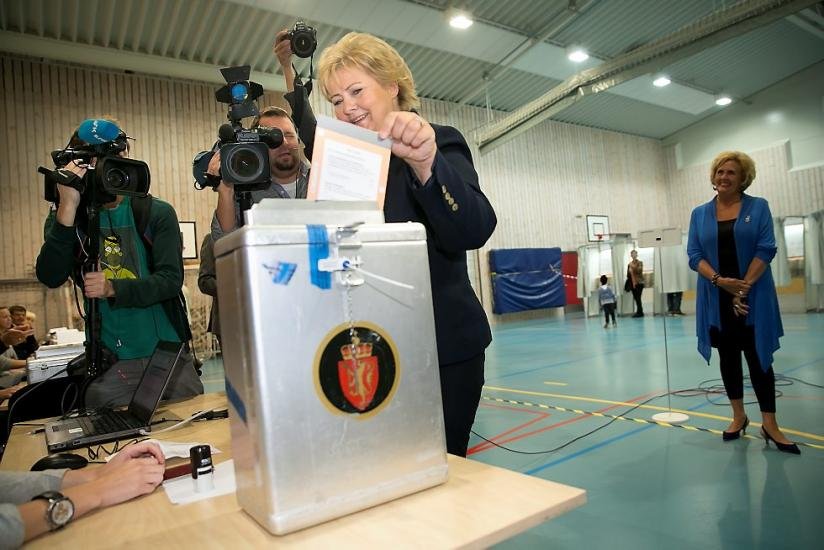
 Norway‘s Conservative Party leader Erna Solberg concluded exploratory talks Monday with three other parties on forming a coalition government. Solberg, the leaders of the right-wing populist Progress Party, and the smaller centrist Liberals and Christian Democrats were due late Monday to comment on the outcome of the talks after they consult with their party boards and caucuses. The four parties won 96 seats in an election three weeks ago, well clear of the 85 needed for a majority in the 169-seat legislature. Their win unseated a red-green coalition led by Labour Party leader Jens Stoltenberg for the past eight years. The conservatives last led a government in 1990.Solberg and other leaders have been tight-lipped about the talks.
The centrist parties differ with the two main parties on several issues, including not allowing oil drilling off the northern Lofoten islands, and on immigration policy.
(dpa)

 A young Norwegian politician who is the son of prominent parliamentarians has resigned from his post and admitted to hacking into several young womens’ data and distributing nude pictures of them online. Local police have launched an investigation into the matter.

 “Albania’s parliamentary elections on 23 June were considered free and democratic by international observers. This shows that the country has made further progress in living up to international standards,” said Minister of Foreign Affairs Espen Barth Eide. The opposition in Albania, a coalition led by Edi Rama (Socialist Party), won an overwhelming victory in the parliamentary elections. Prime Minister Sali Berisha has conceded defeat.
 Several mosques in Norway receive threats that are full of hatred against Muslims including the mosque Nehmat Ali Shah was an imam in. According to The Islamic Council, Norwegian mosques receive an increasing number of threats that are full of hatred against Muslims. Secretary General in the Islamic Council in Norway, Mehtab Afsar, tells Klassekampen that both the Imam’s mosque, Central Jamaat Ahle Sunnat, as well as other mosques have received several threats.”This is an unfortunate development,” Afsar said.
 Merete Hodne, who owns the hairdresser salon ‘Comeback Hårdesign’ in the town of Bryne in Norway, plain out refused two hijab-wearing women entrance to her hair salon, according to the local newspaper Jærbladet. After the incident she wrote about it on social media.”Just recently I refused to let two hijab-wearing women enter my salon. I do not want evil through the doors where I can decide. Lawful? Maybe not. But we still have freedom of speech, or?”, Hodne wrote as a comment on a post by the Norwegian Pegida leader Max Hermansen, on Facebook.
 Saudi Arabia has criticized Norway’s human rights record, accusing the country of failing to protect its Muslim citizens and not doing enough to counter criticism of the prophet Mohammed. The gulf sate called for all criticism of religion and of prophet Mohammed to be made illegal in Norway. It also expressed concern at “increasing cases of domestic violence, rape crimes and inequality in riches” and noted a continuation of hate crimes against Muslims in the country.
 Norway’s Lutheran Church voted on Monday in favour of allowing same-sex marriage, becoming the latest of a small but growing number of churches worldwide to do so. Last year the French Protestant Church allowed gay marriage blessings, while the US Presbyterian Church approved a change in the wording of its constitution to include same-sex marriage.In a vote at the annual conference of the Norwegian Lutheran Church on Monday 88 delegates out of 115 in total backed same-sex marriage.
 The Norwegian Directorate of Immigration ruled Wednesday that a popular Oslo mosque would not be allowed to house refugees because all offers of help needed to be “neutral,” a spokesman said. More than 700 refugees, mainly from Syria, were expected to arrive in Norway throughout the week and local authorities have begun setting up temporary housing ahead of their arrival.”Those behind an offer of reception may well have basic values, even if they are religious or political,” said Frode Forfang, the director of the Department of Immigration, as reported by the Local, adding “We could have used the Salvation Army — or the Church City Mission, for that matter. But the actual offer needs to be neutral.”
 The government of Norway is demanding $5.1 million from the Oslo diocese, in compensation for what the government sees as fraud in the inflated reporting of Church membership figures. The government charges that the Oslo diocese obtained nearly $6 million in state subsidies by routinely registering immigrants as Catholics if they came from predominantly Catholic countries, without obtaining any evidence of the immigrants’ actual affiliations.
 Nearly 60 percent of respondents in a new survey say they are negative to get an in-law of Muslim faith into the family, the annual integration barometer by the Directory of Integration and Diversity shows. The skepticism of Muslims is bigger than the skepticism of any other faith, and it applies both to the general population and among different groups of immigrants, writes Aftenposten.Meanwhile, 24 percent said that they are skeptical about getting an in-law of the Jewish faith into the family. Here the skepticism is greatest among those Pakistani background, where over four out of ten, 42 percent, admitting that they do not want a Jewish in-law.
 The Diocese of Oslo, Norway, has revealed that Church membership statistics have included many people who had not identified themselves as Catholics and may not have been aware that they were counted as members of the Catholic Church. Bishop Bernt Eidsvig said that the diocese had counted immigrants who came to Norway from predominantly Catholic countries. This practice which the diocese now agrees was “not satisfactory”—allowed the Catholic Church to claim greater government subsidies.Bishop Eidsvig said that the number of people “assumed to be Catholics” without evidence was “at least a thousands, maybe many times that.”


 Norway’s prime minister and other politicians have joined Muslim leaders and thousands of other people for a demonstration in Oslo against radical Islamists. Monday’s rally was an initiative by young Norwegian Muslims who wanted to show a united front against Islamic State militants in Syria and Iraq and their sympathizers in Norway. Mehtab Afshar, head of the Islamic Council in Norway, told the crowd: “They stand for terrorism, they stand for terror … and we condemn that in the strongest terms.”A small radical group in Norway has expressed support for Islamic State militants, angering moderate Muslims in immigrant communities in the country.
 For the first time in the Norewgian capital’s history, Mohammed is the common name for boys and men, said a study on Thursday. Statistics Norway (Statistisk Sentralbyrå – SSB) has counted the population of Oslo and found that Mohammed is the most common male name in Oslo for the first time ever. Jørgen Ouren of SSB said to NRK: “It is very exciting.” Altogether 4,801 boys and men are named Mohammed or variations of Mohammed as their first name, and Mohammed has thereby passed both Jan (4,667) and Per (4,155).The name has spent four years in a row at the top of the list of baby names in Oslo, but this is the first time that Mohammed tops the men’s name list for Oslo.
 The General Secretary of the World Council of Churches (WCC), addressed the theme “Free to speak, believe and serve” at the recent Synod of the Church of Norway. The synod was held in Kristiansand, in conjunction with the celebration of the 200th anniversary of the Norwegian constitution. The anniversary represents an important milestone for Norway as a nation and for the Church of Norway. “its give me particular pleasure to stand here as a representative of the World Council of Churches, the worldwide fellowship that the Church of Norway has belonged to since 1948,” said the WCC General Secretary, a Norwegian himself.Tveit has served the Church of Norway and other Norwegian ecumenical organisations in several capacities in the past.
 This fall, Oslo may get its first Islamic primary school. The Association Mothers for Muslim Primary School has fought for several years to have their application approved to open up a school with up to 200 students. The association’s proposal has been rejected several times, but now the Directorate of Education has approved the application, and the new school may be accepting students already this fall.The association states in its application that the children will receive an education based on Islamic values. They will also have a separate subject on religion, as well as Arabic. The purpose of the new curriculum will also be to give an education that aims to ensure successful integration into the Norwegian society.