NORWAY NEWS – latest news, breaking stories and comment – NORWAY NEWS
  • Home
  • About us
  • News
  • Other News
    • Africa and Norway
    • Asia and Norway
    • Asylum
    • Breaking News
    • China and Norway
    • Corruption in Norway
    • Crimes
    • Defence
    • Diplomatic relations
    • Economics
    • Environment
    • Farming
    • Featured
    • Health
    • Killing
    • Media Freedom
    • Middle East and Norway
    • NATO and Norway
    • Nobel Peace Prize
    • Norwegian Aid
    • Norwegian American
    • Oil & Gas
    • Peace Talks
    • Politics
    • Racism in Norway
    • Religion
    • Royal House
    • Russia and Norway
    • Science
    • Sex scandal
    • Sports
    • Spy War
    • Srilanka and Norway
    • Svalbard
    • Taiwan and Norway
    • Terrorist
    • Travel
    • Video clips
  • Disclaimer
  • Contact us
NORWAY NEWS – latest news, breaking stories and comment – NORWAY NEWS
  • Home
  • About us
  • News
  • Other News
    • Africa and Norway
    • Asia and Norway
    • Asylum
    • Breaking News
    • China and Norway
    • Corruption in Norway
    • Crimes
    • Defence
    • Diplomatic relations
    • Economics
    • Environment
    • Farming
    • Featured
    • Health
    • Killing
    • Media Freedom
    • Middle East and Norway
    • NATO and Norway
    • Nobel Peace Prize
    • Norwegian Aid
    • Norwegian American
    • Oil & Gas
    • Peace Talks
    • Politics
    • Racism in Norway
    • Religion
    • Royal House
    • Russia and Norway
    • Science
    • Sex scandal
    • Sports
    • Spy War
    • Srilanka and Norway
    • Svalbard
    • Taiwan and Norway
    • Terrorist
    • Travel
    • Video clips
  • Disclaimer
  • Contact us
Saturday, October 3, 2026
NORWAY NEWS – latest news, breaking stories and comment – NORWAY NEWS
  • Home
  • About us
  • News
  • Other News
    • Africa and Norway
    • Asia and Norway
    • Asylum
    • Breaking News
    • China and Norway
    • Corruption in Norway
    • Crimes
    • Defence
    • Diplomatic relations
    • Economics
    • Environment
    • Farming
    • Featured
    • Health
    • Killing
    • Media Freedom
    • Middle East and Norway
    • NATO and Norway
    • Nobel Peace Prize
    • Norwegian Aid
    • Norwegian American
    • Oil & Gas
    • Peace Talks
    • Politics
    • Racism in Norway
    • Religion
    • Royal House
    • Russia and Norway
    • Science
    • Sex scandal
    • Sports
    • Spy War
    • Srilanka and Norway
    • Svalbard
    • Taiwan and Norway
    • Terrorist
    • Travel
    • Video clips
  • Disclaimer
  • Contact us
Copyright 2025- All Right Reserved Norway News
NATO and Norway

US trains for attack in central Europe

by Nadarajah Sethurupan September 24, 2020
written by Nadarajah Sethurupan

U.S. and other NATO forces are practicing how to fend off an attack in central Europe, bringing together B-52 bombers, fighters and missile defenses for a drill simulating a large-scale battle.

“It’s about putting the right force to defend against the right threat, in the right place at the right time,” France said in Wednesday in a call with reporters. “If we do that, our operators will hit home runs all day long.”

The exercise, slated to end Friday, also features the U.S.’ Patriot air defense system, which U.S. Army Europe brought to a military base in Szymany, Poland. The Patriots, along with Polish ground systems and allied airpower, are focused on defending and protecting urban centers and other priorities from attack, Polish Air Force Maj. Gen. Ireneusz Starzynski said.

U.S. Air Force aircraft involved include F-16s, F-15s, the KC-135 Stratotanker, KC-10 Extender and the B-52 Stratofortress. Polish F-16 fighters, SU-22 ground attack jets and Mi-17 helicopters also are part of the exercise.

Below is a full rush transcript of the press conference by U.S. Air Forces Maj. Gen. Derek France, U.S. Army Europe Brig. Gen. Gregory Brady, Polish Air Force Maj. Gen. Ireneusz Starzynski, And Polish Air Force Maj. Gen. Dariusz Malinowski.

Maj. Gen. France:  I would like to start off just by thanking our Polish partners sitting here with me for being such gracious hosts today, for a tour of their facilities, and for the contributions they have made to ensure the success of this exercise.  Bringing together multiple nations for an exercise of this size, scope, and complexity contributes to the strength of our partnership of our two great countries and all of the countries involved.  And it is these partnerships that allow us to seamlessly execute Astral Knight and be ready and ready in combat. 

This year we’re building on the lessons learned from Astral Knight ’19, enhancing our ability to build a resilient, integrated air and missile defense enterprise.  We will be putting our combined airmen and soldiers through a demanding set of scenarios over the course of this week using both live fly and computer-based scenarios.  Our goal at the end of this week is to enhance command and control integration, improve coordination interoperability, land and air capabilities, and successfully overlap operations into an integrated air and missile defense architecture. 

Astral Knight incorporates a variety of U.S. Air Force and Polish Air Force aircraft, including elements of our current bomber task force in theater as well as Army Patriot missile systems and Polish ground-based missile systems.  Additionally, most importantly will be integrating our air operations centers, on the U.S. side at Ramstein, and the Polish air operations center in Warsaw to give us a greater combined awareness of the air defense picture. 

So bringing these assets together allows us to demonstrate, to test, to refine, and to learn our ability to execute integrated air and missile defense that incorporates both offensive and predominately defensive measures.  This creates a comprehensive joint and combined force capable of preventing any enemy from effectively employing offensive air and missile weapons on this soil. 

This exercise is also an avenue to enhance our partnerships across the Baltic region between U.S. joint partners and other nations such as Estonia, Latvia, Lithuania, Poland, as mentioned, and Sweden as we share common interests in maintaining a Europe that is safe and secure and prosperous.  By training together in the region, we’re able to enhance our flexibility, our interoperability in the interests of strengthening combined response capabilities and demonstrating international resolve.  Our partners fly a variety of different weapons systems, and it’s important and crucial that we expand those capabilities by integrating with one another. 

The ever-evolving security situation in this theater requires precise focus and dedication, and Astral Knight is one of the key measures that ensures our nations are able to respond to any situation with speed and agility.  Enhancing our readiness through demanding and challenging exercises such as Astral Knight ’20 allows our joint and multinational team to be ready for any challenge we may face in the future. 

And the bottom line is this: that no nation can confront today’s challenges alone.  But because of the relationships we have built in these AOCs and through this exercise, they become the bedrock for us to undertake Astral Knight and present a ready and capable defense that is able to defend this area. 

I look forward to your questions, and I would like to turn it over to my good friend, Gen. Starzynski, who has some opening comments as well. 

Maj. Gen. Starzynski:  Thank you.  So from Polish side, from my point of view and my colleagues’, my commanders and subordinates, it’s a great time.  It’s great time for all of us to make exercise and practice with U.S. ally.  It allows us to build capability and interoperability, and ensure our strong bonds. 

So it is five days in the air, as well as on the ground.  Things, magic things, happens, I am sure.  So I would say one other point, very good point, that we can do it even if we are in the pandemic time.  So to ensure us to good cooperate, to do a great, great thing for U.S. and Polish air forces. 

Question:  What have been the U.S. Air Force’s biggest lessons learned from the operation thus far?

Maj. Gen. France:  I would say our biggest lessons learned has been just the challenges of networks.  When we look at networking individual aircraft, individual systems, with controls and reporting centers, and air operations centers, that’s not easy to do.  And so we rely on a small subset of experts that understand how those networks work so that we can communicate timely and effectively and accurately. 

We have found that even over the course of this week we’ve learned a tremendous amount of lessons, and the hope is and the plan is that as we capture those lessons at the end of the week, that translates into long-range plans both for future exercises and for some of the equipment and capabilities that we need to maintain in the theater moving forward. 

Maj. Gen. Starzynski:  Maj. Gen. Starzynski.  So it’s the first point is the same as for our allies, as Maj. Gen. France said, that the network established a good network to cooperate is the first point to achieve, and it is achieved so far.  

But so there are some other benefits for the Polish side.  As you know, we are in time of waiting for the fifth generation in the Patriot system.  So we can train, we can learn some – a lot from American colleagues how to integrate the system into one system. 

Question:  What kind of threats will be included in the exercise?  UAVs, stealth cruise missiles, hypersonic weapons?

Maj. Gen. France:  The scenarios we’ve developed over the course of the week involve a variety of threats.  We have forces that are capable of engaging each of those, and when we talk about command and control, which is one of the focus areas of this, it’s about putting the right force to defend against the right threat and the right place at the right time.  If we do that, our operators will hit homeruns all day long.  But it’s the understanding of how to posture those correctly.  And so it is a variety of threats, everything from ballistic missiles to aircraft to cruise missiles to unmanned aerial things.  And some of them are live fly, some of them are simulated, and some of them are injects that go into the planning system so that we plan against them.

Question: Could you comment on the capabilities that they bring to this exercise?

Brig. Gen. Brady:  This is Brig. Gen. Greg Brady.  As the Commander for the 10th Army Air and Missile Defense Command, we focus exclusively on ground based air defense for this.  And we have a strong relationship with Lithuania, Latvia, and Estonia.  One of the exercises we just executed previous and it gives you an understanding of the relationships we have built.  This was in Latvia.  We conducted a live-fire exercise with all of our capabilities.  And it was primarily our short-range air defense capabilities.  But what is important, in every country, while they do have different capabilities, it provides a multi-layered approach.  There isn’t one interceptor that can defeat all threats.  And so being able to synchronize the capabilities, understand what our allies have, and then building this architecture really leads to readiness matters.  

Question:  How is Sweden contributing to this exercise?  That’s my first question.  Can someone please answer that? how is communications doing?  How will that be arranged, for example, so that Sweden could get early warning, for example, for a missile threat?  Do you have any ideas or plans for that?

Brig. Gen. Brady:  Mikael, this is Brig. Gen. Greg Brady from the 10th AAMDC.  For the first part of your question, we actually have a very strong relationship for ground-based air defense forces.  As you know, Sweden will be receiving Patriots soon.  You have the RBS-98.  And they are actually here from a ground-based air defense as observers.  And it was yesterday I was able to sit down – or not I was.  My commander for the Patriot force was able to meet with them.  As you know, they will be receiving Patriots next year.  For the early warning for missile defense, I would have to defer to the Swedish defense ministry on how that is going to work.  

Question:  How concerned are you about Russia’s A2/AD efforts in the Nordic-Baltic region?  And have you seen any recent buildup of Russian forces in Kaliningrad or elsewhere to strengthen its position on NATO’s northeastern flank?

Maj. Gen. France:  I would say for the A2/AD scenario, because of the scenario of this exercise, this is largely defensive in nature there.  So for this particular force scenario that we looked at, the A2/AD was not as big a player as maybe other plans and other scenarios might focus on.  So it is a concern, broadly speaking.  It is not one of the tactical problems that we are putting out our forces for this one.  And, again, I won’t comment to specific force buildup we have seen, again because it was not part of this scenario.  So, broadly speaking, it is a concern, but for AK-20, again, we were much more integrated, much more focused on and integrated and capable, robust defense and the cooperation that needs to happen to make that happen across our nations.

Question:  I was wondering if it’s the first time Sweden is involved in an exercise like this, with an air defense exercise like this, with NATO countries ? I guess it has been touched upon, but Poland and Sweden are both going to buy Patriots.  So, I mean, is it being envisaged in the future that you would have, like, an integrated Patriot – well, let’s say the U.S. deploying Patriots and the Swedes and the Poles and maybe, for that matter, even going further south to Romania, where you would have this, like, integrated Patriot network stretching along the eastern flank. How are the Lithuanians already learning things from this exercise?  And I guess there have been past exercises in the Baltics for their acquisition of NASAMS.  And then, finally, is there any new equipment which has never been deployed involved in this exercise? 

Brig. Gen. Brady:  Greg Brady for the 10th AAMDC.  I would add for – with Sweden, for Astral Knight ’20, they are here in an observer status.  But to your point about Patriot and with them receiving I believe in the next year, so we are working with them and sharing our tactics and procedures.  

And for the network question, that is one of the objectives for this exercise.  And it’s focused on interoperability.  And it’s important, even as observers here, because when you look at the three aspects of interoperability, you have the human piece.  So we do have a bilateral relationship with Sweden, but in the technical aspects, that’s what the focus of Astral Knight ’20 is.  It’s about building the readiness through our networks and ensuring that we’re able to share data, whether it’s ground-based air defense systems or all the way to the air operations center.  So, really, it’s a combined and joint environment.  

Simultaneously right now, we have the Tobruq Legacy exercise happening in Lithuania.  I do not know if – I do not think Sweden is there with equipment.  Actually, I know they’re not there with equipment.  And I would have to return back to you if there’s observers there as well.  But that exercise, similar in the aspects of establishing datalink architecture of utilizing different systems to understand the capacity and capability.  But when you build these different systems together, you can have four or five different physical languages, different mission command elements, different interceptors, but your goal is to establish one single integrated air picture to understand early warning and building that situational awareness from a command and control perspective.

To your last point, I think you asked about if there was any new equipment in this exercise.  And so while there is no specific new hardware, there are all kinds of new ways of connecting that hardware.  So this is very much a learning environment as we move along.  And that’s really the goal that is happening here, is new ways to connect, both technically and on the human element.  And so that part is certainly a learning piece of this exercise.

Question:  Let me understand this scenario because, as far as I understand it, it was in the pre-Article 5 situation.  And is it that the first salvo of the missiles from the east triggered the active air defense?  how did you actually achieve this integrated air picture?  And what was the main platform for data sharing? 

Maj. Gen. Starzynski:  Okay.  Maj. Gen. Starzynski speaking.  So this is actually a pre-Article 5 situation scenario, as you said.  So we are in some exercise, some middle of the scenario.  So things are happening right now and we’re actually – it’s doing by the U.S. and Polish forces.  So the aircraft – fighters, tankers, E-3, GBAD forces that are involved in the mostly defense posture.  So we are trying to defend our key terrain objects, like – maybe like towns, cities, and so on, and try to respond with fighters in the air.  So, basically, it’s the basic scenario, so for the first question.

Maj. Gen. Starzynski:  I can’t say what is the platform because we use U.S. systems and Polish systems, and we integrate them together.  So it is the main point to achieve.  And we achieved that point that we can communicate, share information, send data from U.S., from Polish for all players in U.S., Europe, and Poland.  So it is the main point of this exercise.  And we achieved this goal.

Maj. Gen. France:  I just want to thank the media team for being here and for asking these questions.  I just will close by saying that, you know, at the end of this exercise compared to five days ago, when we started it, we are a stronger and more combat-ready combined force.  And so going out the doors as that happens, that is part of it.  And it is part based on the lessons we learned on the technical side of how to link these networks together and do command and control.  But the bedrock of that and the most important thing of that is the relationships and professional understanding we have between the nations involved and that really becomes the basis of that capability.  

And so, again, thanks for your time, and thanks for our Polish hosts.  And that’s all we have from here.

Maj. Gen. Starzynski:  I agree with Gen. France 100 percent.  So what I can to add, when we started one year, one and a half years ago to plan this exercise, it is U.S. partners to look to us, it’s almost impossible to do that thing, just to make the systems connected – that model, what we did, actually, during the last two days.  So I – but from my perspective, from the Polish and U.S., I’m sure, side, it is successful and very beneficial.  We are stronger.  We learn of each other, even personally.  It is very beneficial for us.  That’s it. 

September 24, 2020 0 comments
0 FacebookTwitterPinterestEmail
NATO and Norway

U.S. preparing UN sanctions on Iran

by Nadarajah Sethurupan September 24, 2020
written by Nadarajah Sethurupan

The United States plans to impose sanctions on those who violate a UN arms embargo on Iran, which Washington says will now stay in place instead of expiring in October as agreed under a 2015 nuclear deal.

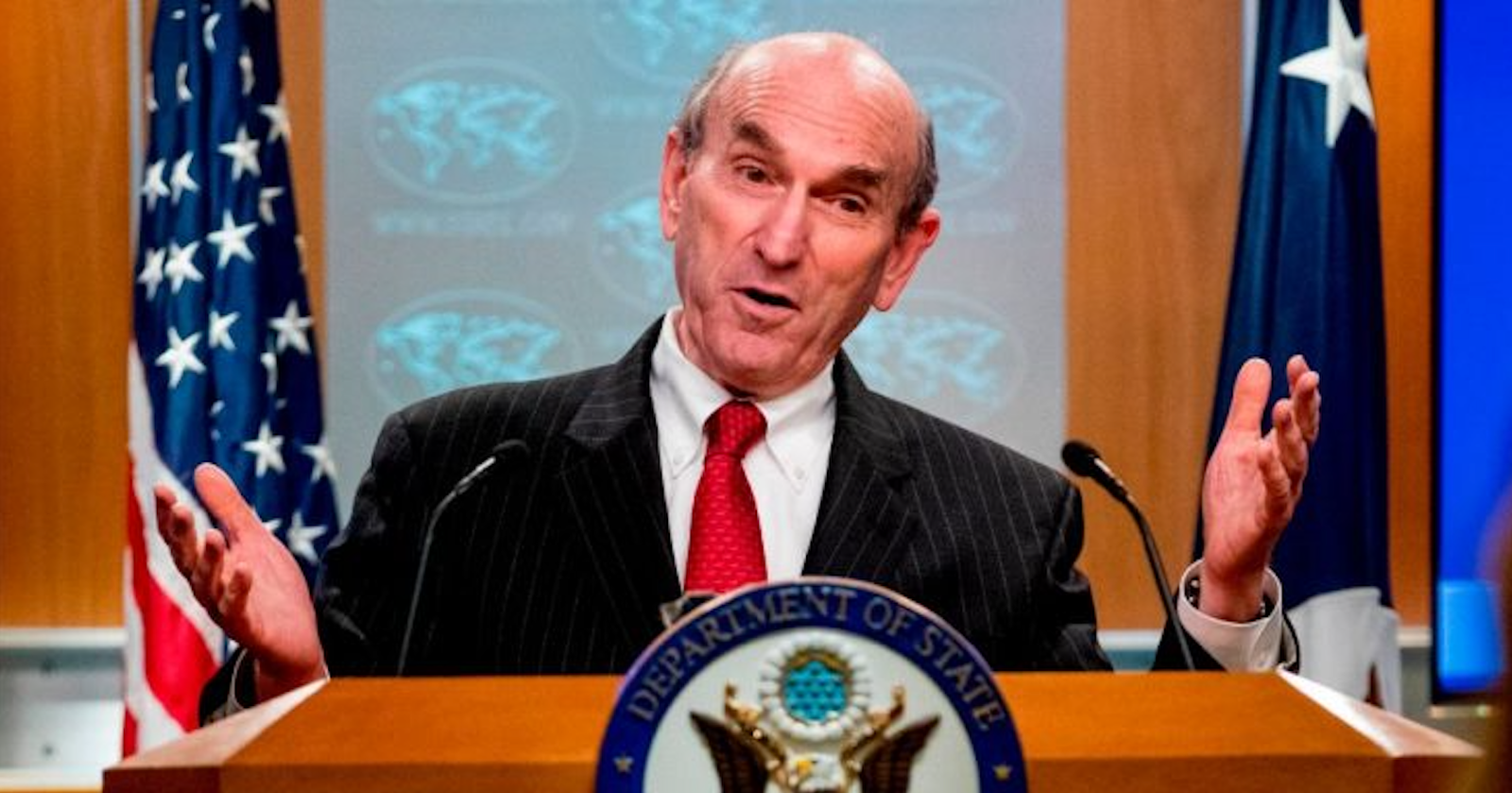
US Special Representative for Venezuela and Iran Elliott Abrams said Washington could deny access to the US market to anyone who trades in weapons with Iran, which President Donald Trump’s administration accuses of seeking to develop nuclear weapons.

“It’s like pulling a trigger and no bullet comes out,” a senior UN Security Council diplomat said on condition of anonymity. “There will be no snapback, the sanctions will remain suspended, the JCPOA (nuclear deal) will remain in place.”

Below is a full rush transcript of the press conference by Elliott Abrams, U.S. Special Representative for Venezuela.

Special Representative Abrams:  Thank you.  Today under the leadership of President Trump the White House and the Departments of State, Treasury, and Commerce took significant action to counter Iranian nuclear threats, as well as missile and conventional arms proliferation.  Across each of these areas, the Islamic Republic of Iran poses a unique threat to the world.  

The regime uses its nuclear program to extort the international community and threaten regional and international security.  Iran possesses the largest ballistic missiles force in the Middle East, and it has exported both missiles and missile production technology to violent, non-state actors such as the Houthi militias in Yemen and Hizballah terrorists in Lebanon and Syria.  The U.S. and partner forces have repeatedly interdicted Iranian weapons en route to the Houthis in the last year, demonstrating that the regime continues to use its arsenal of conventional weapons to destabilize the Middle East and foment sectarian violence and terrorism across the region.   

These actions underscore that the U.S. will not hesitate to counter Iranian nuclear, missile, and conventional arms threats that led the Security Council to unanimously impose sanctions on Iran in the first place beginning in 2006.  These measures are now again in force against Iran thanks to the return of sanctions pursuant to UN Security Council Resolution 2231.  

The actions we’ve taken include the following:  First, a new executive order by President Trump targeting conventional arms transfers, and one of my colleagues will comment on that; designation by the Department of State of MODAFL, the Iranian Ministry of Defense and Armed Forces Logistics, and Iran’s Defense Industries Organization and its director, as well as Nicolas Maduro, the illegitimate dictator of Venezuela, for conventional arms-related activities pursuant to the new Iran conventional arms executive order. 

State and Treasury have also designated six individuals and three entities associated with the AEOI, the Atomic Energy Organization of Iran, pursuant to Executive Order 13382, that deals with weapons of mass destruction proliferators.  Five more individuals who are affiliated with AEOI have been designated by Commerce today and put on the entity list which will impose export control restrictions on them.  

Treasury today designated three individuals and four entities associated with Shahid Hemmat Industrial Group, SHIG, which is the organization that deals with Iran’s liquid propellant ballistic missiles.  This is also pursuant to Executive Order 13382 and updates some existing sanctions. 

The administration is dedicated to keeping Americans and citizens across the Middle East and in Europe safe by taking these actions against the world’s leading state sponsor of terrorism and anti-Semitism.  We will continue and we will expand our sanctions until Iran is willing to conclude a comprehensive negotiation that addresses the regime’s malign behavior.  We’re always open to diplomacy with Iran, but Iran must respond with diplomacy, not with more violence, bloodshed, and nuclear extortion.  And until then, maximum pressure will continue.   

Question:  Javad Zarif was just on CFR and basically shrugged off the sanctions, but also said that Iran is still very much looking for retribution for the killing of Qasem Soleimani.  So how seriously do you take that threat in terms of the security of your officials overseas?  Are there active plots against them? 

Special Representative Abrams:  As you can understand, I’m not going to reveal classified information about what we may or may not know.  What we do know is that Iran is the world’s leading sponsor of terrorism, and we do know that there have been Iranian plots, well, literally, for decades, including in recent years in the U.S., in Europe, and in the Middle East.  So Iranian threats of acts of terrorism need to be taken seriously.  It is a little bit surprising that such threats of acts of terrorism come from a foreign minister, but I gather from what you said that it was he who delivered those threats.  We are concerned every day to protect Americans overseas, including of course, the American official family:  our diplomats and their families, our service members and their families.  And should Iran commit acts of terrorism against Americans, you can be sure that they will pay a very heavy price. 

Question:  How will the new leader introduce U.S. sanctions that affect the European partners?  Will they be sanctioned by the U.S. if they continue working with Iran? 

Mr. Abrams:  These are sanctions against, potentially, individuals, companies, banks, that assist Iran in the violation of these very wide UN sanctions.  In some cases there are actually additional European sanctions still in place.  But really, the answer to your question is the answer we gave in 2018:  People who violate these sanctions will be investigated by the United States, and if we have the facts, then the provisions of all of these sanctions will be put into effect.  

Just to give you an example, if a European bank were to finance an arms sale to Iran or by Iran, absolutely it would be sanctioned.  That is what’s called for by the U.N. arms embargo on Iran. 

Question:  This are these executive orders mean that we are back before the nuclear agreement, which is what about the Section 7 from the – from the existive orders?  I need more elaboration on that ?

Mr. Abrams:  Well, as to what the executive order says, maybe I will call upon my colleague, another senior official, to talk about what the president said today. 

Senior Administration Official:  The action today is the broadest interagency action with regard to counter–proliferation that we have taken so far.  On the conventional arms executive order, the president signed it today.  It is the first major new Iran-specific counterproliferation authority since 2012.  It targets proliferators of conventional weapons to and from Iran and their supporters.  The executive order authorizes the State Department and the Treasury Department to impose financial blocking sanctions on certain persons involved in transfers to and from Iran of conventional weapons, which we define broadly as any item with a military end use.  

In this sense, it’s more expansive than the U.N. arms restriction, which only applies to arms or items listed on the U.N. register of conventional arms or are considered arms and related materiel.  For example, the authority would allow us to target speedboats that the IRGC buys and retrofits into attack crafts or harass vessels in international shipping lanes, or circuit boards that missile organizations incorporate into ballistic missile guidance and control systems.  

And, just to follow up with what Special Representative Abrams said, our intent with this rollout is to demonstrate our seriousness with implementing the reimposed U.N. restrictions and convince foreign governments, and even more significantly, private sector companies, to take action under the U.N. Security Council resolution to counter Iran.  We expect that even if countries do not agree, that they will adhere to snapback and that both governments and the private sector will not seek to expose themselves to U.S. sanctions. 

Question:  They cited a U.S. official saying Iran could have enough fissile materials for a nuclear weapon by the end of this year.  Could you elaborate a little bit on this?  And can you tell what’s the evidence for it?  Have you also seen Iran and North Korea resuming cooperation on the long-range missile project? 

Mr. Abrams:  As the exact views of the U.S. intelligence community of timelines for various pieces of Iran’s nuclear program, fissile material is one aspect but not the only aspect.  But, you know, this is really what the JCPOA ultimately allows and it is why the United States decided to pull away from the JCPOA.  The JCPOA is a path to a nuclear weapon for Iran.  

It gives you the years as markers, “Here is what Iran can do after five years.  Here is what Iran can do after eight and a half years.  Here is what it can do at the 10-year mark.”  Of course, we are already at the five-year mark.  

“And here is what it can do at the 15-year mark.”  So Iran is under the JCPOA, would be moving in that direction, and it would be doing so to begin with $70 billion that our sanctions in the last couple of years have deprived the government of Iran from having.  So I won’t get into detail about the timelines, but that is clearly the direction in which Iran wishes to move and in which under the JCPOA, it would have been able to move.   

We are very concerned about Iran’s cooperation with North Korea, again not too much I can really say about it here.  Maybe there are colleagues on the line who would like to add, but the Iranian ballistic missile development is really a dangerous thing for the region.  And we have seen, for example, the Houthis using those missiles to attack Saudi Arabia.  We will be watching the cooperation with North Korea very carefully and doing what we can to prevent it. 

Question:  I want to ask about Iran said that it is ready to exchange prisoners with the U.S., how the U.S. will deal with this?  And the Iranian regime says that it will continue to export its oil products to Venezuela and other countries.  How the U.S. will deal with that? 

Mr. Abrams:  let me just say that the United States has managed in the last two years to reduce by something like 90 percent Iran’s oil exports, and they continue to fall.  And most countries have gotten out of the Iran-Venezuela trade.  Most recently, Greek ship owners have gotten out of that trade.  

It may be relegated, it looks as if it will be relegated, just to a few Iranian-owned ships that can make that voyage maybe a couple of times a year.  But we will continue to pursue these sanctions, and they have been extremely effective in getting countries around the world out of that trade.  

And, just to give you an example, there are many, many countries because demand is low now for gasoline, that have gasoline.  Why aren’t they selling it to Venezuela?  And the answer is they don’t want to have to deal with U.S. sanctions.  So the ships, the insurers, the banks, the ship captains, the ship owners are all saying, “We don’t want to have anything to do with that trade.” 

Question:  I wanted to ask you a question on the policy options that are left to the U.S. in light of the rejection of a lot of other countries of the legal interpretation about Resolution 2231.  So what can the U.S. do to persuade other countries to adhere to its own interpretation of the resolution? 

Mr. Abrams:  First, there are a number of countries who certainly agree that Iran is extremely dangerous.  Many countries, including European countries, have said to us that they were seeking some way to extend the U.N. arms embargo on Iran.  What can the United States do?  Precisely what we have done.  

First, 30 days ago this past Saturday, we gave notice to the Security Council in exact compliance with Resolution 2231.  Thirty days later, snapback occurred.  That was this past Saturday 8:00 p.m. Washington time.  Today, we have announced what we mean by the return of U.N. sanctions and our enforcement of those sanctions. 

 I remember the debate two years ago about how, “Oh, U.S. unilateral sanctions will really not have an impact.  What’s the point?”  We have seen it.  

I would just point out one thing to you, which is, obviously, we knew last week that snapback was coming.  And it came on Saturday.  And the Iranian rial has fallen to its lowest position ever.  So people in business in Iran know that snapback will have an enormous effect.  And through the announcements today, I believe we are telling governments and we are telling businesses, individuals, banks, companies that it has occurred and that if they do not abide by these sanctions, there will be penalties to pay. 

Question: Could you expand a little bit, please, on your comments regarding the designation of the Iranian Ministry of Defense I think it was – I am afraid the line was not very good at my end – and its director and Mr. Maduro of Venezuela for conventional arms-related activity?  Can you just expand on what that means in practice, please? 

Mr. Abrams:  It should mean to people who are contemplating arms sales to Iran or contemplating dealing with in this case MDAFL, the Ministry of Defense and Armed Forces Logistics, and its director, that there can be sanctions, there can be penalties to pay for those agreements.  

And, by the way, we are under the executive order not required to wait until, let’s say, combat jets or tanks or speedboats are actually physically shipped.  The agreements themselves can lead to sanctions of the individuals involved.  So the message to people who are contemplating deals with that ministry is think twice, penalties are right around the corner. 

Question:  One question on the arms embargo and then another on Iranian uranium stockpiles.  One, I wondered if, you know, have European allies identified any areas in which they can cooperate to impede arms sales by Iran, notwithstanding the dispute over the U.N. Security Council?  And do you have a sense of what prospective customers the Iranians have in mind for arms sales and whether your sanctions can deter those deals?  And then a little more big picture, Iran deal proponents have long argued that the deal postpones the day when, as the saying goes, Western governments would have to choose between bombing Iran or an Iranian bomb.  The most recent IAEA report, if I am not mistaken, pegged the Iranian low enriched uranium stockpile north of 3,100 kilograms, which drew up some of the breakout time estimates of three and a half months.  So I wonder, has that day moved up?  Does the snapback decision diminish Iran’s incentive to abide by those terms of the deal that they are still abiding by?  And if process disputes, such as what we have seen over the arms embargo, can impede U.S.-European cooperation on security matters, you know, in conventional arms terms, how worried are you about whether the U.S. and Europe would be able to be on the same page in a potential breakout scenario to enforce deterring Iran’s development of nuclear weapons?

Mr. Abrams: I feel like saying thank you for your twelve questions. On the first part, there is an EU arms embargo. You know, the EU imposed an eight year arms embargo five years ago. There remains an EU arms embargo on Iran.  And I would hope not only will the EU maintain and enforce that arms embargo.  

Obviously we hope they would extend it, and we hope for very good cooperation from the EU in preventing anyone else from engaging in arms trade with Iran.  We certainly look forward to good cooperation on that. Who are Iran’s customers?  Well, one obvious customer potentially is Venezuela.  That’s one of the reasons why Venezuela and its illegitimate former President Maduro is included here.  The Houthis we know, and Hizballah and other terrorist groups, for example in Iraq, are customers as well.   

One of the things we’re doing here is saying to countries around the world who might be approached by Iran to say, look.  We have the following on our list that we would be prepared to sell you.  And the economic situation in Iran being as poor as it is, the regime probably will be thinking about trying to raise revenue by selling arms.  

Our message to anybody who’s considering buying is, again, don’t do it because the price you will pay will be quite elevated. Does – you asked about a diminished incentive for Iran to abide by strictures of the JCPOA or 2231.  They’re not abiding.  

There is a UN arms embargo for the last five years on Iran that we have now extended, which would have – would have disappeared on October 18th.  

In those five years, does anybody actually think Iran abided by that UN arms embargo, that it did not, for example, ship arms to the Houthis?  We have proved that they have shipped arms to the Houthis.  We have interdicted shipments of arms to the Houthis.  

We have seen in the archive that the Israelis recovered that while it was negotiating and while it was theoretically abiding by the JCPOA, Iran was hiding information from the IAEA.  

And Iran was keeping this archive of material about building a nuclear weapon, and it was maintaining the teams that have engaged in that project intact, preparing for the day that – in which they could start again. 

So I don’t accept the notion that Iran was abiding by the letter and spirit, and now won’t abide.  You may remember that the 2231 calls upon Iran to stop its missile program.  Does anybody believe they stopped the missile program?  So I don’t accept that Iran was abiding, and that there will now be a diminished incentive.  The only thing that is going to lead Iran to keep those commitments is, in our view, more pressure.  

You’re right that we had a process dispute with the EU.  Final point.  We were a little surprised by it.  We were certainly disappointed by it, that EU countries would say, “We want the UN arms embargo extended,” but then not really take any action to extend it.  

And it is their failure to take action to get the UN arms embargo extended that was a main contributor to our decision that the only way to do it was to snap back, in accordance with 2231, all the UN sanctions. 

September 24, 2020 0 comments
0 FacebookTwitterPinterestEmail
Environment

Norway seeks collaboration with EU on offshore renewables and floating wind

by Nadarajah Sethurupan September 24, 2020
written by Nadarajah Sethurupan

Norway’s Minister of Petroleum and Energy Tina Bru has written to EU Energy Commissioner Kadri Simson noting common ground in the way the European bloc and the Norwegian Government see the potential of offshore wind, highlighting Norway’s offshore expertise and how it might be applied to help Europe realise its goals.

Norway is not part of the EU but is associated with it through its membership of the European Economic Area. It was also a founding member of the European Free Trade Association, which was originally set up as an alternative to the European Economic Community, the main predecessor of the EU.

Tina Bru: “Norway has a competent and eager industry that is ready to contribute its offshore expertise

“Norway firmly believes the challenges associated with deploying sufficient renewable energy to combat climate change are best solved through close co-operation and exchange of best practices between countries,” said Ms Bru.

“We share the objective of the EU to identify a strategic direction for offshore renewable energy towards 2050. The instruments for a green recovery from the Covid-19 crisis outlined in the European Green Deal are similar to the way Norway has approached those challenges, with a Nkr3.6Bn stimulus package for a green transition.

“Norway has a competent and eager industry that is ready to contribute with its offshore expertise. It also has excellent wind resources both onshore and offshore. I hope the coming strategy will describe a future where we can contribute towards a renewable energy system in Europe.”

With regard to the public consultation on the EU’s strategy for offshore renewables (about which coverage can be found here, here, here, here and here), Ms Bru said, “Offshore wind has an important role to play in the global development of power systems in the years to come. Europe has a strong starting position. However, it is necessary that the coming developments succeed in further bringing down costs, facilitating the renewable energy transition.

“We believe that market-based solutions are a precondition for succeeding in deploying renewable energy, while at the same time pursuing the goal of affordable energy to all consumers. The development in offshore wind should thus take place within the framework of an effective electricity market and secure a cost-effective development.

“Norway would also like to stress the importance of further technology development and innovation. We believe floating wind will play a significant role in the development of offshore renewables.

“Floating technology allows for power production in deep waters, utilising renewable resources as well as providing greater flexibility regarding the localisation of power production. This makes floating wind well suited for meeting concerns regarding biodiversity and other interests at sea, like fisheries. Offshore wind could also play a role in the future development of production and use of green hydrogen.”

Ms Bru highlighted the Hywind Tampen project, the 88-MW floating wind power project that will provide electricity to two oil and gas fields on the Norwegian continental shelf. “The aim is, in addition to reducing emissions, to help bring down costs for floating offshore wind,” she concluded.

(rivieramm)

September 24, 2020 0 comments
0 FacebookTwitterPinterestEmail
Diplomatic relations

Norway’s main priorities for the 75th session of the UN General Assembly

by Nadarajah Sethurupan September 22, 2020
written by Nadarajah Sethurupan

The 75th session of the UN General Assembly opened on 15 September 2020 at the UN Headquarters in New York.  This year, delegates from capitals around the world will not be physically present for the week of high-level meetings . Attendance in the General Assembly Hall will be kept to a minimum, and Norway will be represented by its Permanent Mission to the UN in New York. Heads of state and government and other leaders from all countries of the world will participate virtually. Addresses and statements will largely be delivered in the form of pre-recorded videos. Norway’s participation will be led by Prime Minister Erna Solberg.

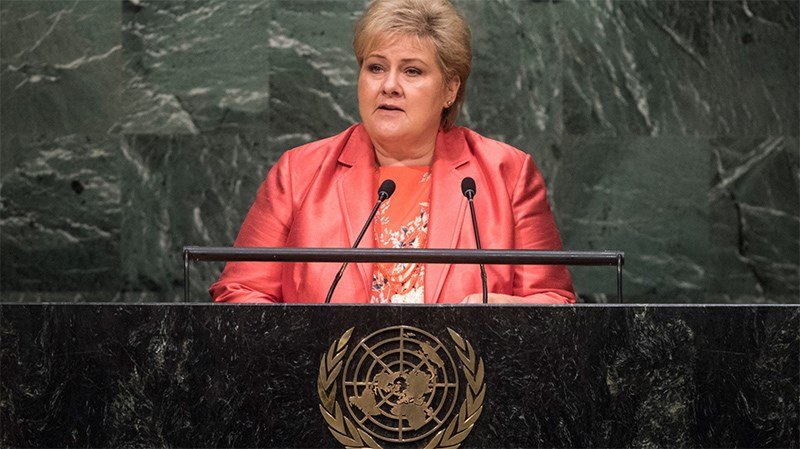
Prime Minister Erna Solberg will lead the Norwegian delegation to the UN General Assembly’s general debate. Credit: UN Photo

Background

The UN General Assembly is the world’s most representative multilateral forum for dialogue and policy development. As such, it provides a unique arena for promoting Norwegian interests, for international cooperation, and for finding solutions to issues of key importance to Norway. The overall guidelines for Norwegian multilateral policy are set out in the white paper Norway’s Role and Interests in Multilateral Cooperation (Meld. St. 27 (2018-2019)).

The 75th session of the UN General Assembly opened on 15 September 2020 at the UN Headquarters in New York, and will begin with the inauguration of the new President, Mr Volkan Bozkir of Turkey. Mr Bozkir has chosen the following theme for the General Debate this year: ‘The future we want, the United Nations we need: reaffirming our collective commitment to multilateralism – confronting Covid-19 through effective multilateral action’.  This year, delegates from capitals around the world will not be physically present for the week of high-level meetings held in connection with the General Debate from 22-29 September. Attendance in the General Assembly Hall will be kept to a minimum, and Norway will be represented by its Permanent Mission to the UN in New York. Heads of state and government and other leaders from all countries of the world will participate virtually. Addresses and statements will largely be delivered in the form of pre-recorded videos. Norway’s participation will be led by Prime Minister Erna Solberg. The Norwegian delegation will participate virtually in the General Debate, and in high-level meetings and side events. Because of the special circumstances this year, the delegation will not include observers from the Storting or representatives of Norwegian civil society organisations. Many of the virtual meetings will be streamed online and will be accessible to everyone. Bilateral talks with other countries and organisations are not a priority for Norway during the high-level week this year due to the current situation.

The 75th session of the UN General Assembly lasts until September 2021. The negotiations in the General Assembly and its six main committees will continue throughout the session, and Norway will be represented by its Permanent Mission to the UN in New York and officials from the Ministry of Foreign Affairs and other relevant ministries in Oslo, who will participate virtually as far as is possible. Work in the committees will have to be carried out in accordance with any Covid-19 restrictions. Formal physical meetings are expected to be reduced to a minimum. Negotiations will primarily have to be conducted in a virtual format, as will interactive dialogues with mandate holders. Resolutions and decisions that are not put to a vote will be adopted under the silence procedure. Resolutions and decisions that require a vote will be put to a vote in physical meetings, where Norway will be represented by its Permanent Mission to the UN.   

In addition to these instructions, a number of other documents are being drawn up that will set out detailed priorities and goals for the negotiations in the General Assembly’s various committees.

In parallel with the work in the General Assembly, Norway will participate in the UN Economic and Social Council (Ecosoc). Ecosoc is the UN’s main body for the formulation of development policy. Norway held the presidency of Ecosoc from July 2019 to July 2020. Norway will follow up its presidency of the Council and will seek to strengthen this key part of the multilateral system, which is so crucial for the UN’s work at country level.   

The Covid-19 pandemic has raised awareness of the importance of digital solutions in all sectors. Norway participated in the UN Secretary-General’s High-level Panel on Digital Cooperation, whose work will be followed up by the Secretary-General’s office during the General Assembly. Norway, as champion of the Digital Public Goods Alliance, is expected to promote digital cooperation, with a view to reducing the digital gap between developed and developing countries, in line with the white paper Digital transformation and development policy (Meld. St. 11 (2019-2020)). 

1. Lay the groundwork for Norway’s membership of the UN Security Council 

Norway has been elected as a member of the UN Security Council for the period 2021-2022. The Security Council is the only body with responsibility for international peace and security that has a mandate to adopt binding resolutions. Through its work in the General Assembly and the Security Council, Norway will seek to safeguard its national and global interests by:

  • strengthening the UN, international law and the multilateral order;
  • helping to prevent, de-escalate and resolve wars and conflicts;
  • shouldering responsibility and strengthening relations with other countries, both within and outside the Security Council.

In this work, Norway will focus in particular on four thematic areas:

  • Peace diplomacy. Norway will use the knowledge it has gained from its engagement in peace processes to strengthen the UN’s conflict prevention and resolution efforts.
  • Gender equality. Norway will work to ensure that women’s participation and rights are safeguarded in UN peace and security efforts.
  • Protection of civilians. Norway will work to strengthen the protection of civilians, including children, and will use international humanitarian and human rights law as a basis for these efforts. Norway will give special priority to efforts to prevent and combat sexual and gender-based violence in conflict.
  • Climate change and security. Norway will work to ensure that the UN discusses climate-related security threats and the impact of climate change on other issues on the UN’s agenda.

2. Be at the forefront of efforts to promote disarmament

The General Assembly is a key arena for the work on disarmament. Norway is working actively to promote disarmament and processes that can bring countries closer together on this issue and deliver results. Nuclear disarmament verification is essential for achieving and maintaining a world without nuclear weapons. The development of a credible multilateral verification regime is therefore vital for promoting disarmament. The delegation will ensure that Norway continues to play a leading role in the work to promote disarmament verification within the framework of the UN, in line with the Norwegian-sponsored resolution on nuclear disarmament verification adopted during the 74th session of the UN General Assembly. The Treaty on the Non-Proliferation of Nuclear Weapons (NPT) will continue to be the cornerstone of the international disarmament and non-proliferation regime, and the UN General Assembly should seek to strengthen the NPT.  

3. Promote binding international cooperation and safeguard the multilateral system

International cooperation is vital for Norway’s security, economy and welfare. We are seeing a tendency to move away from using multilateral organisations to address common challenges through compromise and cooperation. At the same time, the world is facing major global challenges that no country can solve alone. The UN must adapt to this situation. A key goal of the Government’s foreign policy is therefore to promote binding international cooperation and safeguard the multilateral system, so that we can improve our ability to deal with common challenges, such as the Covid-19 pandemic, and defend Norwegian and global interests.

  • Norway will support the implementation of the resolutions adopted by the General Assembly on the reform of UN management, the reform of the UN peace and security pillar, and the reform of the UN development system. Norway will work to secure better financing for the UN, and the Norwegian delegation will work to promote system-wide coherence and ensure that the UN works effectively across its three pillars: peace and security, human rights, and development. Priority will therefore be given to the negotiations to be held in autumn 2020 on the General Assembly resolution on the quadrennial comprehensive policy review of UN operational activities for development (QCPR). These negotiations take place once every four years.
  • The Norwegian delegation will work to promote results-based management in UN institutions, and to ensure that the UN has the funding and flexibility it needs to fulfil its mandates. The delegation will also promote sound and effective management of UN resources.
  • The delegation will promote effective cooperation across the traditional and regional divides of the General Assembly. It will seek to build bridges, listen, and use constructive diplomacy to facilitate solutions for the common good.
  • The delegation will work to strengthen the relationship between the General Assembly, Ecosoc and the Security Council, and will actively promote Security Council reform and greater transparency in the work of the Council.
  • The UN marks its 75th anniversary in 2020. The delegation will play its part in ensuring a fitting celebration of the anniversary.

4. Strengthen the UN’s capacity to prevent and resolve conflicts

Norway will seek to strengthen the UN’s capacity to prevent and resolve conflicts, with a view to promoting peaceful and sustainable development. In Norway’s view, the UN should focus its efforts on countries and areas with high levels of fragility. It is crucial that UN efforts are coordinated and coherent. Cooperation between the UN and other multilateral organisations, such as the World Bank and the regional development banks, is essential in order to achieve the best possible results. Regional organisations have an important role to play in maintaining international peace and security, as the UN Charter makes clear. The partnership between the UN and the African Union (AU) is particularly important. The Norwegian delegation will work actively to strengthen this partnership, especially in the field of peace and security.

  • Norway’s broad involvement in peace and reconciliation efforts has given us important experience and a unique position in this area. The delegation will seek to foster dialogue between parties to conflict and other relevant actors.
  • The delegation will participate actively in UN efforts to combat international terrorism and violent extremism. Priority will be given to following up the work of the Group of Friends on Preventing Violent Extremism, which was established by Norway in partnership with Jordan. A gender-sensitive approach is essential. Norway will give priority to securing the inclusion of women peacebuilders in peace processes in cooperation with i.a. the Women’s Alliance for Security Leadership (WASL).
  • Transnational organised crime is both a development policy and a security policy challenge. The activities of criminal networks are often a driving force behind – and an important source of funding in – conflicts and crises. The Norwegian delegation will promote the implementation of targeted measures to identify and combat these networks.
  • Norway chairs the international donor group for Palestine (AHLC), whose main task is to develop the foundation for a future Palestinian state. The UN is a key partner in this work. The AHLC is the only international forum that brings together the parties to the conflict and the donors for regular meetings to discuss measures that could enhance the prospects of reaching a negotiated two-state solution. The Norwegian delegation will seek to ensure that this work is continued and strengthened.
  • Norway gives high priority to efforts to promote the women, peace and security agenda. The delegation will work to increase the proportion of women participating at all levels of UN peace operations, as both civilian and military personnel. The delegation will work to strengthen women’s participation in peace processes and to ensure that the gender perspective is integrated into peace and security efforts, and will encourage countries to commit to concrete action in this area.
  • The delegation will work, in particular in cooperation with small island states, to raise awareness of the significance of issues relating to the oceans and climate change for international peace and security.
  • Norway is working to improve the effectiveness and coordination of UN peace operations. The Secretary-General’s Action for Peacekeeping initiative (A4P) is giving renewed impetus to efforts to implement the recommendations made by the High-level Independent Panel on Peace Operations in 2015. This year, too, the Norwegian delegation will actively support the initiative, including through the Group of Friends on UN Peace Operations.
  • The delegation will seek to maintain the consensus reached that the reports issued by the relevant UN Group of Governmental Experts provide the framework for what can be considered to be responsible state behaviour in cyberspace. This framework is based on the application of existing international law in cyberspace, compliance with agreed voluntary norms, and confidence-building and capacity-building measures. Both current and future processes must adhere to this framework and must be based on consensus.

5. Promote the implementation of the 2030 Agenda, with a particular focus on supporting an integrated pandemic response, and on the areas of education, health, gender equality, the oceans, climate change, and financing for sustainable development

The 2030 Agenda and the 17 Sustainable Development Goals (SDGs) were adopted by the UN member states in 2015. The 2030 Agenda is a global roadmap for sustainable development designed to benefit all people, and the next decade will be critical. The 2030 Agenda is grounded in the Universal Declaration of Human Rights, and it commits states to leave no one behind. Priority must therefore be given to development that benefits vulnerable and marginalised groups. The Covid-19 pandemic has caused serious setbacks in the efforts to reach the SDGs, including access to financing. Vulnerable and marginalised groups have been hit hard by both the pandemic and its socio-economic ramifications.

Norway is an important partner for the UN and for developing countries in the efforts to implement the 2030 Agenda. The UN Secretary-General has given Prime Minister Erna Solberg a leading international role in this area as co-chair of the group of SDG Advocates. Norway is following up the Agenda by providing strong political support for UN development efforts, financial contributions to UN funds, programmes and specialised agencies, and core funding for multilateral development banks’ funds for the poorest countries, as well as by engaging in bilateral cooperation.

If we are to succeed in achieving all 17 SDGs, we must further develop global partnerships and strengthen cooperation with the private sector in order to mobilise more private capital for these efforts, particularly in developing countries. We must also enhance cooperation with civil society, and forge new partnerships with countries and other actors that we have not worked so closely with before. It will be essential to exploit the potential of digital technology and close the digital gap if we are to meet the SDGs.

  • The delegation will work to ensure that the response to the Covid-19 pandemic is integrated into the UN’s work and contributes to the achievement of the SDGs as effectively as possible.
  • Again this year, the delegation will work to ensure that human rights are integrated into efforts to implement the 2030 Agenda, with a focus on the overall objectives of leaving no one behind and promoting women’s rights and participation. Priority will be given to addressing the needs of vulnerable groups, such as children, religious minorities, indigenous peoples, people with disabilities and sexual minorities.
  • The delegation will seek to inject new momentum into the efforts to implement the SDGs, by promoting political commitments, strategic priorities and constructive partnerships.

In particular, the delegation will work to secure good results in the following areas:

a) Education – which is essential for social and economic development

Norway will highlight the fundamental importance of high-quality, relevant education for all social and economic development. Priority is being given to promoting high-quality education, girls’ education, education in situations of crisis and conflict, vocational training, and investment in the education sector. Norway is playing a prominent role in promoting innovation and the use of technology as part of the efforts to ensure education for all. Norway is also co-chair of the Group of Friends for Education and Lifelong Learning. UN funds, programmes and organisations are important channels and partners for Norwegian aid to the education sector. The impact of the Covid-19 pandemic on education has been devastating.

  • The Norwegian delegation will promote coordination between organisations, funds and programmes, with a view to maximising the effectiveness of aid for education.
  • The delegation will work to ensure that education remains high on the UN agenda and that member states fulfil their commitments in this area. These include promoting access to education for all and domestic resource mobilisation for education.
  • The delegation will work to improve coordination between humanitarian aid and long-term development efforts in the field of education. The delegation will highlight the importance of education in situations of crisis and conflict.
  • The delegation will give priority to inclusive education, including education for children and young people with disabilities.  
  • The delegation will work to ensure that education efforts address the digital divide (access and expertise).
  • The delegation will work to ensure that the negative impacts of the Covid-19 pandemic on the education sector are given adequate consideration when measures are planned and implemented.

b) Good health – which is vital for sustainable development

The Covid-19 pandemic is having far-reaching social and economic ramifications and a major impact on security and development, and has highlighted the fact that health cannot be viewed in isolation from other sectors. Norway’s work to promote digital solutions in the field of health is now more relevant than ever. The UN’s normative role in this area is vital, and UN funds, programmes and specialised agencies are important channels and partners for Norwegian aid to the health sector. Other sectors have a key role to play in promoting good nutrition and food security. Marine resource management is an area where there is huge potential in this regard.   

  • The delegation will work to strengthen the multilateral response to the Covid-19 pandemic and improve health security and preparedness for future pandemics. There will be a particular focus on the needs of vulnerable groups in this context.
  • The delegation will promote universal access to health services and equitable distribution of vaccines.
  • The delegation will give priority to efforts to ensure that children and young people have access to health services, and measures that can reduce sexual violence and sexual harassment, particularly in humanitarian crises and conflict situations.
  • The delegation will work across regional groups of countries to help establish international norms and standards, mobilise funding and protect global public goods.

c) Gender equality – which leads to greater freedom, welfare and democracy

For Norway, strengthening the rights of women and girls is a goal in itself. At the same time, Norway is working to enhance understanding of the ways in which promoting women’s and girls’ empowerment and influence benefits society. Norway will work to eliminate harmful practices such as child marriage, forced labour and all forms of violence and discrimination against women and girls, as well as attempts to disempower women and girls and limit their self-determination. We must tap into the enormous potential that women and girls represent and promote their social and economic participation. At the international level, work to promote gender equality is increasingly regarded as one of the keys to addressing several of the greatest challenges the world is facing, including those relating to climate change, the economy and global health. At the same time, efforts to promote gender equality are meeting strong opposition in some countries, particularly when it comes to women’s sexual and reproductive health and rights. Targeted efforts and proactive alliance building are therefore essential. Girls and women in poor countries have less access to what they need to participate successfully in the digital world. One of the SDGs is devoted to gender quality, and promoting gender equality is a priority for Norway.

  • The delegation will seek to prevent women’s rights from being undermined. It is particularly important to protect women’s sexual and reproductive health and rights.
  • A high-level meeting will be convened to celebrate the 25th anniversary of the Beijing Women’s Conference. Our aim will be to promote Norwegian priorities, support the implementation of the Beijing Platform for Action and strengthen alliances in the field of gender equality. The Norwegian delegation will contribute to these efforts.
  • The delegation will work to improve women’s and girls’ access to education and health services, including sexual and reproductive health services, and to enhance protection against violence and harmful practices, including in areas affected by crisis and conflict.
  • Norway’s delegation will give priority to the efforts to promote women’s participation in the labour market and in business, as well as in politics and governance.

d) Climate change – which is threatening our efforts to reduce poverty and build peaceful societies

The Climate Change Convention in 1992, and the Paris Agreement and the 2030 Agenda in 2015 were all the result of international cooperation. Norway must make active use of the international framework provided by these agreements to promote global climate cooperation. Climate change affects the most vulnerable groups most severely, and is posing a threat to our efforts to reduce poverty. There is also growing recognition of the fact that climate change is a global security challenge and an underlying cause of conflict. A Biodiversity Summit will be held during the high-level week. The aim is to promote the development of a global biodiversity framework that can support the implementation of the 2030 Agenda and help make it possible to realise the 2050 vision for biodiversity of ‘living in harmony with nature.’

  • The delegation will work to put climate change adaptation and prevention of climate-related and natural disasters on the international agenda.
  • The delegation will support the UN Secretary-General’s leadership on climate change.
  • The delegation will work to strengthen efforts to end hunger, achieve food security, improve nutrition and promote sustainable food production.

e) Clean and healthy oceans – which are crucial to human survival

Promoting clean, healthy and productive oceans and sustainable management of marine resources is of vital importance to Norway. The UN Convention on the Law of the Sea provides the framework for international cooperation on conservation and sustainable use of the oceans and marine resources. Pressures on the oceans include climate change, overexploitation of resources, loss of biodiversity and pollution, including from marine litter and in particular plastics. Illegal, unreported and unregulated fishing (IUU fishing) and certain forms of fisheries subsidies are resulting in overfishing. The negotiations on a new agreement, under the UN Convention on the Law of the Sea, on the conservation and sustainable use of marine biodiversity in areas beyond national jurisdiction are a high priority for Norway. The same applies to the work to promote a global framework for combating marine litter. A sustainable ocean economy is vital for achieving a number of the SDGs, not only SDG 14 on life below water, and Norway considers it important to highlight the significance of the ocean economy for development.   

  • Norway’s delegation will seek to ensure that the recommendations of the High-level Panel for a Sustainable Ocean Economy are successfully integrated into the UN’s agenda. The High-level Panel will present its recommendations at the beginning of December.
  • The delegation will seek to increase international recognition of the economic importance of the oceans, and of the need to promote sustainable use of marine resources and clean and healthy oceans as a source of value creation. It is important to ensure that women are given the same opportunities as men to contribute to, and to benefit from, the development of new industries.
  • The delegation will seek to strengthen and further develop the Law of the Sea as the basis for sound ocean management and the sustainable use of resources.

f) Financing for sustainable development, in particular domestic resource mobilisation

There has been a sharp decline in financing for sustainable development as a result of the Covid-19 pandemic. This applies to all countries, but developing countries are most severely affected. There is a need to think along new lines and take critical decisions. It is estimated that close to 90 % of the financing needed to reach several of the key SDGs will have to come from domestic sources. If used wisely to promote domestic resource mobilisation, aid can dramatically increase domestic revenues, promote a greater sense of ownership at the national level and lead to more sustainable public financing. Norway is giving priority to cooperation that seeks to exploit the potential of digital technology to increase financing for development (for example in the context of national tax and procurement systems, and monitoring of cross-border financial flows).  

If we are to succeed in fighting corruption and illicit financial flows, as well as in increasing tax revenues in poor countries, a coordinated global effort is needed to improve tax systems, combat money laundering and ensure that corruption cases are properly investigated and prosecuted. Norway will do its part to achieve this, for example by participating in the discussions on financing for development during the General Assembly. 

  • Norway’s delegation will promote the implementation of the Addis Ababa Action Agenda on financing for development, and will give priority to important issues such as illicit financial flows and the fight against corruption.
  • The delegation will follow up the work of the The High Level Panel on International Financial Accountability, Transparency and Integrity for Achieving the 2030 Agenda (FACTI Panel), which was established by Norway and Nigeria in 2019 in their respective roles as President of Ecosoc and UN General Assembly President.
  • The delegation will emphasise the need for responsible borrowing and lending practices to prevent the risk of new debt problems undermining progress towards the SDGs.
  • The delegation will also highlight women’s role in and contribution to delivering economic growth.

6. Strengthen human rights and the international legal order

The international legal order provides a clear and predictable framework for ensuring compliance with human rights obligations. The UN’s mandate and unique position in the world mean that it has a special responsibility to work to ensure that several decades of progress in the areas of democracy, human rights, development and multilateral cooperation are not reversed.

The Covid-19 pandemic has led many countries to introduce restrictions that undermine human rights and the rule of law. The situation for civil society representatives, journalists and human rights defenders is becoming increasingly difficult. As the pandemic continues, this is particularly affecting those who are working to safeguard people’s rights to health, freedom of expression and access to information. 

Norway considers it vital to safeguard fundamental rights and freedoms, legal protection and the rule of law, particularly in times of crisis. It is essential that any restrictions on fundamental freedoms imposed as part of the response to the Covid-19 pandemic are necessary, proportionate, time-limited, non-discriminatory and set out in legislation. Human rights must be respected and integrated into the pandemic response and recovery efforts.   

  • The delegation will ensure that Norway continues to play a key role in UN efforts to further develop the normative framework for the protection and promotion of human rights.
  • The delegation will continue Norway’s efforts to support and protect human rights defenders, promote women’s rights and gender equality as a cross-cutting issue, and combat discrimination on the basis of sexual orientation and gender identity, religion or belief or other minority status. The delegation will continue Norway’s efforts to protect and promote freedom of expression.  
  • Norway will be at the forefront of efforts to ensure that civil society actors are able to participate meaningfully in UN efforts and processes.
  • The delegation will continue Norway’s efforts to ensure respect for international law, including international humanitarian and human rights law, and promote the international legal order. It will support efforts to promote a world order based on international law, including the principles set out in the UN Charter. In particular, the delegation will
  • work to combat impunity, and as in previous years, Norway will express its readiness to participate in discussions on a new convention on the criminal accountability of UN officials and experts on mission;
  • continue efforts towards completion of the work on a comprehensive convention on international terrorism;
  • participate actively in the discussions on universal jurisdiction, with a view to preventing the debate from being derailed or undermining our capacity to prevent and respond to the most serious crimes;
  • support the International Law Commission’s work on crimes against humanity, as in previous years.
  • The delegation will participate actively in discussions on issues relating to international humanitarian law (IHL), with a view to countering attempts to weaken or undermine existing IHL obligations.

7. Strengthen the UN’s capacity to prevent and respond to humanitarian crises, and promote international cooperation on refugees and migrants

Norway will promote compliance with the humanitarian principles of humanity, impartiality, neutrality and independence in its efforts to help and protect people affected by humanitarian crises.

  • The delegation will work to strengthen humanitarian efforts in the light of the dramatic increase in humanitarian needs as a result of the Covid-19 pandemic.
  • The delegation will work to strengthen protection for people affected by crisis and conflict, with a particular focus on protection of children, on efforts to prevent and combat sexual and gender-based violence, on protection of refugees and internally displaced people, and on protection against mines and other explosives.
  • The delegation will promote efforts to strengthen the UN humanitarian system, in line with the commitments made in the Grand Bargain, which was launched at the World Humanitarian Summit in 2016.
  • The delegation will advocate closer cooperation between the UN and other multilateral institutions in order to improve coordination between humanitarian action, peacebuilding and long-term development efforts.
  • The delegation will work to achieve a more effective and better coordinated refugee response, in line with the Refugee Convention and the Global Compact on Refugees, and will contribute to processes that seek to address the underlying causes of migration.
  • The delegation will work to promote safe, orderly and regular migration and counter irregular migration, within the framework of the Global Compact for Migration.
  • Norway will be a strong advocate in the UN of the need to improve protection for internally displaced people, and will do its part to find lasting solutions in this area. A High-level Panel on Internal Displacement has been established following an initiative from Norway. The delegation will follow up this work.
  • The delegation will promote humanitarian innovation and new working methods that lead to a more effective response and better results for people affected by crisis. This includes efforts to increase the use of digital technology in situations where this can strengthen the humanitarian response.
September 22, 2020 0 comments
0 FacebookTwitterPinterestEmail
Asia and Norway

Multilateralism is at greater risk since Cold War, Kazakh President says at UN

by Nadarajah Sethurupan September 21, 2020
written by Nadarajah Sethurupan

“Multilateralism now faces greater risk than at any point since the end of the Cold War,” said President Kassym-Jomart Tokayev of Kazakhstan, addressing the High-Level Meeting to commemorate the 75th Anniversary of the United Nations“

The history of the United Nations has been a period of intense collective efforts and rich learning: from decolonization to development, from child protection to climate change, from health to human rights, from peacekeeping to peacemaking… When we look around us today, many new challenges – and some old recurring ones – threaten to drag us back in time. Multilateralism now faces greater risk than at any point since the end of the Cold War. COVID-19 has proven surprisingly difficult to be overcome. A second arms race looms. Our strategic development goals are suffering setbacks,” he said.

Kazakhstan’s President Kasym-Jomart Tokayev

However, the President questioned the position that the ideals enshrined in the UN Charter are no longer realistic. “As President of my country and a former senior official of the UN, I strongly disagree. More than ever, we must give rein to the horse of our hopes, not pull back out of fear. We must galvanize efforts in pursuit of those shared ideals, not abandon them. We must continue to build a rules-based community, not return to lawlessness”.

President Tokayev commended strong leadership by Secretary-General António Guterres and supported his work to boost the effectiveness, transparency, and accountability of the UN.

Over the last three decades since independence,  Kazakhstan has participated in endeavors of every major UN body – including the Security Council – in pursuit of a range of priorities including conflict resolution, non-proliferation and nuclear disarmament, combatting terrorism, interfaith and interethnic dialogue, as well as promoting the interests of Land Locked Developing Countries.

September 21, 2020 0 comments
0 FacebookTwitterPinterestEmail
Oil & Gas

DNO decarbonisation project in Iraq begins

by Nadarajah Sethurupan September 21, 2020
written by Nadarajah Sethurupan

Norwegian oil and gas operator DNO has said the Peshkabir Gas Capture and Injection Project in its Tawke license in the Kurdistan region of Iraq is onstream and has reached the 1 billion cu ft of gas injection milestone. The $110-million project is expected to reduce annual emissions from the company’s operated production by over 300,000 tonnes of CO2 equivalent, offsetting the emissions from some 150,000 automobiles. 

Engineering and construction were launched in mid-2018 and commissioning completed in mid-2020 in what is the first gas capture and storage project in Kurdistan. Some 20 million cu ft a day of previously flared gas at the Peshkabir field is gathered, treated and transported 80 km by pipeline to the Tawke field where it is injected for storage and reservoir pressure recharging. 

Effective June 2020, the project halves the average carbon intensity of the company’s operated production from 14 kg CO2 equivalent for each barrel of oil equivalent produced (kg CO2e/boe) to an average of 7 kg CO2e/boe. This compares to the target set by a group of 12 of the world’s largest oil companies comprising the Oil and Gas Climate Initiative (OGCI) to reduce the average carbon intensity of their aggregated upstream oil and gas operations to between 20-21 kg CO2e/boe by 2025 from a collective baseline of 23 kg CO2e/boe in 2017. 

“Gas injection and the associated carbon capture and storage is proven, practical and potentially profitable,” said Bijan Mossavar-Rahmani, DNO’s Executive Chairman. “Our project was completed on schedule and on budget notwithstanding the challenges of working in what is still a frontier oil and gas operating environment and the obstacles posed in the late stages by the Covid-19 pandemic,” he added. 

Gas flaring at the Peshkabir field has been reduced by over 75 per cent, with work underway to reduce it further.

Any Peshkabir field injected gas produced at the Tawke field will be recovered and recycled into the latter or used as fuel to displace diesel. Reservoir models suggest gas injection will increase gross Tawke field recoverable volume by 15 to 80 million barrels of oil, of which 23 million barrels are included in the gross proven and probable (2P) Tawke field reserves in the DNO 2019 Annual Statement of Reserves and Resources. 

DNO’s greenhouse gas emissions increased following commencement of production from the Peshkabir field in 2017 as the oil contains a relatively high associated gas content.

Flaring from the Peshkabir field was the largest single contributor to DNO’s total 2019 greenhouse gas emissions of 639,200 tonnes of CO2e. Mossavar-Rahmani announced the launch of a new initiative to more actively measure, monitor and mitigate methane leakages at DNO’s operated sites, noting that while CO2 emissions from oil and gas operations receive the greatest attention, methane emissions are a significant but underreported source of greenhouse gas with an impact 25 times greater than CO2 on a 100-year horizon. 

DNO operates the Tawke license containing the Tawke and Peshkabir fields with a 75 per cent interest; partner Genel Energy plc holds the remaining 25 percent. The company will publish its corporate social responsibility report, which covers greenhouse gas emissions developments and strategies, in the coming days. 

–Traderabia News Service

September 21, 2020 0 comments
0 FacebookTwitterPinterestEmail
Terrorist

Hezbollah of storing ammonium nitrate in Europe – USA

by Nadarajah Sethurupan September 20, 2020
written by Nadarajah Sethurupan

Militant group Hezbollah has stored chemicals that can be used to make explosives in several European countries, a senior US State Department official said Thursday as he appealed to countries in Europe and elsewhere to impose bans on the organization.

Hezbollah operatives have moved ammonium nitrate from Belgium to France, Greece, Italy, Spain and Switzerland in recent years and are suspected to still be storing the material throughout Europe, said Nathan Sales, the State Department coordinator for counter-terrorism.

Ammonium nitrate is a chemical compound commonly used as a fertiliser, but it can be used to make explosives. It can also be dangerous in storage, as demonstrated by the huge explosion last month in the Lebanese capital of Beirut.

“Why would Hezbollah stockpile ammonium nitrate on European soil?” he said. “The answer is clear: Hezbollah put these weapons in place so it could conduct major terrorist attacks whenever it or its masters in Tehran deemed necessary.”

Sales called on more countries to do the same.

Hezbollah is a “unitary organization that cannot be subdivided into a military and so-called political wing,” he said. Without a full ban, the group can still raise money and recruit operatives.

“Hezbollah is one organization,” he said. “It is a terrorist organization.”

Below is a full rush transcript of the press conference by Ambassador-at-Large Nathan A. Sales State Department Coordinator for Counterterrorism.

Ambassador Sales:  Thanks very much, I’ll speak very briefly.  I just came from a panel discussion hosted by the American Jewish Committee about the Hizballah threat to Europe, and I wanted to share with you some of the key points that came up during this conference. 

The United States has long designated Hizballah as a terrorist organization in its entirety.  That goes back to 1997.  And we encourage more countries around the world to do the same, that is to say, to reject the false notion that there is a distinction between a so-called political wing of Hizballah and Hizballah’s terrorist enterprises.  Our ask is for more countries to designate Hizballah in its entirety. 

We’re seeing really incredible moments on that front as more and more countries around the world recognize reality and designate or ban the group in its entirety.  In 2019, the United Kingdom did so.  Germany this year banned Hizballah in its entirety.  And just within the past several months we’ve seen similar announcements from Lithuania, Kosovo, and Serbia.  Closer to home, here in the Western Hemisphere we’ve seen incredible momentum with countries like Argentina, Paraguay, Colombia, and Honduras designating or banning Hizballah in its entirety within the past 18 months. 

Part of the reason why these countries are designating Hizballah is because they recognize the threat that Hizballah poses to the world and to them.  Earlier today I revealed new information about the threat that Hizballah poses to Europe and its presence in Europe, and I’d like to share that previously sensitive information with you now. 

Since 2012, Hizballah has established caches of ammonium nitrate throughout Europe by transporting first aid kits whose cold packs contain the substance.  And as we all saw in the Port of Beirut explosion, ammonium nitrate is a truly dangerous substance. 

To continue, I can reveal that such caches have been moved through Belgium to France, Greece, Italy, Spain, and Switzerland.  I can also reveal that significant ammonium nitrate caches have been discovered or destroyed in France, Greece, and Italy.  We have reason to believe that this activity is still underway.  As of 2018, ammonium nitrate caches were still suspected throughout Europe, possibly in Greece, Italy, and Spain. 

And that is why we continue to regard Hizballah as a threat, not just to the United States but to our European allies as well.  And that is why we renew our call for more countries to designate Hizballah in its entirety, and for the European Union to expand its 2013 designation of the so-called military wing to reach the entire organization. 

Question:  What’s your assessment of the reality that Hizballah represent in Lebanon and the region? 

Ambassador Sales:  Well, we think that Hizballah is not a force for stability in Lebanon.  To the contrary, we think that Hizballah is a force for instability in Lebanon.  Hizballah is not a solution to Lebanon’s problems.  Hizballah is the cause of Lebanon’s problems.  It has helped foster a culture of corruption and impunity.  It has enriched itself at the expense of the Lebanese people.  And the solution is for us to recognize the reality that Hizballah is not a political organization.   It’s not a legitimate representative of the Lebanese people.  What it is, is a terrorist organization that exists to shed blood around the world, act at the behest of its masters in Tehran.  The way to address this problem is to call it for what it is, and marginalize and isolate Hizballah as the terrorist group that it is.  Thank you. 

Question:  I see that most European countries consider that Hizballah is a completely terrorist organization.  This was well-received by the United States.  But the question is, why France is dealing with flexibility with Hizballah in Lebanon? 

Ambassador Sales:  I think a number of European countries, like the UK and Germany, share our view that Hizballah is a terrorist organization through and through.  We’d like to see more join the club, as it were.  When it comes to France and our objectives in Lebanon, I think France and the United States share the same goal; we all want to see a Lebanon that is sovereign, that is prosperous, and that is stable.  At the same time, I think we have to recognize that we have some pretty substantial disagreements about how best to accomplish that goal. 

We do not think that it is helpful to engage with Hizballah as though it were a legitimate political actor.  In our view, those sorts of engagements only serve to legitimize what is in fact a terrorist organization.  Instead, the U.S. approach is to engage with the legitimate organs of the Lebanese state, including providing extensive assistance to those entities in the hopes that the Lebanese state can stand up strong and prosper without Hizballah’s interference. 

Since 2006, the United States has invested billions of dollars in Lebanon.  We’ve devoted more than $2 billion to improve the capabilities of Lebanon security services.  We’ve also devoted more than a billion dollars of economic assistance to Lebanon.  So we all want the same thing for Lebanon, but the way to get there does not run through Hizballah, in our view. 

Question:  First, what’s the importance of the sanctions today on Hizballah?  And second, what’s the effect of the U.S. sanctions on the party, especially that it’s still able to provide money, salaries, and its followers’ needs? 

Question:  Are you seeing any signs from Lebanon that these sanctions are perhaps driving a wedge between Hizballah and its ally?  And I know it’s one question, but I’m going to just throw that in.  There is a sectarian, now, battle over the formation of the next government.  Does the U.S. object to having a Shia finance minister, I mean, if we can be blunt about it? 

Ambassador Sales:  Thanks for the question.  So these are sort of inside baseball questions about the behind-the-scenes developments in Lebanon as it – as it struggles with some very significant crises:  the financial crisis brought on by decades of corruption and mismanagement, aided and abetted, of course, by Hizballah, as well as the more immediate humanitarian catastrophe in the wake of the Beirut port explosion. 

I don’t have a whole lot to say about what’s going on behind the scenes other than to reiterate what the United States’ goal is in this situation.  We want to see a Lebanon that is sovereign and independent and prosperous and stable.  And we want to see it emerge from the current crises in a way that allows it to reach that goal.  And we think the best way to reach that outcome is not to legitimize Hizballah as a political player, but to marginalize and isolate it and rely on other legitimate organs of Lebanese society and the Lebanese state.  Thanks. 

Question:   Today new sanctions will be issued against Lebanese officials that are linked to Hizballah.  Will the U.S. sanctions be similar to European sanctions?  What will the repercussions be on the struggling Lebanese government?  Will you be able to separate the military and political part?

Ambassador Sales:  Our sanctions do not distinguish between a military part of Hizballah or a political part of Hizballah.  Our sanctions are premised on the reality that Hizballah is a single organization, and it’s a terrorist organization, root and branch.  And you don’t need to take the U.S.’s word for that.  Hizballah itself has been perfectly clear that they do not themselves recognize a distinction between their terrorist operations and a so-called political branch.  So our sanctions against Hizballah are and always have been directed at the entirety of the organization, and that will continue to be the case. 

As far as the effects of our sanctions are concerned, and this is true regardless of whether we’re talking about sanctions on Hizballah or al-Qaeda or ISIS or any other terrorist organization, the effect is to exclude the named individuals and entities from the U.S. financial system, and to drive up their costs of doing business.  We want to make it harder for them to raise money.  We want to make it harder for them to transfer money.  We want to make it harder for them to run front companies because by starving these organizations of resources, you prevent them from committing acts of mass murder. 

Question:  Are you trying to link the incident that took place in our port here in Beirut with what’s happening in Europe and, like, So are you trying to say that these ammonium nitrates belonged to Hizballah at the port?  Is that what you’re trying to picture here, Ambassador Sales?


Ambassador Sales:  We know that Hizballah has stored massive amounts of ammonium nitrate across Europe.  According to the information I revealed today, those sorts of caches have been found in a number of countries, including the UK, Greece, France, Italy, and a number of others.  We also know from what we saw in Beirut the truly destructive power of ammonium nitrate.  It’s capable of inflicting mass destruction when used as an explosive.  That is why the United States has called for a full, open, and transparent and thorough investigation of the explosion in Beirut, and we hope to see the results of that shortly.

Question:  My question was that Mr. David Schenker mentioned that the sanctions on former ministers Finyanus and Ali Hassan Khalil were a message to other Lebanese politicians who failed to fight corruption.  On what grounds would the U.S. administration take this kind of sanctions leaning towards – in – for targeting corruption, or those who didn’t fight corruption?


Ambassador Sales:  Well, we think that the sanctions send a clear signal that business as usual in Lebanon is not going to work for the Lebanese people.  I don’t have much more to add beyond what Assistant Secretary Schenker has said.  But the United States stands firmly on the side of the Lebanese people whose aspiration is for a stable state in which the government is responsive to their needs and not beholden to a terrorist organization.

Question:  I would like to ask you, are there any comments on the Hizballah in the GCC?  As you mentioned on the cache of the ammonium nitrate, do you see a risk of these in this region?  What’s your comment on that?  


Ambassador Sales:  I don’t have any more sensitive information to reveal today.  But what I can tell you more broadly is in the Gulf region, we are grateful to the Gulf Cooperation Council as well as the Arab League for the actions they have taken to counter Hizballah.  Both organizations have joined the United States in designating Hizballah in its entirety, and we commend them for that.  More broadly, we have seen a range of Iran-backed terrorist organizations – not just Hizballah but others backed by Iran – that are active in the region and that seek to promote violence, whether it’s Kata’ib Hizballah in Iraq, Al-Ashtar Brigades in Bahrain, or various other groups with links to Iran.  The story is very similar.  The story is the same.  These groups take money, weapons, and resources from their masters in Tehran, use those resources to commit acts of violence, and the United States will do everything in our power using our sanctions tools to dry up those resources so that our partners in the Gulf don’t have to face this threat.

Question:  You specifically mentioned that sanctions have had an impact on Hizballah specifically.  Do you see the sanctions having a positive impact on the U.S. will to drive a wedge between Hizballah and its allies inside Lebanon?


Ambassador Sales:  If you’ve been sanctioned by the United States and by Britain and by Germany, that is a pretty good sign that you’re not a legitimate political organization.  It’s a pretty good sign that you’re a terrorist organization.  So we think there is an obvious practical effect to our sanctions, which is to dry up resources, and those are having a demonstrable effect.  Hassan Nasrallah not so long ago was publicly requesting donations because our sanctions have had a significant enough bite that he is not able to count on the same level of support that he previously enjoyed.  But in addition to those practical consequences, there’s also a very strong messaging value to our sanctions, and that is to say by branding you a terrorist organization, by recognizing the reality that you’re a terrorist organization, it helps to marginalize and isolate that group.

Question:  You label Hizballah at a whole as a terrorist group; on the other hand, your – as far as I know, your ambassador is in Beirut and is dealing with Hizballah members of government and the U.S. does it too, the whole administration.  So isn’t that consequent – inconsequent, because is the U.S. dealing with terrorists, negotiating?  I mean, that can’t be.


Ambassador Sales:  I guess I’d reject the premise of your question, which is that the United States is engaging with Hizballah.  That’s simply not the case.  Our policy has never been to engage Hizballah, and that is a policy that has stretched back for 23 years and has been shared by presidents and administrations of very different political parties and very different overall views.  But the one thing that has united U.S. policy towards Hizballah since 1997 is to call it for what it is: a terrorist organization.  

Now, we are engaged in very robust diplomacy with Lebanon and we are engaged in very robust foreign assistance to Lebanon.  But make no mistake, that is engagement with the legitimate organs of the Lebanese state, and the purpose of that engagement is precisely to strengthen them against Hizballah’s malign influence.  So we see no double standard whatsoever in marginalizing and sanctioning Hizballah on the one hand, and dealing with non-Hizballah elements of the Lebanese state on the other.  Thank you.

Question:  I want to ask about Ismail Haniyeh’s visit to Lebanon.  he’s living in Lebanon for two weeks.  How does the United States look for this visit, especially since he was in Turkey and he met President Erdogan, knowing that Turkey is a member of NATO?


Ambassador Sales:  It’s not helpful for a designated terrorist like Ismail Haniyeh to be able to travel freely throughout the Middle East or throughout the world.  Our position is very clear.  Hamas is a designated terrorist organization.  Like Hizballah, it was one of the first groups ever to be designated by the United States.  And Haniyeh himself has been additionally singled out as a specially designated global terrorist.  We do not regard him as a legitimate political actor.  He is a person who has blood on his hands and we would encourage the rest of the world to recognize him for what he is and treat him accordingly, as a terrorist, not a statesman.

September 20, 2020 0 comments
0 FacebookTwitterPinterestEmail
Russia and Norway

More NATO jets are being scrambled from Norway

by Nadarajah Sethurupan September 20, 2020
written by Nadarajah Sethurupan

Two NATO F-16s scrambled into the air on Monday to identify Russian military planes, as the number of such QRAs (Quick Reaction Alerts) in the High North has already surpassed the 2019 count.

“We can confirm NATO QRA from Bodø on mission today,” spokesperson Major Brynjar Stordal told the Barents Observer.

A Norwegian F-16 flies alongside a Russian Il-38 aircraft. (Norwegian Air Force via The Independent Barents Observer)

Also this weekend, Stordal said, two Russian Tu-142 anti-submarine warfare planes from the Northern Fleet were identified outside Norwegian air space. The planes continued south to the north of England before returning home. Two weeks ago, the U.S. Navy submarine Seawolf surfaced outside Tromsø in northern Norway for crew replacement.

By September 14, Norwegian fighter jets on NATO alert have been scrambled 41 times. In 2019, 38 QRA take-offs took place. The number of Russian aircraft identified last year was 83, one less than so far in 2020, which still has more than 3 months left.

The Norwegian Joint Headquarters underlines that it has several means to identify Russian military planes, so scrambles itself do not necessarily paint the whole picture.

In the first 15 years after the end of the first Cold War, there were very few scrambles. In 2007, Russian long-range bombers (Tu-95 and Tu-160) again started to fly west of the Barents Sea into international airspace in the North Atlantic.

The number of scrambles from the airbase in Bodø increased until 2014. In 2015-2016 the Russian military flight activity in the High North was substantially lower again, which the Norwegian military attributed to activities other places, and maintenance challenges with the planes. From 2018, when Norway hosted the Trident Juncture exercise, Russia’s long-distance flights increased again.

Last week, Norwegian, British, American and Danish maritime surveillance aircraft were daily met by Russian fighter jets over international airspace in the Barents Sea as the four-nation NATO naval group were exercising navigation in the area.

September 20, 2020 0 comments
0 FacebookTwitterPinterestEmail
Science

Wrocław to deliver electric buses to Norway’s Bodo

by Nadarajah Sethurupan September 19, 2020
written by Nadarajah Sethurupan

Volvo’s Wrocław plant will deliver 31 electric city buses to Norway’s northern city of Bodo. The buses, together with charging and servicing infrastructure, are to be delivered by July 2021.

“This is the largest project for the sustainable development of road transport in northern Norway, which is of great importance both for the region and for us,” Anders Mjaaland, director of Saltens Group, owner of Nordlandsbuss, was quoted in a press release as saying.

The contract has been signed for the delivery of 17 12-metre Volvo 7900 Electric models, and 14 large capacity Volvo 7900 electric articulated buses which can carry up to 120 passengers.Volvo Group

Anna Nojszewska, Volvo Polska communication director, told PAP that the vehicles will be the first electric buses to be operated in the northernmost area of the world and the first to enter service beyond the Arctic Circle.”

The contract has been signed for the delivery of 17 12-metre Volvo 7900 Electric models, and 14 large capacity Volvo 7900 electric articulated buses which can carry up to 120 passengers.

So far this year, Volvo has received orders for 63 electric buses from Norway, among others from Drammen and Alesund.

September 19, 2020 0 comments
0 FacebookTwitterPinterestEmail
Spy War

Intelligence: Diplomatic Impunity In Norway

by Nadarajah Sethurupan September 17, 2020
written by Nadarajah Sethurupan

In the latest of a growing number of incidents, a Russian diplomat was caught while Harsharn Singh Tathgar, a Norwegian citizen originally from India, was turning over classified information in a restaurant. The PST (Norwegian Security Police) men who made the arrest did not realize that the Russian involved was a diplomat although that was revealed loudly and repeatedly when the PST men searched the Russian and his briefcase for the classified data. The Russian had diplomatic immunity and could not be arrested or, technically, searched. Tathgar works for DNV GL, an international risk management firm based in Norway that did business with the Norwegian military, giving Tathgar access to classified material. Tathgar pled not-guilty of espionage but did admit he was receiving money from the Russians for information. The PST had discovered that Tathgar had been doing this for several years.

This was the first time since 1984 that a Norwegian citizen was arrested for selling classified information to Russia. It’s unusual for a Russian diplomat to be so directly involved in local espionage efforts. If caught the diplomat would be expelled and the staff size of the Russian embassy might be reduced. Normally the Russian are more careful when receiving classified information. One thing that is certain is the increasing Russian interest in Norwegian military affairs and technology developed by the many Norwegian firms that develop and export military technology. 

Back in 2008 Norwegian counter-intelligence officials reported that Russian espionage had returned to Cold War levels. Russian espionage has increased worldwide since 2000, ever since former espionage chief Vladimir Putin took charge after he was elected president. He has since become president-for-life. Russia denies this increased espionage, as one would expect, but does defend the use of espionage to protect Russian interests. At first those interests appeared to be mainly economic, but since 2014 military secrets have been sought as well. While Russia depends on the more traditional forms of espionage, like recruiting agents in foreign countries, China has energetically gone the high-tech route, making increasingly effective espionage forays via the Internet. China also uses human spies a lot, but also relies on thousands of Chinese students, businessmen and tourists to pick up bits of intel that are put together back in China to produce useful results.

There was a sharp drop in Russian espionage during the 1990s, and one of the first Russian targets was oil field technology. Norway is a leading developer of off-shore oil drilling equipment and techniques, as well as military equipment and other high-tech items. Norwegians understood Russian interest oil production tech but hoped that, after the Soviet Union collapsed in 1991, the Russians would reduce their espionage efforts in Norway and the rest of Europe. That was the case for a short time before Russian rejoined other nations that were also after Norwegian technology, and had spies active in Norway but not to the extent of the Russians.

(strategypage)

September 17, 2020 0 comments
0 FacebookTwitterPinterestEmail
NATO and Norway

NATO-led Exercise In Georgia Downsized To 5 Nations

by Nadarajah Sethurupan September 16, 2020
written by Nadarajah Sethurupan

Organizers amid the coronavirus pandemic downsized NATO-led Noble Partner military exercises in the country of Georgia to five participating nations from 26 envisaged originally, Deputy Chief of the Georgian Defense Forces Irakli Tchitchinadze told reporters on Tuesday.

“Originally we had 26 different nations from NATO and NATO partners, but… because of COVID it was impossible for everyone to participate here this time,” he said during a phone briefing.

Approximately 2,800 military members from France, Georgia, Poland, the United Kingdom, and the United States, are participating in the exercise that kicked off on September 7 and will include on September 18.

Joe Jarrard, US Army Europe Deputy Commanding General for the Army National Guard, mentioned Ukraine among the countries which were invited, but couldn’t make it to Georgia.

“Ukraine was invited to participate in exercise but… Ukraine along with several other countries was not able to participate due to the mitigation measures,” he said.

Armor, artillery, paratrooper, engineering and other units train at Vaziani and Camp Norio areas in Georgia to increase their “readiness and interoperability,” Tchitchinadze said. They all operate in a coronavirus-proof “bubble” at the training range and so far there has been no cases of contamination during the exercise, he added.

Below is a full rush transcript of the press conference by Maj. Gen.  Joe Jarrard Deputy Commanding General for Army National Guard, U.S. Army Europe And Brig. Gen. Irakli Tchitchinadze Deputy Chief, Georgian Defence Forces.

Maj. Gen. Jarrard:  I’m very pleased to join you today to speak about Noble Partner, and I’m also especially glad to join Gen. Tchitchinadze from Georgia.  U.S. Army Europe is honored and proud to work with our Georgian Defence Force partners to host this exercise, and I look forward to discussing it with you today.

Gen. Tchitchinadze:  Thanks, it’s my pleasure and great honor to speak about Noble Partner 2020.  It’s one of the very important events we are hosting now in Georgia, and especially my thanks and appreciation for Georgian Defence Forces and from Georgian Ministry of Defence to Gen. Jarrard and to our partners.  Thank you again.

Question :  Has the exercise scenario been reflected in the hybrid threats which Georgia and other countries like Ukraine are currently facing?  Was Ukraine invited to participate?  And if not, why not? 

Maj. Gen. Jarrard:  To the answer the second part of the question first, Ukraine was invited to participate in the exercise, but, as everyone understands, COVID is impacting a lot of the training and exercise that we’re trying to conduct in this current environment.  And so Ukraine, along with several other countries, were not able to participate due to the mitigation measures that were needed to take place to participate, and so they are not participating currently.

With respect to the first part of the question, the hybrid threats, we’ve got a numerous force structure participating in the exercise, so there are some artillery units, our Striker units from 2nd Cavalry Regiment, engineer units, along with special forces units.  And so throughout the scenario there are different types of events that are taking place, and there are several hybrid threat scenarios involved in the process.

Brig. Gen. Tchitchinadze:  Actually, we had invited 26 different nations from NATO partners – NATO members and partner countries, but again, as Gen. Jarrard mentioned, because of COVID it was impossible actually for everyone to participate here this time this year.

Regarding the first question about hybrid, if it’s also involved from hybrid threats, I could say yes, definitely, because these exercises also are focusing to improve synchronization planning and improve SOF integration and interoperability as well as interdependence with conventional forces.  So it means that we have conventional forces and where it’s sort of [inaudible] exercised together.  Plus, as you know already, we conduct joint force entry with airborne assaults at Vaziani Training Area.  And so all these [inaudible] forces, they are combined arms and combined units, all together, and of course there is huge efforts regarding hybrid assessment.  

Brig. Gen. Tchitchinadze:  I’d like to mention United States, United Kingdom, Poland, and France.  So we have about 2,800 personnel totally with Georgian Defence Forces, of course, participating this year.

Question : Gen. Jarrard, what were sort of – what are some of the principal capabilities that you will be exercising during the course of this joint exercise?

Maj. Gen. Jarrard:  I’ll quickly read some of the exercise objectives and then talk about some of the types of units that are participating.  So some of the exercise objectives involve conducting a joint forcible entry with airborne assault.  And as my partner just mentioned, build multinational regional combined and joint partnership capacity; exercise coordination and integration capability in a multinational environment; improve interoperability at the tactical level between allies and partner nations; improve synchronization planning for enablers to increase effective fire-and-maneuver units; improve SOF integration and interoperability; and exercise and improve multinational command and control capabilities at the tactical level.  So those are some of the overarching training objectives that are – that we have.  

But then we have the Georgian National Guard is participating with a firing – a field artillery battery, and so they’re getting after some of their training objectives such as processing fire missions and synchronizing fire support operations and things like that. 

The engineer unit from the Georgian National Guard is doing – is conducting – providing support for mobility and breaching operations.  And then you’ve got the 2nd Cavalry Regiment that is also doing – they’re doing some live firing and also working with the partners there throughout the exercise.  So underneath those overarching exercise objectives, the individual units are not only working with their partners, but also working on their readiness objectives with respect to the normal soldier tasks that they need to accomplish if they are ever called to fight.

Question : Gen. Tchitchinadze, what are some of the Georgian military’s goals for this exercise?

Brig. Gen. Tchitchinadze:  So the main goal for us is to increase our readiness and, of course, interoperability with, of course, first of all, the United States and NATO members.  And the key point, again, this is building our interoperability with NATO and allied countries.  Also, to build the trust between the participants and that we really highly appreciate participating from our NATO partners in this exercise.  So I think this is the main one.

Question:  What you’re describing, was originally going to be done for the large exercise of the Europe 20 exercises?  Is this part of that or originally part of that or is this something completely separate?

Maj. Gen. Jarrard:  I will say that the joint forcible entry portion of this exercise was planned as part of the original DEFENDER 20 Exercise, but DEFENDER 20 was a series, really an umbrella over a series of exercises.  And so Noble Partner takes place every other year in even-numbered years, and so it was not necessarily linked to DEFENDER.  But the first part of this exercise, the joint forcible entry, was included in DEFENDER 20 but had to get pushed to the right due to the COVID impact. 

Brig. Gen. Tchitchinadze:  Actually, a little bit just regarding Noble Partner, you know, we are already doing this the fifth time in Georgia because we started from 2015 actually.  And every year, as it was mentioned by Gen. Jarrard, that we do this exercise – this year in Tbilisi, near from Tbilisi.  Just last year, in 2019, we did not because we had another multinational exercise, so conducted with United States and with our partners named as Agile Spirit 2019.  And so this year again, as you all know, we do this Noble Partner 2020.

Maj. Gen. Jarrard:  Well, the first thing I’d like to highlight is the fact that although COVID impacts the things that we’re doing now, we are – we take the safety of our soldiers and those participating in exercises very seriously.  And so – and what we have determined is that we have to continue to train.  And so I think this exercise is a great example that we still will maintain our training exercises, and we will do those with multinational partners and allies, and that we have figured out how to do that safely.

And so all of the soldiers that are participating in this exercise are within a bubble at the training range.  No one enters that bubble other than those that are participating.  And we have mitigation measures in place and the ability to test individuals throughout the exercise to make sure that the bubble is staying clean.  And if somebody does experience symptoms, then we will move them out of the bubble and take care of that – them medically.  So I just want to highlight that we are working in a new way within this COVID environment, but we have figured out how to do it safely, and we will continue to do exercises like this with our allies and partners. 

And so, as Gen. Tchitchinadze mentioned a minute ago, I appreciate him mentioning the word “trust” because we talk about interoperability and a lot of people think that that is through our communication devices and radios and so forth.  And while that is important and may be the hardest part of interoperability, it does involve person-to-person interaction.  And that’s – through these type of exercises, we’re developing that trust with our partners and allies that enables us to understand each other’s culture so that we can train and fight together if necessary.

Brig. Gen. Tchitchinadze:  On behalf of Georgian Defence Forces and Georgian Ministry of Defense, I one more time would like to stress on the importance of this multinational exercise that we are hosting now in Georgia, and especially to send to our partners participating in these exercises this year and especially to United States, one of the most important strategic partners which actively support Georgia’s sovereignty, territorial integrity, and democratic development, and strengthening our self-defense capabilities, of course.  

Regarding Noble Partner, this exercise fosters regional stability and security, strengthening readiness and defense capabilities, as it was mentioned.  And of course, it facilitates stability and peace in the region.  And that’s why we are very, very appreciative and very happy conducting Noble Partner almost every year.

Regarding COVID, as it was mentioned by Gen. Jarrard, there was a lot of regulations, very strict regulations, being set up by us and our partners to prevent this disease, especially during these exercises.  And right now, till now actually we are doing well because we have no single cases, and this makes us even more happy.

So once again, thank you very much for giving us this opportunity to speak a bit about our important events that we are doing here in Georgia.  And again, my deepest appreciation to you, to the organizators and to all our journalists.  And Mr. General, we are looking forward to see you here soon in Georgia.

September 16, 2020 0 comments
0 FacebookTwitterPinterestEmail
Media Freedom

Country marketplaces brief – Norway

by Nadarajah Sethurupan September 16, 2020
written by Nadarajah Sethurupan

With Fruugo, we are publishing a series of country marketplaces briefs and today take a look at Norway:

With one of the highest standards of living and purchasing power in the world, Norway is an attractive market to access. Like their Nordic neighbours, Norwegians are used to ordering goods from international sellers. The most popular categories are Fashion, Electronics and Media.

Norway recently introduced a new simplified tax system in which the VAT element of all sales made via a marketplace for Norway will be the responsibility of the marketplace. As a result Fruugo is collecting and remitting VAT on behalf of all our retailers for sales made to Norway. Each retailer will continue to receive their orders and payments from Fruugo in the same manner and your order totals will be unaffected by these changes.

If you are considering expanding your business internationally, there are a number of market factors to consider. Use the statistics here as well as the links provided below to help inform your decision. Fruugo provides retailers with a risk-free way of selling their products in over 40 countries around the globe.

Population: 5.4 million
Language: Norwegian
Currency: Krone (NKR)
GDP: $403,306 million
Purchasing Power Factor: 1.2
De minimis values: Duties: 350 NKR Tax: 350 NKR (about 33 EUR)
Logistics rating: 3.70, 21st globally
Internet access: 98%
Online shoppers: 82%
Mobile Internet users: 91%
Preferred payment methods: Bank card, Bank transfer, eWallet
Google share of search: 94.7%

September 16, 2020 0 comments
0 FacebookTwitterPinterestEmail
Diplomatic relations

USA will sanction opponents who support Maduro

by Nadarajah Sethurupan September 15, 2020
written by Nadarajah Sethurupan

The United States announced that there will be more sanctions against opponents who support the Nicolás Maduro regime. He asked for union with the factors that fight against usurpation.

Carrie Filipetti, deputy undersecretary for Cuba and Venezuela in the Western Hemisphere Affairs office of the State Department, indicated that it was important that they remain united and focused on the same end goal, she said.

Filipetti acknowledged that there are disagreements among Venezuelan opponents, but said they all seem focused on a single goal: « to achieve free and fair presidential elections. »

« All are working collectively to fight against the attempts of the regime to stimulate democracy, » said the official during an audio conference with journalists.

Asked about the divergent positions of María Corina Machado, representative of the most radical wing of the opposition to Maduro, and Henrique Capriles, more moderate, Filipetti said that « of course » both leaders « still agree with the strategy of the opposition. »

Filipetti pointed out that any vote is impossible under Maduro’s mandate.

“The so-called elections on December 6 are a fraud. They are not free. They are not fair. They are not even really elections, « Filipetti said, warning against Maduro’s attempts to » manipulate « international public opinion.

Below is a full rush transcript of the press conference by Carrie Filipetti Deputy Assistant Secretary of State for Cuba and Venezuela Bureau of Western Hemisphere Affairs.

DAS Filipetti:  As always, it’s my pleasure to speak with all of you, and I hope each of you and your families are staying safe and healthy.  As mentioned, I want to take the opportunity to speak with you about some of the recent developments in Venezuela, and I’d like to start by going back to January 9th, which was over eight months ago, when the United States highlighted what we saw as the illegitimate regime’s next steps.  Aware Maduro and his cronies would continue their years-long effort to subvert all democratic institutions in the country and undermine the constitutional leadership of Interim President Guaido, Secretary Pompeo and the Department of State issued a warning to the international community, noting the importance of insisting on minimum conditions for any upcoming election, and predicting the regime’s efforts to undercut key principles for a free and fair election. 

Now, in this statement, the Secretary highlighted the 4.8 million Venezuelan refugees, the collapse of the Venezuelan healthcare system, and the illegitimate regime’s continued abuse of human rights.  He stressed the importance of the international community insisting that any upcoming election be fully free and fair, and the importance of our continued focus on the root of the problem: the continued usurpation of Nicolas Maduro.

Since that statement, the illegitimate regime has behaved precisely as anticipated, and of course the conditions in Venezuela have only worsened.  What were then 4.8 million refugees are now 5.2 million.  What was then a collapse of the healthcare system to 20-30 percent of its original capacity is now a country in the throes of a global pandemic, without enough soap and water – let alone PPE – to protect its citizens.  And what was then the continued refusal of the illegitimate regime to follow through on recommendations proposed by the UN High Commissioner for Human Rights Michele Bachelet is now the regime’s complicity and transfer and almost full territorial and financial control to the ELN, FARC and colectivos, whose flagrant abuses in the Arco Minero have generated one of the largest health and human rights crises in the country.

But perhaps most significant given the advance of the so-called “elections” on December 6, is the fact that a mere four months out, not a single one of the internationally recognized conditions for free and fair elections are currently in place.  International standards require tested equipment, and yet there are no voting machines in the country.  International standards require freedom of association, yet in Venezuela the majority of the opposition parties are banned from running, or have had their party leadership removed and replaced by regime appointees.  International standards require the removal of all restrictions on individuals and political parties to allow their free participation, yet there remain over 300 political prisoners in the country.  International standards require an open and fair media environment, and yet media censorship runs rampant, with dozens of independent channels blocked by the illegitimate regime and with horrific reports of extrajudicial killings of journalists on a regular basis.  

But these aren’t the only conditions that are lacking.  The National Electoral Council and the Supreme Court of Venezuela are stacked with unconstitutionally appointed regime lackeys, despite the Venezuelan constitution’s requirement for these positions to be appointed by the democratically elected National Assembly.  And the illegitimate regime has requested EU participation, despite the clear mandate for a minimum of five to six months of preparation.

Now, the illegitimate regime, always underestimating the intelligence of the international community, thinks we will ignore all this.  They think they can release 50 political prisoners and we will forget the remaining 300.  They think the answer is an invitation to observe elections, without a commitment to undertake the hard work to make them truly free.  

But the OAS and the EU’s rejection of this invitation is because they know what we know – elections are either free and fair or they are not.  There is no in between.  Multiple documents, including the Inter-American Democratic Charter, the OAS’s American Convention on Human Rights, the UN’s Convention Against Corruption, the UN Human Rights Council, the Handbook for European Union Election Observation, and others, highlight minimum conditions, the absence of any of which would render the election in question neither free nor fair. 

So Maduro cannot merely postpone the election; he cannot merely release a handful of people; he cannot merely replace the CNE.  It is for these reasons that the United States can confidently say that the December 6 so-called “elections” are a fraud.  They are not free.  They are not fair.  They are not even really elections.  They are the Maduro regime’s final effort to replace the opposition-led, democratically elected National Assembly with hand-picked replacements who would be easier to control.  And it’s important to remember this fraud is not a new strategy reflecting a changed Maduro – it is a continuation of his efforts to undermine and sideline democratic institutions in Venezuela, an effort that began with the politically motivated contempt proceedings against the National Assembly and continued with the appointment, in direct contravention of the Venezuelan constitution, of the National Constituent Assembly.

So, in sum, postponement alone is not a solution.  One or two conditions are not a solution.  In fact, parliamentary elections in general are not a solution.  This is because no matter what we may hope to be the case, free and fair elections – parliamentary, presidential, or otherwise – are impossible under Maduro’s leadership.  This was just as true in May 2018 as it is today.  Fraudulent elections under Maduro are the problem, they are not the solution.  This is why we are and will continue to insist on a transitional government, in keeping with the Venezuelan constitution, that can govern during truly free and fair presidential election processes.  We will continue to work with our allies, including the 33 other nations that signed our August 14 Joint Declaration on Venezuela and the almost 60 countries that recognize interim President Guaido, to push for such a transition.  And we will continue to amplify the voices of the Venezuelan people, under Interim President Juan Guaido’s leadership, who are fighting for their lives, their livelihood, and their freedom.

Question:  The United States is concerned about the possibility that Europe will implement a new strategy in Venezuela with less sanctions and a dialogue with Maduro.  How could this affect the efforts made up to now?  Will it weaken the progress? 

DAS Filipetti:  I think so far, the EU and its rejection of the invitation to send electoral observation is focused on precisely the same things that we are.  These are minimum conditions that we need to achieve.  As I said, you cannot just pick and choose which ones you’d like to follow.  We are concerned, of course, that the Maduro regime is going to try to manipulate international opinion, that they may agree to postpone the election but make no other changes.  And so we will work closely with our allies to make sure that we are continuing to insist on minimum conditions, meeting all of those internationally recognized standards, so that these upcoming elections would be seen as free and fair.

As I pointed out, the U.S. position is that the Maduro regime is in no way willing to undertake that difficult work.  To date they’ve refused to postpone the elections, they’ve refused to allow true party leadership to continue to govern their political parties, they’ve continued to hold onto the 300-plus political prisoners, and their attempts at trying to hide this with this dismissal of some of the politically motivated charges against Venezuelan leaders has not worked.  And so we are grateful that the European Union and others are really focused on hitting all of these international standards, and we’ll continue to insist that they meet all of these international standards.

Question:  My question is related to an announce that Maduro made a few days ago.  Nicolas Maduro said at a press conference that Cilia Flores, his wife, allegedly traveled to Puerto Rico.  Could you confirm if that is true, and if so, how it is possible that this would happen if she is sanctioned by the United States? 

DAS Filipetti:  It’s always good to hear from you.  So we also saw those reports.  Unfortunately, I’m not in a position to confirm or deny anything.  But as you rightly point out, all of these individuals have clear sanctions, not only issued by the United States, but also from multiple countries, including the EU and of course the signatories of the Rio Treaty.  And so I think it’s safe to say that the travel of any of these individuals who are sanctioned would not be welcome into the United States, and hopefully into the other countries of our partner states as well.

Question:  Last year the U.S. Embassy in Bulgaria announced that the Maduro regime has transferred large sums of money to a Bulgarian bank.  Has the investigation in the U.S. found the exact amount, the name of the bank, and the purpose of the transfers?

DAS Filipetti:  So there’s nothing that I would add on that that’s not already in the public record, but of course we are always very interested in any attempts by the Maduro regime to continue its theft of resources from the Venezuelan people.  I think it’s really telling that when the Maduro regime tries to get money, it spends that money on lining its own pockets, on supporting its loyalists, and so on; whereas when the interim government and Interim President Guaido have financial resources, they use that for humanitarian assistance and they use it in order to pay the critical healthcare workers who are on the front lines every day.  So it is a great example of the different priorities of the illegitimate regime and the interim government.

Question:  A former aide to the president of Ukraine, Mr. Andriy Bogdan, recently claimed that the U.S. was involved in an operation to lure some Russian nationals to Venezuela and to trap them en route while they were traveling and to bring them to Ukraine.  He claimed that the U.S. Government was involved.  My question is, can you confirm or deny this claim? 

DAS Filipetti:  Thank you for that question, Andrei.  I am actually not aware of this claim and so I have no information to provide on this.

Question:  Deputy Assistant Secretary, I hear what you’re saying about the illegitimacy of the forthcoming election, but for the opposition, what’s the alternative for them?  Because the U.S. policy so far of ever-tighter sanctions has also not produced regime change.  So what can you offer the Venezuelan people that will help them resolve their deadlock if they’re not going to take part in the elections?

DAS Filipetti:  Sure, that’s a great question, Michael, and I think Interim President Guaido has announced his path forward for how to continue to fight for freedom inside Venezuela.  Of course, as you know, there are some individuals that have so far indicated that they have an interest in participating in the elections; there are others who are choosing not to participate.  I think the ultimate end goal is that all of these opposition members, all of the international community, work collectively to insist that we don’t make exceptions for the Maduro regime to further undermine democracy.  We need to continue to fight for those minimum conditions, and most importantly, we need to continue to highlight the fact that a solution here is a presidential election.  

I think as time goes by, we’re seeing more and more of what the United States has been saying from the very outset, which is that Maduro himself cannot be in charge during an electoral process because every time he is, that election is stolen by regime lackeys.  And so we are going to continue to work on – to focus the international attention on that ultimate solution, which is free and fair presidential elections.  This is something that the United States pushed forward in our framework for a transitional government.  Interim President Guaido himself has called for an emergency government to suit similar purposes.  And so we encourage the international community and the Venezuelan people to work with Interim President Guaido to make that emergency government a reality.

Question:  There are two U.S. soldiers, Luke Denman and Aaron Barry, who were jailed recently for 20 years for their involvement in the attempted coup against Mr. Maduro.  Their families have appealed for a pardon for both of them from the Venezuelan Government.  Is the U.S. State Department involved in any way in supporting the men’s attempts to get either released or a reduced sentence?  They claim that they’ve not really had much help from the State Department ?

DAS Filipetti:  Thanks very much for that question.  So as you know, the United States cares very, very deeply about all of our American citizens.  I would just quickly point out that these two individuals are former U.S. soldiers; they are not currently employed by the Department of Defense.  Of course, they were convicted and sentenced without the benefit of lawyers, and it was done in the middle of the night, so that’s of course an incredible miscarriage of justice.  Unfortunately, I can’t get into really any further details other than noting that our embassy is of course in touch with their families and we are tracking this as closely as possible.

Question:  The question is, the Venezuelan opposition seems not to be united at the moment.  Henrique Capriles supports the elections; Maria Corina Machado does not support them, but she does not agree with the management of the interim government to name a few examples.  From the American perspective, it is possible to achieve Maduro’s exit with this scenario?

DAS Filipetti:  That’s an excellent question, and I would answer it by saying: this is what a democracy is about.  There are disagreements.  All of those disagreements seem to be focused on the same ultimate objective, which is to get free and fair presidential elections.  There’s disagreements on how to do that.  Obviously, there’s disagreements on some sides believing that the United States should be much more active and kinetic; there are others believing that there should be more participation in the elections.  In any case, we think it’s really important that they are all united and focused on the same ultimate goal.  And so this is – this is why we believe that the opposition still remains connected and united because they are all working collectively to fight the regime’s attempts to undermine democracy.

DAS Filipetti:  Of course, I would just quickly add that there may be some individuals who will try to support the Maduro regime, who will try to truly undermine democracy, and of course, for those individuals who are actively supporting the regime, we’re going to continue to apply U.S. sanctions and other efforts.  So that is something that we will continue to look out for – there is a distinction between those who disagree on tactics and those who have fundamentally different strategies and hope to support the Maduro regime.  Of course, the individuals that you mentioned are still in agreement with the opposition strategy. 

DAS Filipetti:  I would just say thank you so much for participating.  It’s always wonderful to speak with you, to hear your questions.  I hope we’re been able to answer them.  And we look forward to speaking with you going forward.

September 15, 2020 0 comments
0 FacebookTwitterPinterestEmail
Science

Arrivals from nine EU countries no longer required to self-isolate

by Nadarajah Sethurupan September 15, 2020
written by Nadarajah Sethurupan

People arriving in Lithuania from Germany, Sweden, Poland, Bulgaria, Norway, Iceland, Lichtenstein, Serbia and Canada will no longer be required to self-isolate as of Monday.

As before, arrivals from Finland, Cyprus, Estonia, and Latvia will not need to isolate.

The Lithuanian government has upped the self-isolation threshold from 16 to 25 cases of Covid-19 per 100,000 people, meaning that only people arriving from countries with more than 25 cases will need to spend two weeks in isolation.

People arriving from affected countries will also need to have a prior Covid-19 test which will be held valid for 72 hours. Lithuanian residents are exempt, but will still need to get tested within three days of arriving in the country.

This week, the government may also decide to cut down the self-isolation period to 10 days.

Even if a non-EU country is removed from the affected list, only residents and nationals of EU and EEA countries, including the United Kingdom, Switzerland, Norway, and Iceland, can enter Lithuania.

September 15, 2020 0 comments
0 FacebookTwitterPinterestEmail
Environment

Germany and Norway exchange first renewable energy

by Nadarajah Sethurupan September 13, 2020
written by Nadarajah Sethurupan

The NordLink interconnector has transmitted the first power between Norway and Germany.

According to Nexans, the system is under testing and electricity with a capacity of 70 MW was transferred between the two countries last week.

NordLink is the world’s first interconnection that will enable two countries to exchange and store energy generated from renewable sources. 

Nexans is in charge of designing, manufacturing and installing two 525 kV high-voltage cable subsystems between Büsum, Germany, and Tonstad, Norway, with a total length of over 700 kilometers. 

The 1,400 MW interconnector is a joint project of the Norwegian Statnett and Germany’s DC Nordseekabel GmbH, a joint venture of TenneT and KfW.

September 13, 2020 0 comments
0 FacebookTwitterPinterestEmail
NATO and Norway

New Belarus sanctions in ‘days’ – USA

by Nadarajah Sethurupan September 12, 2020
written by Nadarajah Sethurupan

The United States said Friday it would impose new sanctions on Belarusian figures within days as it urged Minsk and its ally Russia to end a crackdown on protests. Deputy Secretary of State Stephen Biegun said that the United States was coordinating with the European Union and looking to target both individuals and export rules.

“I expect in just a few short days we will be in a position to be able to definitively identify the additional list of sanctions that we will be imposing in parallel with those that are being enacted by the European Union,” Biegun told reporters by telephone.

Secretary of State Mike Pompeo earlier hinted at new sanctions on Belarus as strongman Alexander Lukashenko clamps down on the biggest challenge to his 26-year rule.

Biegun said that the United States backed her demands for “truly free and fair presidential elections, the release of all political prisoners and the investigation of the authorities crimes against the people.”

Biegun asked how Russia “can back such a regime and such violence against peaceful citizens exercising constitutionally protected rights to freedom of assembly, association and speech.”

“If the Kremlin continues down this path, it risks turning the Belarusian people, who have no grievance with Russia, against Moscow.”

Below is a full rush transcript of the press conference by  Deputy Secretary of State Stephen Biegun.

Deputy Secretary Biegun:  As I think is known by most who cover this issue, Secretary of State Pompeo has asked me to play a lead role in advancing our plans, our policies on – in regard to the events that are playing out in Belarus.  Like many in Europe, and also especially the Belarusian people themselves, the United States wants to see a sovereign, independent, successful Belarus in which the Belarusian people themselves have the right to choose their own future.  We commend the unwavering courage of the protesters who we’ve seen on the streets of Belarus, peacefully asserting their right to choose their own leaders in a free and fair election and not subject to unjustified violence or repression by their own ruler.

The abuses and brutal violence that we’ve seen against the peaceful protesters over the past month must end.  All unjustly detained, including the U.S. citizen Vitali Shkliarov, who continues to be held, must be released.  It’s alarming and deeply troubling for us to see the continued reports of politically motivated detentions and the forced deportations and kidnapping of Coordination Council members that we saw just a few days ago.  Belarusian authorities have a responsibility to ensure the full safety of Ms. Kalesnikava, Mr. Shkliarov, and all others who are unjustly detained.

We believe that the Belarusian people must be able to determine their own path free from outside interference or threats, including from powerful neighbors.  U.S. support for the Belarusian people and our support for productive dialogue between the regime and the Coordinating Council does not mean we are asking Belarus to choose between East and West.  This is not a contest between the United States and Russia.  This is a battle between a ruler and the people that he purports to rule.

The Belarusian regime is not working for the best interests of the Belarusian people.  The regime has used ill-gotten wealth to amass and maintain power, through a level of corruption that is all too apparent to those living inside Belarus, not to mention to the rest of the world.  And now, after being clearly rejected by his own people, the ruler of Belarus is using violence to maintain his grip on power and relying upon – increasingly upon support from Moscow to prop him up.  

Most Belarusians have seen Russia as the country closest to their hearts, and we respect that sentiment and sovereign choice.  It thus eludes us how Moscow can back such a regime and such violence against peaceful citizens exercising constitutionally protected rights to freedom of assembly, association, and speech.  If the Kremlin continues down this path, it risks turning the Belarusian people, who have no grievance with Russia, against Moscow.  Even more confusing is the reality that ordinary Russian citizens are also being sucked up by Belarusian authorities as part of the crackdown and subject to the same brutal violence.  Why would Moscow support such a regime?  We can see that the Russian people clearly do not.  And as Sviatlana Tsikhanouskaya said earlier this week, we urge the people of Russia to resist Kremlin-generated disinformation about the protest movement and support the Belarusian people in their desire for justice and free elections.  

And that brings me to a final important point.  Repeated reports suggest that Belarusian authorities have harassed, beaten, and arrested journalists and other media workers who are covering the election and the ongoing protests.  Coupled with the use of internet shutdowns, they have laid bare their blatant desire to suppress the exercise of free speech and to limit access of information to their own people.  

So where do we go from here?  As both Secretary of State Pompeo and I have previously noted, we are closely coordinating with partners and allies on the next steps.  This includes sanctions, and I want to be absolutely clear: The United States continues current sanctions on 16 individuals, including the ruler of Belarus and other high-level officials, and in addition we are closely coordinating with our European partners on targeted additional sanctions to promote accountability for those involved in human rights abuses and repression in Belarus.  We also call upon Belarusian authorities to immediately accept the offer of the OSCE chair-in-office to facilitate a dialogue with the Coordinating Council.

Just a couple weeks ago I had the opportunity of meeting Ms. Tsikhanouskaya in Vilnius.  I’d like to close my remarks before taking a few questions by echoing her three recent demands: truly free and fair presidential elections; the release of all political prisoners; and the investigation of the authorities’ crimes against the people of Belarus.  We share Ms. Tsikhanouskaya’s vision for Belarus’s future and we stand by our long-term commitment to support the sovereignty of Belarus as well as its territorial integrity, as the aspirations of the Belarusian people to determine their own path remains in front of us.  

Question:  My question is for the last year, contacts between the United States and Belarus were more or less well-established and we saw Mr. Kravchenko ultimately in Washington, and it was already planned that there will be exchange of ambassadors again.  Do I understand correct that the whole procedure with ambassadors is now canceled? 

Deputy Secretary Biegun:  The United States has no animosity towards the people of Belarus at all, and in fact, dating back to the very beginning of Belarusian independence in 1991, the United States has sought wherever possible to maintain close relations and cooperation with the people of Belarus, and that remains the same today and is very much why we are giving such voice of support to the Belarusian people.  As far as our ambassador goes, we have an excellent candidate who has been selected by the President by the name of Julie Fisher.  Julie is still in the approval process here inside the United States, and we have not suspended that process.  We believe it’s very important for the United States to have a representative in Belarus that can give a voice to the policies of the United States of America and strongly represent the values and interests that we believe are important to address in our relations with Belarus.  I have noted with great encouragement the presence of several of our partners’ ambassadors in standing side by side with brave members of the Coordinating Council, like Svetlana Alexievich, and I very much look forward to having a United States ambassador standing side by side with her colleagues in Belarus in defense of the Belarusian people.

Question:  You mentioned, the Secretary mentioned sanctions.  Do you care to describe that in any more detail?  One of the sanctions that could be lifted easily are those that were – sorry, that could be reimposed easily are those that were lifted after a waiver in 2015.  You could do that easily.  Is that something you’re considering?  And an overall question about Europe: The EU, as you know, is struggling to maintain unity on Belarus because of divisions over the Eastern Mediterranean.  Does that hamper a unified response?  

Deputy Secretary Biegun:  As far as sanctions go, let me first say that we’re coordinating very closely with our European partners, and as we identify the appropriate targets, we will – we will seek in every possible way to act in concert with our partners in Europe to make a clear statement and also a clear response to those who are perpetrating the violence or who are responsible for the theft of the election on August 9th.

The United States currently has 16 individuals under sanctions, including the ruler of Belarus, as I said.  And we’ve never lifted those sanctions.  In fact, they’ve been in place for a number of years.  Our European partners are reinstituting sanctions that they had lifted in an attempt to draw Belarus into a closer relationship and perhaps moderate the behavior of the current ruler of Belarus.  But in addition to those 16 individuals, we and the European Union are exchanging information on a number of other names that we will be prepared to announce in the very near future.

Separate from these targeted individual sanctions, the United States does have also a number of sanctions against enterprises, some of which have a limited licensing ability for very specific purposes.  We definitely will be reviewing the entire range of sanctions, including the existing sanctions and some of the general licenses that are – have been put in place over the past few years.  We will be announcing all of our steps on sanctions in the very near future, and you’ll see then the ultimate decisions we’re going to make. 

Question:  What are the effective ways of helping the opposition in Belarus?  In the case of Solidarity in Poland in the 1980s it was international support, sanctions, and funding of the opposition.  Is this scenario possible here 40 years later?

Deputy Secretary Biegun:  I want to be very careful to say that first and foremost, the United States is going to fully respect the sovereignty of all the Belarusian people.  We’re not seeking to steer the opposition.  We’re not seeking to control the opposition.  And in fact, we don’t and it’s not ours to do.  When I met with Ms. Tsikhanouskaya in Vilnius just a couple of weeks ago, she very specifically asked that the United States, and all other countries as well, respect the sovereignty of Belarus, and that’s our intention.  Of course, we remain in contact with the breadth of Belarusian society, including members of the Coordinating Council as well as those who inside and outside of Belarus are seeking to support the voice of the Belarusian people and the demands of the Belarusian people.

The United States, we’ll certainly use our international influence to create necessary space for the Belarusian people to achieve their ambitions for a free and fair election under independent observation.  We’ll do that by engaging with friends and countries with whom we don’t always cooperate.  I had a very important meeting just a week and a half ago where we visited Moscow with a delegation to have deep and substantive talks on the issues related to Belarus.  At the time, my sense was that the Russian Government itself was looking for a constructive way forward, and it’s why I find it so disturbing to see increasing signs of overt Russian support to prop up the current regime in Belarus.  But also we’ll be working through international organizations like the Organization of Security and Cooperation in Europe, which has stood up very quickly a troika of the chairman-in-office willing to travel to Minsk to meet with both the government and the opposition to facilitate the dialogue that is going to be necessary in order to allow Belarus to move forward to a better future.

We will use our – the tools we have for leverage inside Belarus, including the sanctions that I mentioned a moment ago, to make clear that those who are subjecting their people to brutal violence or who are responsible for the theft of the election will face consequences even if they live inside a system that currently delivers impunity to them.  

So we will be using our influence in every way possible, carefully respecting the will of the Belarusian people themselves, and respecting the independence and the true voice of the Belarusian people that we see demonstrated in Ms. Tsikhanouskaya and the Coordinating Council.

Question:  why do you think we haven’t seen much messaging on Belarus or Navalny from the President?  And is there concern by the President that being more vocal will jeopardize the New START talks which he had mentioned on Friday?

Deputy Secretary Biegun:  Nobody in the United States is linking our positions on either the theft of the elections and the brutal violence in Belarus nor the tragic poisoning of Alexei Navalny to any other – any other matters, New START or negotiations or anything else.  In fact, the New START negotiations continue and if we are successful in achieving a new agreement, it will be based upon such a negotiation delivering an outcome that respects the interests of the United States of America, and I am sure from the Russian side they would say the same.

As far as the President’s comments, the President has in fact made comments on both of these issues, recognizing the tragic poisoning of Navalny and calling upon our German allies to consider this as the appropriate moment to suspend the completion of the Nord Stream 2 project that will only increase the dependency of Western Europe on Russian energy and reward the very economic interests that are responsible for much of the challenge that we face in U.S.-Russia relations around the world.  

As far as Belarus, the President and the Secretary of State have both spoken out on this issue, and in fact the Secretary has designated and delegated to me the responsibility to play a leading role at a very senior level to ensure that the United States is actively engaged in this issue.  He sent me to Europe just a couple of days after the election.  It was an incredibly important and productive visit, not only to talk to the Belarusian opposition but to have a candid discussion with our counterparts in Moscow and also to work closely with our friends and allies in the OSCE in order to generate a proposal which offers a way out for the Belarusian ruler and allows the international community to use its influence to push for a peaceful conclusion to this dispute.

Question:  The U.S. ambassador to the OSCE said last week in an interview with Foreign Policy magazine that the U.S. should try to persuade Lukashenko that he cannot be the president of Belarus under these circumstances.  Is this the U.S. administration’s position or some freewheeling diplomacy?  Who do you now recognize as the leader in Belarus, and judging by your comments, do you want to see a rerun?  And by the same token, was Mr. Gilmore speaking for the administration and the State Department when he blasted an open letter written recently by a large group of prominent Russia hands, including Thomas Pickering, Thomas Graham, Rose Gottemoeller, and dozens of others?  They were calling for the rethinking of the U.S.-Russia policy.  Do you believe it really was a, quote/unquote, “shameful document,” as Ambassador Gilmore put it?

Deputy Secretary Biegun:  In regard to your first question, the United States believes it’s not simply our belief but it’s also guaranteed to the Belarusian people by the Helsinki Final Act and the OSCE charter document, as well as by the Universal Declaration of Human Rights at the United Nations – the Belarusian people are entitled to a free and fair election in which they choose their own leaders, and they were denied that opportunity on August 9th.  There is no legitimacy delivered to the ruler of Belarus by the August 9th election.  The Belarusian people deserve and demand the opportunity to hold such an election under independent observation, and the United States strongly supports their desire to do so.

As far as the U.S.-Russia relationship and the – and differing views across the spectrum of nongovernment individuals regarding the appropriate course with Russia, I can only say that those of us in government have the responsibility to deal with the critical issues in front of us, and on matters like the tragic poisoning of Alexei Navalny or on ensuring a peaceful outcome in Belarus that gives the Belarusian people their entitled right to have a free and fair election, we do need to talk to the Russian Government about these issues because they are as much in the interest of Russia as the United States, and in the case of Navalny’s poisoning, the burden of an investigation falls entirely upon the shoulders of the Russian Government, which needs to respond with far more urgency to the use of a banned nerve agent – a chemical weapon on the territory of the Russian Federation – against a Russian citizen.  It is unbelievable to us that this would happen on the territory of any country and the government would not react with the appropriate urgency to investigate and hold accountable those who committed the crime.

And so in our relations with Belarus we will continue in our relations with Russia we will continue to engage and we will continue to have an honest dialogue and exchange of the views of the two countries.  I think that’s the appropriate responsibilities of our diplomats in the Department of State, and it is our intention to continue to do so.

Question:  Am I correct in understanding that the United States does not intend to impose additional sanctions on Belarusian figures for the election fraud and violence until it can do so in concert with the European Union?  Second, is the U.S. Government considering the possibility of imposing sanctions on Russia for what you just described as its increasingly overt interference in events in Belarus?  And finally, as I’m sure you’re aware, Lukashenko is to meet with Russian President Putin in Sochi on Monday.  Is – would you like to see that meeting canceled?  Is that the kind of Russian involvement that you feel is deleterious to a resolution of events in Belarus?

Deputy Secretary Biegun:  On your first question, the United States and the EU are not linking their efforts on sanctions; we’re coordinating, and neither would be held up by the other.  The reality of targeted sanctions against specific individuals is that a certain amount of investigative work and documentation needs to take place in order to be able to effectively implement the sanctions.  We are actively doing that in coordination with the United States Department of Treasury, who has the lead on sanctions implementation here in the United States, and I expect in just a few short days we will be in a position to be able to definitively identify the additional list of sanctions that we will be imposing in parallel with those that are being enacted by the European Union.

I don’t speak for the European Union or for the European Commission, but I know they too have their evidentiary process that they need to complete before the final designation of sanctions, and we’re working closely in cooperation with them to ensure that both of us are prepared in the near future.

Deputy Secretary Biegun:  As far as sanctions on Russia goes, I am not at this point going to forecast any specific actions the United States will take in relation to the challenges we have with Russia.  The reality is that a substantial amount of the commerce between the United States and the Russian Federation is already covered by broad and sweeping sanctions dating back to approximately five years, six years ago, when most of these sanctions were enacted, and those remain in place today.  

Regarding the visit on Monday between Presidents Putin – President Putin and the ruler of Belarus, I would only say that it would be our hope that the Russian Government gives full voice to the concerns that all of us share regarding the brutality on the streets of Minsk that we have seen play out in front of us.  I would hope that the president of Russia raises the concerns that we raise about the unjust detention of so many Belarusian people, and also the brutal violence that’s been used against Russian citizens, and especially Russian journalists, by the regime in Belarus.  Of course, ultimately, we hope the message from Moscow to Minsk is that the ruler needs to give way to the will of his people.  A free and fair election will allow the Belarusian people to select who will be the next president of Belarus, and we strongly support their wish to do so, and we very much hope and expect that the Russian president will convey the same message that the regime in Belarus is hearing from so many other nations around the world.

Question:  Yeah, so it’s Iurii Sheiko from Deutsche Welle.  So I have a question, additional question on sanctions.  You spoke about personal sanctions against officials.  So do you consider economic sanctions on Belarus to convince Belarusian authorities to change their policies, or you do not consider these sanctions? 

Deputy Secretary Biegun:  we are looking at targeted sanctions aimed at the individuals who are most responsible for the circumstances, both the violence as well as the theft of the election.  The message will be very clear to them that their assets and their freedom to travel will be affected by the conduct that they – how they comport themselves at this moment in relation to their own people.  It is just unbelievable to me, as an American citizen, to see that level of violence imposed by Belarusian authorities against their own people, and I know it has shocked many Russians and many others in Europe as well to see that.  That behavior will not be treated with impunity by us or our European partners.

As far as sectoral sanctions or enterprise sanctions, I suppose that as events play out it’s possible that additional measures would be considered, but we also are mindful that the people of Belarus need to work and need to earn a wage and need to live.  We certainly, of course, support and admire the courage of those who have chosen to lay down their tools or walk away from their machinery in the factories and in the shops of Belarus.  It’s a clear statement that the Belarusian opposition is united across all strata of Belarusian society.  But we do not also want to impose upon the citizens of Belarus any additional punitive measures unless absolutely necessary in support of the goals that we’re seeking in Belarus.

I will say that, as I said at the beginning, the United States has no animosity towards the people of Belarus, and we want to find a way to tailor our policies to best protect their interests, the stuff that is sorely lacking in the policies of their own government, unfortunately.  

September 12, 2020 0 comments
0 FacebookTwitterPinterestEmail
Farming

Norwegian-Sámi artist Joar Nango opens the Festival Exhibition 2020 at Bergen Kunsthall

by Nadarajah Sethurupan September 12, 2020
written by Nadarajah Sethurupan

The Festival Exhibition 2020 at Bergen Kunsthall presents Norwegian-Sámi artist Joar Nango. Initially trained as an architect, Nango constructs his exhibitions as laboratories, investigating traditions and experiences from his cultural background in Northern Norway, characterized by flexibility, pragmatism and adaptation to nature. 

The exhibition is less a finished product than an arena for a social process of creating places and situations with possibilities for improvisation and collective action. Nango’s work addresses indigenous identity and decolonialization, looking at these topics not in isolation, but as an expression of the ongoing dynamics between the so-called cultural centre and its peripheries. 

The exhibition is based on a theoretical framework that Nango has set up together with collaborators from different artistic or academic backgrounds, including art historian Mathias Danbolt, writer Candice Hopkins and anthropologist Dimitris Dalakoglou. Following Nango’s ongoing investigations of the history of Sámi architecture, his library of books on the topic is being utilized in the exhibition, as well as a series of re-appropriated historical images from the 1700s. This series of hand-coloured drawings was made in the mid-1700s and is among the first known representations of Sámi architecture. In Nango’s exhibition, the images act as an historical counterpoint, and a comment on the appropriation, circulation and representative power of images from indigenous cultures. 

For a large-scale projection screen, Nango makes use of dried halibut stomachs that are sewn together. The technique, called skievvar in the coastal Sami tradition, is a way of making transparent windows in outhouses and simple buildings. Several of Joar Nango’s previous projects are brought to Bergen, and re configured for the exhibition, such as the girjegumpi, a small building made as a nomadic library inspired by the Sami gumpi, a herder’s hut mounted on sleigh runners. Nango’s van, a Mercedes Sprinter which was used in the project European Everything at Documenta 14 in 2017, is also a central element in the Festival Exhibition. The physical infrastructure, and the travel itinerary between Bergen and Tromsø, form a geographical line between two site- specific landing points in the project. For European Everything he drove the same van from Tromsø to Athens – through the length of Europe – in an excursion in which themes of migration, relocation and the nomadic became a concrete experience. In May this year, the Sprinter doubled as a mobile TV studio during the production of Post-Capitalist Architecture TV. 

A book will be published on the occasion of the exhibition, featuring new texts by Dimitris Dalakoglou, Mathias Danbolt, Candice Hopkins, Sigbjørn Skåden and Axel Wieder. Published by Sternberg Press and Bergen Kunsthall. 

September 12, 2020 0 comments
0 FacebookTwitterPinterestEmail
Racism in Norway

Anti-Islam protests in Sweden and Norway spark debate on free speech

by Nadarajah Sethurupan September 11, 2020
written by Nadarajah Sethurupan

Recent anti-Islam protests in Sweden and Norway have sparked debate over the limits on freedom of expression.

Last weekend saw a night of rioting in the Swedish city of Malmo after members of a far-right group set fire to a copy of the Quran. 

Police in Sweden have tried to crack down on anti-Islam protests — not because they’re illegal, but for public safety concerns. 

Days later in Oslo, protesters outside the country’s parliament tore up pages of the Muslim religious text and spat on them.

Norway’s prime minister denounced the actions as “hurtful” to people living in the country but defended the group’s right to express their views.

But what are the limits of free speech and freedom of expression? Our reporter Per Bergfors Nyberg in Stockholm says that’s a question authorities are still trying to answer.

September 11, 2020 0 comments
0 FacebookTwitterPinterestEmail
Terrorist

Nazi warship found off Norway coast after 80 years

by Nadarajah Sethurupan September 11, 2020
written by Nadarajah Sethurupan

A World War II Nazi cruiser which was torpedoed and sunk off the coast of Norway in 1940 has been found by chance at a depth of 490 metres (535 yards) during a subsea power cable inspection, the engineers who discovered the wreck said Thursday.

“Sometimes, we discover historical remains. But I’ve never found anything as exciting as this one,” Ole Petter Hobberstad, a chief engineer at Norway’s power network operator Statnett, told AFP.

The German navy ship Karlsruhe, measuring 174 metres (571 feet), took part in the World War II invasion of Norway.

After troops had disembarked on April 9, 1940 the ship was hit by Norwegian artillery then torpedoed by a British submarine. Badly damaged, it was finally ordered sunk by the German captain off the port of Kristiansand, at Norway’s southern tip.

Three years ago, Statnett’s sonars detected an unidentified wreck close to a high-tension cable between Norway and Denmark, but the company’s engineers did not have time to investigate further at the time, Statnett said.

But on June 30, after a storm in the area, a team was sent out to inspect the wreck with a remotely-operated vehicle (ROV).

About 15 metres from the underwater cable, the ROV “showed a huge shipwreck that was torpedoed. But it was not until the cannons — and Nazi symbol — became visible on the screen that Ole Petter Hobberstad and the crew understood it was from the war,” Statnett said in a statement.

Norway’s Maritime Museum later confirmed that there was no doubt: the wreck was indeed that of the Karlsruhe, which had never been found.

The sunken ship is located 13 nautical miles off Kristiansand. It lies upright on the seabed, a rare sight for warships with a high centre of gravity which normally list over, according to experts.

Built in Kiel in northern Germany, the cruiser was launched in 1927.

© 2020 AFP

September 11, 2020 0 comments
0 FacebookTwitterPinterestEmail
Terrorist

Norway arrests suspect in 1982 attack on Jewish restaurant in Paris

by Nadarajah Sethurupan September 11, 2020
written by Nadarajah Sethurupan

Norwegian police arrested a suspect in a 38-year-old terrorist attack on a Jewish restaurant in Paris that left six people dead and at least 20 wounded.

The suspect, a man who had been sought by French prosecutors for the Aug. 9, 1982 bombing of and shooting at the Jo Goldenberg restaurant, was arrested on Wednesday, reported Reuters.

He was among three former members of the Abu Nidal Organization, which split from the Palestinian Liberation Organization, for whom arrest warrants were issued in 2015, according to Reuters.

Now in his 60s, decades ago he immigrated to and became a citizen of Norway, which prohibits the extradition of its nationals but allows for their prosecution in Norway for offenses committed abroad.

September 11, 2020 0 comments
0 FacebookTwitterPinterestEmail
Economics

Visa and Vipps announce partnership to accelerate mobile payments

by Nadarajah Sethurupan September 10, 2020
written by Nadarajah Sethurupan

Visa and Vipps, the leading digital wallet in Norway, have announced a strategic partnership to accelerate mobile payments in Europe.

Visa’s clients and partners will now be able to take advantage of the Vipps platform to create their own digital wallets and offer customers new ways to pay, be paid and manage their money.

Covid-19 has accelerated the demand for secure, digital commerce solutions worldwide with more consumers and businesses than ever embracing digital payments as the preferred way to manage their everyday spend.

In Europe, over 75 percent of Visa payments are now contactless and June 2020 saw ecommerce transactions increase by more than 25% year-on-year in twenty European countries.

Antony Cahill, Managing Director European Regions at Visa said: “Today, the ability to pay digitally and make cashless payments in-stores, online, in-app, is no longer just a convenience but a necessity. We’re keen to make sure consumers and businesses have access to secure, digital commerce, regardless of where they live or what mobile device they have.

“Our partnership with Vipps will make it possible for our bank partners to develop and create easy to use digital payment products and wallets, meeting the growing demand for contactless, online and mobile payments.”

Vipps is a Norwegian payments app that allows people to send, pay and receive money at a touch of button. Since launching in 2015, it has achieved 85 percent market penetration, attracting 3.7 million users in Norway. Over the last year Vipps has experienced 145 percent increase in transactions in Norway.

Rune Garborg, CEO at Vipps, said: “Our approach to international expansion is through collaboration. We believe a collaboration between Visa; the world leader in digital payments and Vipps; the world’s most successful bank-backed wallet will create magic. Together we are enabling issuing banks to offer smarter and simplified digital payment services to their customers in Europe and beyond.

“Together with Visa we will use our best practices, expertise, and experience, to create services that will excite people through world class simplification.”

September 10, 2020 0 comments
0 FacebookTwitterPinterestEmail
Russia and Norway

Russian aircraft intercepts Norwegian plane in international airspace

by Nadarajah Sethurupan September 9, 2020
written by Nadarajah Sethurupan

A Russian military leader said Saturday that Russian fighter planes intercepted a Norwegian patrol aircraft over the Barents Sea for the third time in a row.

The Russian state-run news agency TASS reported that on Saturday, Russian radars detected a target in international airspace headed toward Russian airspace and a fighter jet was scrambled to intercept it.

A Russian military MiG-31 plane reportedly intercepted a Norwegian aircraft Saturday as it neared Russian airspace. File Photo by Dmitriy Pichugin/Wikipedia 

According to the Russian National Defense Control Center, an MiG-31 fighter with the Northern Fleet’s air defense units identified the aircraft as a P-3S Orion maritime surveillance aircraft belonging to the Royal Norwegian Air Force.

After the Norwegian aircraft turned away from Russian airspace, the MiG-31 returned to its home airfield, according to the Russian government.

According to TASS, Saturday was the third consecutive day Russian planes had intercepted Norwegian aircraft, and last week, an Mig-31 fighter jet intercepted a Norwegian Orion aircraft over the Barents Sea.

Last week two Russian Su-27 Flanker pilots intercepted a U.S. Air Force B-52 bomber over international waters in the Black Sea, and F-22 fighter planes associated with North American Aerospace Defense Command interceptedthree groups of two Russian patrol aircraft near Alaska before they entered U.S. or Canadian airspace.

And in March Norway used an F-35A fighter plane to intercept two Russian Tu-142 anti-submarine aircraft, with MiG-31 fighter planes escorting them, as the Russian crafts came near Norwegian airspace.

September 9, 2020 0 comments
0 FacebookTwitterPinterestEmail
Terrorist

European female ISIS feel like strangers in their own country

by Nadarajah Sethurupan September 8, 2020
written by Nadarajah Sethurupan

They call themselves the «mothers of holy war» and have profile pictures showing women in niqabs, the ISIS flag, paradise-like landscapes and quotes by extreme Islamists.

Young European women discuss online how they can live according to the demands of the terrorist organization ISIS.

«They’re very concerned with things that may not be that important for most people. Can you use coloured shoelaces? No, they have to be black. Can you pluck your eyebrows? No, you can’t,» says linguist Anne Birgitta Nilsen, a professor at OsloMet.

Nilsen has studied about 250 Facebook profiles of women who expressed their support for ISIS between 2014 and 2017.

The young sympathizers are motivated by a literal interpretation of religion that regulates the minutiae of their lives. Maybe it feels safe and comfortable not to have to make the decisions that we have to make every day. And the strict guidelines create a community where everyone agrees on how things are done.

No Norwegians

The ISIS supporters’ lists of Facebook friends are limited, which may indicate that the profiles were created to find others of similar persuasion. They do not accept friends of the opposite sex.

Based on their language choices, the women probably lived in the Netherlands, Belgium, Germany and the United Kingdom.

One woman said hello from Antwerp and asked if anyone there wanted to meet up.

None of the women appeared to be in Norway.

«There are very few such Norwegian profiles, and it would be difficult to anonymise them,» Nilsen says.

A stranger at home

The Arabic word ghurba – translated as estrangement or separation – comes up repeatedly in the Facebook profiles. The term has been used by ISIS to portray a stranger among unbelievers.

Women may feel alienated from the societies in which they live, which are built on values and norms different from their own.

«They talk a lot about how difficult it is to live in the countries where they reside, due to the niqab ban and hospitals where men and women are in the same spaces,» Nilsen says.

But the researcher believes the women’s experience is about more than religion.

«Some of the women who are attracted to extreme groups feel a lack of belonging or that they are different from their peers. They don’t feel fully accepted by society,» she says.

Online they find others who also feel this way. Together they cultivate their social exclusion.

«I think that [shared estrangement] attracts these women. If you somehow feel that you’ve failed a little in society, you might be told that’s completely normal for most of us. It gets redefined as something that’s good,» says Nilsen.

September 8, 2020 0 comments
0 FacebookTwitterPinterestEmail
NATO and Norway

NATO Mine Countermeasures Group-1 participates in Sandy Coast exercise

by Nadarajah Sethurupan September 7, 2020
written by Nadarajah Sethurupan

After several weeks operating in the most Northern part of Europe and on completion of a successful historical ordnance disposal operation in Norwegian waters, Standing NATO Mine Countermeasures Group One (SNMCMG1) is taking part in the mine countermeasures exercise Sandy Coast 20 off the coast of Belgium, NATO MARCOM announced.

From September 1 to 11, 2020 SNMCMG1 including flagship LNS Jotvingis, HNLMS Schiedam, BNS Crocus, LVNS Imanta, FGS Groemitz, HNoMS Maaloy, and ENS Admiral Cowan will participate with a NATO partner Finnish vessel Vahterpaa in the international mine countermeasures exercise.

The exercise is led by the Admiralty Benelux (ABNL). This is a unique collaboration between the Belgian and the Royal Dutch Navies.

The Sandy Coast exercise provides a unique opportunity to challenge participants by exercising experimental tactics, and explosive ordnance device (EOD) techniques and procedures. The 2020 edition equally focuses on harbour protection, and shore-based mine countermeasures operations.

“Time spent together up in the North unified our Group’s actions and procedures which empower Group staff in certain situations to make a fast decision and delegate tasks in the limited time provided. I am looking forward to the challenges ABNL has prepared, and I have full confidence in the units and staff members under my command,” said the Lithuanian Commander Audrius Venckunas, Commander of SNMCMG1.

September 7, 2020 0 comments
0 FacebookTwitterPinterestEmail
Crimes

Person stabbed in Oslo

by Nadarajah Sethurupan September 7, 2020
written by Nadarajah Sethurupan

A person has been taken to hospital after being stabbed several times near Holbergs plass in Oslo. Police have arrested two people not far away.

The Oslo police were notified of the incident, which took place in Sven Bruns gate, at 3.36 on Sunday night.

Holbergs plass.Stabbing in Oslo.Photo: Fredrik Varfjell / NTB scanpix

After the incident, the police came out with a description of a possible perpetrator. According to the police, it is a man of around 25 years, who is dark in the skin, has black caps and a bag over his shoulder.

Police have found a knife not far from the scene.

It was also reported that a person who was involved in the fight was hit, but the police have so far not found anyone who is injured in such a way. Police are still looking for a white car that may have been involved in this, probably a Toyota.

September 7, 2020 0 comments
0 FacebookTwitterPinterestEmail
Newer Posts
Older Posts

Norwegian Nobel Prize 2025

101207 The Norwegian Nobel Committee has decided to award the Nobel Peace Prize for 2025 to Maria Corina Machado for her tireless work promoting democratic rights for the people of Venezuela and for her struggle to achieve a just and peaceful transition from dictatorship to democracy.

Special Interest

  • Africa and Norway
  • Asia and Norway
  • Asylum
  • China and Norway
  • Corruption in Norway
  • Crimes
  • Defence
  • Diplomatic relations
  • Economics
  • Environment
  • Farming
  • Killing
  • Media Freedom
  • Middle East and Norway
  • NATO and Norway
  • Nobel Peace Prize
  • Norwegian Aid
  • Norwegian American
  • Oil & Gas
  • Peace Talks
  • Politics
  • Racism in Norway
  • Religion
  • Russia and Norway
  • Royal House
  • Science
  • Sex scandal
  • Sports
  • Spy War
  • Srilanka and Norway
  • Svalbard
  • Terrorist
  • Taiwan and Norway
  • Video clips

Follow Us

Recent Posts

  • Syrian, Norwegian migration officials discuss cooperation in Oslo

    October 2, 2026
  • Norwegian premier says peace institute funding had no link to Epstein

    October 1, 2026
  • Norwegian ministers grilled in parliament over ties to Epstein

    October 1, 2026
  • Tesla rise across Europe, extending recovery

    October 1, 2026
  • Norway Provides $2.6 Million to UN Afghanistan Trust Fund

    September 29, 2026
  • Vietnam arrests three on terrorism charges, including Norwegian citizen

    September 29, 2026

Social Feed

Social Feed

Editors’ Picks

Norway opens market for Sri Lankan fish exports...

May 13, 2016

Sri Lanka – Nordic Business Council holds discussions...

May 15, 2016

Good governance to Sri Lanka

May 15, 2016

Shock and Joy in Sri Lanka – Erik...

May 15, 2016

Sri Lanka-Norway plenty of new opportunities for business–...

May 15, 2016

NORWAY NEWS is an online news site, written in English, dedicated to Norwegian affairs at home and abroad. Norway News.com is published online. It is a daily online newspaper in existence since May, 2003. The site is run by an Independent Journalist.

Facebook Twitter Youtube

Useful Links

    • Work With Us
    • Contact Us
    • Collaboration
    • Data Collection
    • Workplace
    • Adverstising
    • Privacy Policy
    • International Collab
    • Feedback
    • Terms of Use
    • About Our Ads
    • Help & Support
    • Entertainment
    • News Covering
    • Technology
    • Trending Now

Politics

Syrian, Norway to boost cooperation on mine clearance
Erna to step down as Conservative Party leader in 2026
Norwegian Labour Party on re-election win

Latest Articles

Syrian, Norwegian migration officials discuss cooperation in Oslo
Norwegian premier says peace institute funding had no link to Epstein
Norwegian ministers grilled in parliament over ties to Epstein
Tesla rise across Europe, extending recovery

Norway News 2025 . All Right Reserved. Designed and Developed by Norway News

  • Home
  • About us
  • Disclaimer
  • Contact us
NORWAY NEWS – latest news, breaking stories and comment – NORWAY NEWS
  • Home
  • About us
  • News
  • Other News
    • Africa and Norway
    • Asia and Norway
    • Asylum
    • Breaking News
    • China and Norway
    • Corruption in Norway
    • Crimes
    • Defence
    • Diplomatic relations
    • Economics
    • Environment
    • Farming
    • Featured
    • Health
    • Killing
    • Media Freedom
    • Middle East and Norway
    • NATO and Norway
    • Nobel Peace Prize
    • Norwegian Aid
    • Norwegian American
    • Oil & Gas
    • Peace Talks
    • Politics
    • Racism in Norway
    • Religion
    • Royal House
    • Russia and Norway
    • Science
    • Sex scandal
    • Sports
    • Spy War
    • Srilanka and Norway
    • Svalbard
    • Taiwan and Norway
    • Terrorist
    • Travel
    • Video clips
  • Disclaimer
  • Contact us
NORWAY NEWS – latest news, breaking stories and comment – NORWAY NEWS
  • Home
  • About us
  • News
  • Other News
    • Africa and Norway
    • Asia and Norway
    • Asylum
    • Breaking News
    • China and Norway
    • Corruption in Norway
    • Crimes
    • Defence
    • Diplomatic relations
    • Economics
    • Environment
    • Farming
    • Featured
    • Health
    • Killing
    • Media Freedom
    • Middle East and Norway
    • NATO and Norway
    • Nobel Peace Prize
    • Norwegian Aid
    • Norwegian American
    • Oil & Gas
    • Peace Talks
    • Politics
    • Racism in Norway
    • Religion
    • Royal House
    • Russia and Norway
    • Science
    • Sex scandal
    • Sports
    • Spy War
    • Srilanka and Norway
    • Svalbard
    • Taiwan and Norway
    • Terrorist
    • Travel
    • Video clips
  • Disclaimer
  • Contact us

Editor’s Picks

  • Norway’s Long Shadow Over Sri Lanka: UN Report Exposes Reform Failure as Oslo Faces Pressure to Act

    September 8, 2026
  • UN concern over Sri Lanka’s cases of enforced disappearances

    October 8, 2025
  • UN Human Rights Council Resolution on Sri Lanka’s Path to Reconciliation

    October 7, 2025
  • International should support Sri Lanka: Solheim

    October 4, 2024
  • Norwegian Meets Sri Lankan’s Challenges

    May 3, 2024
  • Norwegian Ambassador meets JVP in Sri Lanka

    May 2, 2024

Newsletter

@2025 - All Right Reserved. Designed and Developed by Norway News