NORWAY NEWS – latest news, breaking stories and comment – NORWAY NEWS
  • Home
  • About us
  • News
  • Other News
    • Africa and Norway
    • Asia and Norway
    • Asylum
    • Breaking News
    • China and Norway
    • Corruption in Norway
    • Crimes
    • Defence
    • Diplomatic relations
    • Economics
    • Environment
    • Farming
    • Featured
    • Health
    • Killing
    • Media Freedom
    • Middle East and Norway
    • NATO and Norway
    • Nobel Peace Prize
    • Norwegian Aid
    • Norwegian American
    • Oil & Gas
    • Peace Talks
    • Politics
    • Racism in Norway
    • Religion
    • Royal House
    • Russia and Norway
    • Science
    • Sex scandal
    • Sports
    • Spy War
    • Srilanka and Norway
    • Svalbard
    • Taiwan and Norway
    • Terrorist
    • Travel
    • Video clips
  • Disclaimer
  • Contact us
NORWAY NEWS – latest news, breaking stories and comment – NORWAY NEWS
  • Home
  • About us
  • News
  • Other News
    • Africa and Norway
    • Asia and Norway
    • Asylum
    • Breaking News
    • China and Norway
    • Corruption in Norway
    • Crimes
    • Defence
    • Diplomatic relations
    • Economics
    • Environment
    • Farming
    • Featured
    • Health
    • Killing
    • Media Freedom
    • Middle East and Norway
    • NATO and Norway
    • Nobel Peace Prize
    • Norwegian Aid
    • Norwegian American
    • Oil & Gas
    • Peace Talks
    • Politics
    • Racism in Norway
    • Religion
    • Royal House
    • Russia and Norway
    • Science
    • Sex scandal
    • Sports
    • Spy War
    • Srilanka and Norway
    • Svalbard
    • Taiwan and Norway
    • Terrorist
    • Travel
    • Video clips
  • Disclaimer
  • Contact us
Sunday, October 4, 2026
NORWAY NEWS – latest news, breaking stories and comment – NORWAY NEWS
  • Home
  • About us
  • News
  • Other News
    • Africa and Norway
    • Asia and Norway
    • Asylum
    • Breaking News
    • China and Norway
    • Corruption in Norway
    • Crimes
    • Defence
    • Diplomatic relations
    • Economics
    • Environment
    • Farming
    • Featured
    • Health
    • Killing
    • Media Freedom
    • Middle East and Norway
    • NATO and Norway
    • Nobel Peace Prize
    • Norwegian Aid
    • Norwegian American
    • Oil & Gas
    • Peace Talks
    • Politics
    • Racism in Norway
    • Religion
    • Royal House
    • Russia and Norway
    • Science
    • Sex scandal
    • Sports
    • Spy War
    • Srilanka and Norway
    • Svalbard
    • Taiwan and Norway
    • Terrorist
    • Travel
    • Video clips
  • Disclaimer
  • Contact us
Copyright 2025- All Right Reserved Norway News
Russia and Norway

Arkhangelsk Region Delegation Signs Important Agreements at International Arctic Forum

by Nadarajah Sethurupan April 10, 2019
written by Nadarajah Sethurupan

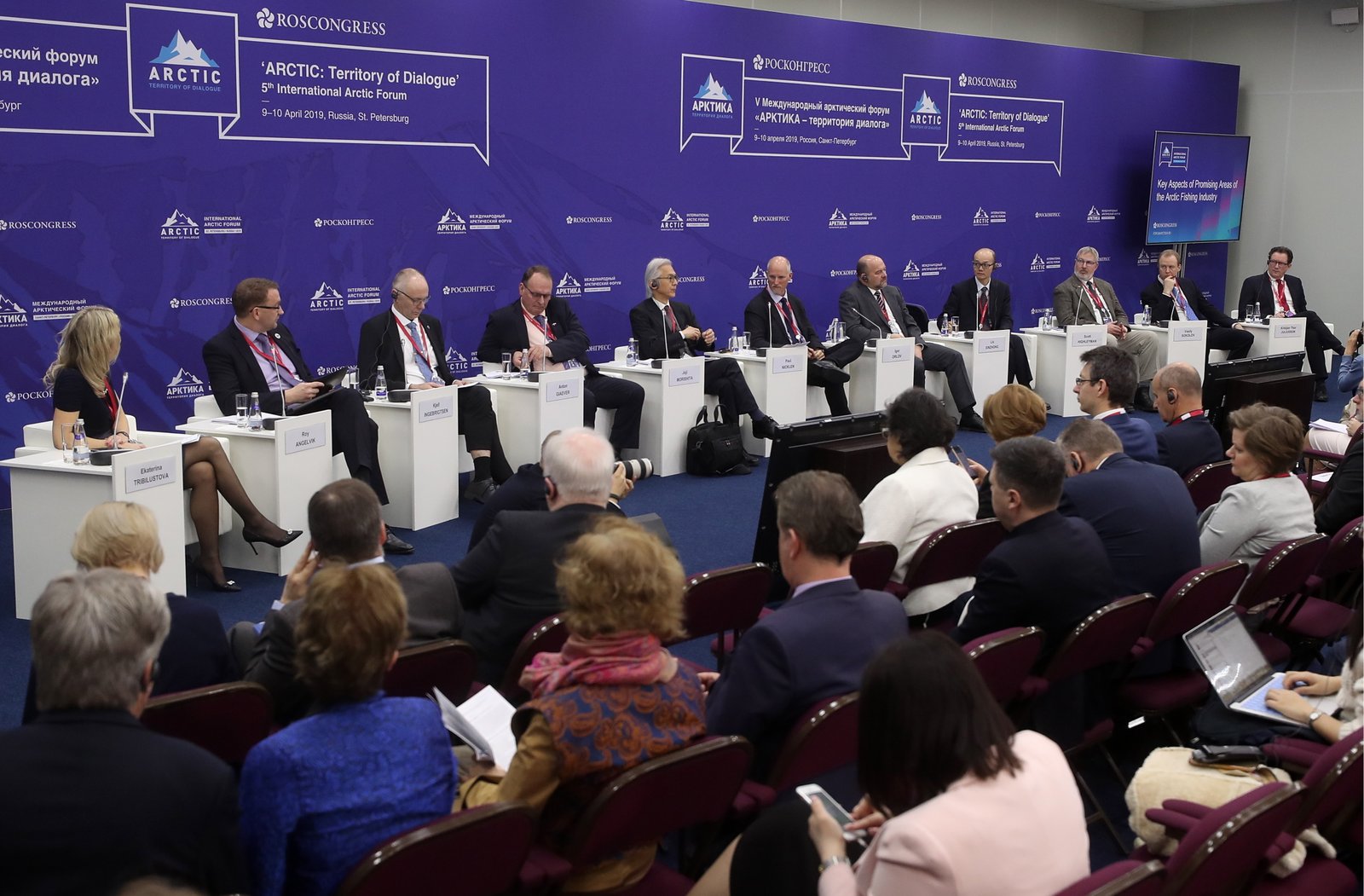
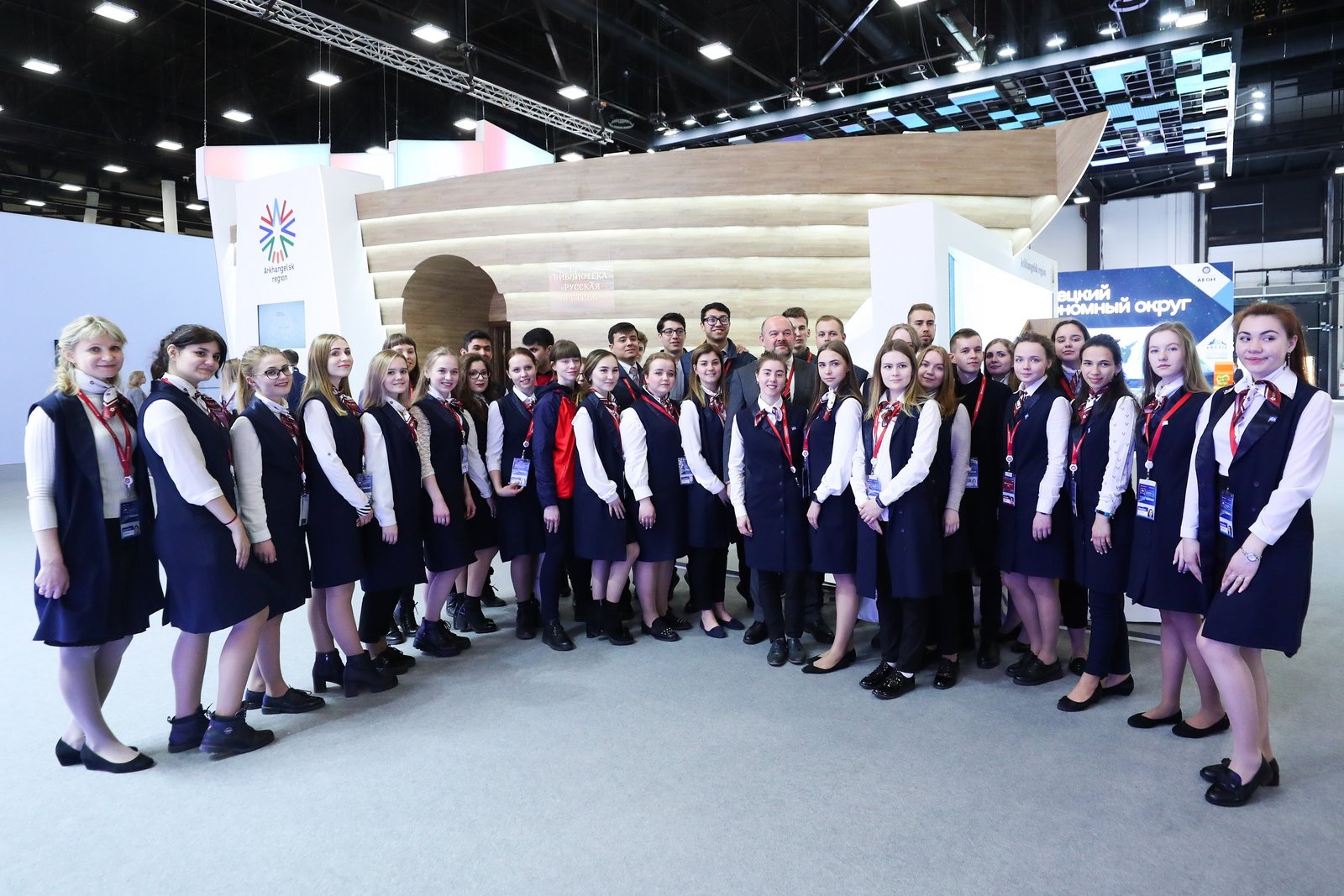
A number of important documents on cooperation were signed by the Arkhangelsk Region and regional representatives and large companies at the ‘Arctic: Territory of Dialogue’ 5th International Arctic Forum.

On the eve of the Forum, Governor of the Arkhangelsk Region Igor Orlov and Acting Governor of St. Petersburg Alexander Beglov signed an Action Plan for the development of cooperation between the governments of the Arkhangelsk Region and St. Petersburg for 2019–2021. The document expands previously reached agreements between the two Russian constituent entities on trade and economic, scientific, technical, and cultural cooperation, adding important fields such as health, education, sports, and the implementation of youth policy.

The Arkhangelsk Region and the Republic of Karelia signed a cooperation agreement defining key areas of cooperation between the two regions for the upcoming three-year period. Governor of the Arkhangelsk Region Igor Orlov and Head of the Republic of Karelia Arthur Parfenchikov identified further cooperation in education and science, the implementation of youth policy and fish farming and forestry projects, and cooperation in the preservation of cultural heritage as priority areas.

The Arkhangelsk Region and the Nenets Autonomous Okrug plan to work together to develop interregional air transportation. The corresponding agreement was signed at the International Arctic Forum by Governor of the Arkhangelsk Region Igor Orlov and NAO Governor Alexander Tsybulskiy. As per the document, the regions made known their intention to work together to develop aviation assets and regional and interregional air transportation.

The Arkhangelsk Region Development Agency signed a cooperation agreement with the Roscongress Foundation at the International Arctic Forum 2019. The document was signed by Roscongress Foundation Chairman of the Board and CEO Alexander Stuglev and Agency General Director Maxim Zaborsky. The agreement is aimed at furthering cooperation and interaction between the foundation and the agency on a long-term and mutually beneficial basis for the purpose of increasing the investment attractiveness and export potential of the Arkhangelsk Region, promoting promising regional investment, export, and other business projects in domestic and foreign markets, and improving legal culture.

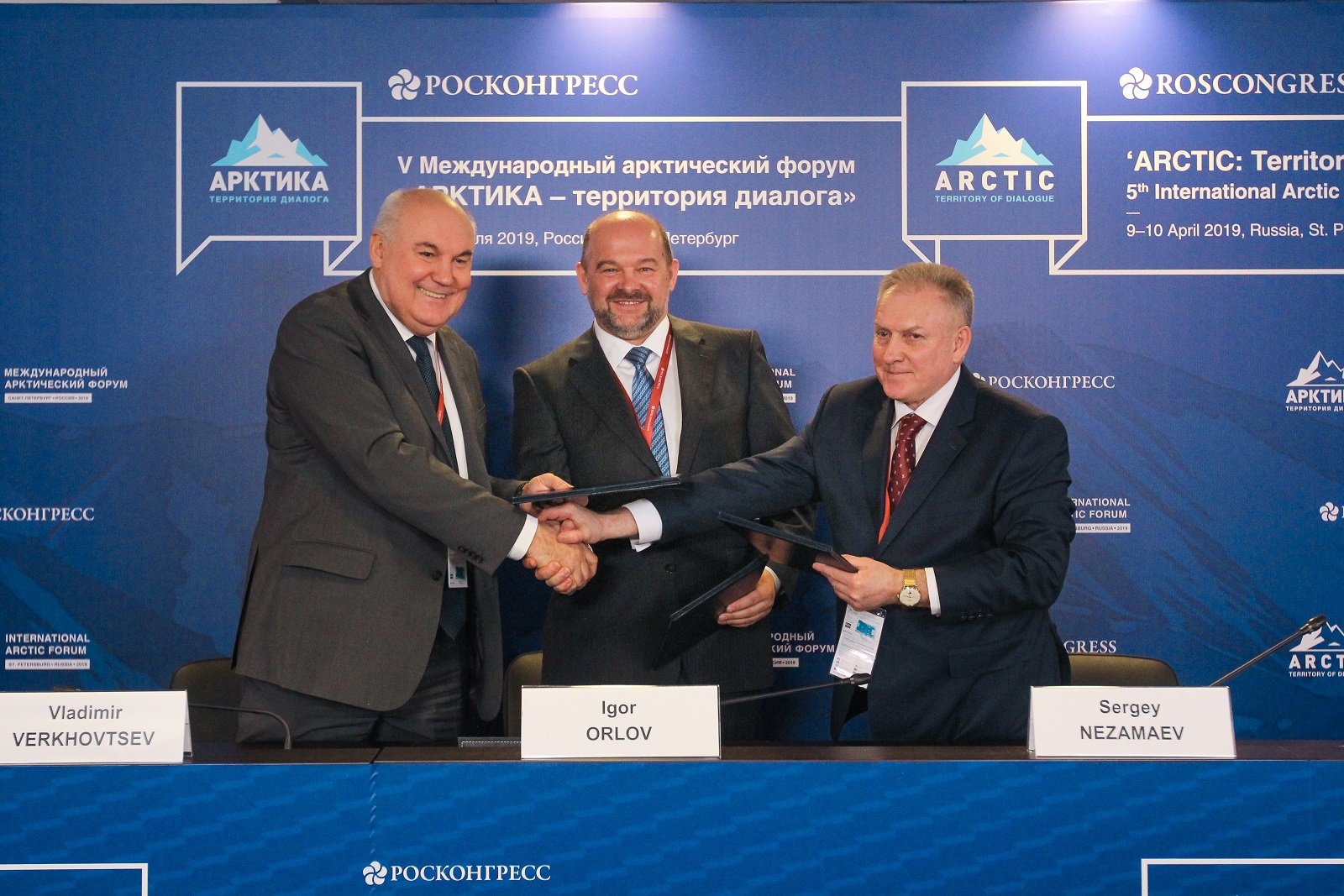
A tripartite agreement was also signed at the Forum and aims to support the Pavlovskoye lead-zinc ore deposit mining and processing plant construction investment project, with total investment in the project estimated at RUB 35 billion. The document was signed by Governor of the Arkhangelsk Region Igor Orlov, General Director of the First Ore-Mining Company JSC Sergey Nezamaev, and General Director of Atomredmetzoloto JSC Vladimir Verkhovtsev.

The Arkhangelsk Region signed a cooperation agreement with the Admiral Makarov State University of Maritime and Inland Shipping at the Forum. Governor of the Arkhangelsk Region Igor Orlov and University Rector Sergey Baryshnikov signed a document focussing on joint work

in areas such as personnel training, advanced training and preparation of workers of large industrial and shipping organizations, as well as on fundamental and applied research.

“We are looking for points of growth shared by our territories that will allow us to achieve the goal set by the President aimed at ensuring the quality of life of Arctic inhabitants on a national level”, Orlov said. “Nowadays, it is essential to increase not only capabilities but also content while working on this issue, which will ultimately significantly affect the quality of life in the Arctic territories”.

April 10, 2019 0 comments
0 FacebookTwitterPinterestEmail
Russia and Norway

The Arctic – An Ocean of Opportunity

by Nadarajah Sethurupan April 10, 2019
written by Nadarajah Sethurupan

Statement by Prime Minister Erna Solberg at the High Level Panel of the Arctic Forum in St. Petersburg, 9 April 2019.

Norwegian Prime Minister Erna Solberg in St. Petersburg. Credit: Trude Måseide/Office of the Prime Minister

Excellencies, ladies and gentlemen – friends of the Arctic,

I am thrilled to be here with you to address common issues on the Arctic.

Together we will discuss the many opportunities and possible cooperation the region has to offer.

But as we meet, there is also cause for concern.

The latest reports of new record-breaking temperatures from Canada and elsewhere are alarming.

The fact is, the Arctic is warming twice as fast as the rest of the globe.

This rapid change is having disturbing impacts on the environment and the living resources of the region.

Indigenous peoples are severely affected.

We have no time to waste.

We need more dialogue and cooperation, based on international law, in order to deal with the risks and impacts.

At the same time, we must look for opportunities.   

10 % of Norway’s population live in the Arctic.

The region is therefore a key national priority.

We need a clear vision to ensure resilient societies in the north.

Sustainable use of natural resources based on knowledge and innovation is important.

Norway does not have all the answers, but has a fairly good track record.

One reason is that we make decisions based on scientific findings and expert advice. 

Another is green thinking.

The third reason I would like to underline is the fact that scientists, politicians and businesses talk and consult.

The people who live, work and raise their children in the Arctic deserve to live in modern, resilient societies. 

We need to invest in infrastructure.

We need high quality daycare for children, and good schools and universities.

We also need football fields, concert halls and hospitals.

I know that Russia has always thought this way.

Now we need to adapt this thinking to a green future in the Arctic.

Political leadership is crucial.

The development and implementation of new and greener technologies are driven by political choices.

Green thinking is part of the solution and must be framed as a business opportunity.

Now and then I hear the Arctic described as a geopolitical hotspot.

This is not how we see it. 

We know the Arctic as a region of peace and stability.

But this should not be taken for granted.

It is the result of political decisions and practical cooperation between the Arctic states.

There is a well-functioning legal regime in place.

The Law of the Sea is the most prominent instrument.

Respect for international law and regional cooperation are keys to ensuring peace and stability across borders.

The regional organisations provide a solid architecture for dialogue and practical cooperation in the Arctic.

The Arctic Council is our most important arena for discussing issues of mutual interest in the region.

One of the reasons for its success is the fact that it gathers all key stakeholders, including indigenous peoples.

The Arctic Council makes it possible to find joint solutions to regional challenges and to ensure continued stability and development in the region.

The Ministerial in Rovaniemi in May will mark the end of a successful Finnish chairmanship.

The Arctic Council has done ground-breaking work in documenting climate change in the region.

We want the statement from Rovaniemi to deliver a strong message on climate change.

We hope that all the member states can agree on this.

Norway and Russia are neighbours and cooperate on issues of common interest in the north.

The Incidents at Sea Agreement, our coastguard collaboration, joint environmental initiatives, and the direct hotline between the Norwegian Military Headquarters and the Russian Northern Fleet all demonstrate a well-functioning cooperation between neighbours.

Our cooperation in the north is more than just meetings and documents.

The people-to-people contact is a valuable contribution to our bilateral relations.

It’s about swimmers and wrestlers training together in Murmansk.

It’s about joint Norwegian-Russian orchestras and Norwegians studying in Arkhangelsk.

And it’s about Indigenous people exchanging experiences.

More than anything, this cooperation is about common understanding and respect between different cultures.

The main platform for our close cross-border contacts is the Barents cooperation.

In October, Norway will assume the chairmanship of the Barents Euro-Arctic Council.

We will work for a strong and resilient Barents region with particular focus on health, people-to-people contact and knowledge.

The ocean as a way of life is a constant in Norwegian history.

The sea is our gateway to the world.

The oceans economy will continue to be crucial for strong Arctic communities in the future.

Healthy oceans are a prerequisite for achieving the Sustainable Development Goals.

Ecosystem-based ocean management and cooperation between coastal states on management of transboundary marine resources are important factors.

As maritime nations, the Arctic states have a special responsibility to take action to ensure healthy and productive oceans.

Norway and Russia have cooperated actively in the field of marine science for 60 years.

During our 40 years of joint fisheries management, we have managed to protect the environment and harvest the fishery resources of the Barents Sea in a sustainable manner.

As a result, the Northeast Atlantic cod and other fish stocks in the Barents Sea are among the best managed in the world.

This cooperation is something to be proud of, and it should serve as an example for other countries and regions to follow.

Marine litter is a growing threat to life in the sea.

Norway and Russia are now joining forces to combat marine litter in the Barents Sea.

All Arctic states need to reduce the threats that could undermine the potential of the oceans.

And we need to make the best possible use of the ocean resources to the benefit of our coastal communities and the people who live there.

Our goal is both to protect the oceans and to optimise their value.

This is why I have established the High-level Panel for a Sustainable Ocean Economy, which consists of the leaders of 14 coastal states, supported by a global group of experts.

In October, Norway will host the seventh Our Ocean Conference.

We will emphasise the importance of a sustainable ocean economy and knowledge-based management of seas and coastal areas.

Ladies and gentlemen,

Let me conclude by once again underlining the importance of dialogue and cooperation.

I would therefore like to thank our Russian hosts for bringing us all together for these important discussions on the opportunities and challenges in the Arctic.

Exchanging views makes us all a little wiser.

And a wise approach is needed to ensure a responsible future for the Arctic.

https://www.regjeringen.no/en/aktuelt/the-arctic.-an-ocean-of-opportunity/id2641222/?utm_source=www.regjeringen.no&utm_medium=epost&utm_campaign=nyhetsvarsel%2010.04.2019&utm_content=The%20High%20North
April 10, 2019 0 comments
0 FacebookTwitterPinterestEmail
Russia and Norway

Chilingarov: Practical Issues in the Arctic Can Be Resolved Only in Collaboration with Science

by Nadarajah Sethurupan April 10, 2019
written by Nadarajah Sethurupan

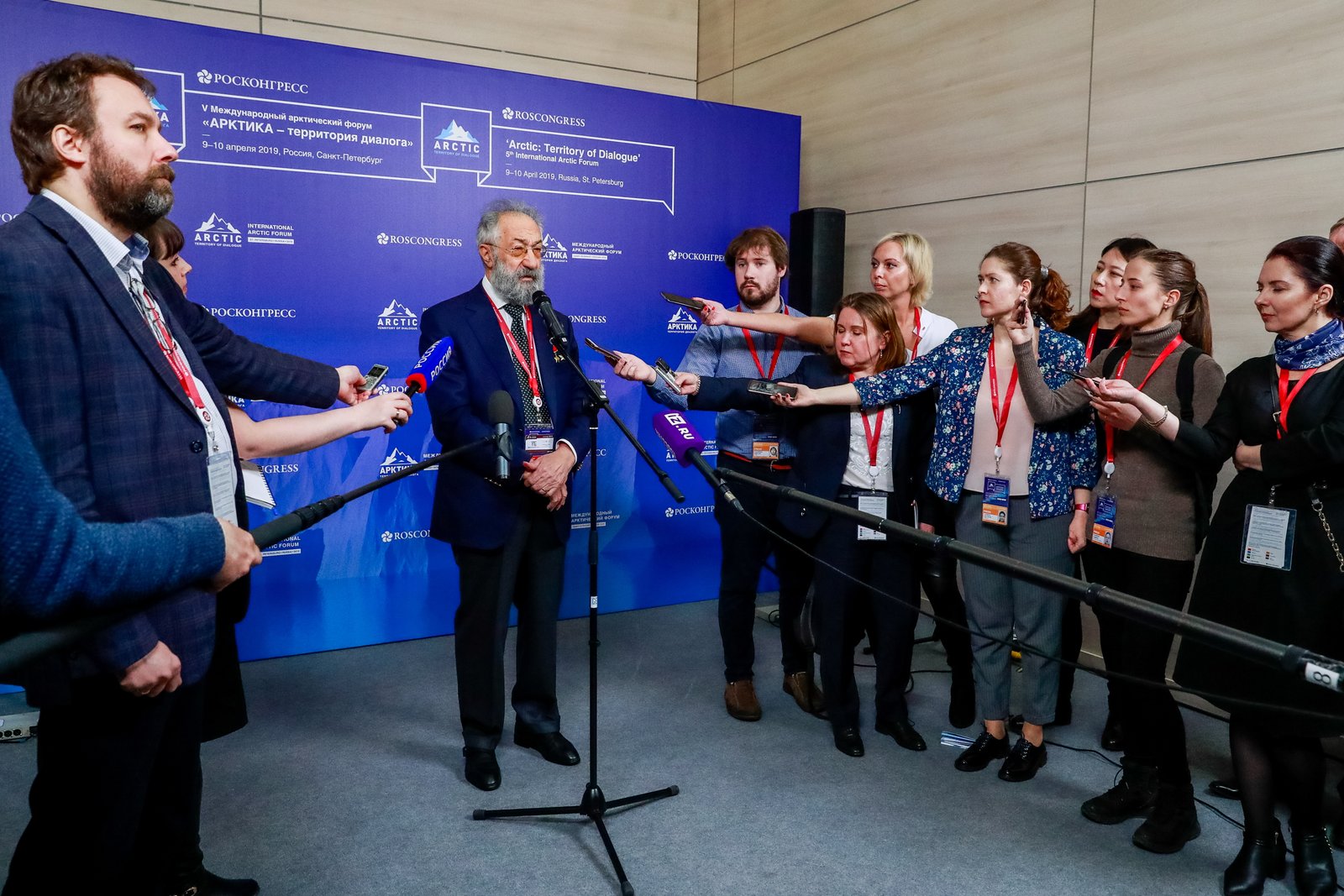
Practical issues related to the Arctic can be resolved only in collaboration with scientists according to a statement made today by the President of the Association of Polar Explorers and Special Presidential Representative for International Cooperation in the Arctic and Antarctic Arthur Chilingarov at the ‘Arctic: Territory of Dialogue’ 5th International Arctic Forum.

“Together with scientists, Russia is implementing interesting international projects that further prove that the Arctic can only be developed nowadays through research. Our expeditionary service is in the Arctic right now aboard the Academic Tryoshnikov research vessel, which is frozen in the ice. 150 scientists from different countries are on board”, Chilingarov said.

Furthermore, Chilingarov confirmed that scientists were working together closely with big business. According to him, icebergs had already been moved in order to ensure the safety of work on drilling rigs in the Arctic.

“Rosneft and the Arctic and Antarctic Research Institute worked together to move icebergs 50 miles from the Laptev Sea”, Chilingarov said, drawing attention to the fact that there were many practical issues and that they were all gradually being resolved.

When asked about the environmental situation in the region, Chilingarov replied: “I must say that the environmental situation in the Arctic is not a simple one. But there is an initiative from the Russian President, who has given instructions to pay special attention to the Arctic environment. We have already cleared a significant part of the territory of industrial waste and waste associated with past military activity. A programme related to cleanliness and exploring different ways of cleaning the region is being actively implemented.”


President of the Association of Polar Explorers and Special Presidential Representative for International Cooperation in the Arctic and Antarctic Arthur Chilingarov has been keeping busy at the anniversary Arctic Forum. He took part in ‘The Arctic. An Ocean of Opportunity’ plenary session and in other key forum sessions.

April 10, 2019 0 comments
0 FacebookTwitterPinterestEmail
Russia and Norway

Supporting Young Enterprise in the Arctic

by Nadarajah Sethurupan April 10, 2019
written by Nadarajah Sethurupan

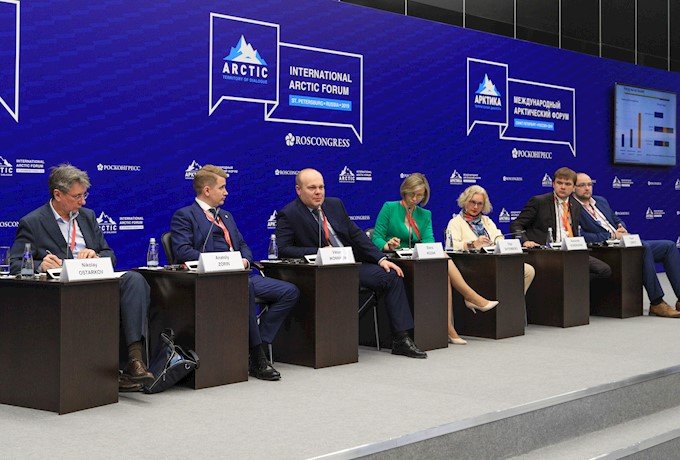
The Youth Day of the International Arctic Forum 2019 offered a panel session entitled ‘Supporting Young Enterprise in the Arctic’. 

Nikolay Ostarkov, Member of the General Council of Delovaya Rossiya (Business Russia) moderated the session and emphasized that “supporting small enterprises is not an easy job. Despite various preferences and privileged regimes, there’s no explosive growth. We need to create a single mechanism to support youth projects aimed at developing northern regions. In the nearest future, we will draft a programme to promote entrepreneurship and we need specific and clear proposals based on this session.”     

Pavel Lenets, Director of Sapphire LLC, shared the following statistics: 18% of Russia’s territory is inhabited by just 2% of its population. Migration balance in the Arctic area is negative. Businesses show an increment in earnings, but their expenses are also on the rise. Over the last three years, the number of registered entrepreneurs has not seen any real growth: in 2017 – 64,039; in 2018 – 64,047; as of 1 January 2019 – 64,137. Services would be the main business profile, as stated by Mr. Lenets. He gave the following answer to the question “What needs to be done to change the situation?”: “We need adequate social and transport infrastructure, preferential interest-free loans, ASEZ and technology parks in the Northern Sea Route’s ports, equipment leasing at minimal interest rates, incentives for enterprises, business training and business incubators.”            

Alexander Kondrashin, Director General of the Agency for Investment Development of Sakha Republic (Yakutia), noted that major businesses in the North were capable of giving 10–15% of their orders to small and medium enterprises. He also stated that “the Arctic needs two fundamental things – investment projects and people. When it comes to delivering public-private partnership (PPP) projects, including the social ones, taxes need to back off a little. The Arctic needs to become an attractive place for people to work and live. Private healthcare, private education and ulus (nomad camp) residents should be exempt from taxes,” concluded Alexander Kondrashin. 

Viktor Ikonnikov, Deputy Chairman of the Government of Arkhangelsk Region, shared his vision of the problems business faced in his region. Mass production for major businesses is done in the central part of the country, as doing it locally is cost-prohibitive. In this case, savings reach 15–20%. The cost of electric energy is very high in the North. It needs to go the wholesale market pool first, which will reduce energy cost and increase efficiency of local businesses. Besides, another burden on the business would be the so-called Northern allowance, shorter business week and longer vacations. “Supporting young enterprise requires developing mentorship, implementing large projects in the Arctic zone and providing financial support to the little ones,” stated Mr. Ikonnikov.   

In her speech, Olga Shtemberg, Chairperson of the Committee for Supporting Entrepreneurship in the Field New Quality of Life and Sustainable Development of the Chamber of Commerce and Industry of the Russian Federation, focused on the environmental problems of the northern areas. “The North is a special and sensitive area, while environmental action is always expensive. The North needs understanding and careful protection. The Arctic is Russia’s face. It needs to be actively cleaned of whatever remained of the Soviet time activities, and business has a long way to go in this department,” emphasized Olga Shtemberg.  

Anatoly Zorin, Director of the Russian Youth Business Assistance Center, spoke about the project to create the automated system called ‘Entrepreneurial Community’ that would serve as a tool to build horizontal ties between business people.   

Elena Kozak, Director of the Center for the Development of Innovative Teams and Projects “Creative Cluster” and Head of the Project “Arctic Youth” at Taimyr College, discussed projects to create and promote folk art brands of the indigenous and small-numbered peoples of the North.    


April 10, 2019 0 comments
0 FacebookTwitterPinterestEmail
Russia and Norway

Roscongress Foundation and University of the Arctic Sign Cooperation Agreement

by Nadarajah Sethurupan April 10, 2019
written by Nadarajah Sethurupan

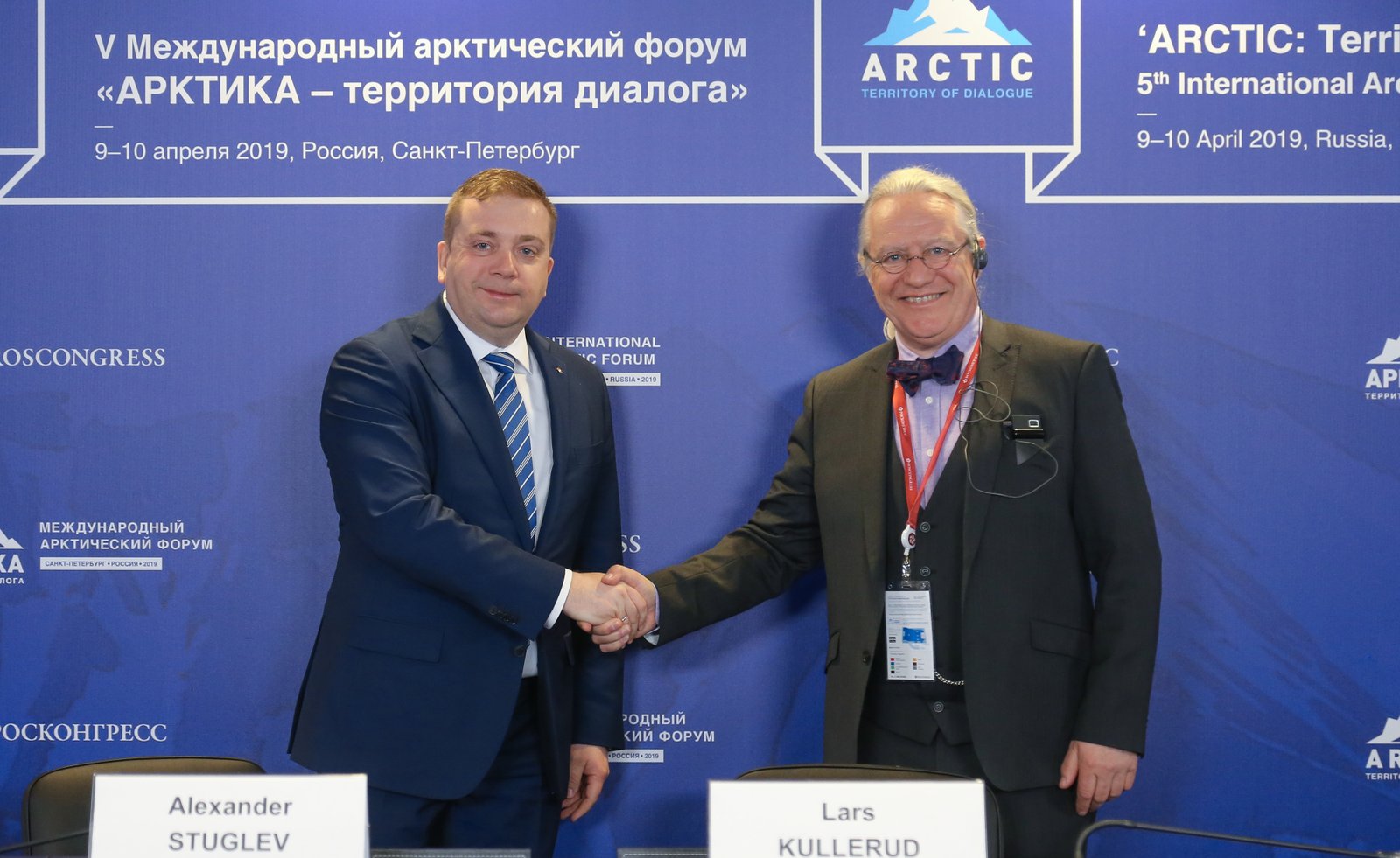
Roscongress Foundation Chairman of the Board and CEO Alexander Stuglev and University of the Arctic President Lars Kullerud on 9 April signed a cooperation agreement to establish effective communication between expert, business, and political communities in the Arctic region and the Russian Federation as part of the scientific and educational spaces of the Arctic regions.

“We are interested in developing common communication platforms at the international level in order to generate interstate cooperation in various areas. One of our key objectives is to help strengthen existing partnerships as well as to find and develop new long-term partnerships between representatives of the business communities of the Arctic region”, Stuglev said. 

The parties agreed to provide mutual advisory, informational, and expert support on pertinent issues on the scientific and educational agenda of the Arctic.

The University of the Arctic is the leading network for cooperation in higher education and scientific research in the subarctic region. Kullerud said that he welcomes this partnership as a way to combine the knowledge and experience of both countries, which are essential for expanding international exploration in the Russian Arctic: “The Arctic already has extensive experience working at such events as the International Arctic Forum 2019. With this agreement, the University of the Arctic and the Roscongress Foundation will expand economic development opportunities for the people of the North, students, and researchers who can work closely with businesses and governments of various countries to ensure the prosperous and sustainable development of the Arctic”.

The University of the Arctic (UArctic) consists of an international network of universities, colleges, research institutes, and other organizations involved in education and research in the North.

At present, the University of the Arctic is one of the most successful examples of international cooperation. The university promotes the growth of human potential in the North, the sustainable development of local communities and the economy as well as the creation of global partnerships.

The University has official observer status on the Arctic Council. The University of the Arctic has two administrative offices in Russia: a research office in Arkhangelsk (based at the Northern (Arctic) Federal University) and the Russian-language centre for information support in Yakutsk (based at North-Eastern Federal University).

“The development strategy of Russia’s Arctic zone designates international relations as one of the priorities for the development of the Arctic territory. The Arctic is a space for international dialogue and cooperation, and its scientific development should take place in close cooperation with foreign partners”, said Marina Kalinina, Vice President of the University of the Arctic and advisor to the rector of Northern (Arctic) Federal University for international cooperation. “Russia is one of the active members of the Consortium. Our country is represented by 53 participants”.

April 10, 2019 0 comments
0 FacebookTwitterPinterestEmail
Russia and Norway

Air and Space Defence Corporation interest in joint Arctic projects

by Nadarajah Sethurupan April 10, 2019
written by Nadarajah Sethurupan

On 9 April 2019, on the sidelines of the ‘Artic: Territory of Dialogue’ International Arctic Forum in St. Petersburg, Almaz – Antey Air and Space Defence Corporation and ARMZ Uranium Holding Co. signed a memorandum of understanding on cooperation in Arctic projects. 

The document was signed by Almaz – Antey Corporation General Director Yan Novikov and Vladimir Verkhovtsev, General Director of ARMZ Uranium Holding Co.

According to the memorandum, the parties intend to explore the possibility of building aviation infrastructure on the Novaya Zemlya archipelago to support ARMZ operations. The document provides for possible participation by Almaz – Antey Corporation enterprises in projects to develop the Pavlovskoye lead-zinc deposit, particularly through production of specialised equipment for working under the Arctic conditions. The parties also expressed interest in co-operating on ensuring the field’s integrated and environmental safety.

ARMZ Uranium Holding Co. is a leader on the global uranium market. The company is implementing a project for commercial development of the Pavlovskoye lead-zinc deposit on the southern Yuzhny Island of the Novaya Zemlya archipelago.

Almaz – Antey Air and Space Defence Corporation is one of the biggest integrated associations of the Russian defence industry, with a staff of about 130,000. Last year, for the first time ever, the holding company was ranked among the top ten of the world’s biggest manufacturers of military products, taking 8th place in the TOP-100 rating of the United States’ Defense News Weekly. The Corporation’s products are in service in more than 50 countries.

Official Forum website: forumarctica.ru 

April 10, 2019 0 comments
0 FacebookTwitterPinterestEmail
Russia and Norway

St. Petersburg Becomes Capital of Arctic Regions during International Arctic Forum

by Nadarajah Sethurupan April 10, 2019
written by Nadarajah Sethurupan

Adviser to the President of the Russian Federation Anton Kobyakov and Acting Governor of St. Petersburg Alexander Beglov met at the ‘Arctic: Territory of Dialogue’ 5th International Arctic Forum on 9 April.

The parties discussed development of the Arctic at the meeting. Alexander Beglov told that St. Petersburg is a point of concentration of research and educational establishments and high-tech production facilities that are necessary for the Arctic exploration and many enterprises are ready to expand their competences in the Arctic Region. Besides, the Baltic Shipyard is currently building three icebreakers, whereas the Admiralty Shipyard is starting the construction of a drifting ice-resistant research station for exploring high latitudes.

Alexander Beglov noted, “The infrastructure of St. Petersburg is ready for hosting events at the highest level, and the International Arctic Forum today proves it. During these several days, our city has become the Capital of the Arctic Regions, which definitely contributes to the strategy of the Development of the Russian Arctic. On top of that, the city takes on the largest part of the exploration of the Northern Sea Route, therefore, hosting the International Arctic Forum in St. Petersburg on a regular basis will help bring together leading scientists and researchers, major representatives of business, international experts working in the Arctic to discuss projects and new working practices.”

According to Adviser to the President of the Russian Federation Anton Kobyakov, great interest in the International Arctic Forum from foreign heads of the Arctic states and representatives of international and Russian business, scientists working in the Arctic Regions, and increasing load on the infrastructure of the receiving party contribute to holding further Arctic Forums in St. Petersburg. 

Adding to the subject of international events, Alexander Beglov told about preparations of the city to the St. Petersburg International Economic Forum. He pointed out that SPIEF 2019 will traditionally take place at the ExpoForum Convention and Exhibition Centre.

April 10, 2019 0 comments
0 FacebookTwitterPinterestEmail
Russia and Norway

75th anniversary of the liberation of northern Norway from the Nazis – Vladimir Putin

by Nadarajah Sethurupan April 10, 2019
written by Nadarajah Sethurupan

Russian President Vladimir Putin met with Prime Minister of the Kingdom of Norway Erna Solberg on the sidelines of the 5th International Arctic Forum The Arctic: Territory of Dialogue.

Next year marks the 115th anniversary of diplomatic relations between our countries. As far as I know, this year also marks the 75th anniversary of the liberation of northern Norway from the Nazis, and, to my knowledge, Norway will celebrate this date at a high level. We took note of this and appreciate it very much said Vladimir Putin on the sidelines of the 5th International Arctic Forum.

Meeting with Prime Minister of Norway Erna Solberg. Photo: Mikhail Metzel, TASS

Indeed, northern Norway is grateful to Russia for liberating East-Finnmark from the Nazi invaders. We will celebrate the 75th anniversary of the liberation in the autumn. We are pleased that Foreign Minister Sergei Lavrov will come for this anniversary. Norway recognises the sacrifices the Soviet people made during liberation from the invaders. We are grateful to Russia for that said Norwegian PM Erna Solberg.

Meeting with Prime Minister of Norway Erna Solberg. Photo: Mikhail Metzel, TASS

we covered extensively the opportunities for cooperation and the threats associated with working in the Arctic. In this regard, I would like to remind you of the positive experiences of our cooperation, the most important of which include agreements on sections of the sea, on cooperation, as well as on activities in the Barents Sea and a portion of the Arctic Ocean. This is good for bilateral relations and for cooperation in the Arctic in general Putin said.

Meeting with Prime Minister of Norway Erna Solberg. Photo: Mikhail Metzel, TASS

We are pleased to take part in this international Arctic conference, the subject of which is closely related to Norway, namely, ocean conditions. We strongly appreciate the invitation to St Petersburg and the warm welcome that we, the Norwegian delegation, have received Erna Solberg said. Indeed, primarily, our two countries cooperate in the north. We maintain neighbourly relations, and we face many common challenges. I hope we will be able to expand this theme-specific cooperation in the future she said.

Russian President Vladimir Putin says he will wait for the trial of a Norwegian man jailed on espionage charges to wrap up before weighing pleas for a pardon.

Frode Berg was arrested in Moscow in December 2017. His lawyer said that Berg, a retired Norwegian border inspector, is the victim of a setup.

Putin commented on the case Tuesday as he sat down for talks with Norwegian Prime Minister Erna Solberg on the sidelines of an Arctic forum in St. Petersburg. Asked by reporters if he would pardon Berg, he responded that “only a convicted person can be pardoned” and added that “we shall see what can be done” after the trial ends.

Russian prosecutors said Berg was accused of collecting information about Russian nuclear submarines for Norwegian intelligence.

Speech at the plenary session of 5th International Arctic Forum

President of Russia Vladimir Putin: Mr Niinistö, Mr Jóhannesson, Ms Solberg, Mr Löfven, ladies and gentlemen, friends,

I am happy to welcome you to St Petersburg, the northern capital of Russia whose history is closely connected with legendary Arctic expeditions, industrial exploration of this unique region and preservation of its nature and unique culture.

This is the fifth time that International Arctic Forum The Arctic: Territory of Dialogue becomes a platform for an open discussion of the Arctic agenda. We thank our foreign guests and representatives of the Arctic Council countries for their readiness to team up and their understanding of our shared responsibility for the future of the Arctic and its stable and sustainable development.

In 2021, Russia will assume presidency of the Arctic Council. We invite all participants of the Council and other states to cooperate in the Arctic. The priorities of our presidency are vital for the Arctic development: promotion of sustainable technologies in all areas, including industry, transport and energy.

Today we are carrying out our projects in the Arctic, including global ones, based on the latest environmental standards. It is enough to mention the Yamal LNG project and the development of the Bovanenkovskoye and Kharasaveyskoye gas fields. Today, the Arctic accounts for over 10 percent of all investment in the Russian Federation. I am convinced that the importance of the Arctic factor in the Russian economy will only grow further. 

This year we are going to draft and adopt a new strategy for the development of the Russian Arctic up to 2035. It is to combine measures stipulated in our national projects and state programmes, the investment plans of infrastructure companies and programmes for developing Arctic regions and cities.

All Arctic regions should be brought to the level of at least the national average in key socioeconomic indicators and living standards. I would like to emphasise that this task should not only be clearly defined in the new strategy of Arctic development but should also serve as a guide for the work of all federal departments and regional authorities of Russia. It is absolutely necessary to take into account the specific nature of the problems facing the indigenous minorities of the North. 

Special attention should be paid to the development of transport and other support infrastructure. We are well aware that this is a necessary foundation for future investment and business initiatives. The construction of theNorthern Latitudinal Railway is a key infrastructure project. This railway will make it possible to start effective development of the natural riches of the Polar Urals and Yamal, and in the long-term, the north of Krasnoyarsk Territory of the Russian Federation. And we will certainly continue developing the global transport corridor that includes the Northern Sea Route and which will be functioning without fail year round.

Our goal to significantly boost the freight traffic and bring it up to 80 million tonnes by 2025 on the Northern Sea Route alone was outlined in the 2018 Address to the Federal Assembly. Just 10 to 15 years ago, this figure looked absolutely out of reach, whereas today it is a realistic, carefully calculated and concrete goal. As of last year, the volume of traffic on the Northern Sea Route already reached 20 million tonnes. This is three times – I reiterate – three times more than the Soviet record set in 1987, when the Soviet Union transported 6.5 million tonnes using this route. Now, it is 20 million tonnes.

In order for this global transport corridor to operate at full capacity, we will develop the communication and coastal infrastructure, including port facilities, navigation, and meteorological aids, and ensure safe commercial navigation.

We encourage our foreign partners to join us in our efforts to create hub ports at the end points of the route. I mean the Murmansk transport hub and port infrastructure in Petropavlovsk-Kamchatsky. In addition, we plan to upgrade the Arctic coast harbours, including the river-sea traffic capabilities.

We will continue to update our icebreaker fleet and to increase the production of ice-class vessels. Three new nuclear-powered icebreakers, namely, the Arktika, the Sibir and the Ural, are being built here in St Petersburg, where we are now. By 2035, Russia’s Arctic fleet will operate at least 13 heavy-duty linear icebreakers, including nine nuclear icebreakers.

To reiterate, our goal is to make the Northern Sea Route safe and lucrative for shippers, and appealing both in terms of the quality of services and price. In particular, the icebreaker escort fee must be competitive and reasonable. The state invests in this operation in order to minimise the tariff burden on carriers and other businesses.

Friends, we intend to use all of our investment support tools, including those that we have used successfully under programmes for the development of Russia’s Far Eastern regions, to launch new projects. These will include lower profit tax rates, reduced severance tax coefficients for mineral extraction, a notifying procedure for VAT refunds and a simplified procedure for providing land plots and invariable terms for implementing investment projects. 

At the same time, with due consideration for the Arctic’s peculiarities, investors should and will receive more advanced and more stable preferences here.

I would now like to address our colleagues. The Government of Russia, as well as experts and the business community, have been instructed to draft a federal law on a special system of preferences for the Arctic zone’s investors. And I am asking you to do this quickly so Russia’s State Duma can pass the law during its fall session. 

I would like to draw your attention to one more point. As you may know, the powers of the Ministry for the Development of Russia’s Far East have been expanded; now, the Arctic is also within its authority and is part of its responsibility. In this connection, it is logical to expand the work of Far Eastern development institutions to the Arctic as well. If necessary, we will expand the capitalisation of the Far East Development Fund for selective financing of Arctic projects.

Furthermore, we need a powerful research, HR and technological foundation for the region’s comprehensive development and for accomplishing unique and unconventional tasks in the high latitudes. We have begun establishing science and education centres in various Russian regions; they integrate the capabilities of universities, research institutes, the business community and the real economy. One of our Arctic regions will certainly receive such a centre that will ensure the development of fundamental research and will help address the applied and practical tasks of developing the Arctic.

We believe that the future belongs to active academic and university exchanges, international research teams and alliances of high-tech companies. We invite all our colleagues to take part in joint projects in shipbuilding, navigation safety, environmental protection, minerals production and bioresources harvesting.

The Arctic offers us immense challenges. And we can only respond effectively if we do it together. One such challenge, as I have told you, is to maintain balance between economic development and preservation of the Arctic environment, conservation of its unique and fragile ecosystems, and, of course, clean-up of the environmental damage accumulated through the economic activity in the past decades, which was extensive from time to time. We have been conducting a major clean-up of Arctic areas for a number of years. Starting in 2012, we have removed and utilised over 80,000 metric tonnes of waste.

In the coming years we will liquidate six major environmental damage sites in Arkhangelsk and Murmansk regions, in the Nenets Autonomous Area, Karelia and Yakutia as part of the Clean Country federal project. We are also to clean up over 200 square kilometres in the Kola Bay area.

We will also develop a system of specially protected natural territories and reserves. Above all, I mean the Russian Arctic national park. It is important to take additional measures to develop civilised ecotourism and build the required infrastructure there.

To conclude, I would like to thank all the participants and guests of our forum. I am certain that our constructive dialogue will help strengthen neighbourly relations and trust in the Arctic region, which means the peaceful and sustainable development of the Arctic.

Thank you.

April 10, 2019 0 comments
0 FacebookTwitterPinterestEmail
Terrorist

U.S. Designates Iran’s Revolutionary Guard As A Foreign Terrorist Group

by Nadarajah Sethurupan April 9, 2019
written by Nadarajah Sethurupan

US State Department officials said that the recent designation of the Iranian Revolutionary Guard Corps (IRGC) was designed to reduce the risk to lives of American soldiers or citizens by Iranian Gen. Qasem Soleimani in the future.

“General Soleimani has the blood of Americans on his hands, as does the force that he leads, and this designation that we took yesterday is another step to reduce the risk that any American soldier or any American will be killed by General Soleimani and the racket that he runs with the IRGC and the Quds Force,” Brian Hook, US Special Representative for Iran, told NORWAY NEWS during a telephonic press briefing along with the State Department’s counterterrorism coordinator, Nathan Sales.

US President Donald Trump designated Iran’s IRGC forces as a foreign terrorist organization on Monday. The designation comes into effect from April 15.

Comprising an estimated 125,000-strong military with army, navy and air units, the IRGC also command the Basij, a religious volunteer paramilitary group. It also oversees the Quds forces, commanded by Soleimani, who have fought Iran’s proxy wars in the region.

Hook referenced to recently declassified documents which said that Iran was responsible for killing over 600 US service members in Iraq from 2003 until 2011.

The US has in the past blacklisted dozens of entities and people for affiliations with the IRGC, but not the organization as a whole. In 2007, the US Treasury designated the IRGC’s Quds Force “for its support of terrorism,” and has described it as Iran’s “primary arm for executing its policy of supporting terrorist and insurgent groups.”

Asked on whether the US decision to designate the IRGC as a terrorist organization would increase the chances of a military conflict with Iran, Hook dismissed the concerns while adding that the sanctions’ primary focus was aimed at “driving up the costs of Tehran’s expansionist foreign policy.”

“There is no better path to support the Iranian people than to pressure the regime from outside and to drive up the costs of its internal repression and external terrorism,” Hook said.

Sales, the State Department’s counterterrorism coordinator, added that US sanctions have had immediate effects.

“Hezbollah used to receive $700 million a year to commit its terrorism from the Iranian regime. They’re now doing a fund-raising drive. That tells you something about the effects that our designations and sanctions tools have had,” Sales said.

Brian H. Hook, U.S. Special Representative for Iran also Senior Policy Advisor to Secretary of State and Ambassador at Large Nathan Sales, Coordinator for Counterterrorism

Below is a full rush transcript of the press conference by Brian H. Hook, U.S. Special Representative for Iran also Senior Policy Advisor to Secretary of State and Ambassador at Large Nathan Sales, Coordinator for Counterterrorism

Mr.Brian Hook who is the Special Representative for Iran and Senior Policy Advisor to the U.S. Secretary of State and Ambassador at Large Nathan Sales, Coordinator for Counterterrorism at the Department of State.

Media:  How would the U.S. designation of the IRGC affects its threat to its neighbors and its intervention in Syria, Yemen and Iraq?  How would the U.S. designation as a terrorist group affect its threats to Gulf countries?

Ambassador Sales: There’s no question that Iran acting through its IRGC is a threat to those countries in the region.  That’s one of the principal reasons why the Secretary has decided to designate the IRGC as a foreign terrorist organization.  Doing so enables us to more aggressively cut off the flow of money into the IRGC’s coffers.  Money that the IRGC would use to fund militias and terrorists in the region and around the world to cause violence and foment instability.

With yesterday’s announcement, we are taking a step to deprive the IRGC of the tools that it uses to pursue its malign agenda in the region.

SR Hook:  I would say that, you asked about the Gulf countries, I think for our Sunni Arab partners in the region, this is a welcome designation because it will make it harder for the Iranian regime to execute its expansionist foreign policy.  Just a week and a half ago in the New York Times, there was an article about how Iran’s proxies are under financial strain because of a combination of Iran mismanaging its economy and U.S. sanctions.  And this action is another layer, the designation of the IRGC and the Quds Force as an FTO, that adds an additional layer of sanctions and it puts a lot of companies around the world on sort of heightened notice that doing business with the IRGC and providing material support to them has liability, both criminal liability, immigration consequences, and that we think that those measures are going to create powerful disincentives for individuals and companies around the world to avoid the IRGC.

That then has very positive consequences for our foreign policy because it just makes it harder for the IRGC to execute on its mission set.  So this will be, we think this will be of help not only to America’s national security objectives, but it will also help our partners in the region.

Media:  Why did you decide to designate the IRGC including its Quds Force as a foreign terrorist organization yesterday?  Did these organizations change something over the last month?

Ambassador Sales:  Well, it’s the next step in our pressure campaign.  This administration has used terrorism and other sanctions for the past two and a half years to drive up the cost to Iran of its bid for regional power and its use of terrorism as a tool of statecraft around the world. 

What happened yesterday was just the next logical step in our increasingly robust sanctions measures that we’re imposing on this regime to get it to stop its malign and outlaw behavior.

Media: Will this designation of the IRGC as a terrorist organization be similar in the U.S.’ previous approach to its designation of like al-Qaida and ISIS?  How proactive will this decision be in terms of then targeting Qasem Soleimani, I mean the way Abu Bakr al-Baghdadi or Bin Laden were in the past perhaps?  Is there any mechanisms within this designation that will apply to Soleimani in that way?

Ambassador Sales:  Well this designation is all about financial impact, law enforcement impact, and immigration impact.  What this designation allows us to do is increase the financial pressure on the IRGC and deprive it of resources.  It enables our prosecutors to more effectively bring terrorism related cases against the IRGC supporters and enablers.  It is now a federal criminal offense for any person to knowingly provide material support or resources to the IRGC.  And third, there are immigration consequences to this designation.  People who provide material support or resources to the IRGC will no longer be admissible to the United States.  We’ll be able to keep them out of our country, stop them from coming here to raise money for the IRGC or to commit other malign acts while here in the United States.  

SR Hook:  We recently declassified numbers, about the number of American soldiers, it was 608 American soldiers who were killed by the Iranian regime and the IRGC during the Iraq War.  General Soleimani has the blood of Americans on his hands, as does the force that he leads, and this designation that we took yesterday is another step to reduce the risk that any American soldier or any American will be killed by General Soleimani and the racket that he runs with the IRGC and the Quds Force.

Media:  Could you clarify what consequences could foreign companies now face for having business with the IRGC?

Ambassador Sales:  The Secretary of State yesterday was pretty clear about this.  It’s now a lot riskier to do business with Iran.  We know that the IRGC has permeated all aspects of the Iranian economy.  It operates front companies around the world.  It’s now a federal crime to provide material support to the IRGC.  So any company that is considering doing business with Iran should take very seriously the risk that in so doing it will be providing material support to the IRGC and potentially incurring federal criminal liability.

The point of this designation, the effect of this designation is to render radioactive the IRGC and send a message to the rest of the world that doing business with Iran is harmful to your company’s financial health.

Media:  How will the designation of the IRGC affect the relations between American authorities and American officials who will visit Lebanon, and the Lebanese government?  Could American officials meet with the Lebanese government?

SR Hook:  Congress, the statute, the FTS statute allows us to take the necessary designations that we need to to protect America’s national security interests while at the same time not impeding our diplomacy.  We have now, I think since 1997, done almost 70 foreign terrorist organization designations, and that has had a range of organizations.  At no point over these last many decades across many different administrations has this impeded our diplomacy.  And we expect in the same way here, it will not impede any of our diplomatic efforts anywhere in the world.

But we do think that, I think you may have seen this just a few weeks ago, maybe it was almost a month ago, the leader of Lebanese Hezbollah for the first time in its history made a public appeal for donations, and that is a good thing, we think, for the people of Lebanon.  We don’t think it’s in the interest of the Lebanese people to have this paramilitary organization that puts at risk the lives of the Lebanese people, prioritizes ideology over the welfare of innocent Lebanese people.  And so we will continue to, Secretary Pompeo was recently in Lebanon, had very good meetings, gave an important speech there which I would refer you to that lays out our approach to Lebanon very clearly. 

Media:  Iranian officials have been mostly focused on threatening the U.S. military forces.  Don’t you think this strategy, this designation, would increase any possibility of a military conflict?

SR Hook:  No, we don’t believe that.  When you look at the history of the regime, it has been chanting Death to America since its inception.  They have, the IRGC is a terrorist organization.  The IRGC, as I said earlier, has already killed over 600 American soldiers in Iraq alone.  That doesn’t include Lebanon and other countries.

We are not going to have peace or stability or security in the Middle East without weakening the Revolutionary Guards, and that’s what our sanctions yesterday are designed to do.

We think that by stigmatizing the IRGC, exposing its operations for what they are, it has all the attributes of a terrorist organization.  We think that this kind of approach and increased pressure will do more to save American lives and to make the middle East more peaceful and stable than essentially being extorted or blackmailed by Iran.

They have a long history of threats.  They regularly threaten to close the Strait of Hormuz, they threaten and execute terrorism in Europe, Argentina, Asia, the Middle East.  This is what they do for a living.  It is identical to a deeply corrupt Mafia.  If we were to guide our foreign policy on the basis of Iran’s threats of retaliation we would be playing by their rules, and that is a mistake I think many countries fall into.  They fear taking action against Iran, the regime, because they fear Iran escalating.  When you fall into that pattern you are playing by their rules, and when you play under the house rules, the house always wins.

We are, in this administration over the last two years have taken an entirely different approach to Iran.  We are imposing historic levels of economic pressure on this regime to drive up the costs of their expansionist foreign policy, their violent foreign policy around the region.  And we think that this approach is the best approach to both protect American soldiers, to protect Americans, to protect our partners in the region.

Media:  What do you expect Europe or the European Union to do now after all the EU sticks to the Iran deal still?

SR Hook:  On Europe, since the time we’ve gotten out of the deal, we have seen Europe take a number of steps to counter the range of non-nuclear threats that Iran presents to peace and security.  So I think that we agree on more than we disagree with the Europeans.  We obviously disagree about the Iran Nuclear Deal, but whenever we’re in a room with our European allies and we talk about Iran’s threats, the missile testing, ballistic missile testing, missile proliferation, the terrorism, terror finance, cyber attacks, maritime aggression, human rights abuses, the arbitrary detention of dual nationals, the oppression of women, we see eye to eye on this.  There isn’t any disagreement.  And I think Europe and our European allies understand that Iran has been able to leverage the Iran Nuclear Deal to expand its ballistic missile testing, and that’s because the Iran Nuclear Deal ended the prohibition on Iran’s ballistic missile testing.

They are in defiance of the Council when they do ballistic missile testing, but as part of the deal, Resolution 1929 was altered and it was succeeded by Resolution 2231 which diluted the ballistic missile testing prohibition, and we’re now dealing with the consequences of that with the increased space launches, ballistic missile testing, and then also just the missile proliferation.

So we are hopeful, especially after the Summary of Conclusions that Europe issued in January, the EU issued in January, that at some point we would love to see the EU match our designations on Iran’s, on the individuals and entities that are facilitating Iran’s missile program.  We think it’s in Europe’s interest, it’s in our interest, certainly in the interest of the Middle East to do that.

With respect to the INSTEX, I think there is an understanding that that sort of vehicle is not going to be used to invade U.S. sanctions.  We don’t see much corporate demand for this special purpose vehicle, this INSTEX because if you’re a European company and you’re given a choice between doing business in the enormous American market and the rather small Iranian market, it’s a very easy decision to make.

Let’s not forget that when you look at all of the trading partners of the European Union, the EU does more trade with Kazakhstan and Serbia than it does with Iran.  It’s the 32nd largest trading partner.  So I don’t want us to lose perspective on this.  Iran is not a significant market for the EU.  So I think in light of all this I think we have an agreement on the threats to peace and security that Iran presents; we disagree about the Iran Deal; we don’t see a lot of corporate demand for INSTEX.

Ambassador Sales:  I just want to echo one of the things Brian just said.  We agree with Europe more than we disagree on these issues.  And one of the areas where we have a very strong common cause is on Iran-sponsored terrorism.  We can all agree that the Iranian regime should not be using European soil to plot terrorist attacks, and we know that they are.  We know that the IRGC and other elements of the Iranian government are active in directing assassinations and terrorism on the continent.

Just within the past several months we saw the foiling of an Iranian-backed plot to bomb a political rally outside of Paris.  We saw the foiling of an Iran-backed plot to assassinate dissidents living in Denmark.  

Set aside the nuclear deal.  We don’t see completely eye to eye with our European friends on that, but we should all be able to agree, and we do agree that Iran-sponsored terrorism on the continent has to stop.

Media: Do you expect Iran regime will increase terrorist activities after this step was taken, will try to use some militias in third-world countries like Lebanon Hezbollah against Israel or try to use Saraya al-Ashtar against Bahrain or try to use another militia in Iraq to after this step was taken?  Do you expect increased activities from Iran’s side?

Ambassador Sales:  You can’t commit terrorism without resources, and that’s one of the principle reasons why the Trump administration has been so aggressive in using our sanctions authorities to cut off the flow of money and other resources to the IRGC, to the Iranian regime generally.  And as Brian pointed out a moment ago, we’re seeing the effects.

Hezbollah used to receive $700 million a year to commit its terrorism from the Iranian regime.  They’re now doing a fundraising drive.  That tells you something about the effects that our designations and sanctions tools have had.  

We can never anticipate with 100 percent clarity what a terror regime like Iran is going to do in response to yesterday’s announcement, but I can tell you that the threat of Iranian terrorism is precisely why we have put the IRGC on our FTO list because that enables us to marginalize that organization and deprive it of the resources that it otherwise might use to commit terrorist attacks in the region and around the world.

Media:  What will happen to the countries that still deal with the IRGC after this decision?  That is to say, what are the consequences in the case that some countries continue dealing with the IRGC and the militias that follow it?

Ambassador Sales:  Well, we think countries have a choice to make.  They can engage with Iran and take the consequences that follow, or they can engage with the United States and our allies and take the beneficial consequences that follow.

You look at all the countries in the Middle East where Iran is active, and they all have something in common.  We’re talking about places like Syria and Yemen and Lebanon and in all those countries you see violence and instability, you see central governments that struggle to stand on their own two feet and represent the interests of their own people.

What Iran offers is submission, violence, bloodshed and instability.  What the United States offers is sovereignty, prosperity, and the free and open exchange of commerce and people, ideas, et cetera.

So we think countries have a choice to make, and we think that when they do the cost/benefit calculus they’ll understand that doing business with the United States, engaging in friendly relations with the United States, is far better for them than being subservient to Tehran.

Media: My first question would be on a critique that have been levied against this decision by Jason Rezaian.  He said that this designation would likely to entrench the power of hardliners in Iran.  So he said that instead it would be better to target individuals that are responsible for particular action inside the IRGC.  So he proposes this is a better strategy.  So what would be your comment on this critique?

And a second very quick question, is there a relation for the fact that the this listing comes after the Islamic State has been finally defeated, a task to which arguably the IRGC has somehow contributed?  Thank you very much.

SR Hook:  I can take the first question.  Jason is wrong.  I think Jason’s position is exactly the position the Iranian regime would like people to take, and it’s what I was saying earlier.  When you play by their rules, they win.  And they have this narrative that they have perfected over 40 years of scaring people from exposing a corrupt religious Mafia and for taking stronger measures to isolate them diplomatically and economically.  

There is no better path to support the Iranian people than to pressure the regime from outside and to drive up the costs of its internal repression and its external terrorism.

Ambassador Sales:  And on the timing, let me just say the reason we announced it yesterday was because the announcement was ready yesterday.  We’ve done a very robust and thorough interagency process that’s lasted quite a while to make sure that we are thinking through all the implications of the FTO designation of the IRGC.  That process was completed in the very recent past, so we announced it when it was ready.  Don’t read anything else into it.

April 9, 2019 0 comments
0 FacebookTwitterPinterestEmail
Video clips

Norwegian Foreign Minister in Russia

by Nadarajah Sethurupan April 9, 2019
written by Nadarajah Sethurupan
https://www.youtube.com/watch?v=dMmgk1lomlE&feature=youtu.be
April 9, 2019 0 comments
0 FacebookTwitterPinterestEmail
Russia and Norway

Russia to conduct missile test in Norwegian Sea

by Nadarajah Sethurupan April 9, 2019
written by Nadarajah Sethurupan

Russia’s air traffic service has announced that the country plans to perform a missile test from vessels in northern Norwegian Sea this week, Norwegian media reported Monday.

The test is to take place off the Andoya Island in northern Norwegian Sea between April 11 and 14, according to the Russian authorities’ Notice to Airmen (NOTAM), newspaper VG reported.

“We register that they want to establish a NOTAM area west of Lofoten. They have their full right to it as there are international airspace and waters,” said Lieutenant Colonel Ivar Moen, spokesman for the operational headquarters of the Norwegian Armed Forces.

According to news agency NTB, Russia announced similar activities outside the Norwegian coast when Norway was the host country for the NATO exercise Trident Juncture in October and November last year.

April 9, 2019 0 comments
0 FacebookTwitterPinterestEmail
Russia and NorwayVideo clips

Norwegian Prime Minister in Russia

by Nadarajah Sethurupan April 9, 2019
written by Nadarajah Sethurupan

President Vladimir Putin on Tuesday put forward an ambitious program to secure Russia’s foothold in the Arctic, including efforts to build new ports and other infrastructure facilities and expand an icebreaker fleet.

Speaking at the Arctic forum in St. Petersburg attended by leaders of Finland, Iceland, Norway and Sweden, Putin said that Russia plans to dramatically increase cargo shipments across the Arctic sea route.

https://www.youtube.com/watch?v=15SMWzI1x8U&feature=youtu.be

He said that the amount of cargo carried across the shipping lane is set to increase from 20 million metric tons last year to 80 million tons in 2025.

“This is a realistic, well-calculated and concrete task,” Putin said. “We need to make the Northern sea route safe and commercially feasible.”

He noted that Russia, the only nation with a nuclear icebreaker fleet, is moving to expand it.

Speaking at the forum, Norwegian Prime Minister Erna Solberg emphasized the need to respect international law and noted that the Arctic Council provides a key arena for dialogue.

“Now and then I hear the Arctic described as a geopolitical hotspot,” she said. “This is not how we see it. We know the Arctic as a region of peace and stability.”

She noted that “this should not be taken for granted,” adding that “it is the result of political decisions and practical cooperation between the Arctic states.”

“Respect for international law and regional cooperation are keys to ensuring peace and stability across borders,” Solberg said.

Solberg and other leaders who spoke at the forum underlined the need for all countries in the Arctic region to focus on areas of mutual interest despite differences.

“We ensure the necessary defense capability in view of the military-political situation near our borders,” Lavrov said, noting that a recent NATO exercise in Norway was openly directed against Russia.

Finnish President Sauli Niinisto emphasized the need to search for common ground despite Russia-West tensions.

“In spite of what has taken place in Ukraine, we still actually from the Urals to Atlantic, we are Europe, and Europe is the neighbor of Russia,” he said. “So usually it is wise to stay in as good relations with your neighbor as possible.”

Putin said that Russia has fulfilled its obligations under an international agreement aiming to limit global warming by cutting emissions of greenhouse gases, noting that the U.S. has opted out of the pact.

Foto: Berit Roald / NTB scanpix Foto: Roald, Berit

Norway’s opposition Labor Party, the biggest party in parliament, decided to drop its support for exploration in Arctic waters surrounding the Lofoten archipelago.

The party, which will vie for government in Norway’s 2021 elections, said it no longer backs an environmental impact assessment of drilling in the far north Lofoten, Vesteralen and Senja islands, acknowledging that there has been a shift in support for the policy within the party.

The move came as a major blow to Norway’s oil industry, which has seen access to Lofoten as a holy grail, unlocking some 3.4 billion barrels of oil equivalent of potential in place oil and gas.

The association representing Norway’s oil and natural gas industry, which has harbored hopes of a government more supportive of new exploration, expressed disappointment at the decision.

“The whole industry is surprised and disappointed that the Labor Party is changing a parliamentary election program in the middle of the period,” said Karl Eirik Schjott-Pedersen, head of Norwegian Oil and Gas. “It does not provide the predictability we depend on.”

Foto: Berit Roald/NTB Scanpix

Speech at the plenary session of 5th International Arctic Forum

President of Russia Vladimir Putin: Mr Niinistö, Mr Jóhannesson, Ms Solberg, Mr Löfven, ladies and gentlemen, friends,

I am happy to welcome you to St Petersburg, the northern capital of Russia whose history is closely connected with legendary Arctic expeditions, industrial exploration of this unique region and preservation of its nature and unique culture.

This is the fifth time that International Arctic Forum The Arctic: Territory of Dialogue becomes a platform for an open discussion of the Arctic agenda. We thank our foreign guests and representatives of the Arctic Council countries for their readiness to team up and their understanding of our shared responsibility for the future of the Arctic and its stable and sustainable development.

In 2021, Russia will assume presidency of the Arctic Council. We invite all participants of the Council and other states to cooperate in the Arctic. The priorities of our presidency are vital for the Arctic development: promotion of sustainable technologies in all areas, including industry, transport and energy.

Today we are carrying out our projects in the Arctic, including global ones, based on the latest environmental standards. It is enough to mention the Yamal LNG project and the development of the Bovanenkovskoye and Kharasaveyskoye gas fields. Today, the Arctic accounts for over 10 percent of all investment in the Russian Federation. I am convinced that the importance of the Arctic factor in the Russian economy will only grow further. 

This year we are going to draft and adopt a new strategy for the development of the Russian Arctic up to 2035. It is to combine measures stipulated in our national projects and state programmes, the investment plans of infrastructure companies and programmes for developing Arctic regions and cities.

All Arctic regions should be brought to the level of at least the national average in key socioeconomic indicators and living standards. I would like to emphasise that this task should not only be clearly defined in the new strategy of Arctic development but should also serve as a guide for the work of all federal departments and regional authorities of Russia. It is absolutely necessary to take into account the specific nature of the problems facing the indigenous minorities of the North. 

Special attention should be paid to the development of transport and other support infrastructure. We are well aware that this is a necessary foundation for future investment and business initiatives. The construction of theNorthern Latitudinal Railway is a key infrastructure project. This railway will make it possible to start effective development of the natural riches of the Polar Urals and Yamal, and in the long-term, the north of Krasnoyarsk Territory of the Russian Federation. And we will certainly continue developing the global transport corridor that includes the Northern Sea Route and which will be functioning without fail year round.

Our goal to significantly boost the freight traffic and bring it up to 80 million tonnes by 2025 on the Northern Sea Route alone was outlined in the 2018 Address to the Federal Assembly. Just 10 to 15 years ago, this figure looked absolutely out of reach, whereas today it is a realistic, carefully calculated and concrete goal. As of last year, the volume of traffic on the Northern Sea Route already reached 20 million tonnes. This is three times – I reiterate – three times more than the Soviet record set in 1987, when the Soviet Union transported 6.5 million tonnes using this route. Now, it is 20 million tonnes.

In order for this global transport corridor to operate at full capacity, we will develop the communication and coastal infrastructure, including port facilities, navigation, and meteorological aids, and ensure safe commercial navigation.

We encourage our foreign partners to join us in our efforts to create hub ports at the end points of the route. I mean the Murmansk transport hub and port infrastructure in Petropavlovsk-Kamchatsky. In addition, we plan to upgrade the Arctic coast harbours, including the river-sea traffic capabilities.

We will continue to update our icebreaker fleet and to increase the production of ice-class vessels. Three new nuclear-powered icebreakers, namely, the Arktika, the Sibir and the Ural, are being built here in St Petersburg, where we are now. By 2035, Russia’s Arctic fleet will operate at least 13 heavy-duty linear icebreakers, including nine nuclear icebreakers.

To reiterate, our goal is to make the Northern Sea Route safe and lucrative for shippers, and appealing both in terms of the quality of services and price. In particular, the icebreaker escort fee must be competitive and reasonable. The state invests in this operation in order to minimise the tariff burden on carriers and other businesses.

Friends, we intend to use all of our investment support tools, including those that we have used successfully under programmes for the development of Russia’s Far Eastern regions, to launch new projects. These will include lower profit tax rates, reduced severance tax coefficients for mineral extraction, a notifying procedure for VAT refunds and a simplified procedure for providing land plots and invariable terms for implementing investment projects. 

At the same time, with due consideration for the Arctic’s peculiarities, investors should and will receive more advanced and more stable preferences here.

I would now like to address our colleagues. The Government of Russia, as well as experts and the business community, have been instructed to draft a federal law on a special system of preferences for the Arctic zone’s investors. And I am asking you to do this quickly so Russia’s State Duma can pass the law during its fall session. 

I would like to draw your attention to one more point. As you may know, the powers of the Ministry for the Development of Russia’s Far East have been expanded; now, the Arctic is also within its authority and is part of its responsibility. In this connection, it is logical to expand the work of Far Eastern development institutions to the Arctic as well. If necessary, we will expand the capitalisation of the Far East Development Fund for selective financing of Arctic projects.

Furthermore, we need a powerful research, HR and technological foundation for the region’s comprehensive development and for accomplishing unique and unconventional tasks in the high latitudes. We have begun establishing science and education centres in various Russian regions; they integrate the capabilities of universities, research institutes, the business community and the real economy. One of our Arctic regions will certainly receive such a centre that will ensure the development of fundamental research and will help address the applied and practical tasks of developing the Arctic.

We believe that the future belongs to active academic and university exchanges, international research teams and alliances of high-tech companies. We invite all our colleagues to take part in joint projects in shipbuilding, navigation safety, environmental protection, minerals production and bioresources harvesting.

The Arctic offers us immense challenges. And we can only respond effectively if we do it together. One such challenge, as I have told you, is to maintain balance between economic development and preservation of the Arctic environment, conservation of its unique and fragile ecosystems, and, of course, clean-up of the environmental damage accumulated through the economic activity in the past decades, which was extensive from time to time. We have been conducting a major clean-up of Arctic areas for a number of years. Starting in 2012, we have removed and utilised over 80,000 metric tonnes of waste.

In the coming years we will liquidate six major environmental damage sites in Arkhangelsk and Murmansk regions, in the Nenets Autonomous Area, Karelia and Yakutia as part of the Clean Country federal project. We are also to clean up over 200 square kilometres in the Kola Bay area.

We will also develop a system of specially protected natural territories and reserves. Above all, I mean the Russian Arctic national park. It is important to take additional measures to develop civilised ecotourism and build the required infrastructure there.

To conclude, I would like to thank all the participants and guests of our forum. I am certain that our constructive dialogue will help strengthen neighbourly relations and trust in the Arctic region, which means the peaceful and sustainable development of the Arctic.

Thank you.

April 9, 2019 0 comments
0 FacebookTwitterPinterestEmail
Russia and Norway

Vladimir Putin sends a welcome to the 5th International Arctic Forum

by Nadarajah Sethurupan April 9, 2019
written by Nadarajah Sethurupan

President of the Russian Federation Vladimir Putin has sent a welcome to the participants and guests of ‘Arctic – Territory of Dialogue’ 5th International Arctic Forum. 

The President wished them all successful and fruitful work at the Forum and noted that, today, exploitation and harmonious development of the Arctic, preservation of its unique nature and traditions are important and vital challenges.

“Russia is striving unfailingly to consolidate collaboration with the states of the Arctic region. I am convinced that, only together, we will be able to turn the Arctic into a territory of peace, stability and partnership. The current meeting’s topic ‘The Arctic. An Ocean of Opportunity’, reflects fully our readiness for such multifaceted, equal co-operation”, Vladimir Putin emphasised.

April 9, 2019 0 comments
0 FacebookTwitterPinterestEmail
Russia and Norway

Role of International Scientific and Technical Cooperation for Arctic

by Nadarajah Sethurupan April 9, 2019
written by Nadarajah Sethurupan

Participants in the session ‘Comprehensive Scientific and Technical Programmes and Projects for the Development of the Arctic: A Dialogue between Potential Partners’ at the International Arctic Forum will discuss which comprehensive, scientific, and technical objectives should be resolved on a priority basis for the sustainable development of the Arctic region. Speakers include Russian First Deputy Minister of Science and Higher Education Grigory Trubnikov, Russian Deputy Minister of Industry and Trade Alexey Besprozvannykh, Director of the Rosneft Department for Scientific and Technological Development and Innovations Alexander Pashali, and Vice President of the International Arctic Science Committee (IASC) and Director of the Finnish Environment Institute’s Marine Research Centre Paula Kankaanpaa.

«One of the main objectives of the Strategy for the Scientific and Technological Development of the Russian Federation is to promote international scientific and technical cooperation and international integration in such areas as research and technological development. Integrated scientific and technical programmes and projects with the full innovation cycle are one of the main tools for implementing scientific and technological development priorities. The international dialogue among the scientific and technical community at the IAF site will make it possible to combine the efforts of the concerned countries to accelerate the pace of development of the Arctic region», Trubnikov said.

Panellists in the session include Science and Innovations (the Scientific Division of Rosatom State Corporation) First Deputy Director General Alexey Dub, Head of the Bioenergy Scientific and Technical Complex at the Kurchatov Institute Research and Development Centre Raif Vasilov, Deputy Director of the Space Research Institute at the Russian Academy of Sciences Yevgeny Lupyan, Rector of the University of Tromsø — The Arctic University Anne Husebekk, and Rector of the University of Oulu Jouko Niinimäki.

«Our job is to look at the current challenges and understand how they can be solved in the next 10–15 years as well as which scientific and technical problems that are relevant to the sustainable development of the Arctic region may be the subject of international cooperation and collaboration», Rector of the Moscow Aviation Institute and Chairman of the Commission for the Development of Education and Science at the Public Chamber of the Russian Federation Mikhail Pogosyan said.

April 9, 2019 0 comments
0 FacebookTwitterPinterestEmail
Russia and Norway

Arctic Regions to Be Discussed at International Arctic Forum 2019

by Nadarajah Sethurupan April 9, 2019
written by Nadarajah Sethurupan

Specific aspects of building in permafrost conditions will be discussed at the ‘Arctic: Territory of Dialogue’ 5th International Arctic Forum. The discussion will be attended by Russian Minister of Construction, Housing, and Utilities Vladimir Yakushev, Director of the Federal Agency on Technical Regulation and Metrology (Rosstandart) Alexey Abramov, and Deputy Chairman of the State Duma Committee on Regional Policy and Problems of the North and the Russian Far East Vladimir Pushkarev.

The Arctic regions are strategically important territories for Russia. At present, major projects for the modernization and reconstruction of the social, industrial, housing, transport, and other infrastructure of the Arctic require new construction regulations that take into account the extreme permafrost conditions.

«In 2019, Russia will continue to update its regulatory framework in construction, primarily as regards the introduction of new materials and technologies. Our job is to develop a regulatory framework for design and construction in the Arctic zone. Considering that our country’s promising oil and gas producing areas are shifting more and more to the Arctic regions, it is strategically important to develop new construction technologies that can be used in the conditions of the Far North», Adviser to the Russian President Anton Kobyakov said.

The Arctic regions have a number of specific features that make it difficult or impossible to develop and build infrastructure for oil and gas companies solely using technologies that have previously been tested at existing fields. Manmade impacts are radically changing the thermal state of rocks in the Arctic zone, which contributes to processes that increase the risk of the deformation or destruction of buildings.

«The remoteness from industrialized regions, the lack of developed infrastructure and the inability to build it quickly as well as unfavourable geo-climatic and challenging engineering and geological conditions all create significant difficulties for the development of Arctic regions. Our job is to find ways to minimize all kinds of burdens on the environment, both during the construction and operation of facilities. To achieve this goal, modern technical solutions that optimize all aspects of interaction with the environment need to be developed and applied, including the use of minimally manned, energy-saving, and eco-friendly technologies», Yakushev said

The development of Russia’s Arctic shelf is one of the state’s long-term strategic goals for the coming decades. The government is conducting expert evaluations of projects for the construction of offshore ice-resistant platforms, the reconstruction of individual platforms, construction of wells from oil and gas production platforms, underwater mining facilities, offshore infield and onshore pipelines, and offshore fixed and floating shipping terminals. Such projects include the Prirazlomnaya offshore ice-resistant platform in the Pechora Sea, the Northern Lights and Polar Star floating drilling rigs, and Lukoil’s stationary offshore ice-resistant shipping dock in the Pechora Sea that can handle the transhipment of up to 12 million tonnes of oil per year.

(forumarctica)

April 9, 2019 0 comments
0 FacebookTwitterPinterestEmail
Russia and Norway

Transport to Be Key Theme of ‘Arctic

by Nadarajah Sethurupan April 9, 2019
written by Nadarajah Sethurupan

The development of the Arctic’s transport infrastructure will be one of the main themes of the ‘Arctic: Territory of Dialogue’ 5th International Arctic Forum. The importance of thoroughly developing logistics in the Arctic region has been repeatedly emphasized during meetings of the Forum’s Organizing Committee and working groups. Building an effective system of air transport services in the Arctic regions and establishing modern transport and logistics hubs will create the basis for the sustainable development of the Arctic economy as a whole. The development of the light aircraft industry will make air transportation in Russia’s Arctic zone more accessible.

The ‘Coastal Territories’ business programme will feature a session titled ‘Aircraft First: Developing the Aviation Sector in the Arctic’, which will be attended by representatives of the Russian Ministry of Transport. The session participants will discuss the feasibility of organizing regular air travel in the region as well as domestic and international flights. Intensifying and developing the air transportation system is one of the top priorities that needs to be addressed to expand opportunities for transportation in the Arctic as a whole. The discussion participants will share the latest data on the development of the airfield network and also devote special attention to the air fleet. Russia is currently developing advanced equipment for the needs of small regional aircraft, including equipment that can operate on unpaved airfields, as well as ground effect vehicles and seaplanes. The session will also address the issue of satellite support since Russia is planning to set up full satellite coverage of the Arctic in the very near future.

“According to the Strategy for the Development of the Arctic Zone of the Russian Federation and Ensuring National Security for the Period until 2020, which was approved by Vladimir Putin, there is a shortage of airplanes, aircraft equipment, and technological capabilities to study and use the Russian Arctic”, Adviser to the Russian President Anton Kobyakov said, underscoring the importance of this theme. “In this regard, we need to develop a programme to transition to an innovative path of expanding the industry’s capabilities in order to create a powerful development trend for the regional economy. I am certain that we will accomplish a lot in this regard during the relevant events of the International Arctic Forum 2019 business programme”.

(forumarctica)

April 9, 2019 0 comments
0 FacebookTwitterPinterestEmail
Russia and Norway

Youth Day at the International Arctic Forum

by Nadarajah Sethurupan April 9, 2019
written by Nadarajah Sethurupan

Russia’s Federal Agency for Youth Affairs (Rosmolodezh) is co-organizing a Youth Day on 8 April at the ‘Arctic: Territory of Dialogue’ International Arctic Forum.

Building communication is the fundamental idea of the forum’s entire Youth Day programme. Youth Day will kick off with a networking session in a unique format that combines networking and education. Participants will be able to get to know each other, share their experience, and socialize with people from the business and science communities.

During the Youth Day business programme, the participants will discuss prospects and problems inherent in developing oil and gas fields in the Arctic, the role of alternative energy in the development of the Arctic, environmental activities among young people in the North, infrastructure development in the Far North, opportunities for self-fulfilment and career growth for young people, and support for youth entrepreneurship in the Arctic.

“The main job of the Federal Agency for Youth Affairs is to maximize opportunities for the self-fulfilment of young people in our country and help them in the activities that are now in demand. The participation of young people in such major international events helps to achieve this goal”, Rosmolodezh Director Alexander Bugayev said.

Leading scientists from the Kurchatov Institute Research Center will hold lectures on the environmental and radiation situation in the region, the processing and recycling of municipal solid waste, bioenergy, and life-support technologies, among other things.

The Mentor Lounge will be open to students, entrepreneurs, and specialists at the Rosmolodezh booth over the entire duration of the Forum. Experienced mentors will help diagnose problems faced by young entrepreneurs and find solutions for business.

Graduates from the ‘Arctic. Made in Russia’ International Youth Educational Forum 2017 will take active part in the Youth Day.

(forumarctica)

April 9, 2019 0 comments
0 FacebookTwitterPinterestEmail
Russia and Norway

Barents Region to Be Key Theme of ‘Arctic: Territory of Dialogue’ 5th International Arctic Forum

by Nadarajah Sethurupan April 9, 2019
written by Nadarajah Sethurupan

The discussion ‘Talking Barents: Prospects and Formats of Cooperation’ will be one of the central sessions the ‘Coastal Territories’ business programme pillar of the International Arctic Forum. During the session, participants representing the countries of the Barents Euro-Arctic Council (BEAC) will discuss priorities for cross-border cooperation and promising projects that can be implemented jointly in the interests of the Far North.

Since it was founded more than a quarter of a century ago, the Council has proven to be one of the most effective organizations for cooperation in the region. The BEAC works to ensure the region’s sustainable development and cooperation in matters concerning the economy, science, technology, infrastructure, and tourism, and also to facilitate the implementation of projects that aim to improve the lives of indigenous people of the North. The parties involved in projects that are being implemented in the region work jointly to solve strategic objectives. As a result of their joint efforts, the countries have managed to create a stable area of trust and open dialogue in Northern Europe.

One of the key themes of the session will be a discussion of the ‘Transport and Logistics of the Barents Region’ project, which focuses on developing and enhancing the efficiency of the region’s transport system well as ensuring environmental protection with the creation of ‘green corridors’.

The panel discussion will be moderated by Head of the International Barents Secretariat Tomas Hallberg and the speakers will include: Magdalena Andersson, Governor of Sweden’s Västerbotten County; Pentti Malinen, Region Mayor at Finland’s Regional Council of Kainuu; Nikolai Korchunov, Ambassador-at-large of the Russian Ministry of Foreign Affairs, and Marina Kovtun, Governor of Russia’s Murmansk Region. Lars Georg Fordal, Head of the Norwegian Barents Secretariat, will also join the discussion. Norway is set to take over for Sweden and chair the BEAC this year.

“Given the complex international situation, multilateral cooperation in the Barents region remains an important channel of dialogue with our Northern European partners and allows for discussing the common issues our countries face in a business-like and constructive manner. In this regard, the BEAC is a successful example of collaboration that demonstrates strong immunity to the fluctuations in the political situation”, Korchunov said.

“Maintaining cooperation and an open dialogue on matters concerning the development of the North is one of the most important strategic objectives. The Arctic as a whole and the Barents region in particular are of interest to numerous countries and can only be successfully developed if there is well-coordinated interaction between the partners, so it is extremely important for us to develop international relations in this region. I am certain that the International Arctic Forum will serve as another effective channel to exchange experience and work out joint practical solutions.

For its part, Russia will do everything possible to preserve stable good-neighbourly relations and an atmosphere of mutually beneficial cooperation in this region”, Adviser to the Russian President Anton Kobyakov said in comments on the importance of this theme.

The ‘Arctic: Territory of Dialogue’ 5th International Arctic Forum will be held in St. Petersburg on 9–10 April. Three pillars will form the basis of the business programme: ‘Coastal Territories’, ‘The Open Ocean’, and ‘Sustainable Development’, which will all be united under the key theme of ‘The Arctic: An Ocean of Opportunity’.

(forumarctica)

April 9, 2019 0 comments
0 FacebookTwitterPinterestEmail
Russia and Norway

Cultural programme for the ‘Arctic: Territory of Dialogue’ 5th International Arctic Forum

by Nadarajah Sethurupan April 9, 2019
written by Nadarajah Sethurupan

A series of cultural events for guests and participants will be held as part of the International Arctic Forum. Forum guests will be able to attend the ‘Living Arctic Legend’ traveling exhibition dedicated to the Icebreaker Krasin, meet the artists behind the winning films of the 2nd ARCTIC OPEN Arctic Countries International Film Festival, and learn the histories of the people linked to the development of the Russian Arctic and the Northern Sea Route. St. Petersburg’s major theatres, museums, and exhibitions will also present their own cultural programmes.

In addition to learning about the history of the Icebreaker Krasin by visiting a dedicated exhibition, during the International Arctic Forum the participants will be able to attend Icebreaker Krasin Museum itself for free by presenting a badge. The Icebreaker Krasin is a cultural and historic monument, significant not just to St. Petersburg, but to all of Russia. The ship became a symbol of Russia’s achievements in the exploration of the Arctic Ocean. The legendary icebreaker Krasin was the flagship of the Soviet expeditionary fleet, helped save Umberto Nobile and the crew of his downed airship, took part in the 9th Kara expedition, was the first to reach Cape Zhelaniya, was the first to guide warships along the Northern Sea Route, and heroically took part in the battle against the German fleet in World War II.

A multimedia exhibition highlighting the history of the talented hydrographer, polar explorer, and seafarer Nikolai Evgenov will be held as part of the Unknown Arctic Heroes International Arctic Project. Evgenov served as the assistant to the head of the hydrographic expeditions on the Vaygach (1913) and Taimyr (1914–1915) icebreaker steamers, participating in the discovery of Severnaya Zemlya (which occurred during Evgenov’s watch) and other Arctic islands, and traversed the Northern Sea Route from Vladivostok to Arkhangelsk. The project was supported by the Russian Geographical Society, Russian State Arctic and Antarctic Museum, Arkhangelsk Regional Museum, Association of Polar Explorers, and Russian oceanologist and politician Vladimir Chukov. The project received financial support from the Presidential Grants Foundation. The exhibition will be presented at several cultural platforms: the State Budget Professional Educational Institution ‘Vorobyovy Gory,’ the Russian State Arctic and Antarctic Museum (SPb), and the Arkhangelsk Regional Museum. A film about Nikolai Evgenov will be submitted to film festivals.

The Forum cultural programme will also include film screenings and meetings with the artists behind two winning films from the 2nd ARCTIC OPEN Arctic Countries International Film Festival: the art film The Lord Eagle (Yakutia, Russia) featuring a meeting with the film’s director Eduard Novikov and the documentary The Great North Route featuring a meeting with the film’s author Leonid Kruglov.

St. Petersburg’s major theatres, museums, and exhibitions will also be holding their own programmes during the International Arctic Forum. Among them are the Mariinsky Theatre, Mikhailovsky Theatre, Russian State Arctic and Antarctic Museum, D. D. Shostakovich St. Petersburg Philharmonia, State Museum of Urban Sculpture, Anna Akhmatova Museum at the Fountain House, Manege Central Exhibition Hall, Peter and Paul Fortress, and more.

Cultural Programme: https://forumarctica.ru/en/cultural-programme/

April 9, 2019 0 comments
0 FacebookTwitterPinterestEmail
Russia and Norway

Second Arctic Municipalities Forum to Be Held During International Arctic Forum 2019

by Nadarajah Sethurupan April 9, 2019
written by Nadarajah Sethurupan

The 2nd Arctic Municipalities Forum will be held as a separate event during the ‘Arctic: Territory of Dialogue’ 5th International Arctic Forum. The Arctic Municipalities Forum provides a platform for leaders of rural and urban municipalities from the Arctic and the heads of federal ministries, departments, and companies to address important issues concerning the social development of Arctic territories and establish a vertical system for collaboration on operational issues. The event was initiated by the Arctic Municipalities Association with the support of the Administration of the Arkhangelsk Region Governor.

“Establishing a dialogue between the municipal, regional, and federal levels of government is an extremely important objective that will lay the foundation for the breakthrough development of the Russian Arctic once it is resolved”, Kobyakov said. “Local leaders should feel like they are on a par with the leaders of Arctic affairs at all levels of the country’s leadership and clearly understand our common objectives and the importance of developing social areas of focus. After all, this is what will ensure a higher standard of living for people in the Arctic”.

The participants in the event will discuss problems involving the development of rural and urban municipalities in the Arctic zone in accordance with the state and regional strategic programmes, improving the quality of life of the population, support measures, sharing best practices, and the participation of the region’s residents in infrastructure projects. Additional issues to be addressed at the 2nd Arctic Municipalities Forum include small and medium-sized entrepreneurship, medical care, education, and staffing for the Arctic as well as the needs and initiatives of the population of the Russian Arctic itself. Targeted work will also be carried out to develop relations among the country’s regions and improve the local self-governance system.

The 1st Arctic Municipalities Forum took place as part of the business programme of the International Arctic Forum in 2017 and was initiated by the Administration of the Arkhangelsk Region Governor. “During the past Arctic Forum, we organized a pilot event for the leaders of the Arctic municipalities to talk with representatives of the Russian Cabinet of Ministers and the heads of leading Russian and international companies”, Arkhangelsk Region Governor Igor Orlov said. “And the effect was extraordinary. They felt like they were an extremely important part of the ‘Balanced Regional Policy’ state programme, which aims to provide conditions enabling each region to have the necessary and sufficient resources to ensure decent living conditions for their citizens, comprehensive development, and enhance the competitiveness of regional economies. And they also appreciated the importance of promoting territories that are a priority geopolitically”.

Arkhangelsk Region Governor spokesman Lev Levit said that the programme of the 2nd Arctic Municipalities Forum would include presentations by Russian Deputy Minister for the Development of the Russian Far East and Arctic Alexander Krutikov about the basic approaches in the new strategic plan for the development of Russia’s Arctic regions, by Russian Minister of Natural Resources and Environment Dmitry Kobylkin about the government’s policy regarding the region’s ecology and natural resources, and by Rosatom State Atomic Energy Corporation Director General Alexey Likhachev, who will inform the heads of the Arctic municipalities about plans for the development of the Northern Sea Route and the coastal infrastructure of the Arctic.

(Arctic Municipalities Association: aamun.ru)

April 9, 2019 0 comments
0 FacebookTwitterPinterestEmail
Russia and Norway

Healthy Life Forum Events as part of Business Programme of the International Arctic Forum 2019

by Nadarajah Sethurupan April 9, 2019
written by Nadarajah Sethurupan

In view of the medical industry’s keen interest in improving the health of the Russian population and the success of the Healthy Life Forum: Towards 80+, discussion around the further development of the global health care system will continue at the International Arctic Forum ‘Arctic: Territory of Dialogue’, which is slated for 9–10 April 2019 in St. Petersburg.

“The Healthy Life Forum: Towards 80+ has proven to be a serious platform for finding mechanisms at the very highest level for achieving the goals of implementing national projects aimed at increasing life expectancy, developing health care, and improving the country’s demographic situation”, Adviser to the President of the Russian Federation Anton Kobyakov said. “Consequently, it was decided that related events should be included in every major forum so that the medical and business communities could develop joint projects. Consolidation of this sort will facilitate a significant breakthrough in the development of health care in Russia. And this is especially important for the regions of the Russian Arctic, where the difficult climatic conditions require that people pay special attention to their own health”.

The first discussion will be devoted to the theme of ‘Healthcare in the Arctic: Two Years’ Progress and New Objectives’. Russia’s Arctic regions play a vital role in achieving the goal of increasing the nation’s life expectancy to 78 years by 2024. The development of the Northern Sea Route presents a new challenge – how can these coastal regions be made more attractive for new workers and their families? Vital to the success of these objectives, just like in other federal subjects, is access to high-quality medical care, preventative health programmes, increasing prosperity, and teamwork. The session participants will discuss how to achieve these objectives in the more difficult conditions of the Arctic and faster than in the regions located below the 60th parallel. 

“The complex demographic and geographic profile of the Arctic gives rise to specific problems related to life expectancy and human well-being. The region includes both sparsely populated areas and large cities, and the aging population, climate change, and cultural diversity can quickly alter the situation”, Director of the Arctic Research Centre at Umeå University Peter Sköld said. “Thanks to improved cooperation in international research, the Arctic has a unique opportunity to improve conditions. Important parts of this process include community health research, digitization of health systems, and improved data infrastructure. The indigenous communities of the North face certain challenges, but at the same time, they have exceptional opportunities to ensure there is a positive transition to health care for indigenous peoples all over the world”.

The second important topic up for discussion will cover recent trends in Arctic medicine as a separate scientific field working with the subtle mechanisms of human adaptation resulting from the body’s exposure to the extremes of the North and preventive measures to ensure the sanitary and epidemiological well-being of the North’s inhabitants. This strategic session was put together with the participation of the Federal Service for Surveillance on Consumer Rights Protection and Human Wellbeing and experts in the field of Arctic medicine.

“The resolution of large-scale tasks for the development of the territories of the Arctic zone and the implementation of investment projects, including the development of the oil and gas industry and Northern Sea Route infrastructure, requires the employment of significant human capital, the creation and development of human settlements, and the protection of the environment and safe working conditions”, Head of the Federal Service for Surveillance on Consumer Rights Protection and Human Wellbeing and Chief State Sanitary Physician of the Russian Federation Anna Popova said. “At the same time, the integrated development of the Arctic zone includes many difficulties resulting from the impact of the conditions of the North itself, especially in the sanitary-hygienic and epidemiological situation, which makes the preservation of human health the most important condition of the economic growth we seek”.

First Deputy Director for Development of the Roscongress Foundation Anastasia Stolkova mentioned the importance of holding these discussions for the purpose of developing concrete solutions since the development of the region would be impossible without measures to preserve human health in the Arctic’s extreme conditions. “We are working with the leading experts, scientists, and health care professionals from Russia and around the world. I am sure that much remains to be done in order to raise the level and quality of life of Russians living in the Arctic, and state assistance is necessary first and foremost. And the business community, in turn, will do its part to attract the necessary investment funds for the further development of healthcare in our country”, Stolkova said.


April 9, 2019 0 comments
0 FacebookTwitterPinterestEmail
Russia and Norway

IAF’s ‘Sustainable Development’ Pillar to Feature Expert Discussion on Improving Arctic Ecology

by Nadarajah Sethurupan April 9, 2019
written by Nadarajah Sethurupan

Two discussions will be held on the ecology of the Arctic as part of the ‘Sustainable Development’ pillar at the 5th ‘Arctic: Territory of Dialogue’ International Arctic Forum, which will be held at the ExpoForum CEC in St. Petersburg on 9-10 April. Executive Secretary of the United Nations Framework Convention on Climate Change (UNFCCC) Patricia Espinosa will take part in the discussions.

The session ‘Arctic of the Future: Sustainable Solutions’ will also be attended by Russian Minister of Natural Resources and Environment Dmitry Kobylkin; State Secretary of the Minister of Trade, Industry, and Fisheries of the Kingdom of Norway Roy Angelvik; Chairman of the Arctic Economic Council and President of Mariadi Oy Tero Vauraste; Ambassador-at-Large for Arctic Affairs of the European External Action Service Marie-Anne Coninsx, and other experts on Arctic development issues. The panellists will discuss the problems concerning global warming in the Arctic climate, which not only entail challenges, but also create new opportunities for international cooperation. 

The second event will be ‘The Arctic – The ‘Weather Kitchen’. The participants will discuss new opportunities that require urgent efforts to adapt measures to avoid a crisis in the region’s economic and social development. The discussion will be attended by Ambassador Extraordinary and Plenipotentiary of the French Republic to the Russian Federation Silvie-Agnes Bermann, Director of the Climate and Energy Programme at the World Wildlife Fund Russia Alexey Kokorin, and other specialized experts.

“We are committed to an open, constructive international dialogue on the future of the Arctic region, and the Paris Agreement could be another step in successfully implementing the Arctic development programme as a whole”, Advisor to the Russian President Anton Kobyakov said. “In this regard, we wholeheartedly welcome Patricia Espinosa’s participation in the International Arctic Forum’s business programme and we expect to receive the most up-to-date information on scientific research concerning the ecology of the region as well as discuss projects that have been created to improve the climate of the Far North”.

Espinosa is the chief of the UN system responsible for climate change. Since 2016, Espinosa has been coordinating work to implement the Paris Agreement, which will take effect thirty days after it is ratified by at least 55 countries responsible for 55 percent of all harmful emissions to the atmosphere.

“We believe that adaptation and greater resistance of the Arctic region to global climate change is a difficult challenge common to all interested countries. Let us note, in this connection, the importance of the Paris Climate Agreement, the possibility of ratifying the Agreement being studied carefully by our country. “This must be a weighed and substantiated decision”, Russia’s Ambassador-at-large of the Ministry of Foreign Affairs Nikolay Korchunov said, stressing the relevance of the issue. “The dialogue on environment protection must be continued. The United Nations Framework Convention on Climate Change remains a proven, authoritative, professional and not politically motivated platform for discussing the climate. We consider that participation by its Executive Secretary in the Forum makes the discussion of the development prospects for collaboration along climate lines even more in-depth and also contributes to substantive discussion of the Arctic development strategy in general.” 
The international community considers the Paris Agreement an important historical document and is counting on the political will of governments and the support of big business and civil society from leading countries in their efforts to transition to a low-carbon economy for the adoption of decisions on the development of the region as part of the agreement. The Paris Agreement establishes a framework for the active efforts of all parties involved in the development of the Arctic.

For reference: ‘Arctic: Territory of Dialogue’ 5th International Arctic Forum  and The Roscongress Foundation

April 9, 2019 0 comments
0 FacebookTwitterPinterestEmail
Russia and Norway

Pitch Session of Innovative Projects to Be Held on Sidelines of International Arctic Forum 2019

by Nadarajah Sethurupan April 9, 2019
written by Nadarajah Sethurupan

A pitch session will be held in the Innovation Space in the central part of Pavilion F at the International Arctic Forum on 9 April. The project aims to support young scientists, inventors, and developers, boost their motivation, and create a generation of technological entrepreneurs in Russia. The pitch session will be moderated by RT international correspondent Ilya Petrenko.

The innovative projects that will be presented at the pitch session focus on the development of the Arctic region. A total of eight teams will present projects, including residents of Skolkovo, participants in the National Champions project as well as students and young scientists.

The Innovation Space is a platform for a dialogue and discussion of trends with leading experts that will help innovators assess the real prospects of their developments. “The participants include both startups and well-known technology companies. It should be noted that all projects are exclusively Russian scientific developments that are truly unique to the international market. And what is especially important is they can all be used in the Arctic region”, Petrenko said.

Experts taking part in the event include Director of the Roscongress Foundation’s Directorate for Raising Investment and Facilitating the Implementation of Business Projects Alexander Shatirov, Director of the Innovative Development Directorate at Gazprom Neft Andrey Petrukhin, Director of the Narva Industrial Park of the Northeast Estonia Industrial Park Development Foundation Vadim Orlov, Director General of the Agency for Investment Development of Sakha Republic (Yakutia) Alexander Kondrashin, and Deputy Head of the NBICS Nature-like Technologies Complex, National Research Centre ‘Kurchatov Institute’ Raif Vasilov, among others.

For reference:  ‘Arctic: Territory of Dialogue’ 5th International Arctic Forum  and The Roscongress Foundation, Official Forum website: forumarctica.ru 

April 9, 2019 0 comments
0 FacebookTwitterPinterestEmail
Killing

Kurdish Woman Killed in Norway by ex-Spouse

by Nadarajah Sethurupan April 9, 2019
written by Nadarajah Sethurupan

An Iranian Kurdish woman was killed by her ex-husband earlier this week in Strommen, east of Oslo, Norway.

Soheyla Gogani was found stabbed to death in her apartment by the police who later arrested the suspect.

Gogani, according to Hangaw Organization for Human Rights, is originally from Naqadeh, Western Azarbaijan province of Iran.

Her ex-husband is suspected of the murder and he is now under custody of the police.

Norway Today reported on Tuesday that the man has already admitted killing Gogani. They have an 8-year-old daughter who is now being taken care of by the police and child welfare services.

“They’re both Iranian citizens. The child was not at home when the murder took place,” says prosecutor in the case, police lawyer Guro Holm Hansen in the Eastern police district, to NTB.

It was not immediately clear what was the motive behind the crime as police is investigating the case with several witnesses to be questioned.

April 9, 2019 0 comments
0 FacebookTwitterPinterestEmail
Norwegian Aid

Norway increases contribution to Green Climate Fund

by Nadarajah Sethurupan April 8, 2019
written by Nadarajah Sethurupan

Minister of International Development Dag-Inge Ulstein is giving priority to the Green Climate Fund as a channel for funding Norway’s climate-related efforts in developing countries in the coming years. Norway is hosting a replenishment meeting for the Fund in Oslo on 4-5 April.

‘We plan to increase Norway’s contribution to the Fund from NOK 400 million to NOK 800 million a year from 2020. The Green Climate Fund has delivered good results so far, and is an important channel for contributing to the implementation of the Paris Agreement,’ said Minister of International Development Dag-Inge Ulstein.

‘Global climate change is one of the greatest challenges we are facing. It is threatening our chances of reaching the Sustainable Development Goals. Norway aims to be a driving force in international climate change efforts, and the Green Climate Fund is important in helping to reach the Paris Agreement goal of keeping the global average temperature increase to well below two degrees Celsius. It also plays a crucial role in helping the most vulnerable countries become more resilient to climate change,’ Mr Ulstein said.

According to the Intergovernmental Panel on Climate Change, climate change will lead to more extreme weather events, keen competition for natural resources, an increase in health problems, weakened economic growth and greater disparities. The most vulnerable groups will be most severely affected.

The Green Climate Fund was established in 2010 by the UN Framework Convention on Climate Change to serve as a key channel for delivering climate finance to developing countries.

The Fund is expected to deliver much of the financing that is necessary to meet the goal of mobilising USD 100 billion a year for climate actions in developing countries by 2020. So far, the Fund has approved about USD 5 billion in support for 102 projects in 97 countries. 

Norway provided NOK 1.6 billion for the Fund from 2015-2018, of a total of about NOK 88 billion that was pledged for this three-year period. The process of replenishing the Fund for the period 2020-2023 will be initiated at the meeting in Oslo on 4-5 April.

In addition to Norway’s contribution to the Green Climate Fund, the Government supports a number of other climate measures. Priority is being given to measures to limit and reduce greenhouse gas emissions and to promote climate change adaptation in developing countries. Focus areas will include emission reductions from deforestation and forest degradation, increased production of and access to renewable energy, the phasing out of fossil-fuel subsidies, measures to promote food and nutritional security, weather and climate services, agricultural research, prevention of natural disasters, and the conservation of biodiversity.

(MFA)

  • Climate
  • Development cooperation
April 8, 2019 0 comments
0 FacebookTwitterPinterestEmail
Newer Posts
Older Posts

Norwegian Nobel Prize 2025

101207 The Norwegian Nobel Committee has decided to award the Nobel Peace Prize for 2025 to Maria Corina Machado for her tireless work promoting democratic rights for the people of Venezuela and for her struggle to achieve a just and peaceful transition from dictatorship to democracy.

Special Interest

  • Africa and Norway
  • Asia and Norway
  • Asylum
  • China and Norway
  • Corruption in Norway
  • Crimes
  • Defence
  • Diplomatic relations
  • Economics
  • Environment
  • Farming
  • Killing
  • Media Freedom
  • Middle East and Norway
  • NATO and Norway
  • Nobel Peace Prize
  • Norwegian Aid
  • Norwegian American
  • Oil & Gas
  • Peace Talks
  • Politics
  • Racism in Norway
  • Religion
  • Russia and Norway
  • Royal House
  • Science
  • Sex scandal
  • Sports
  • Spy War
  • Srilanka and Norway
  • Svalbard
  • Terrorist
  • Taiwan and Norway
  • Video clips

Follow Us

Recent Posts

  • Two dead, one injured after shooting in Norway

    October 4, 2026
  • Syrian, Norwegian migration officials discuss cooperation in Oslo

    October 2, 2026
  • Norwegian premier says peace institute funding had no link to Epstein

    October 1, 2026
  • Norwegian ministers grilled in parliament over ties to Epstein

    October 1, 2026
  • Tesla rise across Europe, extending recovery

    October 1, 2026
  • Norway Provides $2.6 Million to UN Afghanistan Trust Fund

    September 29, 2026

Social Feed

Social Feed

Editors’ Picks

Norway opens market for Sri Lankan fish exports...

May 13, 2016

Sri Lanka – Nordic Business Council holds discussions...

May 15, 2016

Good governance to Sri Lanka

May 15, 2016

Shock and Joy in Sri Lanka – Erik...

May 15, 2016

Sri Lanka-Norway plenty of new opportunities for business–...

May 15, 2016

NORWAY NEWS is an online news site, written in English, dedicated to Norwegian affairs at home and abroad. Norway News.com is published online. It is a daily online newspaper in existence since May, 2003. The site is run by an Independent Journalist.

Facebook Twitter Youtube

Useful Links

    • Work With Us
    • Contact Us
    • Collaboration
    • Data Collection
    • Workplace
    • Adverstising
    • Privacy Policy
    • International Collab
    • Feedback
    • Terms of Use
    • About Our Ads
    • Help & Support
    • Entertainment
    • News Covering
    • Technology
    • Trending Now

Politics

Syrian, Norway to boost cooperation on mine clearance
Erna to step down as Conservative Party leader in 2026
Norwegian Labour Party on re-election win

Latest Articles

Two dead, one injured after shooting in Norway
Syrian, Norwegian migration officials discuss cooperation in Oslo
Norwegian premier says peace institute funding had no link to Epstein
Norwegian ministers grilled in parliament over ties to Epstein

Norway News 2025 . All Right Reserved. Designed and Developed by Norway News

  • Home
  • About us
  • Disclaimer
  • Contact us
NORWAY NEWS – latest news, breaking stories and comment – NORWAY NEWS
  • Home
  • About us
  • News
  • Other News
    • Africa and Norway
    • Asia and Norway
    • Asylum
    • Breaking News
    • China and Norway
    • Corruption in Norway
    • Crimes
    • Defence
    • Diplomatic relations
    • Economics
    • Environment
    • Farming
    • Featured
    • Health
    • Killing
    • Media Freedom
    • Middle East and Norway
    • NATO and Norway
    • Nobel Peace Prize
    • Norwegian Aid
    • Norwegian American
    • Oil & Gas
    • Peace Talks
    • Politics
    • Racism in Norway
    • Religion
    • Royal House
    • Russia and Norway
    • Science
    • Sex scandal
    • Sports
    • Spy War
    • Srilanka and Norway
    • Svalbard
    • Taiwan and Norway
    • Terrorist
    • Travel
    • Video clips
  • Disclaimer
  • Contact us
NORWAY NEWS – latest news, breaking stories and comment – NORWAY NEWS
  • Home
  • About us
  • News
  • Other News
    • Africa and Norway
    • Asia and Norway
    • Asylum
    • Breaking News
    • China and Norway
    • Corruption in Norway
    • Crimes
    • Defence
    • Diplomatic relations
    • Economics
    • Environment
    • Farming
    • Featured
    • Health
    • Killing
    • Media Freedom
    • Middle East and Norway
    • NATO and Norway
    • Nobel Peace Prize
    • Norwegian Aid
    • Norwegian American
    • Oil & Gas
    • Peace Talks
    • Politics
    • Racism in Norway
    • Religion
    • Royal House
    • Russia and Norway
    • Science
    • Sex scandal
    • Sports
    • Spy War
    • Srilanka and Norway
    • Svalbard
    • Taiwan and Norway
    • Terrorist
    • Travel
    • Video clips
  • Disclaimer
  • Contact us

Editor’s Picks

  • Norway’s Long Shadow Over Sri Lanka: UN Report Exposes Reform Failure as Oslo Faces Pressure to Act

    September 8, 2026
  • UN concern over Sri Lanka’s cases of enforced disappearances

    October 8, 2025
  • UN Human Rights Council Resolution on Sri Lanka’s Path to Reconciliation

    October 7, 2025
  • International should support Sri Lanka: Solheim

    October 4, 2024
  • Norwegian Meets Sri Lankan’s Challenges

    May 3, 2024
  • Norwegian Ambassador meets JVP in Sri Lanka

    May 2, 2024

Newsletter

@2025 - All Right Reserved. Designed and Developed by Norway News