NORWAY NEWS – latest news, breaking stories and comment – NORWAY NEWS
  • Home
  • About us
  • News
  • Other News
    • Africa and Norway
    • Asia and Norway
    • Asylum
    • Breaking News
    • China and Norway
    • Corruption in Norway
    • Crimes
    • Defence
    • Diplomatic relations
    • Economics
    • Environment
    • Farming
    • Featured
    • Health
    • Killing
    • Media Freedom
    • Middle East and Norway
    • NATO and Norway
    • Nobel Peace Prize
    • Norwegian Aid
    • Norwegian American
    • Oil & Gas
    • Peace Talks
    • Politics
    • Racism in Norway
    • Religion
    • Royal House
    • Russia and Norway
    • Science
    • Sex scandal
    • Sports
    • Spy War
    • Srilanka and Norway
    • Svalbard
    • Taiwan and Norway
    • Terrorist
    • Travel
    • Video clips
  • Disclaimer
  • Contact us
NORWAY NEWS – latest news, breaking stories and comment – NORWAY NEWS
  • Home
  • About us
  • News
  • Other News
    • Africa and Norway
    • Asia and Norway
    • Asylum
    • Breaking News
    • China and Norway
    • Corruption in Norway
    • Crimes
    • Defence
    • Diplomatic relations
    • Economics
    • Environment
    • Farming
    • Featured
    • Health
    • Killing
    • Media Freedom
    • Middle East and Norway
    • NATO and Norway
    • Nobel Peace Prize
    • Norwegian Aid
    • Norwegian American
    • Oil & Gas
    • Peace Talks
    • Politics
    • Racism in Norway
    • Religion
    • Royal House
    • Russia and Norway
    • Science
    • Sex scandal
    • Sports
    • Spy War
    • Srilanka and Norway
    • Svalbard
    • Taiwan and Norway
    • Terrorist
    • Travel
    • Video clips
  • Disclaimer
  • Contact us
Sunday, October 4, 2026
NORWAY NEWS – latest news, breaking stories and comment – NORWAY NEWS
  • Home
  • About us
  • News
  • Other News
    • Africa and Norway
    • Asia and Norway
    • Asylum
    • Breaking News
    • China and Norway
    • Corruption in Norway
    • Crimes
    • Defence
    • Diplomatic relations
    • Economics
    • Environment
    • Farming
    • Featured
    • Health
    • Killing
    • Media Freedom
    • Middle East and Norway
    • NATO and Norway
    • Nobel Peace Prize
    • Norwegian Aid
    • Norwegian American
    • Oil & Gas
    • Peace Talks
    • Politics
    • Racism in Norway
    • Religion
    • Royal House
    • Russia and Norway
    • Science
    • Sex scandal
    • Sports
    • Spy War
    • Srilanka and Norway
    • Svalbard
    • Taiwan and Norway
    • Terrorist
    • Travel
    • Video clips
  • Disclaimer
  • Contact us
Copyright 2025- All Right Reserved Norway News
Russia and Norway

Indigenous Bands and an Orchestra at the International Arctic Forum 2019 Opening

by Nadarajah Sethurupan April 7, 2019
written by Nadarajah Sethurupan

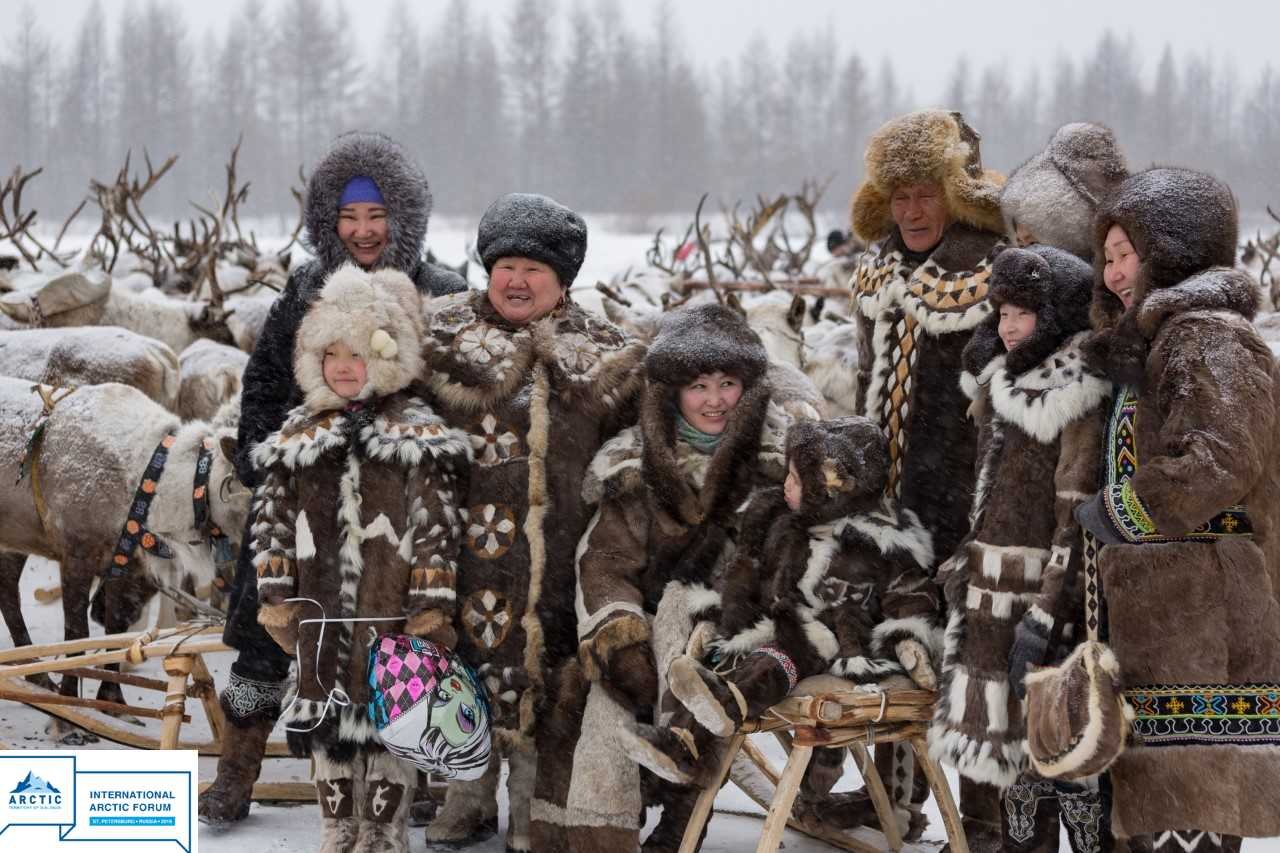
The Gala Concert devoted to the opening of the 5th International Arctic Forum will be held on 8 April on the St. Petersburg Music Hall Big Stage. Bands representing the Arctic regions of the Russian Federation have prepared unique programmes for the Forum’s guests and participants as well as for the city residents. Their performances reflect both the centuries-old traditions of folk art and imperishable world classics. St. Petersburg acting Governor Alexander Beglov will give a welcoming speech before the concert.

The concert will begin with a performance by the Northern Symphony orchestra conducted by Fabio Mastrangelo – one of the most titled and well-known conductors, who participates in many festivals and performances in Russia and abroad.

The concert programme includes performances by Arco ARTico of the Sakha Republic (Yakutia) State Philharmonic, the ethnic music band Ayarkhaan and Chukotka Eskimos band Kochevnik. 

The ethnic music band Ayarkhaan (Yakutia) is a personal project of Albina Degtyareva. The group makes music that goes beyond familiar genres and categories. Using only their own voices and khomus, Ayarkhaan not only plays music but imitates the voices and sounds of wildlife: various birds, cranes, horses neighing, the sound of the wind and the heartbeat, immersing the audience in the amazingly picturesque world of wildlife.

The repertoire of Arco ARTico – the string ensemble of the Sakha Republic (Yakutia) State Philharmonic – includes both classical and popular music, film music, Argentinian tango and pop hits from the past.

Vocal and dance group Kochevnik represents Chukotka. At the Music Hall concert, the group will be accompanied by Olit Tevlyanaut, demonstrating her wide and colourful vocal range and a combination of various performance techniques. Olit’s love of Chukchi folk songs is based on a blend of folk vocals, ethnic music, fusion and mastery of the mouth harp. 

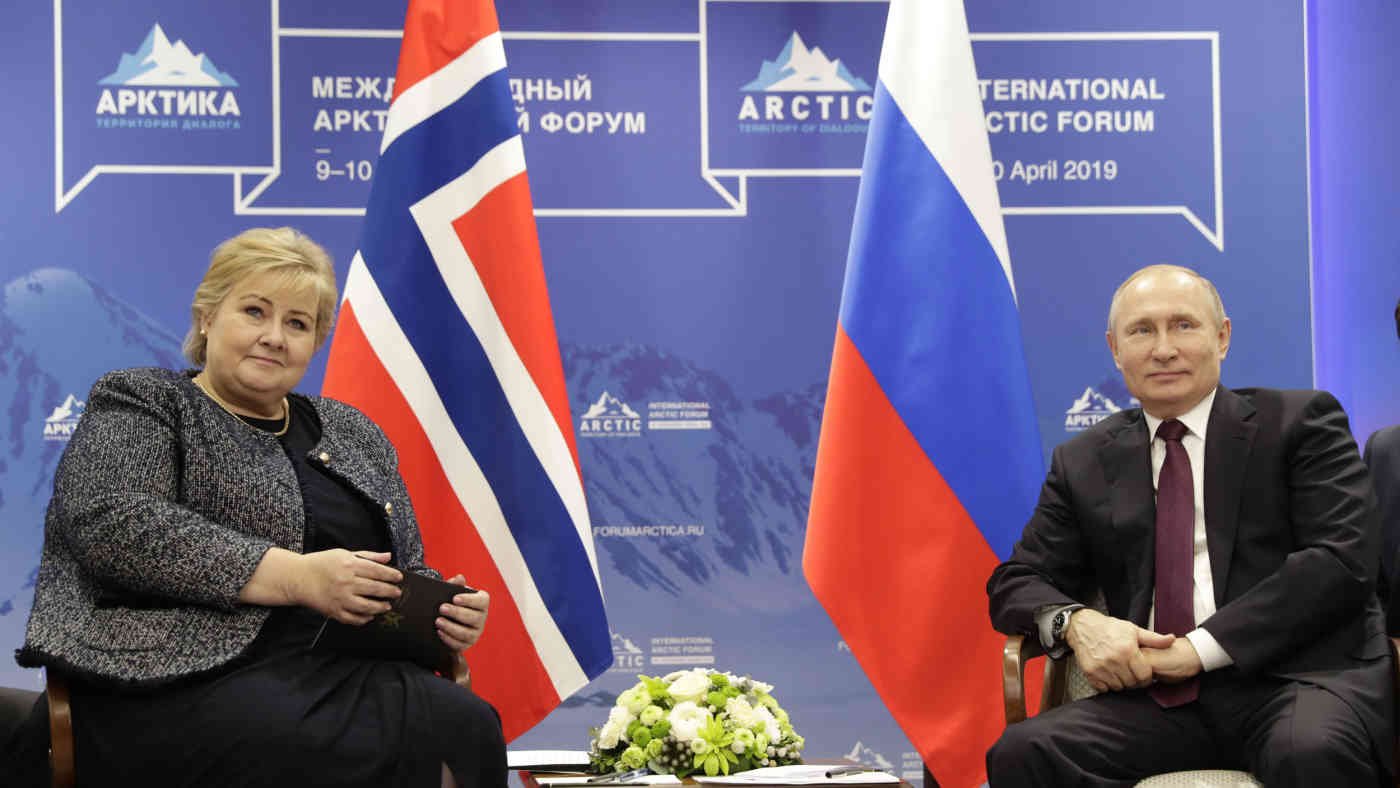
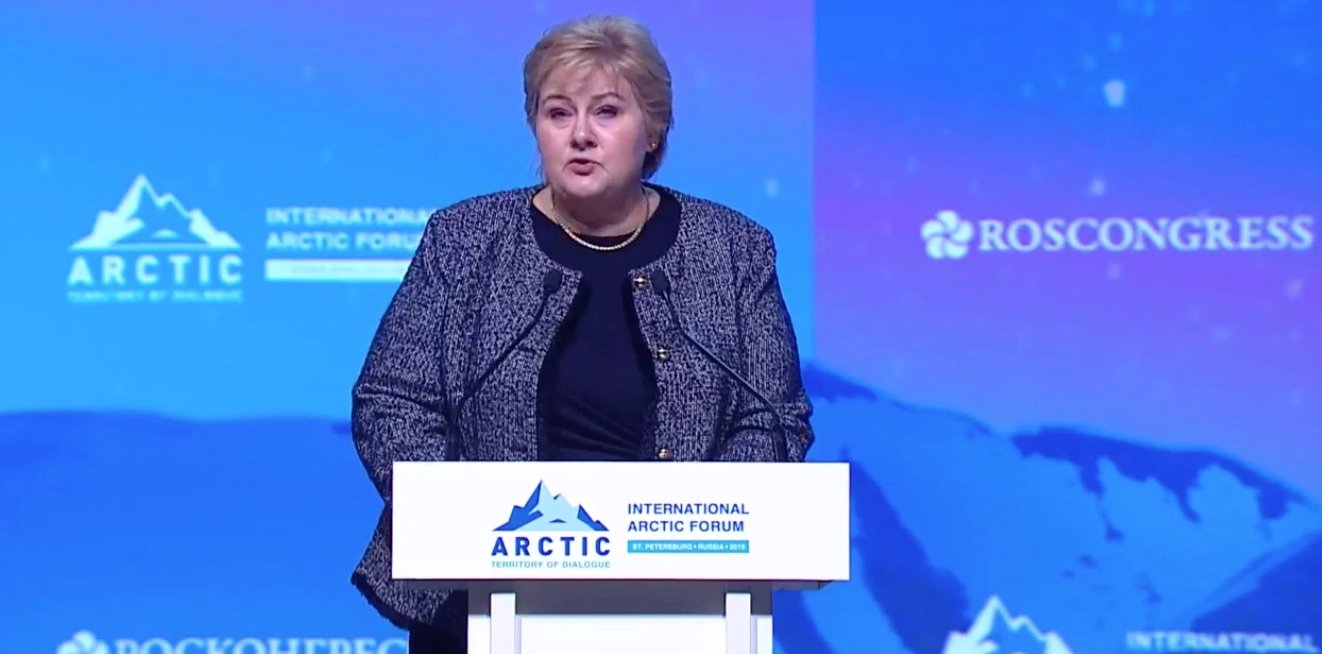
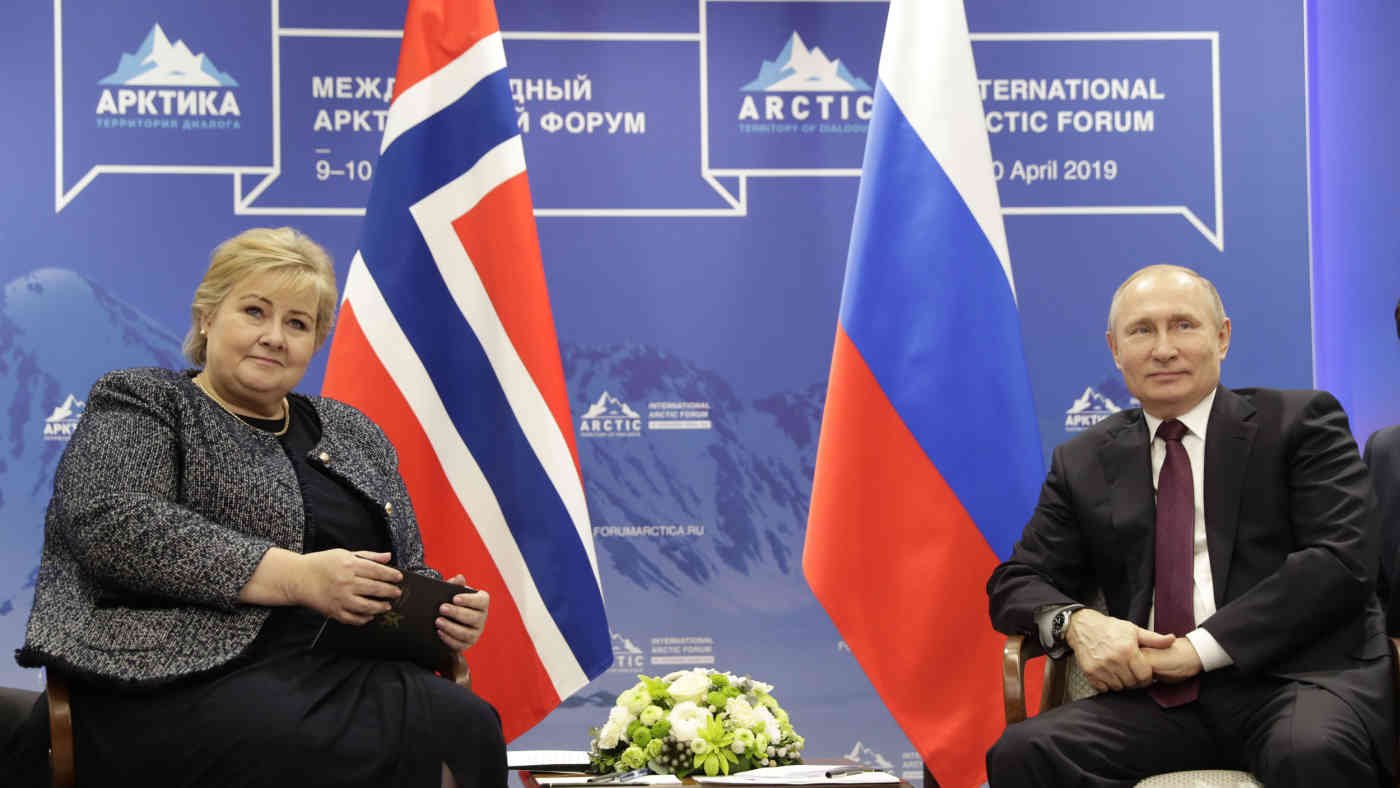
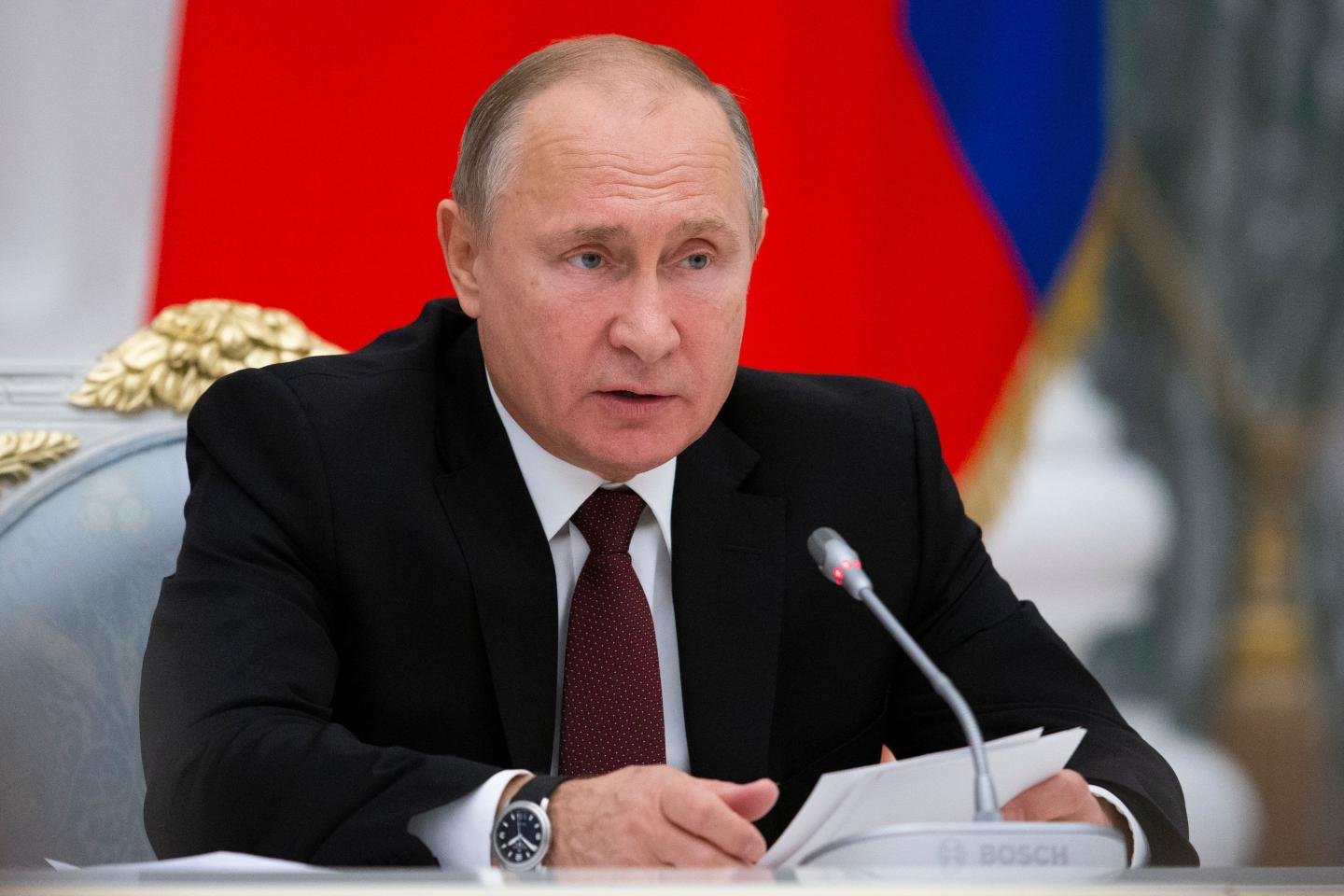
When Norway PM Erna Solberg meets with Russian president in St. Petersburg next week, it will be the first time in ten years that the two countries’ Heads of State are in direct discussions. She will not reveal what they are to talk about. We are clearly witnessing a shift in atmosphere now, says expert on Russia.

Similar discussions between Norwegian and Russian top-level politicians have not taken place since then-prime minister Jens Stoltenberg met then-president Dmitry Medvedev in Moscow in May 2009.

Solberg Wednesday gave a speech at the High North Dialogue conference in Bodø in which she stressed international cooperation and the blue economy as pillars of economic development for Norway in the Arctic.

Solberg would not, however, say what issues she will raise with the Russian president during next week’s meeting.

Senior researcher and Russia expert at the Norwegian Institute of Foreign Affairs (NUPI), Julie Wilhelmsen, argues that Solberg’s visit to Russia fits in to a larger European pattern in which many states have become more realistic about how to relate to Russia.

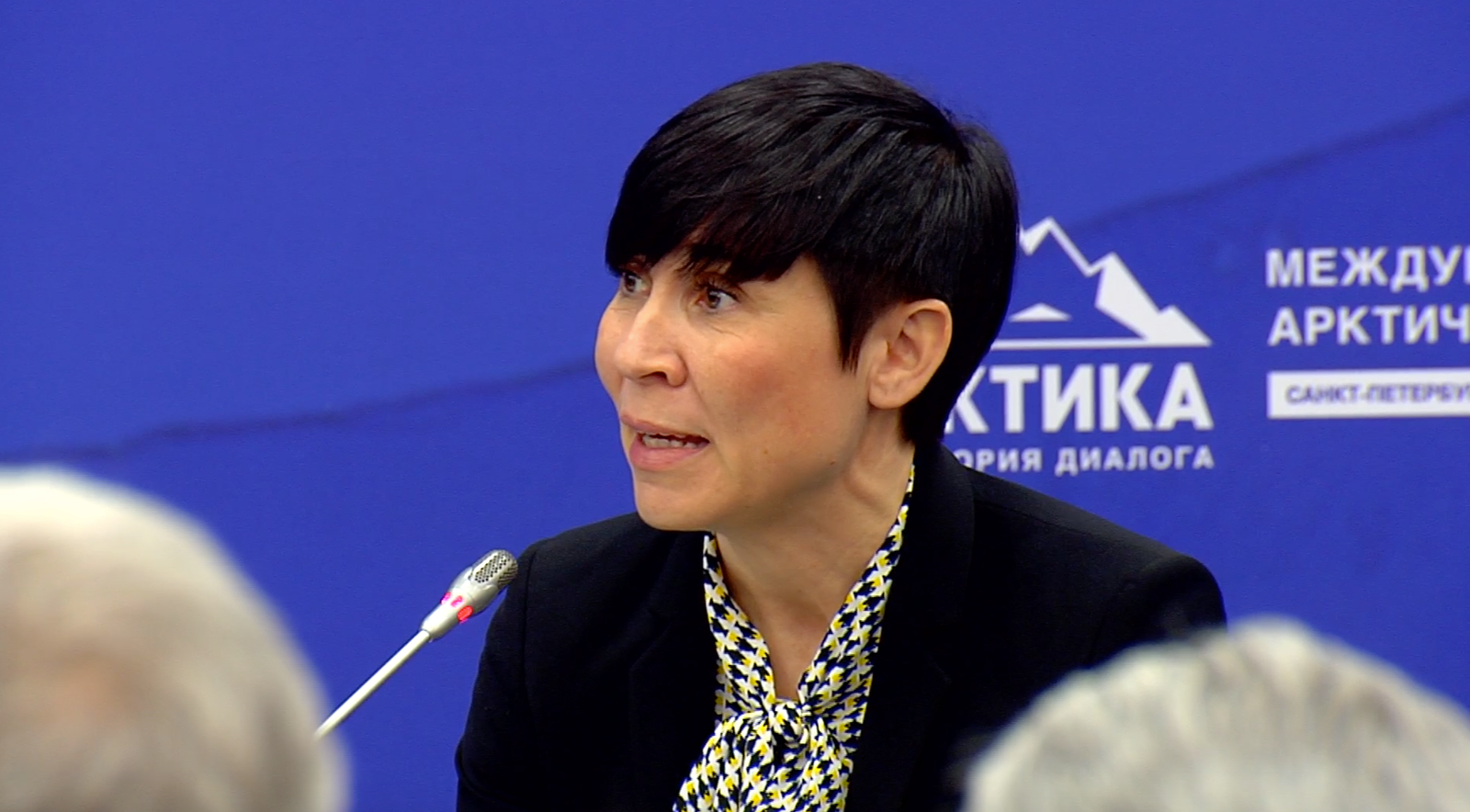
Researcher Arild Moe at the Fridtjof Nansen Institute says Norway sends a strong signal through both the Prime Minister and the Foreign Minister’s attending the conference in St. Petersburg.


April 7, 2019 0 comments
0 FacebookTwitterPinterestEmail
Farming

Norway eyes Brazilian market for salmon

by Nadarajah Sethurupan April 7, 2019
written by Nadarajah Sethurupan

Norwegian fisheries ministers Harald Nesvik has met with Brazilian counterpart Tereza Christina in Brasilia, to discuss a number of seafood-related topics.

This included the conditions for exports of Norwegian clipfish and salmon, and the ongoing free trade negotiations between the European Free Trade Association (EFTA) and Mercosur.

“Brazil is one of our most important trading partners outside the EU,” said Nesvik. “In the meeting with Tereza Christina, I emphasized the importance of predictable frameworks based on international standards for trade between our two countries, so that the Norwegian exporters know what to do.”

“We also want to open up the Brazilian market for the export of Norwegian salmon,” he said.

In January, Brazil introduced new regulations for saltfish and clipfish which have helped to make trade more predictable, but there are still some uncertainties which delegates from Norway and Brazil are meeting to discuss further.

“Brazil showed great interest in Norwegian fisheries and aquaculture management, and wants to cooperate more closely in these areas. I also invited my Brazilian colleague to Norway,” said Nesvik.

April 7, 2019 0 comments
0 FacebookTwitterPinterestEmail
Asia and Norway

Asian space Arms race – India Tests Anti-Satellite Weapon

by Nadarajah Sethurupan April 6, 2019
written by Nadarajah Sethurupan

The Indian government announced March 27 it successfully fired a ground-based anti-satellite weapon against a satellite in low Earth orbit, a test that is likely to heighten concerns about space security and orbital debris.

Indian Prime Minister Narendra Modi said that the country’s military successfully demonstrated an anti-satellite (ASAT) weapon in a test known as “Mission Shakti.” In that test, a ground-based missile, a version of an existing ballistic missile interceptor, hit a satellite at an altitude of about 300 kilometers.

“It shows the remarkable dexterity of India’s outstanding scientists and the success of our space programme,” Modi said in a series of tweets announcing the test. Modi also made a televised announcement, in Hindi, about the test.

According to a statement from India’s Ministry of External Affairs, the missile was launched from the Dr. A P J Abdul Kalam Island launch complex in the northeast part of the country. The missile struck an unidentified Indian satellite. “The test was fully successful and achieved all parameters as per plans,” the ministry stated.

Neither Modi nor the ministry identified the satellite targeted by the test. Indian media speculated that the likely targets were either Microsat-R, launched in January, or Microsat-TD, launched a year earlier. Microsat-R is in a 262-by-280-kilometer orbit, while Microsat-TD is in a 353-by-361-kilometer orbit, according to tracking data by the U.S. military.

The ministry said in its statement that the test was designed to minimize long-lived debris. “The test was done in the lower atmosphere to ensure that there is no space debris. Whatever debris that is generated will decay and fall back onto the earth within weeks.” It wasn’t immediately known how much debris the test generated, but some debris may end up in higher orbits with longer decay times.

The test makes India the fourth country, after the United States, Russia and China, to test an ASAT weapon. Modi and his government said that the test both demonstrated the capabilities of India’s overall space program as well as showed its willingness to defend its satellites against attacks.

“The test was done to verify that India has the capability to safeguard our space assets,” the ministry said in its statement. “It is the Government of India’s responsibility to defend the country’s interests in outer space.”

“India stands tall as a space power!” Modi declared. “It will make India stronger, even more secure and will further peace and harmony.”

The test, though, could increase concerns about the security of space assets in general. A February report by the Defense Intelligence Agency highlighted efforts by China and Russia to develop ASAT capabilities, including both ground-based missiles and other technologies, although neither country has performed a debris-generating test since China destroyed one of its own satellites with a ground-based missile in 2007, generating a large amount of debris that triggered international criticism.

The United States performed its own similar test in February 2008, destroying the USA 193 satellite using a modified version of a ship-based SM-3 missile in a test called Operation Burnt Frost. The satellite was in an orbit about 250 kilometers high when it was successfully intercepted, and the U.S. government, which announced the test in advance, said it was designed to minimize the creation of debris. Most of the debris from that test did reenter within weeks, although the last piece of debris tracked from that test remained in orbit until late 2009.

China surpassed the United States in the total number of space launches for 2018, with 38 compared to 34, and showcased its technological advancements by landing a rover on the back side of the moon.

China’s SJ-17 satellite continued testing remote proximity operations in early 2018 around two other Chinese satellites.

China appears to have placed truck-mounted jammers on Mischief Reef in the Spratly Islands in 2018.

In June 2018, Symantec reported a sophisticated hacking campaign from China that targeted satellite operators, defense contractors and telecommunications companies.

Russia conducted its seventh test of the PL-19 Nudol direct ascent anti-satellite system in December 2018 using a mobile launching system.

A picture surfaced in September 2018 showing a Russian MIG-31 fighter jet carrying what is believed to be a mock-up of an air-launched anti-satellite missile.

In September 2018 it was reported that Russia is developing a suspected new co-orbital anti-satellite system known as Burevestnik designed for operations in geosynchronous Earth orbit.

France in September complained publicly about Russian remote proximity operations near a French-Italian military satellite.

Russia has been actively using its electronic counterspace systems to jam GPS signals around Norway and Finland for multiple NATO and allied military exercises, including Trident Junction 18 and Exercise Clockwork in January 2019.

On India’s recent ASAT test, The Indian government had boasted for years that it had a direct ascent anti-satellite capability, but this was the first time it actually demonstrated that capability. “While the test does not initially appear to be as bad for the space environment as the Chinese test in 2007, it nevertheless produced thousands of pieces of debris, some of which may linger in orbit for decades and pose a threat to other satellites,”.

“The test clearly establishes India as a space rival to countries like China and as an important player to be included in future negotiations of conduct in space,”. The purpose of the test, however, may have been as much about domestic politics as about making a geopolitical statement.

In the foreword to the CSIS report, Rep. Jim Cooper (D-Tenn.) argues that the space security environment is a key reason why the United States should have a Space Force as a separate military branch. Cooper is the chairman of the House Armed Services Committee’s strategic forces subcommittee and a longtime advocate of a military space service.

“The United States is not the leader in anti-satellite technology,” Cooper writes. “We had naively hoped that our satellites were simply out of reach, too high to be attacked, or that other nations would not dare.” But counterspace weapons are now a reality and the Pentagon “has done very little to reduce this existential risk,” he adds.

“This is the year of decision,” states Cooper. “The president has recently demanded a Space Force. The Pentagon has responded with a proposal and this year’s National Defense Authorization Act “will decide the outcome.”

Report released by SWF

The Secure World Foundation’s “Global Counterspace Capabilities: An Open Source Assessment,” edited by Brian Weeden and Victoria Samson, also focuses on advances made by China and Russia. And it includes preliminary details about India’s ASAT test after a prior failure in February 2019.

Like the CSIS report, the SWF study draws from publicly available information. It includes sections on Chinese and Russian directed-energy weapons capabilities and programs, and on both nations’ recent changes to their military space and counterspace organizations.

Russian rendezvous proximity operations in low Earth orbit of late suggest they are part of a space situational awareness program known as Nivelir that may be supporting the co-orbital Burevestnik project, both of which may have begun in 2011, the report reveals. SWF found new evidence that Russia may be upgrading the Krona optical space-based surveillance system with laser dazzling or blinding capabilities.

The militarization of space is a concern, the SWF report says. “A growing number of countries and commercial actors are getting involved in space, resulting in more innovation and benefits on Earth, but also more congestion and competition in space.”

More countries are looking to use space to enhance their military capabilities and national security, and are developing counterspace technologies that can be used to deceive, disrupt, deny, degrade or destroy space systems, says the report.

“The existence of counterspace capabilities is not new, but the circumstances surrounding them are,” according to SWF. There are more incentives to develop offensive counterspace capabilities and greater potential consequences from their use as the global economy and society become more reliant on space applications.”

April 6, 2019 0 comments
0 FacebookTwitterPinterestEmail
Russia and Norway

US, Russian bomber jets conduct simultaneous missions off Norway

by Nadarajah Sethurupan April 5, 2019
written by Nadarajah Sethurupan

The United States and Russia have flown nuclear bombers over the Norwegian Sea, amid rising tensions following the recent withdrawal of the two Cold War-era arch foes from a landmark nuclear arms treaty and the build-up of NATO military forces on the US-led alliance’s eastern flank near Russia.

The US Air Force Europe said in a statement that five giant B-52 bombers had flown over the Norwegian Sea on Thursday and that the planes had continued towards Iceland, the BarentsObserver reported Saturday.

Norway’s Air Force F-16s escorting a US Air Force B-52 on March 28, 2019. (Photo by Norwegian Defense Ministry)

“During the flights, five B-52s conducted training with Norwegian F-16 fighter jets,” the statement said. “Training with NATO allies like Norway enhances the capabilities and readiness of the alliance.”

Reports said Russian strategic bombers, including Tu-160 and MiG-31 fighters, also headed for a southbound flight for the second time this week outside Norwegian airspace, flying from the Barents Sea over the Norwegian Sea and to the North Sea, north of United Kingdom.

Major Elisabeth Q. Eikeland, a NATO press spokesperson, confirmed the presence of the Russian planes, saying, “We monitor them with different types of means like sensors, radar and aircraft.”

Eikeland, however, stressed that two days of Russian planes flying outside Norway “is neither sensational nor abnormal.”

She also revealed that Norwegian F-16s fighter jets had been scrambled to identify the Russian bombers on Thursday.

US President Donald Trump suspended the Intermediate-Range Nuclear Forces Treaty (INF) in February and threatened full withdrawal in six months. His Russian counterpart, Vladimir Putin, signed a decree in response, suspending Moscow’s participation in the nuclear arms treaty.

Singed in 1987, the treaty banned the US and the former Soviet Union from creating ground-launched nuclear-capable missiles with ranges from 500 to 5,500 kilometers

The Trump administration says it would stay in the deal if Russia dismantles the 9M729 ground-launched cruise missile, which Washington believes is in violation of the INF.

Russia has rebuffed US claims by showcasing the missile to journalists and revealing many of its sensitive specifications to ensure the international community that the Trump administration is being dishonest.

While the INF-treaty includes land-based missiles, strategic bomber planes are regulated by the New START treaty between Washington and Moscow.

The Russian and American flights with strategic bombers in the skies over and outside northern Europe were conducted at the same time as Northern Wind drills took place in northern Sweden.

About 7,000 of the 10,000 participating soldiers came from Norway, Finland, USA and Great Britain.

UK jets scrambled to intercept Russian bombers

In a separate report on Saturday, the British Royal Air Force (RAF) said it had scrambled Typhoon fighter jets to intercept two Russian bombers approaching UK airspace.

The Typhoons had been sent from a base in northern Scotland at midday on Friday to monitor the two Russian Tu-160 Blackjack long-range bombers.

The RAF said it had worked closely with its NATO partners to monitor the Blackjacks as they flew over international airspace, saying they had “successfully” intercepted the Russian bombers over the North Sea and escorted them from UK airspace.

The RAF said it was the second time this week that the presence of Russian planes and their military activities had been investigated.

April 5, 2019 0 comments
0 FacebookTwitterPinterestEmail
Environment

Norway asks Sweden to come on board with “huge” carbon capture project

by Nadarajah Sethurupan April 5, 2019
written by Nadarajah Sethurupan

The Swedish Environmental Protection Agency has produced a ‘Climate Action Roadmap’, setting forward the path it believes the government should follow to meet its climate goals. And one area points to greater cooperation with Norway.

Stefan Nyström at the Swedish Environment Protection Agency. Credit: Åsa Stöckel/Sveriges Radio.

Under the terms of the Climate Act, the government this year must present before parliament its Climate Policy for the next four years, setting out its strategies for meeting the goal of zero net greenhouse gas emissions by 2045.

The environmental protection agency (Naturvårdverket) highlights three areas to improve – electrifying the transport system, fossil-free industrial production such as cement ovens and carbon capture and storage (CCS).

“Norway is building a huge CCS facility off Bergen and they are asking Sweden to come on board and be one of the pilot countries to establish this in reality. There is a pilot project here financed by the energy authority to establish a connection with the Norwegians,” says Stefan Nyström, director of the department of climate change and air quality at Naturvårdverket.

(sverigesradio)

April 5, 2019 0 comments
0 FacebookTwitterPinterestEmail
Diplomatic relations

12 embassies post joint statement calling on the Romanian Gov’t to drop justice law amendments

by Nadarajah Sethurupan April 5, 2019
written by Nadarajah Sethurupan

France’s Embassy in Bucharest has posted on its Facebook page a joint statement on behalf of 12 countries, Austria, Belgium, Canada, Denmark, Finland, France, Germany, Ireland, the Netherlands, Norway, Sweden and U.S., asking the Romanian authorities to abstain from any amendments on the justice laws that would weaken the rule of law.

„We, Romania’s international partners and allies, call all the parties involved in drafting the emergency ordinances of the government which amend the legislation on judiciary, to abstain from any amendments that would weaken the rule of law and Romania’s capacity of fighting against crime and corruption”, the statement says.

The signatories argue that their official calls for dialogue on these topics „have unfortunately received no answer since early January this year”.

„We are deeply concerned about the integrity of the Romanian judiciary system, which has been shaken up by the unpredictable amendments that do not strengthen Romania’s efforts to boost progress on judiciary. On the contrary, the cumulative effect of those amendments risk slowing down the fight against corruption and to undermine the independence of justice.”

The embassies argue that they expect the reform process to be based on an approach that would involve all parties, through wide consultations, for the sake of the Romanian citizens.

„This also needs that all involved actors consider the opinions and the support proposals provided by the Romanian and foreign legal experts, in order to avoid an even greater alteration of the remarkable progress  on the judiciary registered by Romania in the past two decades”.

The joint statement says that the emergency ordinances „that seem underway” can have a negative impact over the independence of the Romanian justice, which „would weaken the confidence of the Romanian citizens and of Romania’s partners in the judiciary system and also in the Romanian Government”.

The diplomatic missions of the 12 states underlined that it is essential for Romania take due account of the recommendations of the European bodies, such as the Venice Commission and GRECO, of the European Parliament, the EU Council and the European Commission and to ensure a transparent, efficient and unbiased justice.

„The anticipated amendments risk violating the common values. Besides, they might have a long-term negative impact over the country’s economic growth. The fact that Romania is holding the presidency of the EU presidency at present gives it a further special responsibility.

We urge the Romanian Government and all involved actors to properly consider this joint statement and to reaffirm Romania’s political commitment to support our common values”, the statement concludes.

April 5, 2019 0 comments
0 FacebookTwitterPinterestEmail
Asia and Norway

Amid countless unresolved cases, Amnesty International urges Pakistan to act against enforced disappearances

by Nadarajah Sethurupan April 4, 2019
written by Nadarajah Sethurupan

 Amnesty International has urged the government of Pakistan to take all measures to ensure an end to the practice of enforced disappearances that have long been a stain on the south Asian country’s ‘human rights record’.

Despite the pledges of successive governments to criminalize the practice, there has been slow movement on legislation while people continue to go missing with impunity, as per a statement issued by Amnesty International.

Amnesty International

The Commission of Inquiry on Enforced Disappearances (COIED) has 2178 cases unresolved as of now. As per the Commission’s recent monthly report[3] 48 cases disposed of in the month of January 2019, included 46 traced persons out of which 29 were returned home, 10 were traced to internment centers, five are in jails on terrorism charges and two were described as “dead bodies”.

The UN Working Group on Enforced or Involuntary Disappearance has more than 700 cases pending from Pakistan.

The number of cases of victims of enforced disappearance recorded by victim groups are much higher. Victim groups and the civil society have serious concerns with regards to the effectiveness of Pakistan’s COIED, primarily because it is not using its powers to investigate and hold the perpetrators accountable and that it does not have civil society or the victim groups representation on its board. 

The Amnesty International said the groups and individuals targeted in enforced disappearances in Pakistan include people from Sindhi, Baloch, Pashtun ethnicities, the Shia community, political activists, human rights defenders, members and supporters of religious and nationalist groups, suspected members of armed groups, and proscribed religious and political organisations in Pakistan.

In some cases, persons are openly taken into custody by the police or intelligence agencies, and families trying to find out where they are held are denied information by the authorities.

“Some victims are eventually released or their whereabouts are disclosed to their families but they continue to be held in arbitrary detention including in internment camps. Those forcibly disappeared are also at risk of torture and death during captivity,” read the statement.

Pakistan government and its promises on the issue:

The new government of Prime Minister Imran Khan has said it is committed to criminalizing enforced disappearances. In January 2019, Pakistan’s Ministry of Human Rights submitted a draft bill to the Ministry of Law and Justice to criminalize enforced disappearances, through an amendment in the Pakistan Penal Code.

Shireen Mazari, the Minister of Human Rights has also stated that the government wants to sign the International Convention for the Protection of All Persons from Enforced Disappearance.

While criminalization of enforced disappearance is an important and positive first step in ending these ongoing human rights violations, the process has not included consultations with civil society groups and victims’ families.

In recent months, there have been encouraging reports of people released. Voice of Baloch Missing Persons (VBMP), a human rights organization working on enforced disappearances from the Balochistan province told Amnesty International that 65 forcibly disappeared persons whose cases were registered with them have been released so far, this year.   

However, when the forcibly disappeared are released, they are either warned to not speak to the media and seek accountability or the fear of recurrence stops them from speaking up about their disappearance. Therefore, seeking justice is not an option for the released victims and their families.

Families facing harassment:

Families of the disappeared are often threatened, harassed and intimidated, especially those whom have been more public with their protests and have campaigned openly for justice for their loved ones.

While marching against enforced disappearances, Sasui and Sorath Lohar have spent Eids in hunger strike camps outside the Karachi Press Club with other families of the “missing persons”, as the victims of enforced disappearance are commonly referred to in Pakistan.

In May 2018, during a violent dispersal of the protest they were part of in Sindh, Sasui says she was assaulted by a law enforcement officer. In November 2018, a peaceful march of the missing persons of Sindh was interrupted repeatedly by the Sindh Rangers and by officials in plain clothes – who are thought to be from the intelligence agencies.

On 12 January 2019, Sindh Rangers attempted to detain one of Lohar’s sons, Sanghaar Lohar, without search warrants, from his mobile shop in Karachi. The sisters and mother resisted and raised enough noise to gather neighbours and managed to halt the detention.

The video evidence of the entire incident shows men in uniform claiming that their brother was involved in wrongdoing, without specifying any allegations or charges.

In 2017 and 2018, the family of the blogger Ahmad Waqass Goraya were repeatedly harassed by intelligence agencies.

In 2017, Goraya was forcibly disappeared from January 4 till January 27, along with three other bloggers in Punjab for running Facebook pages critical of Pakistani military’s policies. Goraya’s father, Liaqat Goraya, told Amnesty International that they were continuously under surveillance and felt like their house was watched.

Families of the disappeared suffer significant harm. They live with continuous uncertainty about the fate or whereabouts of their loved ones and their lives are often utterly disrupted by the disappearance. For instance, while waiting for their missing loved one, Lohar’s mother died during her son’s disappearance.

The parents of Masood Ahmad Janjua, one of the emblematic cases of enforced disappearance from the country also passed away during his disappearance.

Political activist Shahid Junejo’s mother kept asking about her son but is gone now while he is still missing. Another Sindhi activist, Aftab Chandio’s family sat with the dead body of his father and demanded that Aftab was permitted to say his funeral prayer.

Lohar’s wife told Amnesty International, “It feels like our lives have gotten stuck in a moment and not moving forward. We cannot take any decisions about our lives, my children cannot get married, their lives have come to a halt.”

In addition to the sudden financial burden as Lohar was the primary income earner for his family, not knowing the fate and whereabouts of their loved ones also takes a huge emotional toll on the health of the families.

Women from the families of the victims who publicly campaign for truth and justice are regularly subjected to gender based harassment- both online and offline.

While the families of the disappeared want their loved ones released, they also want the perpetrators brought to justice.

Sasui Lohar told Amnesty International, “missing relatives should come back but justice is incomplete without perpetrators being held to account.”

(justearthnews)

April 4, 2019 0 comments
0 FacebookTwitterPinterestEmail
Media Freedom

The Holberg Prize Announces Two Journalist Grants for the 2019 Holberg Week

by Nadarajah Sethurupan April 3, 2019
written by Nadarajah Sethurupan

The Holberg Prize is pleased to announce two journalist grants to attend the Award Ceremony for the 2019 Holberg Prize and Nils Klim Prize, as well as related events that will take place in Bergen and Oslo, Norway, from the 3rd to the 6th of June, 2019. The two recipients of the grants will be guests of the Holberg Prize and the University of Bergen and will be invited to all the events, including the Award Ceremony and the Government Banquet on 5 June.

The grants cover travel expenses, hotel accommodation, and meals. An interview with the Holberg Laureate and/or the Nils Klim Laureate may be arranged if requested. The recipients will be selected by an independent evaluation committee. 

The Holberg Prize is awarded annually to scholars who have made outstanding contributions to research in the arts and humanities, social sciences, law or theology. The Prize is worth NOK 6 million (approx. USD 700,000).

The Holberg Board has decided to award the 2019 Holberg Prize to British cultural historian Paul Gilroy for his outstanding contributions to a number of academic fields, including cultural studies, critical race studies, sociology, history, anthropology and African-American studies. Dr. Gilroy is Professor of American and English Literature at King’s College London, and he is one of the most well-known researchers and public intellectuals in the UK today.

The Nils Klim Prize is awarded annually to a Nordic researcher under the age of 35 who has made an outstanding contribution to research in the fields covered by the Holberg Prize. The Prize is worth NOK 500,000 (approx. EUR 50,000).

The Holberg Board has decided to award the 2019 Nils Klim Prize to Icelandic-Swedish philosopher Finnur Dellsén for his research in epistemology and the philosophy of science. Dellsén is Associate Professor at the Department of Philosophy, University of Iceland. His research focus includes the conditions of understanding and the nature of acceptance of scientific explanations.

The Holberg Prize and the Nils Klim Prize will both be conferred during a ceremony in the University Aula in Bergen on 5 June, 2019.

April 3, 2019 0 comments
0 FacebookTwitterPinterestEmail
NATO and Norway

U.K.-U.S. Operational Capability in the Baltic region

by Nadarajah Sethurupan April 2, 2019
written by Nadarajah Sethurupan

Russian activity in the Arctic is within, as an Arctic bordering nation is certainly within, I would expect them to be doing that, and I would expect them to be operating there. I do not consider it a threat, per se, unless they operate outside of the norms of international behavior. Then it comes a threat Lewis told reporters at Chambers Field at Naval Station Norfolk, Va.

The establishment of the U.S. 2nd Fleet is a welcome development. My position as the Deputy for BALTOPS I think signals that it provides another means of cooperation and providing security in this region. Rear Admiral Andy Burns told reporters.

Vice Adm. Andrew Lewis has served as deputy chief of naval operations for operations, plans and strategy (OPNAV N3/N5) since August 2017. As head of 2nd Fleet, he would manage training and operations of naval forces in the Atlantic. 2nd Fleet is meant to serve a similar role as U.S. 3rd Fleet, which prepares naval assets for deployments in the Pacific.

Lewis is a 1985 graduate of the U.S. Naval Academy and was designated a naval aviator in April 1987. He has commanded Strike Fighter Squadron (VFA) 106 and VFA-15, Carrier Air Wing 3 deploying with USS Harry S. Truman (CVN-75), Carrier Strike Group 12 deploying with USS Theodore Roosevelt (CVN-71), and Naval Strike and Air Warfare Center. As a flag officer, he has also served as the vice director for operations (J3) on the Joint Staff and the director of fleet training (N7) at U.S. Fleet Forces Command.

Below is a full rush transcript of the press conference by Vice Admiral Andrew Lewis Commander, U.S. Second Fleet, Joint Forces Command Norfolk and Rear Admiral Andy Burns , Commander United Kingdom Maritime Forces.

Admiral Lewis:  We’re here today in Vilnius, Lithuania for the BALTOPS 2019 Final Planning Conference. 

A few weeks after 2nd Fleet reestablished in August 2018 Admiral Foggo tasked us with planning and executing BALTOPS.  So my staff began coordination and traveling across the Atlantic to ensure the continued security and stability of the region.  I am here at the Final Planning Conference because it is important we get the planning right so we make BALTOPS 19 fit for its purpose and fit for its time.

BALTOPS will mark the first time 2nd Fleet will operate in the European theater, but while 2nd Fleet might be new to the process, we join a practiced team of professionals.  This year will be the 47th time our nations have executed BALTOPS together and only a few months ago the same players executed Trident Juncture.

It’s fitting that as we gather here this week we are celebrating the 70th Anniversary of our NATO Alliance.  The union that has been instrumental in maintaining regional peace and prosperity over the past 70 years.  A union that has only grown stronger with the addition of our Baltic allies and partners.  And worth noting, I’ve been absolutely overwhelmed with the support of our allies and partners given to us as we stand up 2nd Fleet.

U.S. 2nd Fleet was reestablished last summer as a result of the recognition of a changing security environment.  The establishment of 2nd Fleet which is focused on operations in the Atlantic and into the Arctic is one way our U.S. Navy is mobilizing to address the demands of the global security environment and to show our renew focus on maritime operations and stability in the region.  2nd Fleet is leading BALTOPS on behalf of Naval Forces Europe and as a maneuver arm for Admiral Foggo alongside the U.S. 6th Fleet.

BALTOPS 2019 is our opportunity collectively to strengthen our partnerships, enhance regional capabilities, and to demonstrate how we will establish and maintain maritime superiority.  We will only be successful at executing the mission if we practice, and what better opportunity to introduce 2nd Fleet to the theater than BALTOPS, a tried and true exercise involving our partners and NATO allies.

At this time I’m going to turn it over to my Deputy for the exercise, a Royal Navy two star, Rear Admiral Andrew Burns.

Rear Admiral Burns: I’m the Royal Navy’s Commander, United Kingdom Maritime Forces, and Admiral Lewis’ Deputy for BALTOPS as you’ve just heard.  I think my role signals the strength of the U.K.-U.S. partnership between our respective navies but also our commitment to security in the Baltic region.

The exercise is now in its 47th iteration, conducted annually, and takes place in the Baltic Sea.  And it’s a premier maritime focus exercise that will take place later this summer.  It’s scheduled to include air, maritime and ground forces from 18 nations, an annual joint multinational maritime focused exercise that provides an unrivaled training opportunity to promote and sustain cooperative relationships that are critical to ensuring the safety of sea lanes and security on the world’s interconnected oceans, and critical to the free flow of commerce and trade.  It’s designed to improve flexibility and interoperability between all the participating nations and demonstrate the resolve among allies and partner forces in upholding the security of the Baltic Sea region.

The exercise is important because it allows us to collectively gain experience operating forward, to build relationships with our partners and allies in the maritime environment, and to broaden our integration and interoperability further demonstrating our security cohesion.

So ladies and gentlemen, that completes our opening remarks.  Now over to you to any questions you might have.
Question:  BALTOPS is slightly different.  Besides the fact that it is a first for a reactivated 2nd Fleet, can you give us more details on what it will be this time, such as the focus and what new assets, if any, and what kind and numbers?

Admiral Lewis:  This is Admiral Lewis.  I’ll give a short answer and then I will also ask Admiral Burns to add anything to my answer as well.

First of all this focus with 2nd Fleet running the exercise as an expeditionary fleet command headquarters embarked on the command ship normally in the exercise.  We will be there executing the exercise, and what will be different is the higher headquarters, the headquarters that I will be working for will be NAVEUR and I will be exercising as a maneuver arm under NAVEUR.

Additionally, we will be on the tactical level, we will be exercising some amphibious concepts that the NATO Amphibious Group has put together in principle, and we’re going to exercise those hypotheses as we execute the exercise.

Those are two pretty significant changes to the exercise itself.

Finally, in the overall, the exercise is recognition of the importance of the maritime in this region across the Atlantic and into the region in the Baltic on the ground.

Rear Admiral Burns:  I’ll just add a very short comment.  The key for me in this exercise, the fact that it’s NATO representation but also with a joint expeditionary force maritime involved as well.  That’s why you end up with 18 nations demonstrating their collective commitment to the security of the Baltic region.  And of course the security of the Baltic is also connected to the security of the high seas more broadly, and particularly the Atlantic.  

So that is the key for me.  It’s the collective security that’s being demonstrated by the participation of all those nations and they’re contributing force elements in every environment — air, land and sea.  And as we go forward, it’s that combination of environments that will really contribute to the weighted effort.

Question: I want to ask about the Strait of Hormuz and NATO’s participation in the Strait of Hormuz in regards to Iranian activity?  Is that the question?

Admiral Lewis:  What I won’t do is speak for NATO in this regard, but what I will say, NATO countries writ large and the U.S. specifically as well as the U.K. are committed to freedom of the seas, freedom of navigation, and ensuring that we can exercise freedom of the seas and trade and goods can operate without being threatened by anyone.  And we will do what’s necessary under those circumstances to ensure that choke points are not restricted or there’s not contested space in the maritime where it should not be, so we will maintain our commitment to that.

Rear Admiral Burns:  I would just add that there’s a strong and effective maritime coalition already operating in the Middle East to protect the sea lines of communication to and from the Gulf and as Admiral Lewis has pointed out, there are NATO nations who contribute to that coalition, but that is the framework that we will continue to operate within.

Question:  Russia’s building up its Arctic military presence.  Do you view it as a threat?  What is your fleet doing to counter it?

Admiral Lewis:  Russian activity in the Arctic is within, as an Arctic bordering nation is certainly within, I would expect them to be doing that, and I would expect them to be operating there.  I do not consider it a threat, per se, unless they operate outside of the norms of international behavior.  Then it comes a threat.

And I will say on the U.S. side, the U.S. 2nd Fleet side and the alliance and partnership side, we fully recognize that we need to be able to operate in the Arctic.  We need to be able to execute missions, everything from search and rescue to military operations if required.  It’s a space in which, it’s international sea space, international waters, international air space over that sea space.

Most recently, about six months ago, NATO and other partners operated above the Arctic Circle during Exercise Trident Juncture as a confirmation of that commitment to being able to operate in that region.

Question:  Admiral, could you tell us more about why 2nd Fleet is operating in Europe?

Admiral Lewis:  For about the last 15 or 30 years we have not been operating throughout the Atlantic as a continuous space.  Militarily we have not been so much.  We’ve been operating from the East Coast of the United States and deploying to certain regions throughout the world.  The reason that Admiral Richardson, my Chief of Naval Operations, made the determination to reestablish the 2nd Fleet was in order to be able to operate in the Atlantic and ensure that we can execute high end maritime operations.

At the same time, NATO leadership made the determination to establish an additional joint force command called Joint Force Command Norfolk, in Norfolk, Virginia.  So I’m dual hatted as the Commander of both 2nd Fleet and JFC Norfolk.  

The reason why we are operating in Europe as opposed to operating from Norfolk is one of the guiding principles that I was given in reestablishing 2nd Fleet was to be expeditionary in nature and being able to go forward into the Atlantic, all the way into the European continent.  And in so doing I deploy and I am attached to Naval Forces European Command under Admiral Foggo.  So that’s why we’re here.

Rear Admiral Burns:  Well, I can’t comment from a 2nd Fleet perspective, but from the U.K. perspective, the establishment of the U.S. 2nd Fleet is a welcome development.  My position as the Deputy for BALTOPS I think signals that it provides another means of cooperation and providing security in this region.

Of course security of the maritime is becoming even more important as the world becomes increasingly interconnected.  So it’s to our mutual benefit and interest.

Admiral Lewis:  I do want to reinforce the commitment that NATO and our partners globally have to our deterrence mission and ensuring that stability and deterrence are the end states that we’re striving toward, maintaining a peaceful world in which, we’re maintaining that to our strength and capability.  That is what is the important thing to get the returns. 

April 2, 2019 0 comments
0 FacebookTwitterPinterestEmail
Science

Pregnant immigrants in Norway at greater risk for obesity

by Nadarajah Sethurupan April 2, 2019
written by Nadarajah Sethurupan

Women in Norway who were born in the Middle East, or in North or Sub-Saharan Africa are more likely to be overweight or obese during early pregnancy, according to a new study.

Katariina Laine, an obstetrician and researcher at the University of Oslo, noticed that obstetric patients from some immigrant groups seemed more likely to be overweight. “Overweight and obesity are associated with many complications during pregnancy and delivery,” she says, so she decided to investigate whether there really was a difference.

To answer the question, Laine’s team turned to the Norwegian Birth Registry, which has demographic and health information from every pregnancy in the country since 1967. They combined this with data about maternal education level and country of origin from Statistics Norway to look for possible correlations between demographic factors and the prevalence of overweight and obesity in early pregnancy.

Their analysis revealed that 22% of pregnant women were overweight and 12% were obese. Women born in Sub-Saharan Africa, the Middle East and North Africa (MENA) were more likely to be overweight or obese during pregnancy even when correcting for education level or urban versus rural residence, which were also linked with overweight prevalence.

These findings are in line with a 2013 study of older women who weren’t pregnant. “So it seems there’s a pattern for MENA women living in Norway,” says Laine. Genetics or patterns established during childhood, such as dietary habits and low activity levels, could be responsible, though Laine stresses that this study offers no insight into causes.

Given the risk of complications or even stillbirths, the researchers recommend that public health services focus on helping women in these at-risk groups avoid obesity.

April 2, 2019 0 comments
0 FacebookTwitterPinterestEmail
NATO and Norway

NATO To Discuss Black Sea Presence

by Nadarajah Sethurupan April 1, 2019
written by Nadarajah Sethurupan

Ukraine and Georgia are working closely with NATO and in Washington hope that these countries will be able to become members of the North Atlantic Alliance, U.S. Permanent Representative to NATO Ambassador Kay Bailey Hutchison has told reporters on Monday in Brussels.

“I expect that the message from President Trump will be that the United States is committed to NATO — that NATO is important for our shared security — but at the same that we need a fairer sharing of the burden,” Stoltenberg told reporters in Brussels about the planned talks at the White House.

Below is a full rush transcript of the press conference by Ambassador  Kay Bailey Hutchison, U.S. Permanent Representative to NATO. 

Ambassador Hutchison:  I’m looking forward to having this opportunity to really talk to the press about a great 70th Anniversary that we are having in Washington, DC.  We’re going to be at the Mellon Auditorium which is the place where the Washington Treaty was signed almost 70 years ago now.  

And this is going to be a historic time.  It’s going to be historic, too, because Secretary General Jens Stoltenberg has been invited to speak to a joint session of Congress, the first time the head of a multilateral, multinational organization has had that honor. And I think it is an honor because there is such a strong support both in Congress and in the administration for this important historic alliance and 70 years of peace in Europe and North America because we have a security umbrella.  So I think that is the theme of our 70th Anniversary Ministerial, where our Foreign Ministers will meet to talk about the major issues that NATO is facing, not only today but also to talk about our historic successes of the past.

Today we are going to be talking about, of course, our burden sharing and defense investment to make sure that we are strong enough as an alliance to withstand any of the risks or threats that we face today.  We do have threats.  We have threats from a very more aggressive Russia, most certainly after the attempted annexation of Crimea, Russia has continued to sow maligned influence in the Ukraine.  

We also are going to be talking about counterterrorism, something that is very important to all of our countries because we have seen terrorist attacks in many of our countries and we want to prevent terrorist cells from being able to grow anywhere and be imported into any of our alliance or anywhere else in the world, for that matter.

Then we also will be talking about emerging threats.  What are we going to be facing in the future?  One of the areas that NATO can do is look ahead to make sure that we are not only strengthening our alliance in its unity and capabilities, but also to make sure we’re looking at other areas where there could be a fomenting potential risk for any of us, and we want to be able to assess those risks and take the necessary steps to be strong and allied against any risk in the future.

Question:  Mike Pompeo said last week that the NATO Foreign Ministers could announce new measures to counter Russia’s actions in and around Ukraine.  Are you working on it?  And what kind of measures could they be?

Ambassador Hutchison:  Most certainly part of our efforts are going to be looking at how we can shore up the defense in the Black Sea area, and this is caused by Russian aggression on Ukraine.  They are continuing to try to destabilize Ukraine.  They continue to hold and are militarizing Crimea which is a part of Ukraine.  And just most recently capturing ships and taking the sailors from the Ukraine in the Kerch Straits into a Moscow prison is beyond acceptable.  It’s not acceptable, and we will be looking at ways to do more in the whole Black Sea region.  We will be doing more surveillance, there will be more ships in the Black Sea from NATO countries, and there are sanctions that have already been imposed against the people that have perpetrated the taking of the sailors in the Kerch Straits and calling for an immediate return of those sailors from the Moscow prison back to Ukraine. 

Question:  Are NATO countries recognizing the progress that Georgia and Ukraine are making towards joining the alliance?

Ambassador Hutchison:  Well most certainly we are.  We are in partnership with Ukraine and Georgia and I would hope that someday they will be able to be members of NATO.  They are people that have reformed their countries, they have a spirit that is so important, and we have a close alliance with Ukraine and Georgia and we will continue to build on that.

Question:  Seventy years is still young, isn’t it?  Can you comment more on the 70th Anniversary?

Ambassador Hutchison:  I think 70 is very young, actually.  But it is long in terms of an alliance.  It’s the longest standing military alliance really in the history of the world.  It has been strong and unified, and that umbrella of security has provided so much prosperity for the European countries that are members and have become members as well as for our North Atlantic region, Canada and the United States. 

So together we are able to do so much more than any of us could do alone, and it is because of our NATO Alliance that we have seen a relative peace for 70 years in a continent that was war-torn in the previous century.  So I think it’s been a success.  It’s been a long success in terms of alliances.  And of course going from 12 members to 29 and hopefully going on 30 by the end of this year, we feel that we have a major role in the stabilization of Europe.

Question:  When can we expect the U.S. Senate to ratify the NATO Accession Protocol for North Macedonia?

Ambassador Hutchison:  Well as you know, getting the parliamentary approvals of 29 countries does take time because every parliament has their own procedures.  I expect ours to be in the fall.  That’s what we would really like to see.  And I think our Congress is very favorable, and I think our Senate will be able to do this.  And I think when they hear the story of Macedonia and Northern Macedonia and what they have done to produce the reforms that make them eligible for membership, and also when you see the map and how they connect with other NATO countries already, it will make them stronger, it will make NATO stronger, and I believe that the Senate will act in the fall to agree with that accession.

Question:  How can NATO stay committed to certain values while having separatists like Turkey, Poland, and Hungarians in your alliance?  They seem to prefer acting outside NATO.  Why does NATO need ten times more money than Russia?

Ambassador Hutchison:  Most certainly we are stronger in unity, and it isn’t that every country has a smooth pathway.  Sometimes, you know, I think we’ve seen the populist movement, for instance, in many of our countries, and I think that has affected some of the reforms in European countries — not in America and not in Canada really, but certainly in some of our European countries there have been differences.  But those differences are never putting NATO in jeopardy.

We have the strength of unity, we act unanimously, and I think that is a strength even when some of our countries are in divided governments, they are in divided parties, they have to put together unity for a government which sometimes is fragile.  All of these things we have withstood for 70 years and we will see it through again.  And it is the strength of our unity which every one of our countries understands, and that is what will keep us together.

Question:  Are you concerned by the news that Germany may struggle even to reach the equivalent of 1.5 percent of GDP of military spending by 2024?

Ambassador Hutchison:  I think Germany is going to be doing more.  I think they will meet their goal and their commitment to 1.5 by 2024.  Chancellor Merkel said that to the President just last week in a phone call.  And she has recommitted to that.

But in addition, they are going to continue to go toward the 2024 goal of 2 percent.  They don’t say that they will make it in 2024 yet, but they are going to continue to that 2 percent goal.

I think that Germany is one of those divided governments that I had mentioned where there’s a coalition put together, and they are trying to go in that right direction I know, and they must.  We need more from Germany because they are the strongest economy in Europe.  They need to do more.  They say they need to do more.  So I know that the will is there of Chancellor Merkel and her part of the coalition, and I think she is working to bring others in so that they can have that budget that will give us more of the capabilities that Germany can provide.  We need that.  We’re asking for it.  And they say they will deliver.

Question:  I would like to hear your opinion on cooperation generally with Romanian Defense Authorities.  Thank you.

Ambassador Hutchison:  We have a great relationship with the Romanian Defense Authorities and with the Romanian military.  They are very important contributors to our NATO missions.  They are in Afghanistan.  They are with us in most certainly the tailored forward presence as well as enhanced forward presence.  They do their part and we have a great relationship and we will continue to solidify our relations and our military cooperation with Romania.

Question:  How do you evaluate the defense cooperation agreement with Hungary?  In what way will it help American troops fulfill their obligations to the European mission?

Ambassador Hutchison:  Hungary, of course, is one of our important members.  We have a great bilateral relationship with Hungary and we are also, they are also part of our NATO missions.  They are working toward increasing their defense spending, which is very important, as well.  So I look forward to having Hungary in our alliance and being a contributing member of our alliance for the long term.

Question:  How are the deliberations that led to the decision to hold the Foreign Affairs Ministerial in DC but the Leader’s Summit in London?  What were the factors considered by the Secretary General, and the NAC and why at the end did the allies decide on each separate location for each specific event?

Ambassador Hutchison:  Well, we wanted to have a major celebration in Washington on the 70th Anniversary, and because we had the summit less than a year ago we felt that the Foreign Ministerial was the right timing for the 70th Anniversary.  The treaty was signed on April 4th, but it was too soon for a heads of state meeting.  That’s why London stepped up and offered for us to have the heads of state meeting later this year, probably December is my guess.  And that leaves more time for us to have more for the heads of state to discuss and move us forward.

In addition, London was actually the first headquarters of NATO after the treaty was signed.  So it was important for them to celebrate the 70th Anniversary when they were the first headquarters.  And we wanted it to be there as well.  And of course you have to be invited to come to a ministerial or a heads of state meeting because it’s a big effort on the part of a host country.  So having a country that is willing to have you, as well as the timing be right for the ministerials and the heads of state conferences is all a factor in deciding.

Question:  German sources always claim that the low increase in Germany’s defense spending isn’t a big issue within NATO.  Can you confirm that?

Ambassador Hutchison:  Well it’s a big issue in NATO because we made a commitment for 2 percent.  Every country signed onto that that is a member.  And it was recommitted in the Brussels Summit just last July.  So of course we need every country to step up in their own capabilities, and Germany does meet their capability targets, which is the equipment that we ask for them to have for our umbrella, but they don’t contribute the 2 percent that we need in the overall defense spending and that’s what we need for them to do because we know that they’re such a strong economy, and we want their leadership to be felt on the security side as well as the economic side.

Ambassador Hutchison:  Well let me just say thank you for the interest in our 70th Anniversary.  We’re all looking forward to going to Washington, and we are looking forward in Washington to welcoming our 29 NATO Ambassadors.  There are going to be several events where the bilateral ambassadors, the diplomatic corps in Washington which is invited to so many of our government functions, they are also invited to the joint session of Congress where Secretary Stoltenberg is going to be speaking. 

But we also have events and receptions for the NATO Ambassadors as well as the Foreign Ministers who are going to be in Washington, as well.  So there’s going to be a big presence this week for our 70th Anniversary among our Foreign Ministers and the Ambassadors in celebrating our security umbrella which has provided not only security but the security that provides prosperity for our NATO Alliance.

April 1, 2019 0 comments
0 FacebookTwitterPinterestEmail
Norwegian Aid

Norway increases funding for humanitarian efforts in the wake of Cyclone Idai

by Nadarajah Sethurupan April 1, 2019
written by Nadarajah Sethurupan

The UN has asked for a substantial increase in funding for the humanitarian response to Cyclone Idai. ‘The needs are huge. Norway is therefore increasing its support for humanitarian efforts in the wake of the cyclone to a total of NOK 47 million,’ said Minister of Foreign Affairs Ine Eriksen Søreide.

The damage caused by the cyclone is extensive, and Mozambique, Malawi and Zimbabwe are all affected. The UN estimates that nearly three million people are in need of assistance, more than 1.8 million of whom are in Mozambique. Norway is now increasing its humanitarian funding to the region by an additional NOK 24 million, bringing the total to NOK 47 million. These funds are being disbursed to the UN and other humanitarian partners. NOK 17 million of the total is being channelled through the UN Central Emergency Response Fund (CERF).  

‘Norway has a longstanding tradition of providing humanitarian aid to people in need. In addition to the need for lifesaving emergency relief, such as food, shelter and medicines, it is also crucial to protect the most vulnerable people against violence and sexual abuse. Women and children are particularly at risk. Norway will give priority to measures to prevent sexual violence and abuse and to providing medical and psychosocial support,’ said Ms Eriksen Søreide.

The tropical cyclone Idai that hit Mozambique on 14 March also affected Zimbabwe and Malawi. Whole villages have been submerged and extensive damage has been caused to infrastructure and agricultural land. The UN and various humanitarian partners are working flat out to get an overview of those in need and to provide assistance despite huge logistical challenges.

Before the cyclone, Norway had already allocated around NOK 21 million in humanitarian assistance to Mozambique, Malawi and Zimbabwe through CERF.

April 1, 2019 0 comments
0 FacebookTwitterPinterestEmail
Norwegian Aid

Norway fulfils pledge to provide NOK 10 billion to Syria crisis

by Nadarajah Sethurupan March 31, 2019
written by Nadarajah Sethurupan

‘Four years ago, Norway pledged NOK 10 billion to the aid effort in Syria. We have delivered on that promise. The funds from Norway have provided millions of people with access to education, food, health care, water and sanitation, and other services,’ said Prime Minister Erna Solberg.

At the Syria Conference in Brussels, Norway will announce an allocation of around NOK 2.45 billion for 2019. This means that Norway will fulfil its pledge to provide NOK 10 billion to the response to the Syria crisis in the four-year period 2016-2019. Norway is one of the largest donors to the humanitarian efforts in Syria and its neighbouring countries.

Supporting education to children affected by the Syria crisis is a high priority for Norway. Credit: Ministry of Foreign Affairs

‘The conflict in Syria has now entered its ninth year, and it is still ongoing. For the almost 12 million people in need of assistance, it is vital that the international community maintains a high level of aid. Norway will continue to provide support, both to civilians in Syria and to Syria’s neighbouring countries, which have received millions of refugees. Support for education will continue to be a priority. We must invest in the children and young people of Syria. They are the ones who will have the challenging task of rebuilding and stabilising their country,’ said Minister of Foreign Affairs Ine Eriksen Søreide.

The Norwegian funds are being channelled through the UN, the International Red Cross and Red Crescent Movement, and humanitarian organisations. Norway is also supporting the UN-led process to find a political solution to the conflict. An important aspect of this work is ensuring that representatives of civil society and women’s groups are included in the process. 

‘Lasting peace and stability in Syria cannot be achieved without political solutions. UN Special Envoy for Syria Geir O. Pedersen has our full support in his demanding work,’ said Prime Minister Solberg.

State Secretary at the Ministry of Foreign Affairs Marianne Hagen is representing Norway at the conference Supporting the Future of Syria and the Region, which the UN and the EU are co-chairing in Brussels on 12-14 March. The conference is a follow-up to the London conference in 2016, which was co-hosted by Norway together with the UK, Germany, Kuwait and the UN.

March 31, 2019 0 comments
0 FacebookTwitterPinterestEmail
Environment

Norway saw 23.5 MW of solar come online in 2018

by Nadarajah Sethurupan March 31, 2019
written by Nadarajah Sethurupan

Despite the small figure, last year saw the nascent Norwegian PV market expand 29% from the previous year. The country’s cumulative installed PV capacity reached approximately 68 MW at the end of December.

Although its newly installed solar generation capacity was low compared with other European markets, Norway saw another record year for PV deployment in 2018.

According to statistics released by Multiconsult – published on the website of the Norwegian Solar Energy Cluster Solenergiklyngen – the country’s cumulative capacity reached 68 MW at the end of December.

The modest figure nevertheless represented sustained growth for Norwegian solar.
Image: Flickr/xoiram42

The newly installed PV capacity figure for last year was 23.5 MW, which meant a rise of 29% from 2017, when new additions came in at 18 MW. In 2016, new additions totaled only 11 MW but in that year the market registered its largest annual growth – 366%.

“Continued fall in prices and increased electricity prices, as well as more attention to solar energy, explains part of the growth,” said Solenergiklyngen in a statement announcing the 2018 figure.

Trine Kopstad Berenten, general manager of Solenergiklyngen, said: “More and more companies are taking solar energy into their portfolios. In this way, solar energy becomes a more integrated part of the energy mix, together with hydropower and district heating.”

Norway is supporting rooftop solar through the “Plus Customer” scheme – Plusskundeordningen – which requires utilities to buy power from PV system operators.

March 31, 2019 0 comments
0 FacebookTwitterPinterestEmail
Diplomatic relations

Former U.S. Secretary of State Hillary Clinton recognized as an honorary doctorate at BI

by Nadarajah Sethurupan March 31, 2019
written by Nadarajah Sethurupan

On Friday March 8th, on the International Women’s Day, Former U.S. Secretary of State Hillary Rodham Clinton was recognized as an honorary doctor at BI Norwegian Business School.

Secretary Clinton has been a vocal advocate for women’s rights, and she has fought important battles throughout her significant career. This effort corresponds directly with BI’s strategy aiming to shape people and business for a sustainable future. Clinton has used her influence in a number of important areas, and she strives for a society in which women have the power to affect change for development, justice, and peace.

Hillary Rodham Clinton has spent four decades in public service as an advocate, attorney, First Lady, U.S. Senator, U.S. Secretary of State, and presidential candidate.

As First Lady of the United States, from 1993 to 2001, Hillary Clinton championed health care for all Americans and led successful bipartisan efforts to improve the adoption and foster care systems, reduce teen pregnancy, and create the Children’s Health Insurance Program. She traveled to more than 80 countries standing up for human rights, democracy, and civil society.

In 2000, Clinton made history as the first First Lady elected to the United States Senate, and the first woman elected to statewide office in New York. As Senator, she worked across party lines to expand economic opportunity and access to quality, affordable health care. In 2007, she began her historic campaign for president, winning 18 million votes and becoming the first woman ever to win a presidential primary or caucus state.

In the 2008 general election, she campaigned for Barack Obama and Joe Biden, and in December, she was nominated by President-elect Obama to be Secretary of State.

In 2016, Clinton made history again by becoming the first woman nominated for president by a major U.S. political party. As the Democratic candidate for president, she campaigned on a vision of America that is “stronger together” and an agenda to make our economy work for everyone, not just those at the top.

“At BI, we occasionally honor role models and academics who inspire us. The conferral of the honorary doctoral degree is a tradition where we recognize people who have had a profound impact to their field of work, lifting important questions onto the world stage. We are proud to include Former U.S. Secretary of State Hillary Rodham Clinton on the list of distinguished persons awarded honorary doctorates at BI Norwegian Business School and we welcome her to the BI family”, says President of BI Norwegain Business School Inge Jan Henjesand.

March 31, 2019 0 comments
0 FacebookTwitterPinterestEmail
Srilanka and Norway

Norway – Sri Lanka Diplomacy: Trade beyond aid as a pragmatic approach for future collaboration

by Nadarajah Sethurupan March 30, 2019
written by Nadarajah Sethurupan

Sri Lanka- Norway diplomatic relations has entered a dynamic new phase with strengthened ties and bilateral cooperation between the two nations. Prior to 2009, during the civil war between the Government of Sri Lanka (GoSL) and the Liberation Tigers of Tamil Ealam (LTTE), Sri Lanka- Norway relations had not always been harmonious. Norway’s role as official peace facilitators between the parties to the conflict was a matter of debate for many Sri Lankans. 

Led by Eric Solehim as peace-mediator, Norway assisted to broker a ceasefire agreement (CFA) between the GoSL and the LTTE in 2002. The CFA was a realistic plan to give both parties a political voice and to prevent further bloodshed. However, pro war sentiments at home eventually led to the collapse of the cease-fire in 2006 with Sri Lanka’s then-government accusing Norway of favoring the LTTE souring the relationship between the countries. 

 Sri Lanka’s transition from a conflict riddled past into a relatively peaceful and prosperous future has changed the country’s mode of managing its external affairs with Norway. To begin a new era in bilateral relations both nations came up with new lasting ideas that could solidify the bonds.  

Examining the historical and current links between Norway and Sri Lanka   will certainly be of interest to foreign Policy makers of both nations. Existing relations between the two countries dates back to the pre conflict period.  Both countries established diplomatic ties more than six decades ago in 1952. The Norwegians foresaw the possibility of development cooperation as a commitment   to Sri Lanka   at that juncture.  Financial aid   had been Norway’s most important foreign policy tool and the Scandinavian nation has contributed more than 5,000 million NOK to Sri Lanka in development assistance from 1965 up to 2017, according to statistics from Norwegian Agency for Development Cooperation (NORAD). Priority areas of Norway’s assistance to Sri Lanka are also linked to some of the UN’s Sustainable Development Goals (SDG’s)

In providing development cooperation, noteworthy is Norway’s technical support in the field of fisheries since 1971, which includes fisheries management, research and education, and private sector development with the aim of achieving sustainable management of fisheries resources in Sri Lanka. Furthermore, to provide the country with up-to-date data to better monitor its fish stocks, the Norwegian Research Vessel Dr. Fridtjof Nansen successfully completed marine resources survey around Sri Lanka in 2018.  

In addition to economic and technical cooperation, there have been a number of high-level visits between Sri Lanka and Norway in the recent years. Reflecting the renewed commitment to revitalize bilateral ties the then Foreign Minister of Norway Børge Brende and Norway’s State Secretary Tore Hattrem visited Sri Lanka in 2016. Reiterating bilateral cooperation between the countries during his visit, Hattrem stated “We want to strengthen the political dialogue, support the government’s policies for reform and reconciliation, promote business cooperation and support technical cooperation.  It is the positive political development in Sri Lanka that makes this possible.” To further consolidate bilateral ties the Prime Minister of Norway, Erna Solberg visited Sri Lanka later in the same year commending the progress made by Sri Lanka in advancing political and economic reforms and advancing reconciliation since 2015. More recently, in 2018, the State Minister of the Norwegian Ministry of Foreign Affairs Jens Frølich Holte also visited the country coinciding with the arrival of the Norwegian research vessel Nansen.

Looking at enhancing future cooperation and improving bilateral ties both countries should progress from aid diplomacy to the prospects of heightened economic integration. Sri Lanka could look for new areas of focus to enhance trade cooperation. Setting a good example in this direction of trade diplomacy were the discussions held during the visit by Norwegian Ambassador for Sri Lanka Thorbjørn Gaustadsæther to Colombo Dockyard recently focusing on the extent of cooperation that Colombo Dockyard has at present with its Norwegian partners in the Shipbuilding and Ship repairing sectors. In addition to vital discussions on enhanced cooperation to increase bilateral trade, future prospects of collaboration on heavy engineering projects which are in the pipeline under the scheduled infrastructure development in Sri Lanka were also discussed. To further develop economic ties there is also the possibility of expanding Norwegian investment in Sri Lanka, both through portfolio and foreign direct investment. Such close cooperation if implemented would be a foundation to lift economic ties to a new height. 

 In order to pursue a strengthened relationship between Norway and Sri Lanka, which in turn will benefit the two countries and its people, it is important for both countries to learn from historical mistakes while moving forward.  For a more robust bilateral relationship there should be a common commitment to strengthening ties between the two countries along with a pragmatic foreign policy. From Sri Lanka’s stand point, it is imperative that the country pursues a stable foreign policy position in its external relations that does not alter course each time there is a change of government.  

This opinion piece gives the views of the authors, and not the position of the Sri Lankan government or the Norwegian government.

Srimal Fernando is a PhD Research scholar at the Jindal School of International Affairs (JSIA), India and Global Editor of Diplomatic Society, South Africa. He won the 2018/2019 Best Journalist of the Year award in South Africa. 

Mizly Nizar is a foreign policy analyst and a former visiting lecture at the Bandaranaike Centre for International Studies (BCIS) and the Open University of Sri Lanka (OUSL).

(By Srimal Fernando and Mizly Nizar )

March 30, 2019 0 comments
0 FacebookTwitterPinterestEmail
Nobel Peace Prize

Norway MPs want Nobel for student climate campaigner

by Nadarajah Sethurupan March 30, 2019
written by Nadarajah Sethurupan

Greta Thunberg, the Swedish school girl climate campaigner who has inspired worldwide protests, should be awarded this year’s Nobel Peace prize, Norwegian lawmakers said yesterday. “We have proposed Greta Thunberg because if we do nothing to halt climate change it will be the cause of wars, conflict and refugees,” Norwegian Socialist MP Freddy Andre Ovstegard said.

“Greta Thunberg has launched a mass movement which I see as a major contribution to peace,” he added. Six months ago no one knew who Thunberg was when, as a 15-year-old, she camped outside Sweden’s parliament next to a hand-written sign: “SCHOOL STRIKE FOR CLIMATE”. Since then she has gone global, striking a chord with younger people disillusioned by the slow progress of the adult world in halting climate change. 

On Friday, thousands of students are expected to demonstrate in more than 100 countries in what activists say could be a milestone moment. “We are only seeing the beginning,” Thunberg, now 16, tweeted recently. “I think that change is on the horizon and the people will stand up for their future.”

March 30, 2019 0 comments
0 FacebookTwitterPinterestEmail
Oil & Gas

Norway moves to sell some oil and gas shares from wealth fund

by Nadarajah Sethurupan March 30, 2019
written by Nadarajah Sethurupan

The Norwegian government has recommended that the country’s US$1 trillion wealth fund sell its holdings in a group of companies that focus on finding and producing oil and gas.

The decision, the result of a two-year review of the giant fund’s investments in fossil fuels, is a compromise that stops short of divestment in major energy companies like Exxon Mobil and Royal Dutch Shell. But the fund’s activities are closely watched, and the move seems likely to increase concern among investors about the risks of holding such stocks.

“It clearly will send a signal to the fund industry and the investment community,” said Jan Erik Saugestad, chief executive of Storebrand Asset Management, a Norwegian financial services firm.

The Norwegian finance minister, Siv Jensen, said Friday that the government aimed to “reduce the vulnerability of our common wealth to a permanent oil price decline.”

The stocks to be sold are from a group of 134 companies labeled exploration and production firms by the London-based index provider FTSE Russell, a list that includes US oil producer Occidental Petroleum and shale driller Pioneer Natural Resources. A fund spokeswoman pegged the value of those holdings at 66 billion kroner, about US$7.6 billion.

The fund, called the Government Pension Fund Global, was created with revenue from the country’s oil and gas operations and is invested in securities and real estate outside of Norway with the intention of providing for an aging population and for when oil revenues begin to decline. The government also draws on the fund for current needs.

Its managers and other experts have argued that because Norway, a large oil and gas producer, already has large petroleum holdings, the fund should not invest in oil and gas stocks. The fund is managed by the Norwegian central bank.

The move, which will need ratification from Parliament, appears to mark at least a temporary end of a debate that began in late 2017 when the fund’s manager, Yngve Slyngstad, recommended exiting oil stocks to hedge against “the vulnerability of government wealth to a permanent drop in oil and gas prices.”

The companies the fund would divest would be phased out gradually, once the policy is approved, the government said.

Some analysts said the Norwegian government’s move signaled fears about the future of the oil business, as concerns grow about the industry’s role in climate change.

“Obviously, oil and gas will be around for some time, but being too dependent on oil and gas is risky, whether it be for a nation or an oil company,” said Bard V. Solhjell, chief executive of the WWF-Norway, an environmental group.

While Norway has a strong environmental movement, its economy is heavily dependent on the oil and gas industry, which contributed about 21 per cent of government revenues last year.

Explaining why it was not excluding giant oil companies from the fund, the finance ministry said it anticipated that almost all the growth in renewable energy over the next decade would come from diversified companies that did not focus exclusively on renewables.

Analysts said the ministry was probably referring to oil giants like BP and Royal Dutch Shell, which are among the top 20 equity holdings of the fund. (At the end of last year, oil and gas stocks made up about 6 per cent of the fund’s stock portfolio.) These companies are making investments in renewables that, while sizable, are modest compared with the amounts of cash they continue to pump into oil and gas.

“The reason they are keeping them is because they think they might increase their renewables, which are of course a direct competitor to oil and gas,” said Andrew Grant, a senior analyst at Carbon Tracker, a research organisation that warns investors about potential climate risks.

Grant and others said the Norwegian government, perhaps as a political compromise, was dumping the oil companies in the fund that had the greatest perceived risk because they were focused on fossil fuels, while encouraging those that remained to invest more in renewables.

NYT

March 30, 2019 0 comments
0 FacebookTwitterPinterestEmail
Diplomatic relations

Norway increasingly concerned, USA threatens Russia for meddling in Venezuela

by Nadarajah Sethurupan March 29, 2019
written by Nadarajah Sethurupan

President Donald Trump’s special envoy to Venezuela warned that the administration could impose financial sanctions against Russia if it continues to meddle in Venezuela.

Elliott Abrams said he has already delivered a list of options to Secretary of State Mike Pompeo, including diplomatic pressure and economic sanctions, that can be employed against Russia if it continues to send military personnel to Caracas.

“I think it’s a mistake for the Russians to think they have a free hand here,” Abrams said.

Norwegian Foreign Minister Ine Eriksen Søreide (H) is increasingly concerned about the humanitarian situation in Venezuela. She continues the dialogue with the parties in the conflict. 

“There is only one political solution to this situation, and the humanitarian situation is getting only worse. The government in Venezuela must take responsibility for that,” says Eriksen Søreide to NTB.

The Trump administration ratcheted up its warnings Friday against Russia and other countries who may be considering sending military personnel to Venezuela by calling the action a direct threat to peace and security in the region.

Below is a full rush transcript of the live conference by Elliott Abrams, U.S. Special Representative for Venezuela.  

MR ABRAMS:  I would just say I met yesterday with Fabiana Rosales, Juan Guaido’s wife.  As you know, she met the Vice President and the President yesterday.  And then we made some remarks at the White House.  But it was a valuable and very interesting meeting.

Secondly, I would just comment on the continuing blackouts in Venezuela.  Twenty years of lack of maintenance, lack of investment have produced a terrible situation for the people of Venezuela, where we’re now into the second week, soon into the third week, of these continuing blackouts.  And it’s a symbol of the mismanagement that the Maduro regime is responsible for.

Question: “What can be done to counterbalance the ongoing Russian disinformation campaign built around the Trojan Horse narrative that tries to portray U.S. humanitarian aid as malign interference?”

MR ABRAMS:  Well, I think that campaign really discredits itself; it’s so completely ridiculous.  The United States provided some aid, and we had journalists all over those warehouses.  We have said that we would be happy to work with the Catholic Church in Venezuela.  Anyone who wants to inspect the aid can do so.  This really is disinformation, and I think most journalists who are covering it know that.  The U.S. military planes were used because we wanted to try to get as much aid down there as quickly as possible.  But we are completely open about what we are bringing, and any kind of legitimate inspection regime would be perfectly welcomed.

Question: “Can you explain why, in the middle of this deep crisis, with a lack of food, electricity, and medicines, the Venezuelan army is still behind Maduro’s regime?”

MR ABRAMS:  Well, it is troubling.  I think part of it is fear.  There are several thousand Cuban intelligence officers permeating both the civilian and the military intelligence agencies in Caracas, the DGCIM and the SEBIN.  And their – one of their key goals is precisely to make sure that no one in the military who asks that same question – why are we still supporting Maduro? – gets away with it and is not immediately apprehended and punished.  So the fear is part of it.  

I think at the high levels – there are a couple thousand generals – they are still benefitting from participation in the regime.  But I think we have some evidence that this is being fought about a lot at the – in the military.  Because if you’re in the military, you have a brother and a sister, you have aunts and uncles and cousins, you know how they are suffering.  So I think there are conversations going on – happily, conversations that are not visible.  And I do believe that in the end, the Venezuelan military will act on behalf of the Venezuelan people.

Question: “Did the U.S. make an error of judgment not anticipating Maduro’s ability to hold onto power?  And would the U.S. accept early presidential and parliamentary elections?”

MR ABRAMS:  Well, we certainly want elections – presidential, parliamentary – on a timetable that, you know, that Venezuelans will consider to be proper.  The election, the presidential election of last May, May 2018, was a farce, and international observers all said so.  So they need a presidential election because under their constitution, the presidency is vacant.  That’s why they have to have an interim president, Juan Guaido.

I don’t think we made any mistakes here.  We are supporting the Venezuelan people in their desire to get rid of the Maduro regime and return Venezuela to democracy.  No one has a timetable for this.  It would be better if it happened this afternoon, but no one can predict exactly when Maduro will be gone, and the United States had no timetable.  We are supporting the Venezuelan people; we’re supporting Interim President Guaido for as long as it takes.  

Question: “Are you still in contact with Russia on the issue of the presence of Russian troops in Venezuela?  And are those contacts constructive?”

MR ABRAMS:  I was recently in Rome where I met with Deputy Foreign Minister Ryabkov.  This was prior to those flights, but – where we had, I thought, a useful conversation about Venezuela.  And this past weekend – Sunday, I think – Secretary Pompeo spoke with Foreign Minister Lavrov specifically about those flights.  We were in contact with Russia pretty regularly about a wide range of issues.  We certainly think that those flights and Russia’s role are very unconstructive for any solution to what’s happening in Venezuela. 

Question: “The U.S. has recognized Guaido as president.  Are you prepared to talk directly with Maduro about his political future?  Are you empowered by President Trump to engage Maduro?  And if so, what incentives can you offer to induce Maduro to leave office?”

MR ABRAMS:  Secretary Pompeo testified yesterday in Congress and said what has been our policy very clearly.  There’s no evidence at all that negotiating with Maduro does any good.  There have been previous negotiations with him involving the Venezuelan opposition in previous years.  He simply uses them to kill time and try to divide the opposition.  The only thing to negotiate with Maduro about is what are the terms of your departure.  Venezuelans have many, many things to talk about and negotiate about, but not with Maduro, because he has already shown who he is and what he is doing to the country. 

Question: “How do you think European countries should react now that Guaido failed in the 30-day deadline to ensure free elections?” 

MR ABRAMS:  Guaido has not failed.  Guaido has provided and is providing and will provide leadership for returning Venezuela to democracy that it has actually not had.  That is, in the past people have said well, the opposition’s so divided.  Now the opposition came together.  They chose a president of the National Assembly, Juan Guaido.  Under Venezuela’s constitution, he is legitimately the interim president.  So I reject the notion that the National Assembly has failed or that Guaido has failed.  He is continuing his efforts; the National Assembly is continuing their efforts.  And we and 53 other countries in the world regard him as the legitimate president of Venezuela and we will continue to support him.  

Question: “Juan Guaido has asked the European Union for more sanctions on top officials from the Maduro government, specifically to target their financial assets.  Is that something that the U.S. Government agrees with?  Has the U.S. asked the EU to impose those kind of sanctions?” 

MR ABRAMS:  We do agree with it, certainly, and we’re doing it; that is, we in the United States are doing it.  And we’ve frozen accounts all over the world; we’ve talked to governments and banks all over the world.  And there needs to be more of this, because the money in those accounts was stolen from the people of Venezuela.  So I – we have asked governments in Europe and other places to review this question and to impose more sanctions, in some cases to look also at visas for representatives of the Maduro regime.  And I hope that more governments will actually pursue that line of activity. 

Question: “Will Turkey face any consequences if it continues with its support to President Maduro through gold processing and other measures?  And what would those consequences be?” 

MR ABRAMS:  Well, I think it is fair to say that Turkey is strongly supporting the Maduro regime.  And we have asked a number of countries, whenever we see the movement of assets out of Venezuela, assets that belong to the people of Venezuela, anywhere – whether it’s gold or anything else of value, we inquire and we ask the governments in question to stop it, even though often these are private transactions with a private party in that foreign country.  And we have not had the cooperation from Turkey that we want.  

So what happens?  Well, I think – one thing that people in Turkey should realize is that Venezuela is going to be free.  Venezuela is going to be a democracy.  And Venezuelans are then going to ask themselves who helped and who didn’t help.  So Turkey is undermining its own position not only in Venezuela but all of Latin America, because Latins are looking at this. Most of the major countries of Latin America have also said we support Juan Guaido and we support the people of Venezuela in their struggle to return to democracy.  They will also look at this.  They are looking at it now.  I think that’s the cost for Turkey.

As to what the United States will do in terms of our bilateral relationship, that’s something that I think we’ll leave for bilateral talks.

Question: “As the U.S. sanctions deprive the Venezuelan Government of its revenues, the effect of those sanctions will also be felt by the population.  How can the U.S. ensure that sanctions do not harm the Venezuelan people?”

MR ABRAMS:  First, U.S. sanctions started to be imposed less than two months ago, about two months ago, but in some cases with a 90-day grace period so they haven’t even taken effect yet.  We had nothing to do with the million-percent inflation in Venezuela last year.  We had nothing to do with the fact that by the turn of the year – several months ago now – three out of five Venezuelan hospitals were closed.  We had nothing to do with the continuing blackouts that are just causing devastation for the people of Venezuela.  We had nothing to do with the return of communicable diseases that had been eliminated in Venezuela.  So the notion that the United States is responsible for any of this, I think, is completely contradicted by the evidence.  

Going forward, what are we trying to do?  We are trying to move humanitarian aid into Venezuela.  Why are the tons and tons and tons of aid that we ship down there sitting in Cucuta, Colombia rather than going into Venezuela?  And there would be much more, because many other countries are willing to help.  There’s one reason:  The Maduro regime blocks it.  I would hope that as the situation internally gets worse – and if you look at the electrical blackouts, it will get worse – the Maduro regime even will realize that a foreign humanitarian assistance is really needed by the people of Venezuela.  

Now, I would just add about that that this regime has used humanitarian aid as a weapon.  They have weaponized it.  They have politicized it.  They have given it specifically to supporters of the regime and denied it to people who are not supporters of the regime.  Now, we’re not going to play that game.  We are certainly not going to participate in the scheme where American assistance and other foreign assistance goes to the regime, which then distributes it not on the basis of need, but on the basis of political support.  But humanitarian assistance that goes to those in need, that’s what the United States is trying to do.

Question: “What countries, apart from Spain, could host Venezuelan Government politicians during a transition?”

MR ABRAMS:  Well, I think – there are two questions here.  I wonder if he means “could host somebody like Maduro when he leaves.”  There are a number of countries that I think could do that.  I don’t know whether anybody needs to do that.  If what is meant – I’m sorry, but if what is meant is “host negotiations,” in most cases in Latin America that I can think of, the negotiations have been held in the capital city.  They have not needed to be held – excuse me – overseas.  

Spain could certainly be helpful here.  The church in Venezuela could be helpful here.  But I’m inclined to think that transition talks are more likely to be held in Venezuela, perhaps with the help of mediators or facilitators.  Usually, as I think back to decades of Latin transitions to democracy, the people of the country are talking directly to each other inside the country.

Question:  “What is your assessment of the Russian strategy in Venezuela and the size of the forces and assets that it has deployed to achieve that strategy?”

MR ABRAMS:  Well, I think the Russian strategy is to support this regime.  They are completely unconcerned by the degree of repression that the regime is using, and that degree is growing without any apparent objection from the Russians.  They want a regime in place that looks to Cuba and Russia rather than looking to its neighbors in Latin America, which have rejected it, or looking to the United States or the other democracies that have already recognized Juan Guaido as legitimate interim president.

So I think one other thing the Russians are trying to do, I would add:  They think they are trying to protect the money that they’re owed by Venezuela.  One of the arguments I made to Deputy Foreign Minister Ryabkov was:  You’ll never get your money back from Maduro because his regime, his economic policies are destroying the economy of Venezuela.  Only with prosperity could your loans or investments be paid back.  

But the Russian role, which we now see includes the landing of military planes and some military presence, does absolutely nothing for the people of Venezuela.  It is not just a net negative; it is completely negative. 

Question: “What more is the U.S. willing to do to compel the release of Roberto Marrero?  Is there concern that Maduro will immediately move to arrest Guaido?”  

MR ABRAMS:  People in the regime have, over the past month or two, threatened President Guaido, threatened to arrest him.  And I would say that’s a concern of the United States and of every – obviously of the other 53 countries that have recognized him as interim president.  The arrest of his advisor, his Chef de Cabinet Roberto Marrero, may be a test by the regime of how far they can go.  

And by the way, it wasn’t just an arrest.  You may have seen the pictures – many of the journalists will – of the way they deliberately just wrecked his house in doing that needlessly.  So it’s a very bad sign of increasing repression on the part of the regime.  We have developed some options for what the United States will do.  We will make it clear to the – those options will make it clear to the regime the price they’re paying.  I think that they recognize they will pay an enormous price for doing anything to Interim President Guaido, not just diplomatically but internally from the Venezuelan people.  So we certainly hope that they don’t go down that path.  

Question:  And I think our last question will come from Lindsey Hilsum at Channel 4 News in the UK:  “Is military intervention possible?  And if so, by whom?”

MR ABRAMS:  I think we don’t have much more to say about that than what the President has said.  The President always says – indeed, he said yesterday – all options are on the table.  Why does he say that?  He says it because it’s true.  All options always are on the table.  This is not the path that the United States is choosing right now.  The path we are choosing is economic, political, diplomatic, financial pressure on the regime, support for the people of Venezuela and Interim President Guaido.  But those options exist, as the President reminds us. 

March 29, 2019 0 comments
0 FacebookTwitterPinterestEmail
Norwegian Aid

Norway provides humanitarian assistance to Mozambique

by Nadarajah Sethurupan March 29, 2019
written by Nadarajah Sethurupan

‘The humanitarian situation in parts of Mozambique, Malawi and Zimbabwe is precarious after the devastation caused by Cyclone Idai. Norway is now providing NOK 6 million in humanitarian aid to those affected by the cyclone, and will consider providing additional support. Norway’s support is being channelled through the World Food Programme,’ said Minister of Foreign Affairs Ine Eriksen Søreide. 

Cyclone Idai has caused massive damage, particularly in Mozambique. When it hit Mozambique last week, the region was already severely affected by flooding. Large parts of the port city of Beira, where the cyclone hit land, have been destroyed. According to UN estimates, several hundred thousand people will need humanitarian assistance in the time ahead.

‘Seeing the massive devastation in the affected areas makes a deep impression. There are reports that the death toll is rising steadily. In addition to the support we are providing through the World Food Programme, we are also funding the deployment of personnel from the Norwegian Directorate for Civil Protection to the UN’s relief efforts in the area,’ said Ms Eriksen Søreide.

Before the cyclone, Norway had already provided around NOK 21 million in humanitarian assistance to Mozambique, Malawi and Zimbabwe this year, through the UN Central Emergency Response Fund (CERF).

(MFA)

March 29, 2019 0 comments
0 FacebookTwitterPinterestEmail
Politics

UK’s opposition considers Norway-type deal as Brexit deadline approaches

by Nadarajah Sethurupan March 29, 2019
written by Nadarajah Sethurupan

The leader of the UK’s opposition, leftist Labour leader Jeremy Corbyn, recently held talks with former Conservative ministers Nick Boles and Sir Oliver Letwin about a so-called “Common Market 2.0 option” only weeks before the UK is due to leave the EU on March 29.

Many Labour and Conservatives MPs are calling for the UK to remain in the Single Market by becoming part of the European Economic Area.

Britain’s opposition Labour Party leader Jeremy Corbyn on stage at the Labour Party Conference in Liverpool, north west England on September 23, 2018, the official opening day of the annual Labour Party Conference. – Britain’s Labour Party kicks off its annual conference on Sunday hoping to prove it is ready to unseat the embattled Conservative government despite its own splits on Brexit and rows over anti-Semitism. (Photo by Paul ELLIS / AFP) (Photo credit should read PAUL ELLIS/AFP/Getty Images)

British parliamentarians will vote on whether to back the Withdrawal Agreement on 12 March, but if the Withdrawal Agreement is rejected, the UK parliament will have the option of applying for a delay in its plan to quit the bloc.

There is a distinct possibility that the parliament could push aside the government and take control of the Brexit process by abandoning efforts to press for changes to the backstop, particularly as the negotiations appear to have entered into a more contentious stage

Corbyn says he wants to avoid “a disastrous no deal outcome” and is currently looking at all options. He has declared Labour’s support for a new Brexit referendum, but is also working on alternative plans that could command a majority in parliament.

The prospect of a Norway-type deal – one which would see the UK remain a member of the European Economic Area and the European Free Trade Association, which would give it full access to the EU single market – or a second referendum remains in question as a number of the remaining 27 EU members, including Germany, are reluctant to accept if there is no prospect of substantial progress in  the Withdrawal Negotiations.

March 29, 2019 0 comments
0 FacebookTwitterPinterestEmail
Africa and Norway

Norwegian association invites Zambian entrepreneurs to business summit

by Nadarajah Sethurupan March 28, 2019
written by Nadarajah Sethurupan

The internationally acclaimed Norwegian-African Business Association (NABA) has invited the Zambian business community to its annual business summit to be held in October this year.

And NABA has disclosed that its associates will attend the Chisamba Agritech Expo in April this year.

This came to light earlier this week when Zambia’s Ambassador to Norway (on non-residential basis), Her Excellency Ms. Rose Salukatula met NABA Managing Director, Mr. Eivind Fjeldstad, and Mr. Oystein Botillen, Business Development Manager for Yara International, a global company specialising in agricultural products and environmental protection agents.

Mr. Fjeldstad informed the ambassador that NABA will be holding their annual business summit in Oslo on 8th October, 2019 which will have over 400 delegates from 48 African and Nordic business entities.The Nordic-African Business Summit is the Nordic region’s leading business conference focusing exclusively on African markets.

NABA is a network for Norwegian companies working in African markets seeking to promote business opportunities on the African continent and serve as a bridge between Norwegian and African business communities.

Mr. Fjeldstad also informed the Zambian envoy that NABA associates will attend the Chisamba Agritech Expo in April this year.
The Agritech Expo is the ultimate business-to-business buying platform for agricultural professionals, from small scale farmers to commercial enterprises. The platform allows participants to engage and conduct business with world leading suppliers to the agricultural industry.

And Mr. Botillen updated Ambassador Salukatula on the operations of Yara International which he said has been working in Zambia since 2016 after the company bought off Greenbelt Fertilisers.

Mr. Botillen pointed out that Yara International aims at becoming a leading crop nutrition provider specialising in lower carbon footprint nitrogen fertilizers.

In the southern African region, Yara International also operates in Malawi and Mozambique.In her remarks, Ambassador Salukatula took the opportunity to market Zambia’s favourable investment potential; including the first North-western Province investment Expo to be held in August, and the annual Copperbelt Agriculture and Mining Show which takes place in June in Kitwe.
The ambassador was in Oslo, Norway to presents her Letters of Credence to His Majesty King Harald V, of the Royal Kingdom of Norway on 7th March, 2019.

Issued by:
Nicky Shabolyo
Counsellor
ZAMBIAN EMBASSY IN SWEDEN

March 28, 2019 0 comments
0 FacebookTwitterPinterestEmail
Terrorist

US sanctioned “vast network” to combat Iran’s terror funding

by Nadarajah Sethurupan March 27, 2019
written by Nadarajah Sethurupan

The U.S. has sanctioned a “vast network” of 25 people and entities in Iran, Turkey, and the United Arab Emirates, who they accuse of helping Iran exchange over one billion dollars to finance Iranian military operations across the Middle East.

The U.S. Treasury announced that it was blacklisting 25 individuals and entities, including front companies located in Iran, Turkey, and the United Arab Emirates (UAE), associated with Iran’s Islamic Revolutionary Guard Corps (IRGC) and the Ministry of Defence and Armed Forces Logistics (MODAFL).

The IRCG remains Iran’s most important powerful security organization and controls vast swathes of the Iranian economy and yields massive influence over the country’s political system.

The sanctions are designed to lock those responsible out of the global financial system by prohibiting both American citizens and businesses from dealing with them in any financial capacity.

Treasury Under Secretary for Terrorism and Financial Intelligence Sigal Mandelker also explained that “Specifically our action targeted a total of 25 Iran, UAE and Turkey based entities and individuals and exposed an extensive sanctions evasion scheme established by the Iranian regime. Central to this network is the IRGC controlled Ansar Bank and its wholly owned currency exchange arm Ansar Exchange. Notably, Ansar Bank was previously designated in 2010 for providing financial services to the IRGC, and as we describe in our press release, Ansar Bank also provides financial services to the IRGC Quds Force including salaries to IRGC Quds Force officials and is also used by IRGC Quds Force to pay its foreign fighters, particularly those in Syria.

Below is a full rush transcript of the press conference by Under Secretary Sigal P. Mandelker, Terrorism and Financial Intelligence , U.S. Department of the Treasury

U/S Mandelker: Thank you so much, As was already mentioned, I’m here in Kuala Lumpur, Malaysia on a three-country trip. We’re also going to Singapore and to India with a very heavy focus on the maximum pressure campaign against Iran as well as other illicit finance issues. In fact coinciding with my trip this week we’ve taken two actions related to Iran. Very specifically, yesterday, March 26th, OFAC took action, as was already mentioned, against a vast network of Iran, UAE and Turkey based front companies that one, procured and transferred over a billion dollars and euros to the Islamic Revolutionary Guard Corps, IRGC, and to Iran’s Ministry of Defense and Armed Forces Logistics, MODAFL, and that also procured millions of dollars’ worth of vehicles for MODAFL, again, Iran’s Ministry of Defense.

Specifically our action targeted a total of 25 Iran, UAE and Turkey based entities and individuals and exposed an extensive sanctions evasion scheme established by the Iranian regime. Central to this network is the IRGC controlled Ansar Bank and its wholly owned currency exchange arm Ansar Exchange. Notably, Ansar Bank was previously designated in 2010 for providing financial services to the IRGC, and as we describe in our press release, Ansar Bank also provides financial services to the IRGC Quds Force including salaries to IRGC Quds Force officials and is also used by IRGC Quds Force to pay its foreign fighters, particularly those in Syria.

Our action peels back the layers of deception the Iranian regime uses to traffic in dollars, euros and gold. Specifically Ansar Bank with Ansar Exchange created layers of intermediary entities in the UAE and Turkey to exchange devalued Iranian rials ultimately into dollars and euros in order to line the pockets of the IRGC and MODAFL.

The pattern that you see here is consistent with the kinds of deceptive practices and patterns that we’ve exposed numerous times over the past couple of years. Here it’s the use of banks, trading companies and other companies in these countries to move vast amounts of currency, again, for the benefit of IRGC. And as I already mentioned, the Quds Force MODAFL who then exploit these networks to pay foreign fighters and purchase vehicles for the military.

This vast network is just the latest example of the Iranian regime’s use of deceptive practices to exploit the global financial system.

We also emphasize to the private sector that it’s yet another reason why it’s so important for companies to do extensive, enhanced due diligence when dealing with Iran. This regime intentionally uses layers of intermediaries to cover up ultimate beneficiaries, and companies need to be well aware of those risks and of the steps they need to take to keep themselves from being caught in that web.

First, to execute the scheme Ansar Bank, that designated bank, established a network of front companies and intermediary agents in Iran, Turkey and the UAE.

Second, Ansar Bank used its wholly owned Iran based exchange broker, Ansar Exchange, to conduct a significant volume of foreign currency exchange services. Again, to the tune of over a billion dollars, using this network of front companies and agents in Iran, Turkey and the UAE to again exchange this devaluated Iranian rial.

Third, Ansar Exchange would then provide the currency it received through foreign currency exchange services to IRGC controlled Ansar Bank, MODAFL, and the IRGC.

I want to point out here, for those who don’t know more about MODAFL. So MODAFL, among other things, supervises Iran’s development and production of missiles including those used by Iran based Houthis in Yemen against coalition forces. It has also provided logistics support to the Quds Force and its regional proxy groups.

So on Tuesday we also sanctioned MODAFL for providing this material support to Iran’s IRGC Quds Force.

To be clear, MODAFL had been previously designated under our other authorities, but it is now designated under our terrorism authorities.

I would also note that the European Union had also designated both of these entities in 2011 under its nonproliferation sanctions authorities.

You’ll find a lot more detail in our press release, again, about how these companies operated and worked. Very significantly here you have all of these trading companies and we provide substantial details about these trading companies, where they were located and how much money some of them had exchanged in the context of this scheme. And also, of course, about the fact that the scheme also resulted in MODAFL being able to procure hundreds of vehicles for the Defense Ministry.

So we had two actions I mentioned this week. The other step that we took was on Monday where we provided an update to a Treasury Maritime Advisory that we had first issued in November 2018. This initial advisory was in concert with a vast oil for terror scheme that we exposed and sanctioned which involved Iran’s movement of crude oil, movement of money; it involved Russia and subsidiaries of the Russian Ministry of Energy; and it also involved Syria. We call this an oil for terror scheme in which we saw the transport of Iranian oil to Syria in return for hundreds of millions of dollars to Iran’s terror proxy groups including Hezbollah, Hamas and the Quds Force.

When we updated this advisory Monday we highlighted additional risks associated with shipping oil destined for Syrian government owned ports and we also included additional guidance to the private sector on risk mitigation. The advisory specifically describes deceptive shipping practices as well as the risks associated with facilitating the shipment of petroleum, again, destined for Syria. And we also identify a number of risk mitigation measures that companies and governments should be using to help counter those risks.

So in terms of the deceptive practices we highlighted, we noted that there’s been falsification of cargo and vessel documents, the disabling of automatic identification systems or AIS, and the changing of vessel names to obfuscate prior illicit activities. Then in the advisory again we recommend a whole number of risk mitigation measures that companies should take.

This new iteration of the advisory also includes major updates to the annex in which we added 16 vessels to the list of tankers that have delivered petroleum to Syria since 2016 in total. What we’ve done in the advisory is included more than 30 vessels that have engaged in ship-to-ship transfers of petroleum destined for Syria as well as adding another two vessels which have exported Syrian petroleum.

So when putting out this list it is our expectation that companies, ports, governments, will be alert to these ships and engaged in significant action, due diligence, refusal of port entry among other things in the event that the vessels are in fact carrying what we would consider to be illicit shipments of oil.

With that, we’ll turn it over to questions. My only final note that I would have about my trip to the region, and really in the various travels that I and many others have taken over the last year is we are seeking always to be fully transparent, to work closely with government counterparts but also be fully transparent about the enforcement of our sanctions.

As you know, the Iran pressure campaign is a very significant one with substantial resources dedicated to it. The kind of action that we’ve taken, we took yesterday, is just indicative of the kinds of actions we’ve taken in the past and that we’re going to continue to take in the future to put unprecedented maximum pressure on Iran.

Question: you have elaborated on networks and companies and you also underline that you’re working with governments regarding your actions. Could you elaborate on your cooperation with the Turkish government? The Turkish government has been very critical regarding the Iran sanctions. How would you define your cooperation and what are your specific expectations from Ankara?

U/S Mandelker: Thank you for the questions. I’m not going to get into details about our discussions with Turkey. Of course, we have had a number of visits to Turkey by Treasury officials and others. We do, for example, cooperate with them on efforts to counter ISIS among other areas.

Our message to Turkey is the same as our message to other countries worldwide which is our mandate is to aggressively enforce our sanctions. We do not want to see companies or countries unwittingly, or wittingly of course, caught up in what we believe is a web of deception that the Iranian regime engages in. And just as we’ve taken action yesterday where we designated Turkish companies that were involved in this significant currency scheme, so too in the future will we designate other companies that are violating our sanctions and that are providing support to IRGC, the Quds Force, MODAFL and others associated with the Iranian regime and their malign and nefarious activities.

Question: Timeframe of the alleged violations by these companies and this network. When did these take place? would these activities be prohibited even under the JCPOA? Or is this solely part of the U.S. sanctions?

U/S Mandelker: In terms of the timeframe, we put in some dates in the press release, and I’m just going to refer you to the dates that we put in to that press release. But look, Ansar Bank was designated in 2010. It has continued to be designated. It never came off of our list. And it was designated under authorities that carry secondary sanctions implications. So of course the kind of activity that you see here with the movement of U.S. dollars, of gold, some of those authorities came back into place because the President lifted the nuclear-related sanctions.

But independent of that, regardless of that re-imposition, this is the kind of activity that we would have targeted. Again, here you have the movement of money for the benefit of the IRGC, previously designated MODAFL, previously designated under the auspices of Ansar Bank, previously designated through this deceptive web of companies that were used really to obfuscate who the ultimate beneficiaries were. So it’s exactly the kind of activity that we targeted. In fact it’s similar to activity that we targeted pre re-imposition of the sanctions.

Question: How will the U.S. protect minorities in Iran? Will the sanctions stop the IRGC from attacking minorities like the Ahvazi people?

U/S Mandelker: I would answer that question two different ways. Number one, our actions are not only intended to bring maximum pressure on Iran in connection with the nuclear file, but also to disrupt the ability of the IRGC, IRGC Quds Force to gain access to the funds that they need to continue to carry out their activities. And you’re seeing a lot of pressure from us in that regard.

Similarly, as you’ve also seen, we have exposed in a number of our tranches of sanctions, there’s been 25 tranches with over 900 individuals and entities designated since the beginning of this administration. In a number of those we have exposed the grave human rights abuses that this regime is engaging in. Just recently, for example, we took action against the Basij militia which had a network of multi-billion-dollar companies that they were using to fund themselves. Basij, by the way, is directly under the IRGC. The Basij for many, many years has been recruiting, training and sending child soldiers to places like Syria where they go and they fight and they die. And we think it’s extremely important to expose that kind of abhorrent behavior.

Similarly, we’ve taken action against entities and individuals in Iran who have been responsible for torturing their citizens. Again, this is a regime that thinks nothing of imprisoning protesters, peaceful protesters. Throwing them in jail in places like the Evin Prison where they’re then tortured.

Look, for anybody who’s even considering doing non-sanctionable trade with Iran, they need to appreciate who they’re dealing with and what they may be contributing to by investing in that economy. Because unfortunately, so much of the economy is controlled by the very same people who are exposing and abusing children and others in Iran. So we stand very much with the Iranian people in protest of their government and will continue to take exactly these kinds of actions that expose that behavior and disrupt it.

Question: I would also like to know which countries is Iran, for example, I’m sure there are leading sanctions busters in countries which help Iran evade sanctions. Could you elaborate on your findings? Which countries are the most challenging ones for you?

U/S Mandelker: What I can say there is you can look at the countries where we’ve designated, for example, other government actors. So Syria would be a prime example where the two countries are working hand in hand to engage in absolutely abhorrent behavior. Obviously we’ve been deeply disturbed by what’s been going on in Yemen with the Houthis. There are many other countries. I’m not going to go into the specifics, but many other countries where we have a very heavy focus and a very heavy concern either about the relationship with the government or alternatively, that the government has been able to expose and abuse vulnerabilities.

March 27, 2019 0 comments
0 FacebookTwitterPinterestEmail
Terrorist

Consensus must be found on ISIS returnees, U.K. Major General

by Nadarajah Sethurupan March 27, 2019
written by Nadarajah Sethurupan

The international community must agree on how to bring ISIS fighters to justice after SDF forces captured their last enclave of Baghouz, a senior commander says.

Maj Gen Christopher Ghika, deputy commander of the combined joint task force, said in Baghdad that his organisation and the global coalition fighting ISIS were trying to find fighters responsible for crimes against the Iraqis and Syrians.

“There is a specific strand of work on foreign terrorist fighters that seeks to identify those most responsible and their whereabouts if they are in custody,” Gen Ghika said on Tuesday.

“We need to come to an international consensus on how we deal with those who are responsible for the horrendous crimes of the past five years.”

Gen Ghika said how foreign citizens who travelled to Syria and Iraq to join ISIS should be dealt with was a matter for each country to decide, but more co-operation was an option.

“In the longer term, we probably need to seek an international consensus on a process that holds those who are members of Daesh or who have assisted them to account,” he said. “That may be in the region, it may be elsewhere.

“I think that’s a subject of ongoing discussions. But the basic premise is that foreign terrorist fighters and the policy on what to do with them must be the preserve of sovereign national governments.”

“These family members will not easily abandon their ideology. Their reintegration into society will require a collective effort from the coalition and international community to help to eliminate conditions that would allow Daesh to re-emerge.”

The risk is that ISIS will try to evolve into an underground organisation, Gen Ghika said.

“They’re going to try and become a group that uses insurgent tactics to attack the stabilising forces of the state, to undermine efforts of reconstruction and stability, and to attack the population,” he said.

Gen Ghika said that the best way of battling that risk was to support the Iraqi security forces and SDF in rooting out ISIS members and supporters.

U.K. Major General Christopher Ghika, Deputy Commander of Strategy and Information for the Combined Joint Task Force Operation Inherent Resolve

Below is a full rush transcript of the press conference by U.K. Major General Christopher Ghika, Deputy Commander of Strategy and Information for the Combined Joint Task Force Operation Inherent Resolve.

I’ll just give a couple of opening remarks and then I’ll turn it over to you for questions, because I think your questions will be the most valuable part of this, but I think it’s fair to say that this weekend has been a highly significant one in the fight against Daesh. It’s a signal to the end of their territorial control. This was an organization that established itself in 2014 and really made its mark by its claim of the creation of an extremist state which held land, where now today it holds nothing.

But I don’t think this is the end of Daesh. It’s not the end of the threat from Daesh or the military campaign against them, which will continue. It will continue because Daesh continues to pose a threat both to Iraq and Syria but also to the region and the world. They have adapted. They are trying to morph into an underground movement. They are seeking to conduct targeted attacks. And with the aim of destabilizing areas of Iraq and Syria, and we’ve seen this with some of their attacks in the last few months.

That is why the coalition are committed to supporting the Iraqi Security Force, supporting the Syrian Democratic Force to continue the fight against Daesh and prevent their reemergence.

That’s kind of where I stand this morning, but I’d be very happy to take any questions that you may have.

Question: Reports have mentioned that there are tens of thousands of silent ISIS supporters spread throughout Iraq and Syria. What measures are being taken to fight this threat?

Major General Ghika: I think that really speaks to ISIS’, Daesh’s narrative, because the silent supporters of those who for one reason or another have subscribed to Daesh’s narrative. That’s why you would be a silent supporter. That’s why you would be in any way a supporter of this organization. And I would say that if you were to go to people in the liberated areas of Iraq and Syria as I have done. I’ve walked down the street in Raqqa, in Kobani, in Mosul, and if you talk to the people who’ve lived under Daesh’s oppressive regime you would need no persuasion that people should move away from that narrative.

But countering the narrative against Daesh is one of the key challenges. One can defeat a military force, but defeating the narrative is more difficult. The way in which the narrative can be transmitted in this day, in the 21st century by the internet is one of those challenges.

So I think what we need to do is engage a whole collection of people, all elements of government. I think we need to engage different groups, different organizations, to show the evil in Daesh’s narrative; to show a better way of life. We need to have regional voices engaged in this so that we can bring out in the open and lay bare the emptiness and the evil of Daesh’s narrative which will at least go some way to countering those tens of thousands of supporters and persuading them that they are pursuing and supporting an empty group.

Question: I wonder now that the end of the territory is over, the military campaign so far, certainly from the public’s perspective, has been very much an air campaign. I wonder what kind of military campaign it is going forward? And do you have any idea how long this coalition will need to remain as a coalition, as a military force?

Major General Ghika: I wouldn’t want to be drawn on time in a call like this, but I think on the ground and from a U.K. perspective for BFBS, I think what’s important to understand is that the U.K. is at the center of a coalition of over 30 nations in the Middle East, 74 nations more broadly, who are training, developing, raising the capability of the Iraqi Security Forces — for the U.K. that’s at Taji and Erbil — so that the Iraqi Security Forces are increasingly capable of countering the threat from Daesh on their own. That is an effort that’s been going on since 2015. That is an effort that is working. I was here myself in 2014 and ’15 and I can see that the effort the coalition has put into the capability building of the Iraqi Security Forces really is working.

Question: According to data there are I think 1600 foreign fighters who joined ISIS and spread in the area of Iraq and Syria. I wonder, and many of them are women and children who are right now in the camp area which is under by SDF military forces. I wonder whether the government is proposing to send them back to their original country before?

Major General Ghika: We’re talking here I think about the foreign terrorist fighters who have been [inaudible]. And I think that my first thing to say is that those who have committed crimes, those who have been members of Daesh must be held to account in the force of the law.

The issue of what to do with foreign nationals who have left their own countries to fight for this terrorist organization is a matter for the sovereign national governments of those individuals.

I think more broadly, in the longer term, we probably need to seek an international consensus on a process which holds those who are members of Daesh or who have assisted them to account. That may be in the region, it may be elsewhere. I think that’s a subject of ongoing discussions. But the basic premise is that foreign terrorist fighters and the policy on what to do with them must be the preserve of sovereign national governments.

Question: Where will ISIS fighters go after being defeated in Syria and Iraq?

Major General Ghika: Thank you for the question, and that’s something which I think everybody’s concerned about. We know that a number of Iraqi fighters aspire, they want to return to Iraq, and that’s why the coalition is so active in helping the Iraqi Security Forces to raise their capability so they can counter that effectively. And the Iraqis are doing a very good job of that.

There are other places they could go. I suspect some of them would try and go back to places in Syria where they came from, and that again, is why we will assist the Syrian Democratic Force to provide security for the local populations in Syria so that they can prevent that happening.

But I think the intention is to make sure that the ISIS fighters do not have that freedom of action to decide where they want to go, and that we do everything we can to prevent their freedom of action.

Question: In places where the coalition has been working to defeat Daesh, we see huge infrastructure damage and what appear to be kind of lack of planning about the day after. And I wanted to ask you about what the long-term strategy is for the families of ISIS who’ve now come out of the Baghouz area in Syria. What is the long-term strategy for these families behind keeping them in an overcrowded camp with very bad humanitarian conditions and possibly not sufficient services? What’s the long-term strategy?

Major General Ghika: I think it’s fair to say that the, and I think you’re talking about the al-Hawl camp here in particular where a large number of the families are.

I think it’s fair to say that the population in al-Hawl, the population which has come out of the last ISIS pocket is bigger than anybody really expected. But the SDF, our partner force, have been very effective in screening the ISIS families and the aid agencies have done an excellent job in providing food, water, shelter, and essential supplies to the population of al-Hawl. But as you alluded to, that is a short to medium term solution.

I think the long term solution is that that population return to their homes. The government of Iraq have agreed that the Iraqi citizens can return to Iraq, and we would anticipate the Syrians doing likewise.

I think it’s important to remember that the issue of IDPs is not new in this conflict. Over seven million have been displaced in the course of the last five years, and the very vast majority of that population have returned home. That has been our long term strategy all along, and it remains so to this day.

Question: The first question would be could you give us any kind of guess how many ISIS fighters you think are still active somewhere in those hidden cells? The second question is, what do you know about the whereabouts of Abu Bakr al-Baghdadi?

Major General Ghika: In the ISIS cells we’re unsure of the exact number but we think it’s probably some thousands. But it’s difficult to tell, and I think those thousands are probably split into some are fighters and activists and others are supporting members of Daesh.

Baghdadi, an often talked about subject. I’m afraid I don’t know where he is. If I did know, we would do something about it. But I think it’s important to realize that he is increasingly less relevant. He had his moment of prominence in 2014 and we believe that he is an ISIS member like any other, but one who decreases in relevance with every day that goes by.

Question: I was actually going to ask about Baghdadi. But what’s being done, now the caliphate has fallen, how much work is being done to sort of identify those who weren’t physically in the caliphate, who were internationally based, who were supporting them financially and acting as their agents abroad? I’m in Britain, so I’m thinking are we able to identify if anyone in the U.K. was supporting them. But I know it was an international movement.

So now that their physical compact is gone, how much work is being done to look at the international network that made up Daesh at its height? Does that make sense?

Major General Ghika: That’s a really good question.

I think there’s no doubt that Saturday was a very significant moment here in the Middle East because Iraq and Syria is where Daesh set their heart, it’s where their anchor point is, if you like. But it’s important, as you alluded to, to realize that this is a global issue. They present a global threat. So I would point you to the work of the Global Coalition. That’s the 74 nations and 5 organizations. And the Global Coalition has set up bespoke programs, bespoke lines of effort to deal with the breadth of the threat. So there are programs to counter financing, the ideology, the military operation, to bring in stabilization to liberated areas and thereby undermine the causes of Daesh’s rise. But the one you talked to, there is a specific strand of work on foreign terrorist fighters which seeks to identify those most responsible and their whereabouts, if they’re in custody.

Then as I said earlier, I think we need to come to an international consensus with how we deal with those who are responsible for the horrendous crimes of the last five years.

Question: What are your expectations for the next ISIS moves?

Major General Ghika: I think ISIS’ next moves are quite easy to talk about because ISIS, Daesh have put them out in the open source. What they’re going to try to do, they recognize that they are no longer a credible force holding territory. We’ve seen that, and they understand that. They’re going to try and turn themselves into an underground organization. They’re going to try and become a group that uses insurgent type tactics to attack the stabilizing forces of the state, to undermine efforts of reconstruction and stability, and to attack the population.

So what we need to do to counter that is to support the Iraqi Security Forces, support the Syrian Democratic Force, so that they can with our support identify where that is happening and then counter it effectively.

Question: how many boots on the ground are you planning to leave in Syria? And what are you expecting Turkey to do in the near future?

Major General Ghika: You’ll forgive me if, I don’t think you would expect me to tell you exactly how many forces we’re going to leave in Syria, but I think what’s happened since the end of February is that the United States have understood the threat that Daesh pose if they’re allowed to form a safe haven in Northeast Syria, if they’re allowed to reestablish themselves. So the president’s been quite clear that we will leave some forces behind who will be there with the intention of conducting a mission against Daesh to ensure with our partners, the Syrian Democratic Force, that they cannot reestablish themselves.

Question: I was just wondering if you could say to what extent allies coordinate their actions with the Russian side? How would you assess overall Russia’s contribution to defeating ISIS?

Major General Ghika: I think everybody in the world recognizes the threat that’s posed by Daesh, and I think that includes Russia. So I think we share a common view of the threat posed by Daesh and a common and positive view about what happened this weekend.

Question: With ISIS territorial defeat, how should the prisoners be handled? What are the security concerns with respect to the thousands currently in SDF custody?

Major General Ghika: I think the same applies to this question as applies to the numbers in the IDP camps. I think we’ve been really surprised by the numbers coming out of the MERV, out of the final Daesh pocket. But the SDF, our partner force, have done a really excellent job in screening the fighters and the families, to separate the fighters from the non-combatants. And the fighters are being held in SDF prisons. They are being held in accordance with international humanitarian law. Those prisons have been inspected by the ICRC.

I think that at this stage we need to leave it to what is an ongoing discussion about the way in which we hold accountable those who are proven to have been members of Daesh so that they are held to account for their crimes.

Question: The Pentagon has confirmed that the war on ISIS hasn’t ended completely yet. And that the limited number of U.S. troops will stay in Syria for an indefinite period of time. And that there is a plan to support a credible Syrian opposition to form about 60,000 fighters.

So my question is to you, does the Pentagon announcement encourage other coalition forces to keep troops east of the Euphrates? And what is the role in the previous U.S. proposal for the peacekeeping force and the international observers in that region?

Major General Ghika: I think the U.S. intention for Syria has been very clear, which is to keep a force in Northeast Syria which can help and partner the SDF in preventing the resurgence of Daesh.

As I think’s been clear by the tenor, the tone of some of the questions, it’s obvious that they still pose a threat and the continued American presence in Northeast Syria is recognition of that threat. It will enable a continuing effort against the Daesh so they cannot form a safe haven there from which they can threaten security in the region.

With respect to the coalition, I think the coalition presence is in Iraq so it’s not relevant in discussion of Northeast Syria.

Question: ISIS may have lost its territories and caliphate but many reports say that it remains, that the group remains a financial powerhouse. It still has access to hundreds of millions of dollars. What measures are you taking to confront this huge amount of money? And do you have information about transferring this money to Turkey or other countries?

Major General Ghika: The lead for this sits in the Global Coalition, so the Global Coalition of 74 nations have a specific cell, a specific group who work on the money, the funding flow for Daesh.

When you say they remain a financial powerhouse, I would challenge that, and I think if you were to examine their financial position compared to say four or five years ago, you would find that it was substantially reduced. In other words, this is going in the right direction.

The execution of that plan is not anchored, it’s not headquartered here in Baghdad, it is with the Global Coalition. There are a number of ways in which we are taking that effort on. For example, making it more difficult for Daesh to conduct any kind of transactional activity, making it difficult for them to sell a product like oil. There are a number of ways in which we do that, but I think it’s going in the right direction. Like in other areas, there remains more work to be done, but I think it’s trending positively.

Question: if the European countries don’t move as fast as you would like to take back their citizens, and that appears to be the case. Belgium, as one example, is fighting a court order to take back children of ISIS fighters. Is it still the case that there’s the threat that they would just be let go where they are? If they have no other place to go, they don’t have passports, nobody wants them. I mean what’s the scenario for them?

Major General Ghika: That is not a credible solution, a credible option. As I say, this is an issue, as I said before, for individual sovereign governments, but at the moment the SDF are holding the ISIS fighters. It is their interest probably above anybody else’s to hang onto them because they recognize only too clearly the threat that they pose. So they’re not going anywhere at the moment. They’re being held in humanitarian and acceptable conditions, and I think it’s a matter for discussion now with national governments about what happens to their own nationals. And then there needs to be a consensus about the way in which we hold those who are most accountable to a court of law and to justice.

But the threat of letting them go, I don’t see as credible.

Question: I just asked about the money, but there’s also possible ISIS using a hawala system. This system is very hard to detect. Are you aware of such transactions or such money moving from ISIS members?

Major General Ghika: I think there are reports of a range of ISIS attempts to continue their financial revenue streams. I don’t know how many of them are credible. But I think the more the work of the international coalition develops on preventing the movement or the transfer of ISIS money the more effective it will be and the less easy it will be for them to carry out what they’ve been able to do for the last few years.

I also think that as an organization that does not hold ground, it makes their long-term financial sustainability far more difficult because they’re less able to conduct extortion, smuggling, and sale of goods than they were in the past.

So I think as time goes on these restrictions will begin to bite. And as I said, the downward trend in ISIS’ financial credibility will continue.

Major General Ghika: I’ve enjoyed the question and answer session and I’d be willing to do it again if people would like to.

March 27, 2019 0 comments
0 FacebookTwitterPinterestEmail
Environment

Norway crowned safest country to drive in

by Nadarajah Sethurupan March 26, 2019
written by Nadarajah Sethurupan

Road safety is an issue that costs the world billions and claims hundreds of lives every year. But which countries have the safest drivers? Using data from the Department for Transport, Just Tyres have analysed 39 countries around the world to see which are the safest, and most dangerous countries to drive in. You can view their full findings in this graphic here.

Norway was crowned as the safest country to drive in, with only 20 road deaths per million population in 2017. It’s easy to underestimate the driving distances and time in the longest country in Europe, however roads and motorways in Norway are relatively free of traffic by international standard, well maintained, and the country has more than 70 years experience in using road toll payments to finance costs of bridges, tunnels and roads.

Norway was also found to have the lowest child road mortality rate in a 2018 report by the European Transport Safety Council. So what makes the Norwegian roads so safe to drive on?

Driving in Norway is generally easy as traffic is calm, and the majority of drivers are law-abiding. Norway has a human oriented traffic culture that prioritises pedestrians and cyclists. In general the Norwegian speed limit is 80 kilometres per hour, except for in built-up areas or town centres, where it is generally 50 kilometres per hour.

Norway also has one of the strictest drink driving laws in Europe, allowing only 0.1 milligrams of alcohol per millilitre of blood – much stricter than, for example, the UK where the limit is 0.8 milligrams.

In addition, drivers in Norway have to undertake a comprehensive process in order to obtain a driver’s license, compared to other countries around the world. Drivers in Norway must complete a four day class called “trafikalt grunnkurs” (elementary traffic class) which covers general road rules, before taking their driver’s theory and practical test. Therefore compared to European drivers in other countries, who only take theory and practical tests, the cost of obtaining a license in Norway is considerably more expensive.

All of these factors combined lead to Norway being the safest country to drive in. See where other countries rank in the full piece here.

https://www.justtyres.co.uk/pages/drive-safe-the-world-s-most-careful-drivers

March 26, 2019 0 comments
0 FacebookTwitterPinterestEmail
Newer Posts
Older Posts

Norwegian Nobel Prize 2025

101207 The Norwegian Nobel Committee has decided to award the Nobel Peace Prize for 2025 to Maria Corina Machado for her tireless work promoting democratic rights for the people of Venezuela and for her struggle to achieve a just and peaceful transition from dictatorship to democracy.

Special Interest

  • Africa and Norway
  • Asia and Norway
  • Asylum
  • China and Norway
  • Corruption in Norway
  • Crimes
  • Defence
  • Diplomatic relations
  • Economics
  • Environment
  • Farming
  • Killing
  • Media Freedom
  • Middle East and Norway
  • NATO and Norway
  • Nobel Peace Prize
  • Norwegian Aid
  • Norwegian American
  • Oil & Gas
  • Peace Talks
  • Politics
  • Racism in Norway
  • Religion
  • Russia and Norway
  • Royal House
  • Science
  • Sex scandal
  • Sports
  • Spy War
  • Srilanka and Norway
  • Svalbard
  • Terrorist
  • Taiwan and Norway
  • Video clips

Follow Us

Recent Posts

  • Two dead, one injured after shooting in Norway

    October 4, 2026
  • Syrian, Norwegian migration officials discuss cooperation in Oslo

    October 2, 2026
  • Norwegian premier says peace institute funding had no link to Epstein

    October 1, 2026
  • Norwegian ministers grilled in parliament over ties to Epstein

    October 1, 2026
  • Tesla rise across Europe, extending recovery

    October 1, 2026
  • Norway Provides $2.6 Million to UN Afghanistan Trust Fund

    September 29, 2026

Social Feed

Social Feed

Editors’ Picks

Norway opens market for Sri Lankan fish exports...

May 13, 2016

Sri Lanka – Nordic Business Council holds discussions...

May 15, 2016

Good governance to Sri Lanka

May 15, 2016

Shock and Joy in Sri Lanka – Erik...

May 15, 2016

Sri Lanka-Norway plenty of new opportunities for business–...

May 15, 2016

NORWAY NEWS is an online news site, written in English, dedicated to Norwegian affairs at home and abroad. Norway News.com is published online. It is a daily online newspaper in existence since May, 2003. The site is run by an Independent Journalist.

Facebook Twitter Youtube

Useful Links

    • Work With Us
    • Contact Us
    • Collaboration
    • Data Collection
    • Workplace
    • Adverstising
    • Privacy Policy
    • International Collab
    • Feedback
    • Terms of Use
    • About Our Ads
    • Help & Support
    • Entertainment
    • News Covering
    • Technology
    • Trending Now

Politics

Syrian, Norway to boost cooperation on mine clearance
Erna to step down as Conservative Party leader in 2026
Norwegian Labour Party on re-election win

Latest Articles

Two dead, one injured after shooting in Norway
Syrian, Norwegian migration officials discuss cooperation in Oslo
Norwegian premier says peace institute funding had no link to Epstein
Norwegian ministers grilled in parliament over ties to Epstein

Norway News 2025 . All Right Reserved. Designed and Developed by Norway News

  • Home
  • About us
  • Disclaimer
  • Contact us
NORWAY NEWS – latest news, breaking stories and comment – NORWAY NEWS
  • Home
  • About us
  • News
  • Other News
    • Africa and Norway
    • Asia and Norway
    • Asylum
    • Breaking News
    • China and Norway
    • Corruption in Norway
    • Crimes
    • Defence
    • Diplomatic relations
    • Economics
    • Environment
    • Farming
    • Featured
    • Health
    • Killing
    • Media Freedom
    • Middle East and Norway
    • NATO and Norway
    • Nobel Peace Prize
    • Norwegian Aid
    • Norwegian American
    • Oil & Gas
    • Peace Talks
    • Politics
    • Racism in Norway
    • Religion
    • Royal House
    • Russia and Norway
    • Science
    • Sex scandal
    • Sports
    • Spy War
    • Srilanka and Norway
    • Svalbard
    • Taiwan and Norway
    • Terrorist
    • Travel
    • Video clips
  • Disclaimer
  • Contact us
NORWAY NEWS – latest news, breaking stories and comment – NORWAY NEWS
  • Home
  • About us
  • News
  • Other News
    • Africa and Norway
    • Asia and Norway
    • Asylum
    • Breaking News
    • China and Norway
    • Corruption in Norway
    • Crimes
    • Defence
    • Diplomatic relations
    • Economics
    • Environment
    • Farming
    • Featured
    • Health
    • Killing
    • Media Freedom
    • Middle East and Norway
    • NATO and Norway
    • Nobel Peace Prize
    • Norwegian Aid
    • Norwegian American
    • Oil & Gas
    • Peace Talks
    • Politics
    • Racism in Norway
    • Religion
    • Royal House
    • Russia and Norway
    • Science
    • Sex scandal
    • Sports
    • Spy War
    • Srilanka and Norway
    • Svalbard
    • Taiwan and Norway
    • Terrorist
    • Travel
    • Video clips
  • Disclaimer
  • Contact us

Editor’s Picks

  • Norway’s Long Shadow Over Sri Lanka: UN Report Exposes Reform Failure as Oslo Faces Pressure to Act

    September 8, 2026
  • UN concern over Sri Lanka’s cases of enforced disappearances

    October 8, 2025
  • UN Human Rights Council Resolution on Sri Lanka’s Path to Reconciliation

    October 7, 2025
  • International should support Sri Lanka: Solheim

    October 4, 2024
  • Norwegian Meets Sri Lankan’s Challenges

    May 3, 2024
  • Norwegian Ambassador meets JVP in Sri Lanka

    May 2, 2024

Newsletter

@2025 - All Right Reserved. Designed and Developed by Norway News