NORWAY NEWS – latest news, breaking stories and comment – NORWAY NEWS
  • Home
  • About us
  • News
  • Other News
    • Africa and Norway
    • Asia and Norway
    • Asylum
    • Breaking News
    • China and Norway
    • Corruption in Norway
    • Crimes
    • Defence
    • Diplomatic relations
    • Economics
    • Environment
    • Farming
    • Featured
    • Health
    • Killing
    • Media Freedom
    • Middle East and Norway
    • NATO and Norway
    • Nobel Peace Prize
    • Norwegian Aid
    • Norwegian American
    • Oil & Gas
    • Peace Talks
    • Politics
    • Racism in Norway
    • Religion
    • Royal House
    • Russia and Norway
    • Science
    • Sex scandal
    • Sports
    • Spy War
    • Srilanka and Norway
    • Svalbard
    • Taiwan and Norway
    • Terrorist
    • Travel
    • Video clips
  • Disclaimer
  • Contact us
NORWAY NEWS – latest news, breaking stories and comment – NORWAY NEWS
  • Home
  • About us
  • News
  • Other News
    • Africa and Norway
    • Asia and Norway
    • Asylum
    • Breaking News
    • China and Norway
    • Corruption in Norway
    • Crimes
    • Defence
    • Diplomatic relations
    • Economics
    • Environment
    • Farming
    • Featured
    • Health
    • Killing
    • Media Freedom
    • Middle East and Norway
    • NATO and Norway
    • Nobel Peace Prize
    • Norwegian Aid
    • Norwegian American
    • Oil & Gas
    • Peace Talks
    • Politics
    • Racism in Norway
    • Religion
    • Royal House
    • Russia and Norway
    • Science
    • Sex scandal
    • Sports
    • Spy War
    • Srilanka and Norway
    • Svalbard
    • Taiwan and Norway
    • Terrorist
    • Travel
    • Video clips
  • Disclaimer
  • Contact us
Monday, October 5, 2026
NORWAY NEWS – latest news, breaking stories and comment – NORWAY NEWS
  • Home
  • About us
  • News
  • Other News
    • Africa and Norway
    • Asia and Norway
    • Asylum
    • Breaking News
    • China and Norway
    • Corruption in Norway
    • Crimes
    • Defence
    • Diplomatic relations
    • Economics
    • Environment
    • Farming
    • Featured
    • Health
    • Killing
    • Media Freedom
    • Middle East and Norway
    • NATO and Norway
    • Nobel Peace Prize
    • Norwegian Aid
    • Norwegian American
    • Oil & Gas
    • Peace Talks
    • Politics
    • Racism in Norway
    • Religion
    • Royal House
    • Russia and Norway
    • Science
    • Sex scandal
    • Sports
    • Spy War
    • Srilanka and Norway
    • Svalbard
    • Taiwan and Norway
    • Terrorist
    • Travel
    • Video clips
  • Disclaimer
  • Contact us
Copyright 2025- All Right Reserved Norway News
Science

Autonomous electric ferry to enter use in Norway

by Nadarajah Sethurupan August 4, 2018
written by Nadarajah Sethurupan

Pedestrians and cyclists in the Norwegian city of Trondheim may soon have a quicker option for crossing the canal between the Ravnkloa fish market and the Vestre Kanalhavn dock. Engineers are developing an autonomous electric ferry that could be summoned like an elevator.
Currently being developed by a team at the Norwegian University of Science and Technology, the full-scale version of the non-cable-guided “Autoferry” will carry at least 12 passengers, along with their bicycles or baby strollers. If it’s not already on their side of the canal, those passengers will be able to call it over simply by pressing a button.

Once it picks them up, the ferry will then self-navigate its way over to the opposite bank, guided by an onboard GNSS (Global Navigation Satellite System). It will also use four integrated sensors – a radar unit, an infrared camera, an optical camera and a LiDAR (Light Detection And Ranging) unit – to detect and avoid other watercraft. Sensors located on the shore will provide additional assistance, by wirelessly transmitting data to the ferry.

When picking up and dropping off passengers, it will automatically top up its batteries using chargers installed at the docking stations.

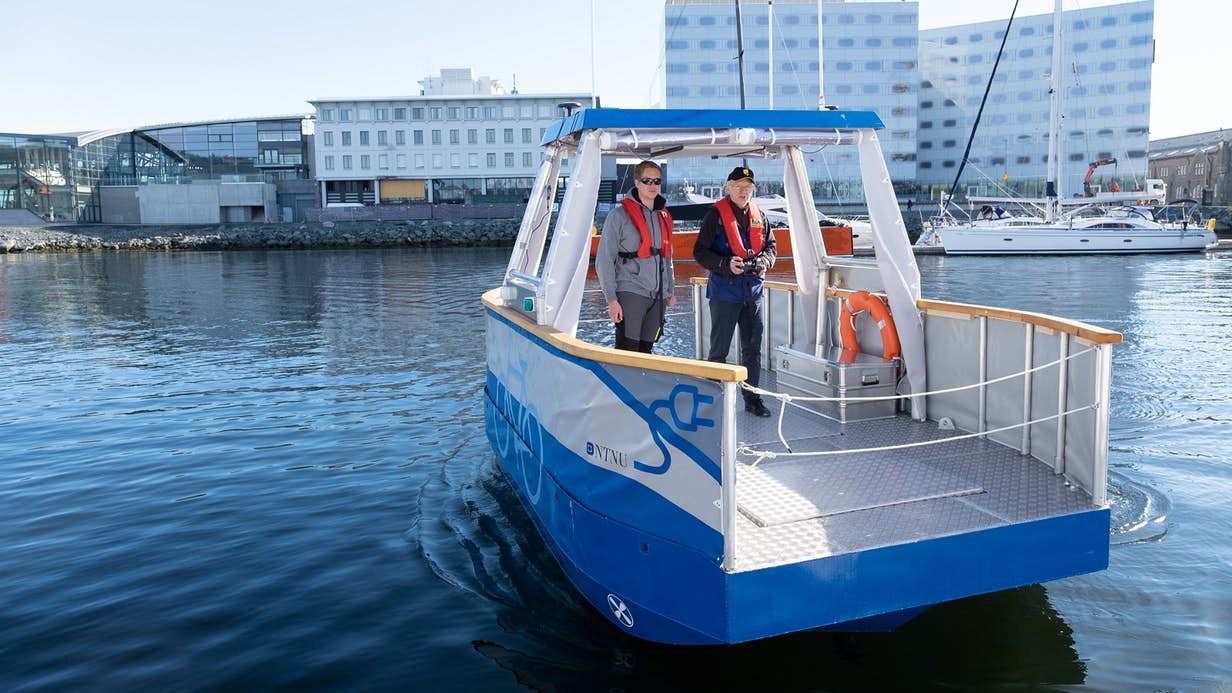
It is hoped that the Autoferry may enter use as soon as sometime next year. In the meantime, a remotely-controlled half-scale prototype (pictured above) is being tested in the canal. It can complete the crossing, which is a little under 100 m (328 ft) wide, in one minute. By contrast, if pedestrians were to take the closest bridge, it would take them 10 to 15 minutes. Simply building an additional bridge would reportedly cost more than running the ferry, plus it would disrupt boat traffic.

August 4, 2018 0 comments
0 FacebookTwitterPinterestEmail
Environment

Facts about Norwegian renewable energy

by Nadarajah Sethurupan August 4, 2018
written by Nadarajah Sethurupan

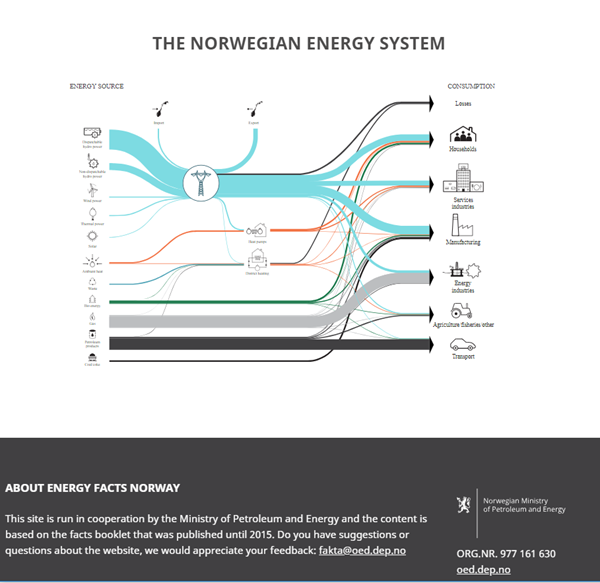
The Norwegian energy facts website EnergyfactsNorway.no is now available in English. The site contains facts about the Norwegian energy system, and can be a useful source of information for the energy sector, educational institutions, the public sector, businesses and institutions that cooperate with the energy sector.

The site gives an overall presentation of the production, transmission and consumption of energy in Norway. It also contains information about the regulatory and legal framework for the energy sector.

August 4, 2018 0 comments
0 FacebookTwitterPinterestEmail
Environment

Norway steps up the fight against illegal deforestation with a £12m fund

by Nadarajah Sethurupan August 3, 2018
written by Nadarajah Sethurupan

The cash pot, announced this week, will be spent on expanding an Interpol taskforce to investigate the gangs that drive illegal deforestation

Halting and reversing land degradation and tropical deforestation could have a huge, positive impact on climate change. To this end, the Norwegian government has announced a fund of 145m kroner (£12m) to help fight forest crime such as illegal tree clearances.

The fund, announced on Wednesday, will go to a partnership between Interpol, the UN Office on Drugs and Crime and the Rhipto Norwegian Center for Global Analyses to combat illegal deforestation. Organised criminals make up to US$152bn (£116bn) a year illegally cutting down invaluable tropical forests.

There are multiple opportunities to break the law along the deforestation ‘value chain’, said the government in a statement this week, from bribes, corruption and fake licences, to illegal land conversion, the illegal export of timber and hiding the money in tax havens.

Companies operating illegally, organised criminal groups and even cartels are destroying the planet’s forests. The deforestation has a huge impact not only on climate change, but also on indigenous people who live in the rainforests and the unique biodiversity that the rainforests contain.

Because the criminal activity behind illegal deforestation is complex, there is a need for a holistic law enforcement approach, hence the partnership approach. “It is paramount to scale up and intensify the battle against forestry crimes to reach national climate goals, the Paris agreement and Sustainable Development Goals,” said Ola Elvestuen, the Norwegian minister of climate and the environment.

“In collaboration with ambitious partner countries, we will no longer permit criminals to perform massive destruction of tropical forests. We will intensify the effort to stop them through this extensive support to tackle forestry crimes.”

August 3, 2018 0 comments
0 FacebookTwitterPinterestEmail
Environment

International Young Eco-Hero Awards 2018 – Norwegian

by Nadarajah Sethurupan August 3, 2018
written by Nadarajah Sethurupan

Action For Nature is proud to announce our 2018 International Young Eco-Hero Awards, which recognize young people 8 to 16 years old for their environmental achievements. We hope the accomplishments of these outstanding young people will inspire many others to preserve and protect the Earth upon which all life depends.

In rural Sri Lanka, children sometimes had to miss school because of heavy rain and danger from elephants on the five-kilometer route. But now, thanks to the work and fundraising of Anya and the Sri Lankan Wildlife Conservation Society, they can travel safely on an “Elefriendly Bus.” The elephants are sometimes violent because of their negative interactions with local farmers who are trying to protect their crops from destruction by these animals who are searching for food.

Each year between 50 and 80 humans die and between 150 and 250 elephants are killed due to human/elephant conflict “Elephants are an important symbol of Sri Lanka for me and I want future generations to be able to live together with these giant, beautiful creatures,” explains Anya. Through her writing, videography and speaking out, Anya is educating her community on ways that humans and elephants can co-exist.

https://actionfornature.org/eco-hero-awards/2018-awards

August 3, 2018 0 comments
0 FacebookTwitterPinterestEmail
Environment

2018: Dry and hot July in Norway

by Geir Yeh Fotland August 2, 2018
written by Geir Yeh Fotland

– The combination of high temperature and lack of rainfall has been quite exceptional. Together with 2014, it is the hottest July month we have had, – says climate scientist Reidun Skaland at Meteorological Institute to Dagsavisen. – If you see Norway as a whole, temperatures have been 4.3 degrees above the norm. Eastern Norway has been the warmest with 5.3 degrees above the norm. Oslo thrones at the top, with 5.6 degrees above the norm. Thursday July 24th was the hottest day ever measured at Blindern, Oslo, with 33.4 degrees. In summer 2009 it showed 33 degrees. The former observation station at Solli Plass, Oslo, started 160 years ago and measured 35 degrees on July 21, 1901. 

Very high fire danger. All use of fire,  even outdoor cigarette smoking, was forbidden till it started raining in August.

Taiwan shaped Islet appears next to Eidsfoss Church, Norway, as hot weather and no rain since May has lowered the surface of the lake. The church was built in 1904

– We have received about half of the rainfall that is normal for July on a national basis. But the southern Agder counties had only a third of the usual rainfall. It is the dryest July in 117 years, only 1901 had less rain in Norway, says Reidun Skaland. – I believe we must be prepared to get more summers of this type in the coming years.

Photo July 26, from Hvervenbukta, Oslo.

– Good weather in several parts of Norway has led to increased activity in sea and water. We have had a 40-50 percent increase in all types of assignments this summer, explains Communications Manager Frode Pedersen in the Rescue Company (Redningsselskapet) to NRK on 20th of July. – So far this month, twelve people have died in drowning accidents. It’s more than all July last year.

Mr. Geir Yeh Fotland – Taiwan National Correspondent NORWAY NEWS.com
Email: – geiryeh@gmail.com, or news@norwaynews.com

August 2, 2018 0 comments
0 FacebookTwitterPinterestEmail
Racism in Norway

Norway’s Silent Scandal

by Nadarajah Sethurupan August 2, 2018
written by Nadarajah Sethurupan

The conviction for child porn of a prominent expert in Norway’s troubled child protection system has put the organisation under scrutiny once again.

In April this year a child psychiatrist was convicted of downloading thousands of child pornography images on his computer. Up until his arrest he played a key role in decisions about whether children should be separated from their parents for their own good.

But there has been no public discussion in Norway about the implications of his conviction, no outrage in the newspapers, no plans to review cases he was involved in – even though the country’s child protection agency, Barnevernet, has been much criticised in recent years for removing children from their families without justification.

In April 2016 Tim Whewell reported on the story for Crossing Continents after Barnevernet attracted an international storm of protest over its child protection policies.

Tim now returns to Norway to report on this extraordinary twist in the story and to find out why child protection in one of the world’s wealthiest countries appears to be in crisis. Produced and Reported by Tim Whewell.

https://www.bbc.co.uk/programmes/b0bclvxq

August 2, 2018 0 comments
0 FacebookTwitterPinterestEmail
Environment

Portugal accused of being European gateway for illegal Congo timber

by Nadarajah Sethurupan August 1, 2018
written by Nadarajah Sethurupan

Details of a new investigation by Global Witness, has this week revealed systemic illegal logging by a major European company in the Democratic Republic of Congo, while Norway and France are on the brink of funding expansion of the country’s industrial logging sector.

Global Witness said that a two-year investigation revealed that European company Norsudtimber is the biggest single owner of logging concessions covering over 40,000 km2 of rainforest in the Democratic Republic of Congo (DRC).
At the same time, Norway and France are planning to fund an US$18 million programme, which includes backing the expansion of industrial logging in DRC and support to Norsudtimber – which is headquartered in Liechtenstein. This, according to Global Witness, directly contradicts both countries’ climate and forest protection goals.
Expanding industrial logging in DRC’s rainforest could generate 35 million tonnes of extra CO2 emissions per year, thereby accelerating climate change.

Portugal, China, Vietnam, France and Portugal are also all said to be recipients of Norsudtimber’s timber trading.
The majority of timber exports to Europe went to either Portugal or France.

Almost 60 percent of the timber exported is said to come from endangered or vulnerable tree species.
Global Witness also said in a statement that the report “Total Systems Failure” shows how a global web of secrecy is facilitating this illegal international trade whilst protecting three Portuguese brothers at the head of the company from scrutiny.

The full study can be found by visiting

https://www.globalwitness.org/en/campaigns/forests/total-systems-failure/

In the meantime, the Congo still ranks among the poorest countries in the world and is 176th out of 187 on the most recent Human Development Index calculated by the UN. It had the highest number of internally displaced people in Africa last year, with almost 2.2 million people forced from their homes. Furthermore, the country is currently in the midst of an Ebola outbreak and the risk of famine and conflict is looming large.

Back in 2009, the Portuguese branch of the environmental association WWF (World Wildlife Fund) called on the Government to implement legislation against the importation of wood that is of illegal origin after it published a report that highlights this country as one of the world’s biggest importers of tropical woods.

Portugal was identified as being the Democratic Republic of Congo’s most important client in terms of wood importation, as well as being the sixth biggest importer of tropical woods from Brazil, a target of environmentalists concerned about depleting rainforests.

According to WWF, the Iberian Peninsula ranks number one in Europe and the second region in the world regarding the importation of tropical woods.

Its report highlighted the non-existence in Portugal of national legislation to control this type of business.
“What we intend is that a clear difference is made between wood that we don’t know from where it comes, and therefore to which there is an associated risk of it being from illegally felled trees, and wood that comes from controlled sources”, said Luís Silva, head of WWF in Portugal.

He added that “there is very poor control of where wood comes from”, and therefore “associated risks are very high”.
“We are very confident that a high percentage of wood entering Europe is illegal”, he warned.
Portugal has also faced previous criticism from Global Witness, which a decade ago had already said the country was only behind China and France in terms of imports of timber from the DRC.

Jules Caron, campaigner from Global Witness also accused Norsudtimber of “cutting down DRC’s rainforest illegally and profiting from it, thanks to a secretive corporate structure relying on tax havens. It is no surprise that there is no rule of law in DRC, but it is shocking that Norway and France want to fund industrial exploitation of a rainforest and support law-breaking and emissions-producing companies, in direct contradiction of its climate commitments.”
Eva Joly, Member of the European Parliament for Europe added that the revelations of the latest Global Witness report on illegal logging in the Democratic Republic of Congo are particularly worrisome.

“If President Macron really wants to ‘make our planet great again’ and fight climate change, he must stop all funding going to industrial exploitation of the largest untouched tropical forest in Africa”, she said.

(the portugal news)

August 1, 2018 0 comments
0 FacebookTwitterPinterestEmail
Asia and Norway

Romania to consider potential negative impact of criminal law amendments

by Nadarajah Sethurupan July 31, 2018
written by Nadarajah Sethurupan

The United States, Belgium, Canada, Denmark, Finland, France, Germany, Luxembourg, the Netherlands, Norway, Sweden, and Switzerland have launched a joint call for Romania to avoid changes to criminal law that could weaken the rule of law or the anti-corruption fight.

The full statement reads: “We, Romania’s international partners and allies, call on all parties involved in amending Romania’s criminal and criminal procedure codes to avoid changes that would weaken the rule of law or Romania’s ability to fight crime or corruption.  Romania has shown considerable progress in combatting corruption and building effective rule of law.  We encourage Romanians to continue on this path.

EU partners also recall the Council conclusions on the Cooperation and Verification Mechanism of 12 December 2017 calling on Romania to focus its efforts on further consolidating progress made, avoid taking any steps backwards, and safeguard the independence of judges and prosecutors.  We are following closely the changes to the criminal codes and remain concerned that several are likely to impede international law enforcement cooperation and negatively impact the fight against violent crime, transnational organized crime, financial crimes, and drug and human trafficking.

We encourage all parties involved to reconsider feedback provided by domestic legal experts such as the Superior Council of Magistracy, and to seek support from international legal experts such as the Group of States Against Corruption and the Venice Commission.”

July 31, 2018 0 comments
0 FacebookTwitterPinterestEmail
Sports

Olympic champ Skofterud dies in jet-ski accident at 38

by Nadarajah Sethurupan July 31, 2018
written by Nadarajah Sethurupan

Norwegian cross-country skier Vibeke Skofterud, an Olympic gold medallist and double world champion in relay, has died in a jet-ski accident at 38, Norwegian authorities said.

Skofterud was reported missing on Saturday. Her body was found on Sunday morning on a small island near the town of Arendal.

“All the indications are that it was a jet-ski accident,” Sveinung Alsaker of the local police said in a press release. Skofterud won gold in the 4 x 5km relay at the Vancouver Winter Games in 2010. She was also part of the team that won the same event at the 2005 and 2011 World Championships. She retired from skiing in January 2014.

“I have lost one of my best friends,” said Therese Johaug, a team-mate in the 2010 and 2011 medal-winning teams, via the Norwegian Ski Federation.

July 31, 2018 0 comments
0 FacebookTwitterPinterestEmail
Africa and Norway

Nigeria, Norway partner on film development

by Nadarajah Sethurupan July 30, 2018
written by Nadarajah Sethurupan

In a bid to further strengthen the money spinning industry and create jobs, the Nigeria Film Corporation has reaffirmed its commitment to partner with Norway and develop their film industries, which bear some similarities in terms of the role they play as tools for change and social re-engineering.

This renewed commitment, and several others were given when the Ambassador of Norway to Nigeria, Jens Petter Kjemprud, visited the headquarters of the Nigerian Film Corporation, Jos.

Speaking at the meeting, Managing Director/Chief Executive of the Nigerian Film Corporation (NFC), Dr. Chidia Maduekwe, commended the Ambassador for the visit and assured that the NFC as the lead regulatory government film agency was desirous in creating the enabling environment for the Nigerian film industry to par with other film cultures. Dr. Maduekwe was emphatic that Nigeria has become the next frontier in terms of global creative economy.

NFC, he further said, is developing a robust plan, which includes domestic and foreign linkages, that will serve as catalysts for Nigerian film practitioners to ply their profession.

Maduekwe, emphasised that training and capacity building to deal with skills gap in the film sector was being addressed through the National Film Institute (NFI), and called for further partnership and exchange programmes between the National Film Institute (NFI) and the Norwegian Film Institute (NFI).

Kyenprud said he was at the NFC to seek ways of partnership and collaborations for film agencies in Norway.

According to him, Nigeria has a large and robust film industry with an employment of about 100 million practitioners.

This to him, and in addition to the rich culture and literature of Nigeria, makes the Nollywood a brand for Nigeria.

He averred that the Nigerian film industry had a duty to correct the negative portraiture of Nigeria, through the development of appropriate storylines in films. “Nigerian films must strive to breakdown these negative perception,” he said.

Other decisions reached during the visit include, the participation of Norway at ZUMA film festival 2018, taking place in Abuja, December 1 to 7; the participation of Nigeria at the yearly International Business Forum held in Oslo between November and December; a joint Nigerian Film Festival to be held in Norway, yearly, and partnership between the film training institutes of both countries.

The development and subsequent signing of a co-production treaty between Nigeria and Norway was also discussed.

In the same vein, the film body has announced an extension date for the submission of entries for the essay competition, which was to close June 29; the date has been extended by two months. The new closing date is Friday, August 31.

In a statement by corporation’s Head of Public and Inter-governmental Affairs, Brian Etuk,interested participants are given the extension to enable them forward their entries for the essay competition which attracts N250,000; N100,000 and N75,000 as cash prizes for the first, second and third best entries respectively.

All entries are to comply with all rules and regulations of the competition, which include, the format for submission, in Arial font, 14 font size, typewritten in double line space and, should not be more than 15 pages on A4 size paper.

The age of participants remain 18 years and above, but below 25 years as at December 2018. The topic of the essay competition is Projecting Nigeria’s Value as a Great Nation through Film. All entries should be through the email: essaycomp2018nfc@gmail.com.

Winners in the essay competition will be announced in September 2018, and presentation of certificates to participants and cash prizes will take place during the 2018 edition of ZUMA film festival schedule for December 1-7, in Abuja Nigeria.

Extension of time has been granted to interested participants to submit.

July 30, 2018 0 comments
0 FacebookTwitterPinterestEmail
Asia and Norway

Norway’s ambassador completes diplomatic mission in Azerbaijan

by Nadarajah Sethurupan July 28, 2018
written by Nadarajah Sethurupan

Azerbaijani Foreign Minister Elmar Mammadyarov has received Ambassador of Norway Bard Ivar Svendsen in connection with the completion of his diplomatic mission in Azerbaijan, the Azerbaijani Foreign Ministry said in a message June 28.

According to the message, the reliable partnership between the countries in the energy sector was appreciated during the meeting.

The ambassador expressed gratitude to Azerbaijan for supporting diplomatic activity. Mammadyarov wished Svendsen success in further diplomatic activity.

Svendsen began to work as ambassador to Azerbaijan in September 2014.

July 28, 2018 0 comments
0 FacebookTwitterPinterestEmail
Norwegian American

The US may introduce sanctions against Nord Stream-2 ?

by Nadarajah Sethurupan July 27, 2018
written by Nadarajah Sethurupan

The USA may introduce sanctions against German energetic companies and number of other European countries that take a part in the building of Russian gas pipeline Nord Steam-2. Francis Fallon, Deputy Secretary of the US for Energy Resources claimed this, According to him, the USA is endorsing the continuity of the gas transit through Ukraine.

‘We continue endorsing the gas transit through Ukraine. The best thing that would ensure Ukraine the possibility to be an important partner in the gas transit area for Europe after 2019 is to ensure that Nord Stream-2 and TurkSream are not built,’ Fannon stated.

The Deputy Secretary claimed that European reliance on Russian gas makes them strategically vulnerable.

‘Russia can and should remain a gas supplier to Europe, but should not dominate the market in order to achieve its hostile political goals,’ he noted.

Also, he thinks that Nord Stream-2 will divide Europe and will enhance Russian abilities to use their energy resources for political pressure and harmful influence.

As is known, Gazprom and his partners are intended to begin the realization of the Nord Stream 2 project, which costs ten billion dollars in April 2018. It is expected that the 1200 km gas pipeline will be laid through the Baltic Sea, and will connect Russia and Germany passing Ukraine, Poland, and Baltic countries. The capacity of the gas pipeline will be twice increased than the first Nord Stream. The construction is estimated to be completed by the end of 2019.

Full text: Francis Fallon’s press conference transcript

This is my first bilateral trip since being confirmed as Assistant Secretary for Energy Resources at the State Department.  I’m the first Assistant Secretary to be so confirmed, and I think my confirmation underscores the critical importance the United States government views energy diplomacy and the broader context of security of our friends and allies.
Earlier I was in Ukraine and Poland and now Greece — three critical energy partners of the United States and champions of European energy security.  The energy security of our European partners and allies has been a longstanding strategic priority for the United States.  Energy secure partners and allies can be strong partners and allies in meeting global challenges.  We have long agreed and reaffirmed our view.  It’s critical for Ukraine to develop a transparent and competitive energy sector.
This can help not only to ensure its own long term energy and economic security, but also to retain its role as a key transit state for European gas supplies.
Make no mistake, the United States remains committed to the success of a stable, prosperous, democratic and free Ukraine.  U.S. support for Ukraine’s territorial integrity remains unwavering.  Russia’s aggression against Ukraine remains the greatest threat to European Security.  Our sanctions against Russia must remain in place until Russia reverses the actions that triggered them.  We expect Russia to honor its commitments under the Minsk Agreements and cease its support for the illegal armed formations it arms, trains, leads and fights alongside.  We’ll never recognize Russia’s purported annexation of the Crimean Peninsula.
The United States is and will continue to be a staunch supporter of Ukraine and its Euro Atlantic aspirations, especially its efforts to develop democratic institutions and a transparent and competitive market economy firmly rooted in Europe and the West.
I’d like to speak a bit further regarding Ukraine’s ongoing reform efforts.  First, it’s important to understand how far they’ve come in a relatively short period of time.  We recognize that more must be done, but the government has taken meaningful and measurable strides to fundamentally open and liberalize Ukraine’s energy markets.
Two weeks ago the Rada passed a critical anti-corruption law designed to counter oligarchic practices. And earlier this week I was in Kyiv and met with Prime Minister Groysman, President Poroshenko, Rada committee leaders and other senior officials.  During that time the supervisory boards of Naftogaz and MGU reached an agreement to take tangible steps toward the goal of unbundling by January 1, 2020.
More work must be done, but we in the international community should pause to recognize this critical step and applaud MGU and Naftogaz’s supervisory boards and the leadership of the government of Ukraine on achieving this important milestone.
Europe’s reliance on Russian gas is a strategic vulnerability.  While Russia can and should remain a supplier of gas to Europe, it should not be allowed to leverage market dominance to achieve maligned geopolitical goals.  If completed Nord Stream 2 would undermine the great strides taken toward Europe’s collective energy security goals while presenting acute security risks for all of Europe.  In particular, Nord Stream 2 would divide Europe and strengthen Russia’s ability to use its energy resources for political coercion and malign influence.  It would allow Russia to use the pipeline’s construction as a means of increasing its aggressive military presence in the Baltic Sea region, undermine European energy diversification goals, and stall critical European energy diversification infrastructure projects that the EU has deemed vital projects on the EU’s Projects of Common Interest list, and damage Ukraine’s economic and strategic stability by giving Russia the ability, in tandem with the multiline Turkish Stream pipeline to end or significantly diminish gas transit via Ukraine.  This in turn would eliminate a powerful disincentive for further Russian aggression against Ukraine.
Together, Nord Stream 1 and 2 would concentrate on two-thirds of EU’s imports of Russian gas in a single route, creating an energy security choke point.  It would make much of the continent more vulnerable, because any disruption would affect such a large portion of Europe’s gas imports.
So this begs the question, what is the purpose of Nord Stream 2?  Our view is that Nord Stream 2 is first and foremost a geopolitical pipeline.  One designed to achieve the Russian government’s geopolitical goals.  It is not just a commercial deal.  Rather, it is an instrument of Russia’s policy of using its energy resources for political coercion.  This especially is clear in Central and Eastern Europe where Russia’s domination of energy market is well known and longstanding.
But even in other parts of Europe Russia uses its energy resources for political influence including by providing commercial advantages to targeted corporate partners.  Energy is one of the hybrid tools Russia is using to co-opt officials, to spread malign influence, and to sew discord in the transatlantic community.  This is why the U.S. continues to strongly oppose Nord Stream 2 and the multi-line Turkish Stream.
Question:  Assistant Secretary Fannon, would you please comment about the energy security and energy differentiation in the area ?
Assistant Secretary Fannon:  Yes.  We very much welcome Greece’s work to diversify via LNG terminals as well as other critical infrastructure, especially the Interconnector Greece-Bulgaria, and the Vertical Corridor.  These are critical steps to diversify and also creates a significant opportunity for Greece as it sits at a geographic competitive advantage to be really the doorway to export gas from Greece throughout the region.
Of course we continue to praise Greece’s role in advancing the Southern Gas Corridor via TAP, especially these days.  And we see some real positive strides towards that end.
Question: How far U.S. government is willing to go to, how to say, to persuade European allies not to go on with Nord Stream 2?  And what exact steps, what concrete measures U.S. government can take to, obviously to make European allies more understanding in this?
Assistant Secretary Fannon: First, the U.S. will continue to diplomatically advance the notion of energy security through diversification of routes, sources and supplies of energy.  More specifically with respect to Europe, we look forward to the European Commission advancing the Gas Directive.  We think that that is an important point and it will advance the principles of transparency that Europe has long championed.  I think there seems to be strong support for it, and so we anticipate the Commission would move forward with it.
Further, I think we support certainly Denmark’s actions around its national security grounds, and we’re clear that firms operating in the Russian energy pipeline sector are engaging in a line of business that carries significant sanctions risk, and that goes for Nord Stream 2, and of course Turkish Stream multiline.
Question:  When you mentioned, as State Department officials frequently do, that the companies involved in Nord Stream 2 risk elevated sanctions, why does the President not repeat that on his visit to, when he met with European and German officials recently?  He didn’t say that in public, and he didn’t appear to say that in private.  So are they at risk of elevated sanctions?  Why isn’t the President backing you up on that message?
Assistant Secretary Fannon: The President was very clear in his position at NATO and so I think the position of the U.S. is quite strong and the issue, the risk of sanctions is ongoing.  In terms of future sanctions and whether and when, the United States does not comment on what we intend to do in the future, but we want to underscore the serious risk that exists.
Question: we saw this week that President Trump and the Commission President Juncker were talking about progress on a trade deal and potentially easing the path for more U.S. LNG to Europe.  Given that the U.S. is very keen to help Europe diversify energy supplies, what exactly can the U.S. do to help Europe diversify?  And is it going to give European companies special privileges when it comes to buying U.S. LNG?
Assistant Secretary Fannon:  First, we’re pleased to see Mr. Juncker and the President make the shared statement.  And besides that, the ongoing activities in a lot of countries’ importing companies are choosing to bring U.S. sources of energy into the continent.  LNG is just one part of that broader, all of the above approach to energy diversification. But the U.S., of course we don’t have a state-driven energy economy, and so it’s really up to the private sector actors of the U.S. companies to engage in those projects as it does.  And we’ve seen that in a variety of countries’ export of U.S. LNG because it makes sense, in particular commercially but also in the broader sense of diversification for the purposes of advancing energy security.
Question:  How does the Assistant Secretary rate the chances of Ukraine completing energy sector reform, in particular the unbundling of its gas pipeline system?
Assistant Secretary Fannon: As I indicated in my opening, certainly more work always needs to be done, but I am extremely heartened and pleased to see this Memorandum of Understanding between the advisory boards of Naftogaz and MGU following the strong leadership of the Ukrainian government to advance the unbundling.
It’s going to take some time, and this is an important milestone toward that end.  But it is, the process will unfold over the next year and a half, but we feel very confident after this agreement by the stakeholders to begin this process and to begin it now.
Question:  I would like to ask about the U.S. government position on the drillings that are going to take place in the next month in the Cyprus Exclusive Economic Zone.  And if you have any fears that there may be some tension then, especially with regards to Turkey that has already halted the drillings in part of the last October ?
Assistant Secretary Fannon: First, I guess, going in reverse order, the U.S. supports Cyprus’ right to explore and produce energy in its own economic zone.  We, of course, want all parties to find agreement and work things out as amicably as possible, but it’s certainly their economic zone to manage their resource.
And in terms of the meeting, I’m meeting with multiple officials including the Energy Minister Stathakis, the Prime Minister’s office, and the MFA Secretary General [inaudible].  They discussed a variety of their shared interests, and we continue to applaud Greece on the important and meaningful steps toward its own diversification and its ambitions to become a meaningful hub for energy transit throughout the rest of Europe.
Question:  The U.S. sanctions in Iran, on exporting more oil in the region.  That will make a shortage.  So can the U.S. counsel its allies to export more oil and more to move the shortage?
Assistant Secretary Fannon:  I would say that the U.S. producers are certainly active and looking for all opportunities to find markets.  We’re confident that the world, that the supplies will be [inaudible] going forward and we’ll work with ourselves and other producers to make that so.
Question:  What is the current position of the United States on the Nord Stream 2 pipeline project, and can we expect any economic sanctions to stop this project?
Assistant Secretary Fannon: The U.S. remains unwavering in opposition to the Nord Stream 2 pipeline, and also I think, not just in our opposition to that pipeline but also our support for continued gas transit through Ukraine.
With respect to — the best way to ensure that Ukraine continues to serve as a critical transit partner for Europe from 2019 is to ensure that Nord Stream 2 and multi-line Turkish Stream are not built as Gazprom would have the technical capability to cut off gas to Ukraine with these projects.
With respect to sanctions, as I mentioned, any business, any businesses operating within the Russian energy pipeline sector are engaging in a line of activity that carries significant sanction risk, and that goes for Nord Stream 2.
Question:  if you could expand a little bit on the significant sanctions, especially in the wake of the bill adopted last summer.  I’m curious as to what would prompt the President to utilize the powers for the term by the bill to stop Nord Stream 2, especially given that this project has been going on for a while.  Construction has actually started, and other than Denmark they have secured all the permits.  So there doesn’t seem to be any impetus in Europe to stop this or get ahead of it somehow.  So will the U.S. unilaterally act to stop it?
And if I may, I realize your trip isn’t focused on Iran, but just curious as to the Iran files, where does the U.S. administration stand in terms of exemptions for European companies operating in Iran and/or countries, oil purchases from Iran.  Will you consider exemptions?
Lastly, what do you make of this idea that France, Germany, Italy and some other European Central Banks might facilitate various payments in euros to Tehran for oil payments?
Assistant Secretary Fannon:  I’ll try to unpack that one by one.
With respect to sanctions in Nord Stream 2, the United States’ position is to not comment on future sanctions activities.  But I do want to underscore repeatedly the significant risk affiliated with firms that participate in the Nord Stream 2 project.
I also think it would be, just to make sure you’re all aware, and I’m sure you are, of the considerable calls for Congress for action on bipartisan grounds.  There’s been multiple bills introduced within the last week or two in both chambers, and again, under strong bipartisan grounds.  So I think that’s just an illustration of the strong unified U.S. position opposing Nord Stream 2 and support for Ukraine in the strongest possible terms.
Switching to Iran sanctions, the U.S. is proceeding, again, with the imposition of sanctions.  It’s not the same as it was before.  With respect to the possibility of any exemptions, the government, U.S. government is calling for the reduction of Iranian, the imports of Iranian crude as close to zero as possible.  And with respect to exceptions, those will be, countries certainly are open for discussion, but those discussions will be taking place bilaterally on an individual basis.  There will be certainly a high bar in those considerations and we urge countries to take meaningful steps toward full compliance as fast as possible.
Question:  Do you believe Turkey poses a threat to the greater region concerning energy security as well?
Assistant Secretary Fannon:  We see also Turkey as an opportunity to play a really critical and supportive role in advancing the Southern Gas Corridor.
Question:  The U.S. assessment on the new Romanian offshore energy exploitation to Nord Stream 2 ?
Assistant Secretary Fannon:  We have concerns with respect to the offshore law and we view the Black Sea region as a place of tremendous opportunity for energy diversification.  In that context, we strongly support the BRUA pipeline.
Question: U.S. is currently putting a considerable amount of pressure on Europe in the domain of energy security.  So on one side [wanting] to reduce the dependency on Russian diversification but on the other side to stop imports from Iran which could be a possible significant source of diversification for the European allies of the United States.  In the meanwhile, we also have supplies of oil coming from Venezuela dropping on account of the political situation in Venezuela. So how can you act when it’s caught between two fires on one side?  The European allies are being asked to diversificate, but on the other side they have less and less sources available for their energy supplies ?
Assistant Secretary Fannon:  Well, they’re a bit two different issues.  With respect to Russian gas, the case is clear.  Diversification options change market dynamics in regions, and amongst countries.  It changes the entire pricing mechanism of energy because the options become available.
Our view is to advance options, and it’s clear, in the case of Lithuania, for example, developed its own LNG facility and it changed the entire pricing dynamic of gas, of Gazprom gas into that country.  It turned a project that was invested in as a security measure, to build the infrastructure, into one that is commercial because it changed the complexion of Gazprom’s contracting ability, their pricing power.  So that’s what we support.
We fully anticipate that Europe will continue to import Russian gas.  The question is to what extent will there be diversifying options available to those countries to ensure not just the reliable flow of energy, one that’s free of coercion, but also one that can allow for those countries to have an ability to negotiate.
So that’s our support for that.
With respect to the other issues with respect to oil markets, we will continue to monitor to ensure that there’s sufficient balance in the market.  The law requires that for the [president] to certify as such prior to the imposition of sanctions.  So that’s something we, again, by law, by U.S., must monitor closely and ensure, certify appropriate supplies are available in the market.
Question:  LNG in Croatia and your opinion of Russian influence ?
Assistant Secretary Fannon: The United States very much supports the buildout in Croatia of the Krk Island terminal.  We’ve been a longstanding supporter of that project and encourage the Croatian government and others in the region to advance it.
Of course the European Commission also recognizes it as such and named it as a Project of Common Interest.
So I would suggest that it’s not just U.S. support, which was the subject of the question, but there’s far broader European support as well.
With respect to Russia, we already spoke to that a little bit.  They oppose and work against the diversification of projects and they do this through multiple channels including disinformation campaigns.  But again, as I described in the context of Lithuania, we know what the outcome is if countries have options.  It’s better for those countries and it’s better for those in the region and the broader national security of Europe.
Assistant Secretary Fannon:  Thank you very much.  I would just like to say, again, this was my first bilateral trip as being the first confirmed Assistant Secretary of State for Energy Resources.  I selected this trip to underscore the criticality of energy security in this part of Europe, and I expect to be back here a lot more.  And I want to applaud these three countries on their efforts, ongoing efforts, and the U.S. government will continue to work to support them in every way we can.
Thank you.
July 27, 2018 0 comments
0 FacebookTwitterPinterestEmail
Economics

First interstate council joins South Australian councils voicing concerns on oil drilling in Great Australian Bight

by Nadarajah Sethurupan July 27, 2018
written by Nadarajah Sethurupan
  • Victoria’s Moyne Council (Port Fairy) demands consultation on Bight oil drilling proposals
  • 11 SA local governments now oppose Bight oil exploration, representing 540,000 residents
  • Opposition has jumped since Kangaroo Island Mayor fronted Statoil-Equinor AGM

The first interstate council has weighed in on oil drilling in the Great Australian Bight after 11 South Australian local governments have voted their opposition to risky ultra-deepwater drilling in Australia’s southern seas.

Victoria’s Moyne Council, centred on the tourist hotspot of Port Fairy, passed a motion on Monday expressing its concerns about oil exploration in the Bight and asking Norwegian oil giant Equinor (formerly Statoil) and relevant federal ministers to be included in any consultation over any proposals.

Eleven South Australian coastal local governments representing 540,000 people have now flexed their muscle voting to oppose oil and gas exploration in the Great Australian Bight.

Local government opposition has stepped up dramatically since Kangaroo Island Mayor Peter Clements fronted the Statoil-Equinor annual general meeting in Norway in May to ask the company to drop its Bight plans. Shortly after, South Australia’s biggest council, Onkaparinga City, voted its opposition followed by the state’s third biggest council, City of Port Adelaide Enfield, last month.

Wilderness Society South Australia Director Peter Owen said: “The opposition to oil and gas exploration in the Great Australian Bight is escalating rapidly, with 11 South Australian local governments representing more than half a million residents now opposed, and now interstate councils are demanding to be consulted.

“Five South Australian councils ‑ Port Adelaide, West Torrens, Onkaparinga, Marion and Alexandrina – have passed resolutions opposing oil and gas in the Bight since May when Kangaroo Island Mayor Peter Clements travelled to Statoil-Equinor’s AGM in Norway to ask the oil giant to drop its plans to drill in the Bight.

“In May more than a thousand people lined the shores across Australia to oppose offshore oil and gas exploration and calling Statoil-Equinor to drop its Bight plans at Hands Across the Sands events from New South Wales right across to Western Australia. About 500 people attended the Adelaide event at Semaphore Beach while 300 turned up to the Port Fairy event.

“Will Statoil-Equinor defy this huge community opposition to push ahead with risky ultra-deepwater drilling in the pristine waters of the Great Australian Bight?”

The Moyne Council motion states: “That Moyne Shire Council acknowledges concerns regarding deep sea oil drilling in the Great Australian Bight and commits to writing to Equinor and the relevant Federal minister to request full consultation from Equinor in relation to the development of its proposed Environmental Plan.

“That Moyne Shire Council seek regular updates from Fight for the Bight Port Fairy Group, Equinor and the National Offshore Petroleum Safety and Environment Management Authority (NOPSEMA) in relation to the application, with particular emphasis on oil spill risk and risk mitigation strategies.”

Mr Owen said: “Equinor has thumbed its nose at the growing community opposition and extraordinarily reasserted its intention to attempt risky ultra-deepwater drilling in the Great Australian Bight Marine Park next year while pushing for an extension to its drilling timeline. Statoil-Equinor’s continued dismissal of the community’s concerns brings the reputation of the entire offshore oil and gas industry into disrepute.

“Equinor should start listening to the people and quit its plans to drill in the deep, rough and remote waters of the Great Australian Bight, just as BP and Chevron have already done.

“The international Hands Across the Sand movement grew from the Deepwater Horizon disaster in 2010 when 800 million litres of oil spewed into the Gulf of Mexico.

“The Great Australian Bight waters are deeper, more treacherous and more remote than the Gulf of Mexico. BP’s own oil spill modelling showed a spill from an ultra-deepwater well blowout in the Great Australian Bight could impact anywhere along all of southern Australia’s coast, from Western Australia right across to Victoria through Bass Strait to NSW and around Tasmania. A spill could hit Adelaide in 20 days and could hit Port Lincoln and Kangaroo Island in 15 days.

“A spill would be devastating for South Australia’s $442 million fishing industry and its tourism industries in coastal regions, worth more than $1 billion. The two industries employ more than 10,000 full-time positions.

“There is no established offshore oil and gas industry in South Australia to deal with a disaster. More than 6800 boats were involved in the Gulf cleanup but the South Australian Oyster Growers Association says that SA and neighbouring states probably have only 20 vessels that could operate safely in the waters where BP-Statoil planned to drill.

“The Great Australian Bight is a unique, pristine marine environment, with 85 per cent of its marine species found only in these waters. The Bight is a haven for 36 species of whales and dolphins, including the world’s most important nursery for the endangered southern right whale. The Bight is Australia’s most important sea lion nursery and supports seals, orcas, giant cuttlefish, great white sharks and some of Australia’s most important fisheries.”

The South Australian councils opposing oil exploration in the Great Australian Bight are: Port Adelaide-Enfield, Kangaroo Island, Victor Harbor, Yorke Peninsula, Onkaparinga, Yankalilla, Holdfast Bay, Marion, West Torrens, Elliston and Alexandrina.

July 27, 2018 0 comments
0 FacebookTwitterPinterestEmail
Economics

Norway wants to invest more in Ukraine – foreign minister

by Nadarajah Sethurupan July 27, 2018
written by Nadarajah Sethurupan
Norway is interested in developing cooperation with Ukraine in the field of energy efficiency.

Norway’s Foreign Minister Ine Eriksen Søreide stated this at the Ukraine Reform Conference in Copenhagen today, an Ukrinform correspondent reported.

“The reforms in Ukraine have positive results for attracting investments of Norwegian business. Significant investments are made in renewable energy sources. We will continue to support energy efficiency in Ukraine. We would like to see more investment between Norway and Ukraine,” the Norwegian minister assured.

She notes that Norway is a true friend of Ukraine and consistently supports the sovereignty and territorial integrity of the country.

The Norwegian foreign minister also calls on Kyiv to complete the reform of the energy sector and strengthen the fight against corruption.

ish

July 27, 2018 0 comments
0 FacebookTwitterPinterestEmail
NATO and Norway

USAFE chief: Military doing ‘360-degree’ review in Europe

by Nadarajah Sethurupan July 25, 2018
written by Nadarajah Sethurupan

The top U.S. Air Force officer in Europe said Wednesday that his command is examining how military sites are spread out across Europe as part of a review to identify potential vulnerabilities.

“We’ve been asked to take a look at infrastructure throughout the entire European continent,” U.S. Air Forces in Europe chief Gen. Tod D. Wolters said during a news conference.

Wolters, who was asked whether the Air Force is reviewing the merits of moving more airmen into Poland, said he is taking a broad look at how military facilities are arranged, from the Arctic to NATO’s southern and eastern flanks.

“We’re looking at the European continent from a 360-degree position to make sure we don’t leave any vulnerabilities,” he said.

Since Russia’s 2014 invasion of Ukraine, the military has expanded missions in Eastern Europe, where U.S. troops rotations have steadily increased. USAFE has a year-round mission in Poland manned by a rotating group of troops.

There is a debate within the military about whether a more permanent presence should be established in Poland, which has lobbied Washington for more U.S. forces.

The Pentagon could soon be required to consider basing more servicemembers there and elsewhere in Europe, in keeping with pending federal legislation that calls for a military study.

Meanwhile, Wolters said USAFE has steadily built up military infrastructure during the past few years in the Baltics and Poland, where the U.S. has invested in airfield upgrades and depots for pre-positioned equipment.

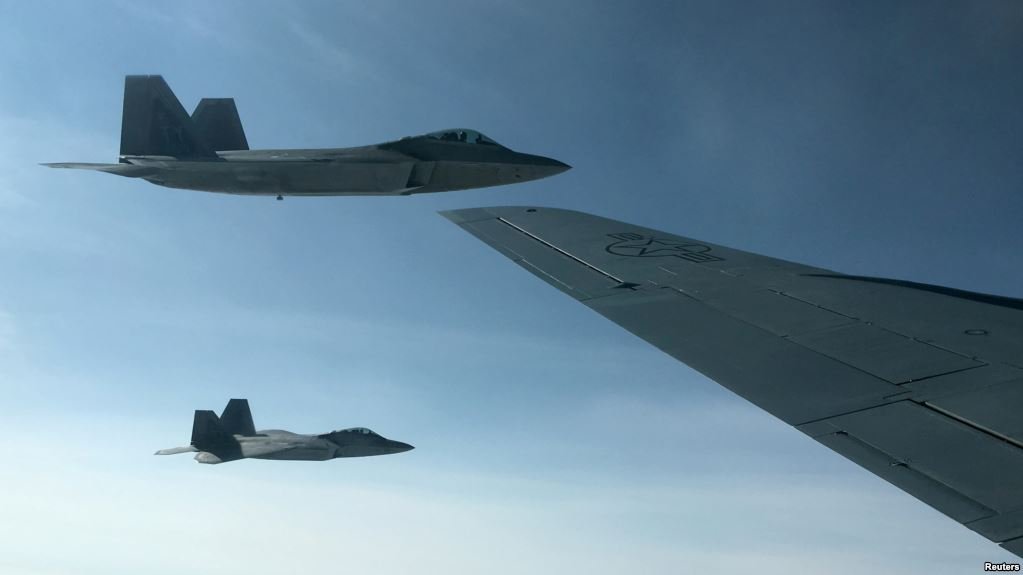
Later this year, the Air Force will be rotating fifth-generation aircraft into Europe to train with allies, Wolters said.

He did not specify which warplanes would be deploying, but the Air Force’s fifth-generation aircraft include F-22 and F-35 fighters.

Full tex..

I certainly hope that you find this venue useful. We certainly do here at USAFE/AFAFRICA. Last fall we started this series of media engagements to provide regular updates on our U.S. Air Force’s operations and training activities across Europe and Africa. Today we’d like to continue the conversation with updates in a few areas, specifically readiness, partnerships, and some current operations. Readiness continues to be our centerpiece and we certainly had an exciting summer. Airmen in the command have been involved in over 15 exercises which have been crucial to enhancing our capabilities and partnerships within Europe and Africa. Through a total force integration effort, we utilized the full spectrum of our United States Air Force via participation from the Active, Guard and Reserve.

Additionally, these exercises further demonstrated the value of partnerships and further strengthened the critical relationships we have with our allies and partners. Specifically, exercises like Saber Strike and BALTOPS improved our resiliency, responsiveness and lethality. Saber Strike promoted regional stability and security while strengthening partner capabilities and fostering trust. The combined training opportunity it provided great improved interoperability among participating NATO allies and key regional partners. Over 18,000 participants from 19 countries were involved in complex scenarios in Estonia, Latvia, Lithuania and Poland. Our United States Air Force provided U.S. F-16s, KC-135s, as well as elements from various state Air National Guard Units. And as in past iterations of Saber Strike, ground and air forces worked together to strengthen the development of our joint leaders and teams across the multi-domain environment. In addition to Saber Strike, our Airmen continued our annual involvement in BALTOPS. Beginning in 1972, BALTOPS continues to be an excellent opportunity for both NATO and non-NATO countries to strengthen interoperability. We do this through a series of combined tactical scenarios. BALTOPS brought together over 5700 personnel from 17 nations involving over 40 ships, submarines and more than 40 aircraft. We had an impressive amount of U.S. Air Force air power participating. F-16s, F-15s, E-3s, B-1s and a JSTAR from across the entire enterprise. It showcased our ability to project global combat power anytime, anywhere, while bolstering integration capabilities with our partners.

Not only do exercises foster good relations with our partners, but the European Defense Initiative, or EDI, enables the U.S. to enhance our deterrence posture, increase the ready and responsiveness of our forces in Europe, and support the collective defense of NATO allies and partners. EDI activities increase the readiness of U.S. forces to support our NATO allies, allowing for sharper responses to any aggression. EDI funds improved our infrastructure and presence across Europe.

Through these initiatives we’re developing a mature operating environment where our air crew and aircraft can operate more efficiently and more effectively now and into the future. EDI funding has allowed us to complete projects such as munition storage facilities in Lithuania; a hangar and extended parking aprons in Romania; and airfield upgrades in Hungary, Iceland and Slovakia. These projects help us enhance the infrastructure in forward operating locations that we utilize with our partner nations. Ultimately, they let us achieve our goal of developing more resiliency, and thus enhancing our readiness.

We also continue to bolster our presence through ongoing theater security package deployments. The current TSP rotation is made up of F-15s from the 142nd Fighter Wing with the Oregon Air National Guard and the 104th Fighter Wing with the Massachusetts Air National Guard. Like previous deployments, these units have participated in exercises and training across Europe.

And on top of the TSP deployments, we are executing the proof of concept for our Deployable Air Base System, or DABS. DABS provides enhanced pre-positioning of U.S. equipment, increases responsiveness and readiness by pre-positioning ammunition, fuel and equipment, and improves infrastructure to enhance our ability to provide a rapid response. Looking into fiscal year 2019, we are proposing an EDI budget that demonstrates the U.S. commitment to NATO. Our total EUCOM request includes a significant funding increase from 4.7 billion to 6.5 billion. While the proposed increased funding is welcome news, what we need is consistent funding that is steady, stable and predictable that will continue to improve our readiness and advance the lethality of our forces.

Lastly, I would like to announce that we will be welcoming back U.S. 5th Generation assets into the European theater later this summer. These assets will work with U.S. and allied forces that are already in Europe including partner nation 5th Generation assets to build on the integration from previous deployments. The integration of 5th Generation assets allows the coalition to maintain the air superiority advantage by complementing the capabilities of our powerful 4th Generation fleet. These assets continue to be a game-changer in developing the right size and mix of capabilities to compete, deter and if required, win.

The demand for air, space and cyber power is only continuing to grow. America’s Airmen need to be resourced and trained to fight as a joint and allied military team to answer these challenges. As the Commander of U.S. Air Forces in Europe and Air Forces Africa, I can guarantee that we will continue to remain laser focused on maintaining and improving our readiness and warfighting posture.

Q – Which specific additional contributions towards aerial defense would you urge Germany to make?

General Wolters: A great question and the first response I’ve got to offer is certainly that’s a decision that the German government and the German military should need to consider heavily. And we offer a wide array of selections that I think they should consider. And as we press forward in NATO what we continue to dialogue back and forth about is the tremendous relationship that exists between the German government, the U.S. government, the German military and the U.S. military. What I would advocate for is those contributions should enhance our ability to improve indications and warnings, to improve command and control, and to improve mission command. And I would just recommend that the German military looks at those three areas, and they have certainly been busy in doing so, and I’m absolutely positively convinced when it’s time for them to make the decision, whatever decision they make it will certainly enhance NATO’s ability to improve command and control indications and warnings and mission command.

Q – Recently the Defense Minister of Niger confirmed that armed drones were now being flown by the U.S. out of Niger. I’d like to ask how many armed drone missions have there been so far? How many strikes? How many terrorists neutralized? And also, who are these armed drones targeting and where are they?

General Wolters: I’m not privileged to have the opportunity to talk about ongoing operations. But what I can say is in the area of improving indications and warnings and command and control and command and feedback, we are working by, with and through the countries to improve our ability to build partnership capacity. And we’re pleased to report in those campaign areas we’re continuing to make improvements. So the posture of the forces and their ability to provide command and control are improving over time.

Q – Question about the announcement by the British government that they are proceeding to develop essentially a competitor to the F-35, so a next-generation aircraft, and I’m wondering if you were able to have any conversations during your time in England about whether the United States could potentially play a role in that UK project called Tempest, and if so, what kind of a role that would play ?

General Wolters: I had the opportunity to see the unveiling of the Tempest at Farnborough electronically from afar, and I have not had any conversations with my counterparts in the UK specific to this aircraft, but we certainly had conversations about future systems. One of the key ingredients that has to go into any future system is to make sure that it’s interoperable with existing systems, and certainly the systems that the UK is embracing as we speak. So the closest we’ve had in a conversation in that area is to ensure that as the UK decides to go forward with a system that could be called Tempest, that we would hope that it would be as interoperable as possible with the great system that they just acquired and they just received at Marham like the F-35B. That interoperability with 4th Generation capability, that interoperability with 5th Generation capability is powerful, and that, I’m certain, is probably something that the UK is looking very closely at.

Q – can you be a little bit more explicit concerning the future deployments of 5th Gen aircraft to Europe within the next few months?

General Wolters: I can’t reveal the specific airframe and the specific dates and locations, but the purpose is to introduce a U.S. 5th Generation capability one more time onto the European continent and afford it the opportunity to get out and about to separate nations so that we can, number one, improve our interoperability with other 5th Generation assets that are already on the continent; and also improve our interoperability with other 4th Generation assets that are on the continent.

And on top of all that, we’ll do all that we can with the 5th Generation asset to work on our campaign design of enhancing indications and warnings, command and control/feedback, and mission command.

Q – What kind of exercises have you already made and will you make in Spain? And how important is the Moron Air Base for the operations of the United States across Europe and North Africa?

General Wolters: Spain is a fantastic NATO partner, Kathy, first and foremost. Numerous exercises have occurred with Spain. As many probably know, just at Torrejon itself, Air Base, which is outside of Madrid, we have a wonderful command and control organization that is NATO centric but has fantastic members of the Spanish Air Force and the U.S. Air Force involved. And that organization at that location dramatically improves our command and control. Moron is a base that affords us the opportunity to lift and shift. We can move large amounts of cargo, large amounts of personnel, large amounts of hardware and software through Moron as a port, and it also serves as a force multiplier to allow us to project power out of the European continent from Spain through the Mediterranean into the northern portion of Africa. So those are just a few examples of what Spain does to enhance our capability not only in NATO, but certainly our ability to power project and build partnership capacity in Africa. Finally, on the fighter pilot side of the house there’s a tactical leadership program at Albacete, Spain. At that program we send down very, very experienced fighter crews and they’re able to participate in high-level sorties that are complex and complicated, and when they depart that course, after having attended the tactical leadership program, that their readiness improves dramatically. Again, another example of the great contributions from Spain.

Q – I just wanted to ask, you mentioned a little bit about some of the infrastructure that was being developed as part of the EDI, but more broadly, there’s a lot of talk about potentially moving large parts of the U.S. military infrastructure in Europe further East into Poland. Have you been reviewing anything like that? Have you been asked to give input to anything like that?

General Wolters:  we’ve been asked to take a look at infrastructure throughout the entire European continent, in the North Arctic, in the South in the vicinity of the Mediterranean, certainly in the vicinity of Poland. So yes, that has been a factor and we’re looking at the European continent from a 360 degree position to make sure that we don’t leave any vulnerabilities. Our goal with EDI with respect to improvements are to increase
the presence, improve our exercises and training events, enhance the pre-positioning of resources, obviously to improve the infrastructure which is the point you built on, and to build partnership capacity. And with the assistance of all the components reporting to EUCOM, EUCOM is able to put together a comprehensive game plan that assists all of the components, all the domains, and takes a very, very smart 360 degree approach to
improving the overall disposition of the European continent.

Q – can you tell us about is there any plan existing of the United States Army or the government making the Camp Bondsteel which is located in Kosovo a permanent presence of American Army into this part of Europe, the answer to a growing ?

Q – Kosovo Security Force has been recently equipped with 50 Humvees. Do you see any possibility in the near future after this Kosovo Security Force becomes a real Army, to be equipped with aircraft, for example?

General Wolters: As the Air Component Commander, both of those subjects, I’m not familiar with so I’d have to have you defer that to Headquarters, USEUCOM or to U.S. Army Europe.

I just wanted to ask a follow-up on the British investing in their own, developing their own fighter jet. Whether you were worried as a key partner in the F-35 program that the U.S. now would not be buying 138 F-35s as they initially said because they will clearly have to siphon some of that money off to develop their own fighter?

General Wolters: As the U.S. Air Component Commander and the NATO Air Chief, that certainly wasn’t a worry. The discussions always involve doing everything we possibly can to improve our disposition from a security perspective, and obviously the UK investing in something along the lines of the Tempest, I think if Stephen Hillier believes that to be a plus for the Royal Air Force then I do also. But as I alluded to before, Jonathan, and I know Stephen would agree with me, we want to ensure that the interoperability piece with platforms that we’re certainly embracing and systems that we’re certainly gaining as we speak, that the interoperability with anything new that the UK would invest in is critical.

Q – I am afraid I haven’t understood the whole truth about exercises at all. What are they recently more? Still an instrument to improve partnership inside NATO, or let’s say to test the troops? I mean, doing all those exercises inside NATO, I would understand, but doing them that close to Russia at the border of Russia, what does it mean that Russia is a real enemy? Are there real detailed threats to attack the West? Or why is it that the locations are, let’s say, the other way around, it would be the similar scenario when Russia would do an exercise in Mexico under the new government?

General Wolters:  we conduct exercises throughout the European continent. In the United Kingdom, in the vicinity of Norway, in the Aegean, in the Western Mediterranean, along the Eastern European area. So we ensure that we cover all 360 degrees of NATO.

And the other aspect of exercises is the national capacity coupled with the NATO contribution. So we certainly take into account what existing nations can add or need with respect to exercises, and that affords us the opportunity to pick and choose the locations that best improve the security disposition of our NATO forces.

Q – Shifting to Africa, General Wolters, can you affirm recent media reports that the U.S. is considering a substantial drawdown of its military forces in Africa? If that does occur, what would be the likely ramifications for stability in a country such as Somalia?

General Wolters: I can just tell you that as the Air Component Commander serving USAFRICOM, our disposition in the region has only gotten stronger over time, and the number of exercises have improved in frequency and in relevancy.

What we’re very, very excited about, what we see is an increase in exercises that build partnership capacity and we’re very, very excited to see the growth in capabilities that exist in many of the nations.

One of the recent activities is the African Partnership Flight Program. That’s where we have crews and a specific aircraft that has specific expertise, and they forward deploy as a team and they stay anywhere from two days to two weeks and they share tactics, techniques and procedures on how to aviate, navigate and communicate and on how to lift and shift resources. And it dramatically improves the disposition of the air components that exist on the African continent. And we know that that continues to take place. It will continue to take place in the future, and we’re very, very excited about the improvement that we see.

General Wolters: I just want to say thanks to you and the team for the opportunity to share some thoughts. We exercise and train as hard as we possibly can, and we do so for the purpose of peace. And as long as we continue to have peace and we project that peace is on the horizon, that’s very, very productive for all of us. So thank you very much.

July 25, 2018 0 comments
0 FacebookTwitterPinterestEmail
Defence

Chancellor of Justice: Patria permits for defence exports to UAE were legal

by Nadarajah Sethurupan July 24, 2018
written by Nadarajah Sethurupan

Norwegian media reports that Patria products from Finland have been spotted in use during Yemen’s brutal civil war.


Finland’s Chancellor of Justice says that the government’s decision to approve exports of armoured personnel carriers to the United Arab Emirates complied with the law.

Chancellor Tuomas Pöysti said that the office of the prime minister was open to criticism, however, given the UAE’s involvement in Yemen’s civil war.

Finland granted two permits for Patria to sell vehicles to the UAE, in 2015 and 2018. Pöysti said the second of these was more questionable because the UAE was clearly embroiled in the Yemeni conflict by then, but nevertheless the decision complied with Finnish law.

According to information received by Yle, Patria has sold personnel carriers to the UAE. Finland has been criticised for that decision, after claims that Patria products had been spotted in Yemen.

Pöysti also criticised the Defence Ministry’s report on the issue, which did not include how the UN Human Rights Council and other UN bodies have assessed the situation in Yemen.

According to the law on defence exports, permits are granted based on a case-by-case assessment, and in line with the UN’s Arms Trade Treaty and the EU’s standards on oversight of defence firms. Human rights, security and stability in the region should all be taken into consideration.

The Chancellor of Justice dealt with the issue after a complaint by the Peace Union of Finland and the pacifist Committee of Hundred in Finland.

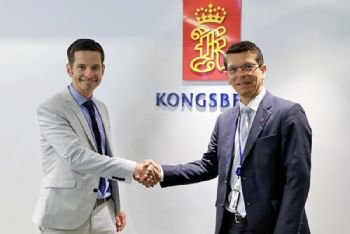
The State of Finland owns just over half of Patria, with the rest held by the majority-state-owned Norwegian firm Kongsberg Defence & Aerospace. Patria has been embroiled in a series of corruption cases and other scandals, most recently related to the suspicious death of a consultant in Uganda.

(yle)

July 24, 2018 0 comments
0 FacebookTwitterPinterestEmail
Norwegian American

American recording artist Ry Bradley launching free music camp for Norway youth

by Nadarajah Sethurupan July 23, 2018
written by Nadarajah Sethurupan

Ry Bradley, the American recording artist that has had songs featured in hit U.S. TV series like Chicago Med and The Fosters, will be hosting Ry’s Rock and Roll Camp in Norway August 19-24, 2018. Registered campers will get the opportunity to work with Ry to build their songwriting, musicianship and performance skills as he guides attendees through the process of building a band. The week will culminate with one of camp’s bands getting the opportunity to open for Ry at the camp closing concert. Presented via an outreach program and partnership with the city of Ringsaker, Norway, Ry’s Rock and Roll Camp will be available free of charge for youth ages 12 to 20. 

“There are 34,200 citizens who live here in the middle of Norway,” says Ringsaker Mayor Anita Steen.  “I am very proud of my municipality and all its wonderful people. Norwegians are as diverse as people elsewhere. Some of us love outdoor activities, some love soccer/football and some love music. And many of us enjoy Ry Bradley’s music. He has been here in Ringsaker several times. It is a wonderful gesture to our young people that he is hosting Ry’s Rock and Roll Camp Norway in August. He’s giving back to the young talent and local youth via this learning opportunity! We are looking forward to August and for Ry’s return to Ringsaker.”

“People in Norway are very thoughtful and genuine,” says Ry.  “I have made many true friends there. Many Norwegians love American music and if I can support any young musicians, I will. This is an opportunity for me to make even more friends and possibly inspire young people to make their own music. I’m so grateful for the mentors I’ve had in my life and I’m happy to give something back.”

Throughout the week, sessions will cover songwriting techniques and lessons on the acoustic and electric guitar, bass guitar and drums.  The goal of the week is to provide attendees with the skills to start and build the trust needed to provide the foundation for a performing band. Lessons will be presented in both Norwegian and English. For more information on how to register for the camp, visit the following link: https://rybradley.com/norway/. Ry’s latest album Everything I’ve Got will be available on online retails on July 13.  

Video Option: https://youtu.be/hdp31lnG1jA

July 23, 2018 0 comments
0 FacebookTwitterPinterestEmail
Sex scandal

Sri Lanka Cricket Star allegedly raping Norwegian woman

by Nadarajah Sethurupan July 23, 2018
written by Nadarajah Sethurupan

A 26-year-old Sri Lankan who holds UK citizenship,was arrested by the Kollupitiya police in Sri Lanka last night in connection with an alleged rape of a Norwegian woman at a star class hotel in Kollupitiya.

Police said the 23-year-old Norwegian woman had lodged a complaint with the Bandaranaike International Airport (BIA) police stating that she was raped at the hotel in Kollupitiya on Saturday.

Danushka Gunathilaka, 27, and his friend, who cannot be named, took two Norwegian women to the hotel where the player was staying in Colombo in the early hours of Sunday.

Meanwhile, Sports Ministry sources said the arrested suspect is a friend of Sri Lankan cricketer Danushka Gunathilake whose name had also been mentioned in the complaint lodged by the victim.

He said there was no allegation against Gunathilaka, who is currently Sri Lanka’s best-performing batsman in an ongoing tour by South Africa.

However Sri Lanka Cricket on Sunday night suspended him on a “misconduct” charge, although he is allowed to play in the match that is currently taking place.

The governing body’s rules stipulate that during matches players must be back in their hotel rooms by midnight and cannot have guests.

The cricket board will also “withheld Gunathilaka’s fee for the ongoing Test match until the outcome of the inquiry,” it said.

The BIA police had handed over the investigation to the Kollupitiya Police.

The Kollupitiya police has arrested the Sri Lankan who was residing at Nawala.

Police said the woman was produced to the Colombo Judicial Medical Officer for a medical examination on Sunday.

“Sri Lanka Cricket (SLC) decided to suspend Danushka Gunathilaka from all forms of international cricket for breaching the ‘Player Code of Conduct’, pending inquiry,” the SLC said in a statement.

“The decision to suspend the player was taken following an initial inquiry conducted by Sri Lanka Cricket, after the team management reported that the player have violated the ‘Code of Conduct’.”

July 23, 2018 0 comments
0 FacebookTwitterPinterestEmail
Media Freedom

Facebook, Google Manipulate Users to Share Personal Data Despite GDPR

by Nadarajah Sethurupan July 22, 2018
written by Nadarajah Sethurupan

Despite the new GDPR regulation entering into effect across Europe, Facebook and Google are manipulating users into sharing personal data by leveraging misleading wording and confusing interfaces, according to a report released today by the Norwegian Consumer Council (NCC).

In its 44-page report, the Norwegian agency accuses Google and Facebook of using so-called “dark patterns” user interface elements into “nudging” users towards accepting privacy options.

These dark patterns include misleading privacy-intrusive default settings, misleading wording, giving users an illusion of control, hiding away privacy-friendly choices, take-it-or-leave-it choices, and choice architectures where choosing the privacy-friendly option requires more effort for the users.

Google and Facebook making users work for their privacy

“Facebook and Google have privacy-intrusive defaults, where users who want the privacy-friendly option have to go through a significantly longer process,” the NCC says.

“They even obscure some of these settings so that the user cannot know that the more privacy intrusive option was preselected.

“Choices are worded to compel users to make certain choices, while key information is omitted or downplayed,” the NCC says in its report.

Google and Facebook threaten users with loss of service

Furthermore, investigators discovered that both Facebook and Google threaten users with loss of functionality or deletion of the user account if they don’t choose the privacy-intrusive options.

The NCC also analyzed the privacy options in Microsoft’s Windows 10 operating system but gave the product a generally favorable rating after the agency discovered that Windows 10 was using “privacy by default” settings.

July 22, 2018 0 comments
0 FacebookTwitterPinterestEmail
Killing

Norwegian journalist dies in Lapland gyroplane crash

by Nadarajah Sethurupan July 22, 2018
written by Nadarajah Sethurupan

One man was killed and another person injured when a gyroplane crashed into the ground near the Norwegian border in Enontekiö, Lapland on Friday. The deceased is confirmed to be Morten Ruud, 57, a journalist for the Norwegian national broadcaster NRK.

Police say the only other person on board the lightweight autogyro craft was mildly injured in the accident in the wilderness of Kilpisjärvi, and was sent to hospital in Norway.

The details of the crash are as yet unknown, police say, but an investigation is underway. The route of the craft, including both its origin and destination, is also unknown.

“We don’t know what the gyro was doing in Finnish airspace. Police have yet to speak with the injured survivor,” says Lapland police inspector Kirsti Huhtamäki.

Finnish agency skips investigation

The Finnish Safety Investigation Authority (OTKES) will likely not be involved in the investigation of the crash; gyroplanes are not within the jurisdiction of European investigation authorities.

“We have no reason at this time to investigate this accident, but we will help the Norwegians if they so wish,” chief researcher Ismo Aaltonen from OTKES says.

Aaltonen says the Investigation Authority has already collaborated with local police in order to acquire the aircraft’s possible GPS data.

“We will be relaying this information to Norway, so that they will have the best means of looking into the crash,” Aaltonen says.

Oulu police say the Finnish Air Navigation Services received word around 7 pm Saturday that a Norwegian gyroplane had fallen from the sky inside Finland’s borders, north-east from Dierpmes lake in Kilpisjärvi.

Gyroplanes or gyrocopters are similar to helicopters except their unpowered rotors produce lift aerodynamically. They are very lightweight and must sustain forward thrust to stay airborne.

(yle)

July 22, 2018 0 comments
0 FacebookTwitterPinterestEmail
China and Norway

China-Finland cargo train link extends to Norway and Sweden

by Nadarajah Sethurupan July 21, 2018
written by Nadarajah Sethurupan

The first direct cargo train route linking China and Finland is being extended to Norway and Sweden as part of a Finnish city’s plans to establish itself as a Northern European logistics hub for China-bound rail freight.

The route linking the southeastern Finnish city of Kouvola with Xi’an and Zhengzhou in central China was opened last November and the service has run in both directions every week since April. It takes 10 to 12 days to complete the one-way journey from Finland through Russia and Kazakhstan to China, compared to eight weeks when shipping by sea.

“We now have a working cargo rail connection to China and would like to make use of it for all Nordic countries,” said Simo Päivinen, development director in charge of logistics at Kouvola Innovation Co.

“We have partnered with the cities of Narvik in Norway and Haparanda in Sweden so that local businesses there, such as import and export companies, can utilise this transport corridor too,” Päivinen told gbtimes.com.

The agreement with Narvik was signed last week and a similar deal will be finalised with Haparanda by the end of June.

The two northern cities in Sweden and Norway will act as collecting points for local companies’ cargo, which will be transported via rail or trucks to Kouvola and then loaded on trains to China. Similarly, goods coming from China will be transported from Kouvola onwards to Haparanda and Narvik.

Depending on the type of contracts that companies have with their Chinese partners, the first goods could be transported between Norway and Sweden and China via Kouvola by the end of this year, according to Päivinen.

Trains from China to Finland have so far been filled with Chinese-made consumer products of all varieties, while bulk goods, raw materials, machinery and equipment have been shipped the other way. Food products, such as pork, have not yet been shipped to China because of counter-sanctions placed on them by Russia in response to EU sanctions over the Ukraine conflict.

“We hope that transit cargo would be exempted from sanctions and food products could be transported through Russia at some point,” Päivinen told.

Silk Road hub in Northern Europe

The Kouvola-Xi’an route is part of China’s Belt and Road initiative, which seeks to boost trade and infrastructure investment, including railroads, across Eurasia. China has so far launched similar routes to 42 cities in 14 European countries, with most of them passing through Kazakhstan, Russia, Belarus and Poland to destinations in western and southern Europe.

Although rail freight still accounts for a fraction of the total China-Europe trade, it is growing fast thanks to subsidies offered by China under its Belt and Road initiative. Last year, a total of 350,000 containers were transported between China and Europe on the main route through Poland and Belarus and that number is expected increase to one million by 2020.

While there may not be enough cargo from Finland alone to fill up more frequent trains to China, the city of Kouvola, which is the biggest railroad logistics centre in the country, seeks to benefit from growing demand in overall China-Europe traffic.

“The route through Poland is already full. Since there are only two main rail routes between China and Europe, we expect more traffic to be directed through Kouvola,” Päivinen said, adding that besides Sweden and Norway the route could be attractive to companies in Denmark and elsewhere in Northern Europe.

With plans up to 2030 and beyond, the Finnish city has reserved a 300-hectare area for distribution centres storing products made in China, final-assembly factories, logistics companies and other related businesses. The expanded logistics area will also enable to load cargo on trains longer than 1,000 metres.

July 21, 2018 0 comments
0 FacebookTwitterPinterestEmail
Norwegian Aid

Danish-Norwegian Return Center for Minors in Kabul: Well-Founded Initiative?

by Nadarajah Sethurupan July 21, 2018
written by Nadarajah Sethurupan

Norway and Denmark are closer than ever to establishing a children’s center in Kabul for unaccompanied Afghan minors whose asylum claims have been denied. The concept raises serious concerns under international law.

After nearly a decade of discussion with Afghan authorities, Norway and Denmark are closer than ever to establishing a children’s center in Kabul for unaccompanied Afghan minors whose asylum claims in Norway and Denmark have been denied. Once the center is established, however, these minors can be immediately expelled from Norway and Denmark to the center and reside there until, presumably, they reunite with family or age out.

From the perspective of the current Norwegian and Danish governments, the establishment of such centers preserves the integrity of the asylum system, by ensuring that persons without a real protection need are swiftly removed to their country of citizenship. Some politicians also argue the centers will deter future inflows of unaccompanied youth, by sending a signal that it is likely that they will not be able to stay. Not only would overall numbers of refugee claims decline, but children would no longer be encouraged to embark on dangerous journeys in the first place. Finally, a solution based in the country of origin is more cost-efficient in the short term than providing schooling, health care and integration support in Europe, according to these politicians.

While it is not yet clear who would be responsible for running the center in Kabul, or what services it would offer, the concept itself raises serious concerns under international law.

Misleading Claim

First, the claim that unaccompanied minors from Afghanistan have “no protection need” is misleading at best. Indeed, many of these minors do have an established need for protection in their area of origin, but they are deemed to have an “internal protection alternative” somewhere else in Afghanistan. For example, a young man kidnapped by the Taliban in Kunduz who manages to escape and flee the country may be refused refugee status if he could safely settle in another Afghan area, typically Kabul. Norwegian and Danish authorities have determined that the general security situation in Kabul does not pose a real risk of personal harm.

Is Kabul a Safe Haven?

Second, the claim that Kabul offers a safe haven from insecurity and persecution at home must be challenged. In France, for example, the National Court of Asylum has ruled that the situation in the capital in 2018has reached the threshold of (non-international) armed conflict. The same conclusion was reached by the French Court of Appeal of Lyon. It is noteworthy that the Ordinary Court of Rome, in a fresh decision of June 5, held that a 20-year-old Afghan male without a support network in Afghanistan could not be lawfully returned from Italy to Norway under the Dublin Regulation. This would have violated his fundamental human rights, because of the risk of deportation from Norway to Kabul. The large numbers of civilian deaths, the increased presence of different armed groups and terror attacks, ethnic fragmentation, and the deteriorating humanitarian situation compounded by the arrival of 1.6 million Afghan refugees from Pakistan, Iran, and lately Turkey, paints a picture of great precariousness.

Even if security improves in Kabul, is it likely that Afghan authorities can and will protect people from new or more targeted harms? Deported children face not only generalized threats of violence but also specific risks related to their age and position. Many minors come from areas far from Kabul; some have even lived their whole lives as refugees in Pakistan and Iran. They become internally displaced persons upon their so-called “return.” Research on young returnees documents drug use, exploitation, trafficking, forced recruitment, and marriage. Twenty percent of all children in Afghanistan have been estimated to suffer from post-traumatic stress disorder.

To compound their vulnerability, there is no tradition in Afghanistan of institutional care. This means that in addition to basic security threats these youths would face significant social stigma. Already, returnees are suspected of transmitting Western values and mores. In other words, no matter what risks of persecution or harm they faced in their previous homes, life in Kabul – especially at a high-profile center that may be considered a useful target by the Islamic State or others – is simply no solution when it comes to security. This presumes that the returnees even remain there. Fifteen years ago, the Dutch established a similar center in Angola: only one youth ever ended up there, and only for a few days.

Child’s Best Interest

And finally, the Convention on the Rights of the Child imposes a duty on states to consider whether return would be in the child’s best interest. It is hard to see under what conditions return to a children’s center in Kabul would better serve the child’s interests than a secure asylum in Europe.

Not even traditional arguments for return, which highlight the child’s interest in family unity and cultural integrity, are persuasive in these types of cases. Indeed, even if the returnee does find his family, it is not certain that the relatives – whose hopes and expectations he failed to realize – will welcome him with open arms. In the current armed conflict in Kabul, it is questionable whether the best interest of the child now, when the person is below 18, can ever be overcome by immigration regulation concerns – regardless of a new return center.

Despite claims that the children’s center is intended for minors who are refused refugee status after an individual assessment, it does not take great imagination to see how the existence of a “safe haven” could become the basis for such a refusal.

Instead of reasoning that Kabul is safe but for the absence of an adult caregiver, a decision-maker might reason that the center itself is an “internal protection alternative.” This might even silently be considered one of the beneficial effects by the Danish and Norwegian governments. This would be, however, a serious distortion of refugee law, which is concerned with providing stable solutions for people facing a risk of persecution in their home countries. It is not aimed at creating new forms of forced displacement, and especially not to expose children to a specific risk of being subjected to a future war crime and terrorist attack.

If a center nonetheless does open, it is essential that post-return monitoring follows these children after return, including to determine the impact of deportation in keeping with the Convention on the Rights of the Child. In addition, Danish and Norwegian ministers should start preparing for the worst-case scenario.

(theglobepost)

July 21, 2018 0 comments
0 FacebookTwitterPinterestEmail
Media Freedom

Thanks these women, Norwegian women can vote

by Nadarajah Sethurupan July 21, 2018
written by Nadarajah Sethurupan

Without these hard fighting women, our country may not have been as successful and far ahead in terms of equality as it is today. 

Fredrikke Marie Qvam – Collected almost 300,000 signatures for women’s right to vote

Qvam (1843-1938) was a humanitarian feminist who worked to win women the right to vote and have a political voice. As president of the Norwegian Association for Women’s Rights (NKS), Qvam ran an initiative which contributed to women being granted the right2 to vote in 1913. Women had been denied the right to vote in a referendum on Norway’s union with Sweden, so the NKS collected over 300,000 women’s signatures and delivered it to parliament, gaining the respect of many.

Gina Krog

Krog (1847-1916) was a pioneering feminist who lead several campaigns fighting for women’s right to vote and to access education. Like many writers in her time, Krog wrote articles under a male pseudonym, and used her platform to campaign for equality. She co-founded a number of women’s rights organisations including the Norwegian Association for Women’s Rights, which campaigns to improve women’s socio-economic and political status.

Katti Anker Møller

Møller (1868-1945) championed the interests of children born out of wedlock, co-producing the Castberg laws which gave illegitimate children full rights of inheritance and the option to take their father’s surname. Also interested in ‘woman’s right to decide over her own body’, Møller stood firm in the face of strong opposition, and campaigned to introduce birth control and reproductive rights in Norway.

Anna Rogstad – First woman in the Parliament before they got the right to vote!

As an educator and politician Rogstad (1854-1938) dedicated much of her life to improving educational policies, particularly those relating to women. As the first female MP in Norway, Rogstad’s initial appearance in Parliament was a source conflicting public interest and the viewing galleries were overcrowded with curious onlookers. She used her elevated position to push agendas such as gender equality, access to teaching and mediation over conflict.

See it in full here: https://www.expedia.no/vc/c/takket-vaere-henne/en

July 21, 2018 0 comments
0 FacebookTwitterPinterestEmail
Africa and Norway

Norway to provide an additional NOK 30 million for emergency relief in Somalia

by Nadarajah Sethurupan July 20, 2018
written by Nadarajah Sethurupan

Norway will provide a further NOK 30 million to alleviate the situation in Somalia. The funds will be channelled through the Somalia Humanitarian Fund, which is administered by the UN, and through Save the Children Norway and Norwegian Church Aid.

‘Over the last year, Somalia has been severely affected by drought. Now, the population has been hit by flash floods and river flooding. The authorities and humanitarian actors are doing their best to respond to the situation. It is important that Norway also does its part,’ said Minister of Foreign Affairs Ine Eriksen Søreide.

Heavy rainfall has caused extensive flooding in Somalia. Some 800.000 people have been affected and more than 230.000 have been displaced.

‘It is crucial that aid organisations deliver help quickly to those who have been affected and have had to flee their homes,’ Ms Eriksen Søreide said.

The additional funding will go towards water and sanitation projects, efforts to combat cholera, and the reconstruction of schools and infrastructure. Norway provided more than NOK 163 million in direct humanitarian aid to Somalia in 2017. The substantial support provided by Norway through multilateral channels and the UN Central Emergency Response Fund (CERF) comes in addition to this.

July 20, 2018 0 comments
0 FacebookTwitterPinterestEmail
Defence

It’s official: The US Navy has a new ship killer missile

by Nadarajah Sethurupan July 19, 2018
written by Nadarajah Sethurupan

The U.S. Navy has selected the Norwegian Naval Strike Missile as its new over-the-horizon anti-ship missile destined for the littoral combat ship and likely the service’s future frigate as well.

The NSM, which was a joint submission between Kongsberg and Raytheon, was widely expected to win the competition after its main competitors — Boeing’s extended range Harpoon and Lockheed Martin’s Long-Range Anti-Ship Missile — dropped from contention. Both companies felt the competition was skewed towards the Raytheon/Kongsberg offering, Defense News reported last May.

The introduction of the NSM to the fleet breaks the venerable Harpoon’s decades-long lock on the surface over-the-horizon mission and is a huge boost to Kongsberg’s ambitions in the U.S. market.

The initial contract is listed at about $14.86 million but it could grow to as much as $848 million over the life of the contract.

It positions the missile well as the market for surface-to-surface missiles is expected to increase in the coming years, said Oeyvind Kolset with Kongsberg’s missile systems outfit. Many of the word’s anti-ship missiles are coming to the end of their service lives and the selection of the missile by the U.S. Navy bodes well for future sales, Kolset said.

It is also a major victory for the European defense industry, which is seeing increasing interest from the U.S. Navy as it races to fill capabilities gaps in the face of competition with Russia and China.

In a conference call, Raytheon’s head of the Naval Strike Missile, Joint Strike Missile and Tomahawk programs said that his company was anxious to get started and that conversations with the Navy on exact details of how and where the first NSMs will be integrated began Friday morning.

“We just started dialogue with the customer, this has been a long competition and we are just now having those initial conversations with the U.S. Navy,” Chris Daily said.

The Naval Strike Missile has a range of more than 100 nautical miles and has target-recognition capabilities that limit the need for another ship or aircraft to hold a track on the target.

In January, Rear Adm. Ronald Boxall, the chief of naval operations’ director of surface warfare, forecast that the competition would be wrapped up by summer and said the next step will be going after targeting at longer ranges.

The Navy is looking at a combination of manned aircraft, unmanned aircraft and submarines as potential partners in helping the surface Navy hold adversaries at risk at increasing ranges.

(defencenews)

July 19, 2018 0 comments
0 FacebookTwitterPinterestEmail
Newer Posts
Older Posts

Norwegian Nobel Prize 2025

101207 The Norwegian Nobel Committee has decided to award the Nobel Peace Prize for 2025 to Maria Corina Machado for her tireless work promoting democratic rights for the people of Venezuela and for her struggle to achieve a just and peaceful transition from dictatorship to democracy.

Special Interest

  • Africa and Norway
  • Asia and Norway
  • Asylum
  • China and Norway
  • Corruption in Norway
  • Crimes
  • Defence
  • Diplomatic relations
  • Economics
  • Environment
  • Farming
  • Killing
  • Media Freedom
  • Middle East and Norway
  • NATO and Norway
  • Nobel Peace Prize
  • Norwegian Aid
  • Norwegian American
  • Oil & Gas
  • Peace Talks
  • Politics
  • Racism in Norway
  • Religion
  • Russia and Norway
  • Royal House
  • Science
  • Sex scandal
  • Sports
  • Spy War
  • Srilanka and Norway
  • Svalbard
  • Terrorist
  • Taiwan and Norway
  • Video clips

Follow Us

Recent Posts

  • Two dead, one injured after shooting in Norway

    October 4, 2026
  • Syrian, Norwegian migration officials discuss cooperation in Oslo

    October 2, 2026
  • Norwegian premier says peace institute funding had no link to Epstein

    October 1, 2026
  • Norwegian ministers grilled in parliament over ties to Epstein

    October 1, 2026
  • Tesla rise across Europe, extending recovery

    October 1, 2026
  • Norway Provides $2.6 Million to UN Afghanistan Trust Fund

    September 29, 2026

Social Feed

Social Feed

Editors’ Picks

Norway opens market for Sri Lankan fish exports...

May 13, 2016

Sri Lanka – Nordic Business Council holds discussions...

May 15, 2016

Good governance to Sri Lanka

May 15, 2016

Shock and Joy in Sri Lanka – Erik...

May 15, 2016

Sri Lanka-Norway plenty of new opportunities for business–...

May 15, 2016

NORWAY NEWS is an online news site, written in English, dedicated to Norwegian affairs at home and abroad. Norway News.com is published online. It is a daily online newspaper in existence since May, 2003. The site is run by an Independent Journalist.

Facebook Twitter Youtube

Useful Links

    • Work With Us
    • Contact Us
    • Collaboration
    • Data Collection
    • Workplace
    • Adverstising
    • Privacy Policy
    • International Collab
    • Feedback
    • Terms of Use
    • About Our Ads
    • Help & Support
    • Entertainment
    • News Covering
    • Technology
    • Trending Now

Politics

Syrian, Norway to boost cooperation on mine clearance
Erna to step down as Conservative Party leader in 2026
Norwegian Labour Party on re-election win

Latest Articles

Two dead, one injured after shooting in Norway
Syrian, Norwegian migration officials discuss cooperation in Oslo
Norwegian premier says peace institute funding had no link to Epstein
Norwegian ministers grilled in parliament over ties to Epstein

Norway News 2025 . All Right Reserved. Designed and Developed by Norway News

  • Home
  • About us
  • Disclaimer
  • Contact us
NORWAY NEWS – latest news, breaking stories and comment – NORWAY NEWS
  • Home
  • About us
  • News
  • Other News
    • Africa and Norway
    • Asia and Norway
    • Asylum
    • Breaking News
    • China and Norway
    • Corruption in Norway
    • Crimes
    • Defence
    • Diplomatic relations
    • Economics
    • Environment
    • Farming
    • Featured
    • Health
    • Killing
    • Media Freedom
    • Middle East and Norway
    • NATO and Norway
    • Nobel Peace Prize
    • Norwegian Aid
    • Norwegian American
    • Oil & Gas
    • Peace Talks
    • Politics
    • Racism in Norway
    • Religion
    • Royal House
    • Russia and Norway
    • Science
    • Sex scandal
    • Sports
    • Spy War
    • Srilanka and Norway
    • Svalbard
    • Taiwan and Norway
    • Terrorist
    • Travel
    • Video clips
  • Disclaimer
  • Contact us
NORWAY NEWS – latest news, breaking stories and comment – NORWAY NEWS
  • Home
  • About us
  • News
  • Other News
    • Africa and Norway
    • Asia and Norway
    • Asylum
    • Breaking News
    • China and Norway
    • Corruption in Norway
    • Crimes
    • Defence
    • Diplomatic relations
    • Economics
    • Environment
    • Farming
    • Featured
    • Health
    • Killing
    • Media Freedom
    • Middle East and Norway
    • NATO and Norway
    • Nobel Peace Prize
    • Norwegian Aid
    • Norwegian American
    • Oil & Gas
    • Peace Talks
    • Politics
    • Racism in Norway
    • Religion
    • Royal House
    • Russia and Norway
    • Science
    • Sex scandal
    • Sports
    • Spy War
    • Srilanka and Norway
    • Svalbard
    • Taiwan and Norway
    • Terrorist
    • Travel
    • Video clips
  • Disclaimer
  • Contact us

Editor’s Picks

  • Norway’s Long Shadow Over Sri Lanka: UN Report Exposes Reform Failure as Oslo Faces Pressure to Act

    September 8, 2026
  • UN concern over Sri Lanka’s cases of enforced disappearances

    October 8, 2025
  • UN Human Rights Council Resolution on Sri Lanka’s Path to Reconciliation

    October 7, 2025
  • International should support Sri Lanka: Solheim

    October 4, 2024
  • Norwegian Meets Sri Lankan’s Challenges

    May 3, 2024
  • Norwegian Ambassador meets JVP in Sri Lanka

    May 2, 2024

Newsletter

@2025 - All Right Reserved. Designed and Developed by Norway News