
As King Harald V was laid to rest from Oslo Cathedral on Wednesday, September 9, the world’s eyes were fixed on Norway. While over 70 heads of state and royalty arrived in the capital, four countries were notably absent from the top-level guest list.
The Ministry of Foreign Affairs confirmed that Russia, Sudan, Myanmar, and Afghanistan were only invited at a diplomatic level. This means that their heads of state were not welcome to attend the ceremony.
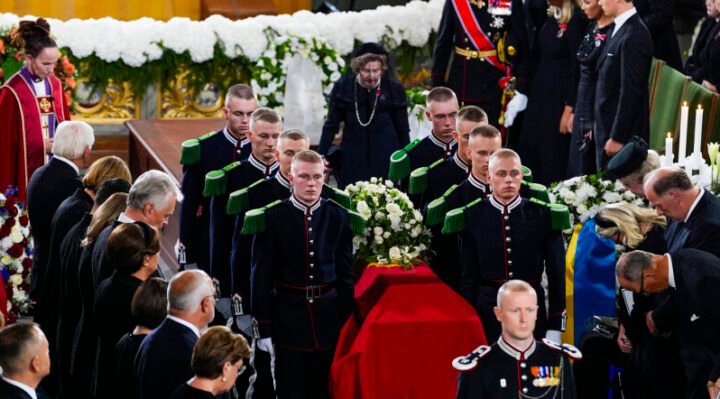
“All countries with diplomatic representation in Oslo are invited. The same applies to NATO, EEA, and EU countries without representation in Norway. The countries decide for themselves who they send,” said press officer at the Ministry of Foreign Affairs. She emphasized, however, that these four countries constitute an exception: “Russia, Sudan, Myanmar, and Afghanistan are only invited at a diplomatic level. Thus, their heads of state are not invited.
The reasoning behind this special treatment has not been officially commented on, but several Norwegian media outlets have pointed to Ukraine as a central factor. The political situations in Sudan, Myanmar, and Afghanistan – where the Taliban holds power – are also believed to have played a role.
The decision was made by a group representing the Royal Palace, the Office of the Prime Minister, and the Ministry of Foreign Affairs. According to former ambassador, it is a thorough screening process: “You cannot just show up – not even a head of state.”
The four countries were still permitted to send their ambassadors in Oslo to represent them. The Russian Embassy confirmed that its flag flew at half-mast over the embassy building, and that the ambassador would sign the condolence book at the Palace.
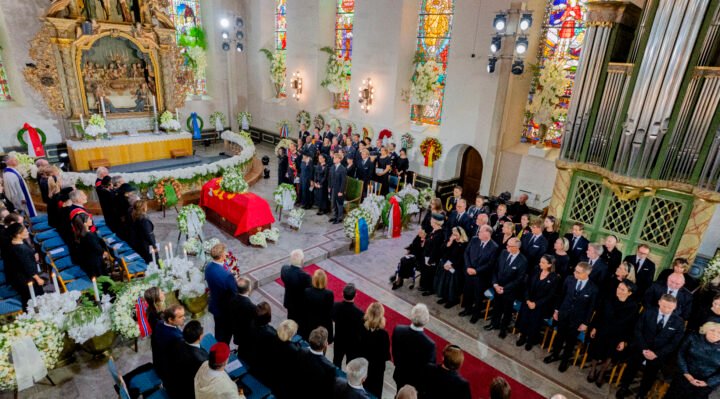
Another country that was not represented on the guest list was Sri Lanka. According to the guest list published by the Ministry of Foreign Affairs, no delegation from Sri Lanka was invited to the funeral. Norway and Sri Lanka have traditionally had a friendly relationship, but the country has for years been subject to serious criticism from the UN for human rights violations and breaches of international law.
In a recent report from the UN High Commissioner for Human Rights, dated September 3, 2026, it is stated that there is still no acknowledgment or accountability for crimes under international law, gross human rights violations, and serious violations of international humanitarian law committed during the civil war in Sri Lanka, which ended in 2009.
Human Rights Watch (HRW), in its own report from September 1, 2026, has documented that the government under President Anura Kumara Dissanayake, who took office in September 2024 with promises of justice, has not fulfilled the promise to establish an independent prosecution office or implemented necessary legal and structural reforms.
Furthermore, Sri Lanka continues to use the repressive Prevention of Terrorism Act (PTA) to harass and arrest human rights defenders, journalists, and relatives of victims. The government has also not accepted the Sri Lanka Accountability Project, established by the UN Human Rights Council to collect evidence of serious human rights violations.
This is not the first time Sri Lanka has been absent from a major international ceremony. During Queen Elizabeth II’s funeral in 2022, then-President Ranil Wickremesinghe was invited, but at that time Sri Lanka was also not among the invited to the ceremony in London – a fact that was seen in connection with the country’s human rights record.
As the world bid farewell to King Harald in Oslo Cathedral, five nations – Russia, Sudan, Myanmar, Afghanistan, and Sri Lanka – were relegated to the sidelines. For Sri Lanka’s part, the reason appears to be a clear signal from Norwegian authorities that serious violations of international law and human rights have consequences, even when it comes to participation in Norway’s most significant ceremony in decades.
